
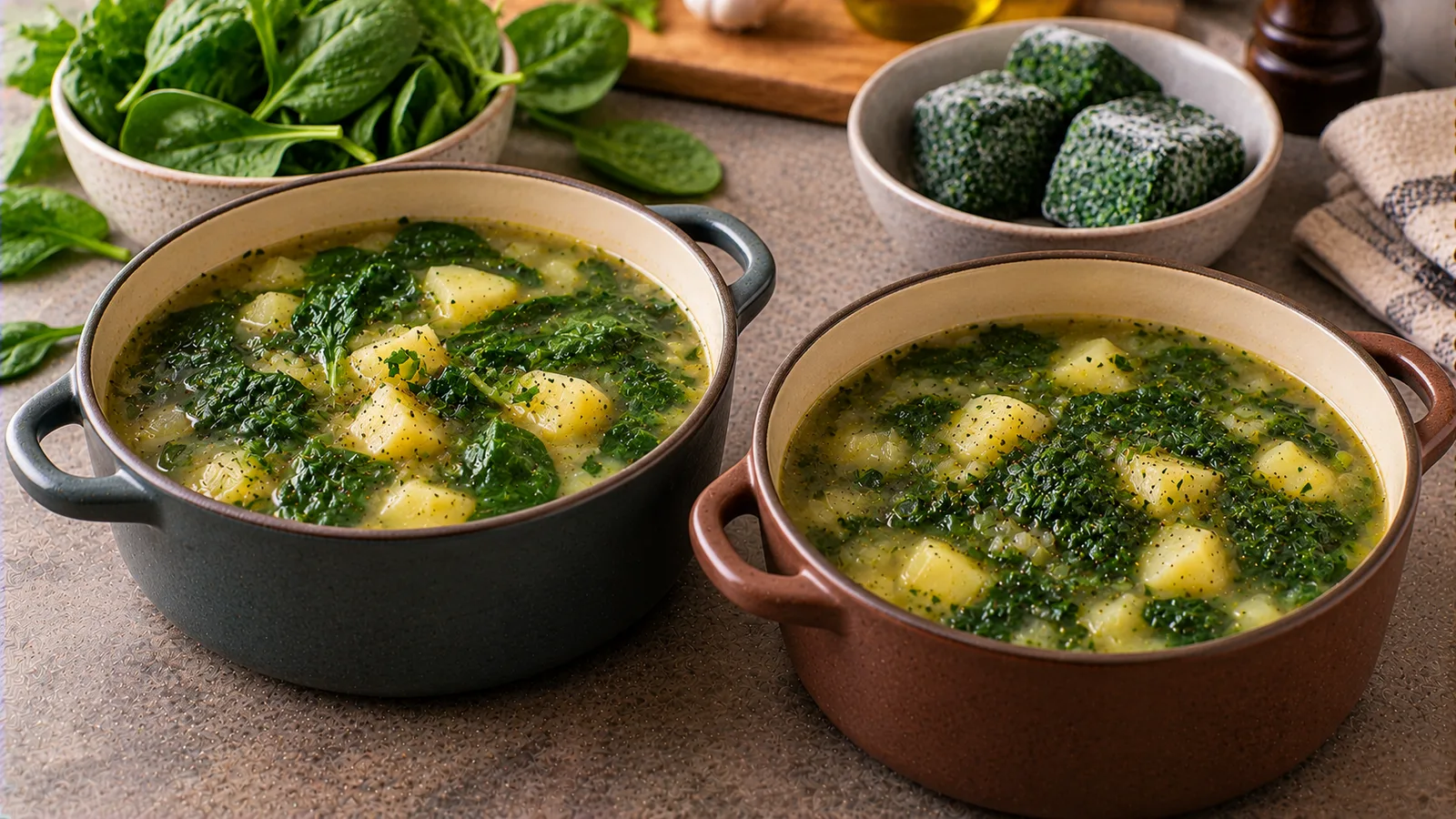
A bag of fresh spinach and a block of frozen spinach can carry very different price tags, but the cheapest sticker is not necessarily the cheapest portion in the soup. Fresh leaves may include damaged pieces and thick stems. Frozen leaves may release considerable water when heated. Both change weight during cooking. The relevant comparison is how much usable cooked spinach each purchase actually supplies, and what that amount costs.
This guide compares four adult soup portions, each with 100 g cooked, lightly drained spinach—a 400 g finished-spinach target. The prices and yields below are a worked hypothetical example, not measured store offers, laboratory values or average national losses. They illustrate a repeatable method. Your actual result may differ considerably; weigh your own spinach to make a buying decision.
The comparison in one table
| Measure | Fresh leaves | Plain frozen spinach |
|---|---|---|
| Illustrative purchase | 3 packs × 200 g | 1 pack × 500 g |
| Illustrative price | €1.49 per 200 g pack | €1.59 per 500 g pack |
| Checkout for spinach | €4.47 | €1.59 |
| As-purchased spinach | 600 g | 500 g |
| Assumed preparation loss | 60 g (10% of 600 g) | 0 g discarded before heating |
| Spinach entering heat | 540 g | 500 g |
| Assumed cooked, lightly drained amount | 400 g | 400 g |
| Cooked amount per bowl, four bowls | 100 g | 100 g |
| Spinach cost per bowl | €1.12 | €0.40 |
Here the frozen pack costs €2.88 less for four portions, or approximately €0.72 less per bowl, after rounding. That conclusion belongs only to these assumed weights, yields and prices. Spinach supplied as frozen creamed spinach, or a loose fresh bunch with less trimming, requires a different calculation.
Define edible yield before comparing prices
Three different weights are often confused. Purchased weight includes everything paid for. Prepared edible weight is what remains after removing wilted leaves, soil-contaminated pieces or unwanted fibrous stems. Cooked, lightly drained weight is what remains after heating and draining briefly in the same way for both products. The last measure makes it possible to compare a stated amount of spinach in four bowls.
In the illustrative fresh case, 600 g purchased minus 60 g removed leaves 540 g prepared. Heating and briefly draining 540 g yields 400 g, an assumed cooked retention of 400 ÷ 540 = 74.1%. The total purchased-to-cooked yield is 400 ÷ 600 = 66.7%. For the frozen product, we assume the full 500 g goes into the pot and 400 ÷ 500 = 80% is recovered after the same draining procedure. None of those percentages is a universal spinach conversion factor.
In particular, wilted spinach looks dramatically smaller because the leaves collapse; volume reduction is not the same as weight loss. Likewise, water squeezed from thawed spinach should not be called discarded food. If the liquid is safe to use and you return it to the soup, you still consumed it: the drained weight is merely a consistent comparison unit. Using one method for fresh and a hard squeeze for frozen would make the numbers unfair.
Calculate euros per cooked 100 g
For a purchase used completely, divide the price paid by the recovered cooked grams and multiply by 100:
Price per cooked 100 g = (spinach purchase price ÷ recovered cooked spinach in g) × 100.
In this example fresh spinach is €4.47 ÷ 400 × 100 = €1.1175, rounded to €1.12 per cooked 100 g. Frozen is €1.59 ÷ 400 × 100 = €0.3975, or €0.40 per cooked 100 g. Each of the four bowls gets 100 g on the same drained basis, so these are also the spinach-only costs per bowl. Do not label either amount as the price of an entire soup lunch.
Before cooking, the sticker comparison looks simpler: €7.45/kg as purchased for fresh (€4.47 ÷ 0.6 kg), versus €3.18/kg as purchased for frozen (€1.59 ÷ 0.5 kg). Those kilogram prices are informative, but they ignore usable yield. Prices in the example are invented inputs for arithmetic; consult the shop shelf and package label for a real budget.
A common mistake is to divide €4.47 by 540 g washed raw and €1.59 by 500 g frozen before heating, then claim equal cooked portions. Those are unlike denominators. Another mistake is to pretend that 400 g cooked and drained spinach has the same nutrient composition in both forms. Water content and processing can differ; this example does not establish nutrition equivalence.
A four-portion spinach soup with matched portions
This is a flexible four-bowl vegetable soup, not an assertion that both products will always yield exactly 400 g cooked spinach from these packet sizes. The spinach target is controlled by weighing; adjust the actual amount if your yield differs.
| Ingredient for four bowls | Fresh trial | Frozen trial |
|---|---|---|
| Spinach, as bought | Start with 600 g | Start with 500 g, plain and unsauced |
| Onion, peeled | 120 g | 120 g |
| Potatoes, peeled | 400 g | 400 g |
| Water or unsalted stock | About 900 ml | About 900 ml |
| Olive oil | 10 ml | 10 ml |
| Optional seasoning | Pepper, garlic, lemon | Pepper, garlic, lemon |
- Prepare separately. Wash fresh leaves thoroughly and remove damaged parts; weigh discarded material and the cleaned leaves. Keep frozen spinach frozen until cooking, unless its pack states otherwise. Choose plain frozen leaves or chopped spinach, not creamed spinach with sauce.
- Measure the cooked sample. Heat the spinach in a covered saucepan with a little of the recipe's water or stock, following the frozen product's instructions where relevant. Cook it fully. Lift the cooked spinach into a strainer, let it drain briefly without squeezing, and weigh it. Use the same strainer, draining time and method for each trial. Keep the cooking liquid to return to the soup.
- Make the base. Soften 120 g onion in 10 ml oil; add 400 g diced peeled potatoes and the rest of approximately 900 ml water or stock. Simmer until the potatoes are tender. Cooking time depends on cube size, usually around 12–20 minutes after simmering begins.
- Finish four bowls. Stir 400 g of the measured cooked spinach into the soup; return suitable cooking liquid to the pot and heat thoroughly. Blend some or all of the soup if preferred. Divide into four similar bowls, aiming for 100 g cooked spinach per bowl. If your measured yield is below 400 g, cook additional spinach and recalculate cost instead of pretending you reached the target.
A blended soup masks the texture difference better than a broth with visible leaves. Fresh baby spinach tends to make delicate ribbons; chopped frozen spinach is convenient for a smoother soup. Texture is a practical reason to pick one even if price points toward the other. The soup base's potatoes, onion and oil cost the same in both trials and are intentionally excluded from the spinach-only comparison.
What if the real yield is different?
Suppose a particular 500 g frozen pack yields only 350 g cooked, lightly drained spinach under your method. The four-bowl target needs 400 ÷ 0.70 = 571.4 g frozen spinach. You may have to buy two 500 g packs at €1.59 each, paying €3.18 at checkout. If you measure out 571.4 g, the ingredient used cost is approximately €1.82 (571.4 ÷ 500 × €1.59), and the unused frozen remainder has future value if stored correctly. Checkout spend and recipe cost are not interchangeable.
Similarly, if 600 g fresh yields only 350 g cooked, buying another pack may be necessary to meet the four-portion target. A partially used fresh bag that later spoils is a genuine additional loss; a fully used fresh purchase is not automatically worse than frozen merely because it is sold in smaller packs. Record leftovers and their realistic use, rather than deducting an imaginary resale value.
| Scenario | Purchased at checkout | Spinach used for target | Accounting point |
|---|---|---|---|
| Fresh, worked 400 g yield | €4.47 | €4.47 | All three packs used |
| Frozen, worked 400 g yield | €1.59 | €1.59 | One pack used |
| Frozen, 70% drained yield | €3.18 | About €1.82 | Remaining frozen spinach saved if usable |
Use price per cooked 100 g to compare efficiency; use checkout spend when checking whether you have the cash for tonight. For a longer meal plan, also count ingredients still available for tomorrow. See a broader frozen-vegetable price and waste comparison for a general vegetable price-and-waste framework and the overall fresh-versus-frozen vegetable guide for broader fresh-versus-frozen cooking differences; neither replaces this spinach-specific test.
The hands-on test that makes the comparison fair
If you want your own answer rather than the hypothetical one, buy the actual brands you would use. Photograph or note pack size and price. Weigh fresh spinach before and after sorting; record damaged leaves separately. For frozen plain spinach, note the weight straight from the label and any ingredients other than spinach. Cook two samples in the same pan using the same quantity of water and heat setting where practical, but always respect the frozen product's safety instructions. Drain each cooked sample in the same sieve for the same short interval; do not press one but not the other.
Record purchased grams, usable grams, cooked drained grams, price paid, and unused stock. If the frozen product is clumped, separate it while fully cooking rather than tasting cold pieces. If the fresh leaves are sandy, rinse until clean. Do not treat a single kitchen test as a national average: weather, season, variety, brand, age and handling all influence the yield you observe.
Food safety, storage and waste
Fresh spinach is perishable. The German BZfE storage guidance lists spinach among vegetables for the refrigerator and emphasizes prompt use. Inspect leaves; discard slimy or spoiled pieces. Wash fresh spinach before cooking even when it looks clean, unless the pack is specifically ready-to-eat and your use follows its instructions.
The BZfE freezing guidance explains that frozen vegetables can go directly into a pot or soup. The FDA storage guidance says commercially frozen foods should be cooked following their package directions: freezing itself does not reliably kill all bacteria. Do not assume a frozen spinach block is ready to eat simply because it was blanched before freezing.
Refrigerate leftover soup promptly in shallow covered containers. A conservative practical target is to eat home-prepared refrigerated soup within about two days, consistent with the BZfE hygiene guidance, or freeze portions promptly. Reheat until thoroughly hot throughout, stirring well. Avoid repeatedly warming the same pot and leaving it standing for hours.
Spending more for fresh spinach can still make sense if the leaves are being used in a salad or as visible garnish, if it is locally abundant and cheap, or if you will use the whole pack quickly. Frozen spinach may be more practical for blended soup and repeated small portions, especially when reducing spoilage matters. Neither is intrinsically 'healthier' simply because of its temperature at purchase; nutrition depends on actual product, portion and preparation.
A buying rule for the next four bowls
First decide on the 400 g cooked, lightly drained spinach goal—not 400 g bought. Then estimate or measure each product's usable yield, divide the total price by the amount you can actually use, and check what remains after four bowls. In the example fresh costs €4.47, frozen €1.59; the modeled saving is €2.88 across four portions. Treat those numbers as an example to replace with your own, not a price promise.
For a different soup featuring additional vegetables or grains, try a high-fiber soup with barley and white beans; that recipe has its own ingredient quantities and should not be counted as the same cooked-spinach comparison.
Sources
- BZfE: Food storage and fresh vegetables — handling and fridge storage.
- BZfE: Freezing and cooking frozen vegetables — adding frozen vegetables directly to cooked dishes.
- FDA: Are You Storing Food Safely? — frozen-food safety and following pack instructions.
- BZfE: Kitchen hygiene — safe storage and prepared food.
Editorial method: All € prices and cooking yields are illustrative assumptions calculated in this article, not values attributed to these sources.