
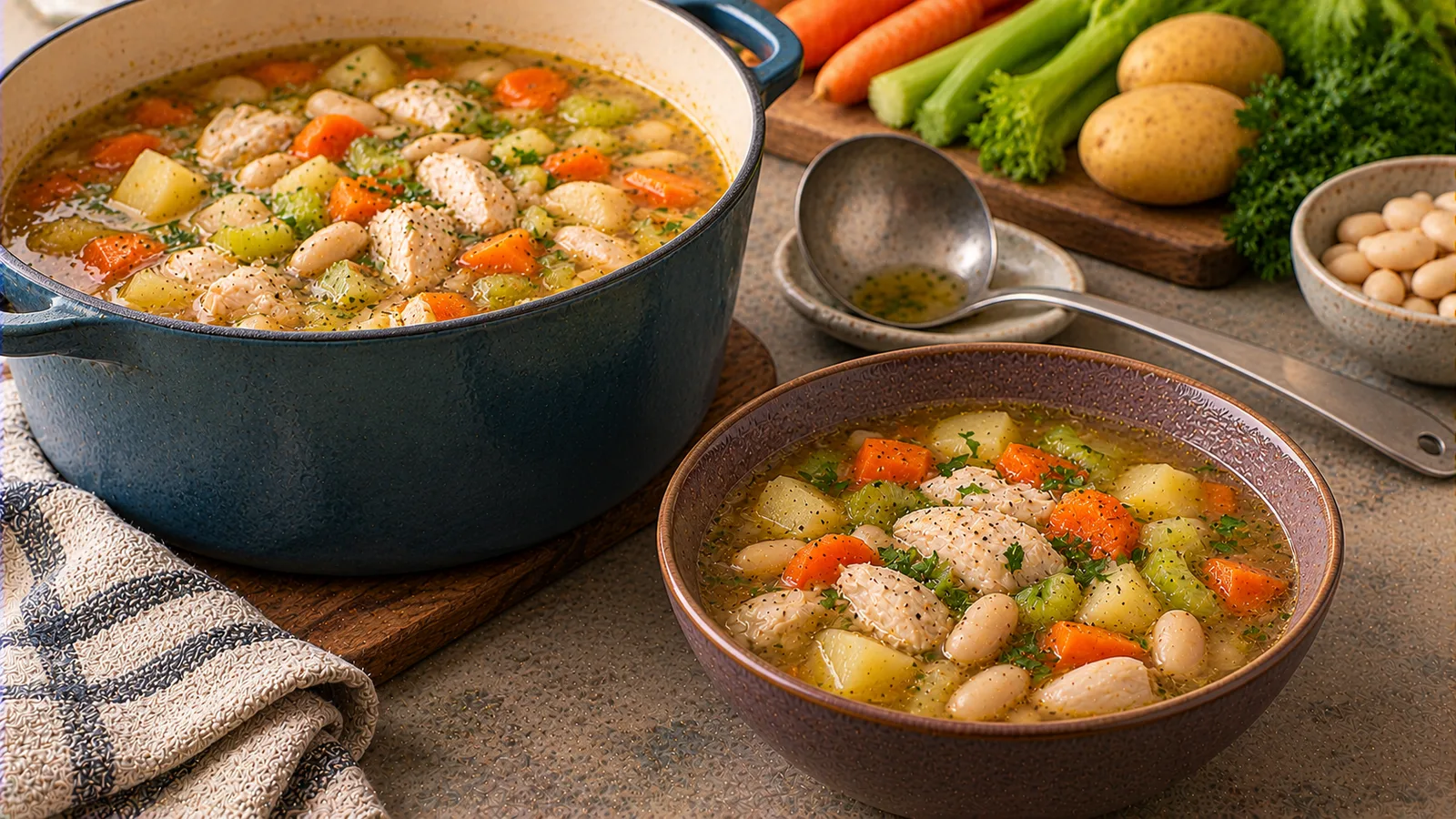
A bowl of homemade soup does not have a protein label. The useful way to estimate its protein is to calculate the protein in the complete pot, weigh the finished soup, and allocate that pot total to the amount you actually serve. Counting a few chicken pieces in one bowl or using the weight of uncooked ingredients as the finished weight can give the wrong answer.
This is a calculation guide, not a soup recipe. The worked numbers below are deliberately hypothetical inputs for teaching the method, not measured nutrient declarations for a particular brand or a tested pot of soup. For an actual meal, substitute values from your food labels or a suitable entry in USDA FoodData Central. The related explanation of why adding water changes concentration is in how water changes soup protein concentration; here we cover the entire process from ingredient records to the final bowl.
The two quantities you need
First estimate P, the grams of protein in the entire finished pot. Second measure W, the mass of all edible finished soup in grams, excluding the empty pan. If a bowl receives B grams of well-mixed soup, its estimated protein is:
Protein per bowl (g) = P (g) × B (g) ÷ W (g).
The mass units cancel. This is a proportional-allocation model: it assumes the mixture is reasonably uniform and that the calculated protein has remained in the liquid and solids you will eat. A dense bowl scooped mainly from the bottom can contain more beans or meat than one ladled from the top. When distribution is uneven, weigh or track the solid ingredients served separately rather than assigning the pot average as if it were a laboratory measurement.
If the entire pot is divided into N equal servings, the shortcut is P ÷ N, but only when those servings are truly equal portions and none of the mixture was left behind. A household "bowl" is not a defined mass.
Step 1: build an ingredient protein ledger
Write down each ingredient's edible amount and its protein for the same state of preparation. Food data often list protein per 100 g. In that case:
Ingredient protein (g) = edible weight (g) × protein per 100 g ÷ 100.
Do this for ingredients containing measurable protein. Water, salt and plain oil contribute no meaningful protein to this example. Record ingredients added late as well as those in the original pan. If you taste a substantial amount before dividing portions, measure or estimate what was removed.
Here is an illustrative ledger, with assumed protein values chosen solely to show arithmetic. It does not claim that every cooked lentil, chicken or bean product has exactly these values. Use product-specific labels or a database record for the real calculation.
| Assumed ingredient and state | Amount in pot | Assumed protein / 100 g | Protein in pot |
|---|---|---|---|
| Cooked lentils | 240 g | 9.0 g | 21.6 g |
| Cooked chicken, edible meat | 300 g | 28.0 g | 84.0 g |
| Canned beans, drained | 200 g | 7.0 g | 14.0 g |
| Tomatoes | 400 g | 1.0 g | 4.0 g |
| Carrots | 100 g | 1.0 g | 1.0 g |
| Water, oil and seasonings | Measured separately | 0 g in this model | 0 g |
| Whole-pot estimated total | 124.6 g |
The arithmetic is 240 × 9.0 / 100 = 21.6 g for lentils and 300 × 28.0 / 100 = 84.0 g for chicken. Adding the five protein-containing rows gives 21.6 + 84.0 + 14.0 + 4.0 + 1.0 = 124.6 g for the pot. The sum is the input to the bowl formula.
A key warning: this table treats chicken and lentils as already cooked and weighed in that cooked state, whereas the beans are weighed after draining. If you start with 300 g raw chicken, do not apply a value defined per 100 g cooked chicken to it. Either use a suitable raw composition value with raw edible weight, or weigh cooked meat and use a matching cooked value. Avoid counting both the raw and cooked amounts as separate ingredients.
Step 2: weigh the finished pot, not the shopping list
In this teaching example, suppose the finished, mixed soup that can actually be served weighs 2,400 g. That is an assumed measured final yield, not the sum of raw package weights. You can determine it in either of two ways: weigh the pan plus soup and subtract the pan's tare weight, or transfer the soup into one or more tared containers and add those readings.
Do not weigh the pan with its lid, ladle or a dishcloth unless that weight is included in the tare. Weigh after cooking and any planned addition of stock or water, ideally just before portioning. Note what happens if some broth boils away or you later top up the soup. Those changes affect final weight.
For the hypothetical pot:
| Quantity | Value |
|---|---|
| Total estimated pot protein | 124.6 g |
| Edible finished soup mass | 2,400 g |
| Protein per 100 g of mixed soup | 5.19 g |
| Protein per 400 g bowl | 20.77 g |
| Six equal 400 g bowls | 6 bowls |
The 100 g estimate is 124.6 ÷ 2,400 × 100 = 5.1917 g, rounded to 5.19 g. This is not a claim that the whole pot was independently tested for protein.
Step 3: weigh the bowl you will eat
Put the empty bowl on a scale and press tare. Ladle in the soup and read B in grams. For the assumed 2,400 g / 124.6 g pot:
| Finished soup served | Share of the pot | Estimated protein |
|---|---|---|
| 350 g | 350 / 2,400 | 18.17 g |
| 400 g | 400 / 2,400 | 20.77 g |
| 500 g | 500 / 2,400 | 25.96 g |
| 600 g | 600 / 2,400 | 31.15 g |
For a 350 g bowl: 124.6 × 350 ÷ 2,400 = 18.17 g. For a 500 g bowl the same equation gives 25.96 g. Choosing the bigger bowl raises the estimated protein amount because more soup is eaten—not because a different kind of protein appears during heating.
Soup consistency matters. Stir thoroughly before each portion; if a bowl contains an unusually large share of chicken or beans, the pot average may be misleading. In that case you can weigh the solids added to the bowl and estimate their protein independently, then estimate protein in the remaining soup base without double counting.
What if you count portions instead of weighing?
If the whole 2,400 g pot is really divided into six equal bowls of 400 g, dividing 124.6 g ÷ 6 yields 20.77 g per bowl. If four people instead receive 600 g each, each gets 31.15 g. However, "six portions" written in a recipe card does not tell you how much your actual ladle holds. Unequal bowls require the weight calculation.
A practical tracking shortcut is to keep a note with the pot's total protein and final weight. Weigh the first bowl, record it, and reduce the available pot weight after serving. If a family member adds separate grated cheese, yogurt or other protein-containing toppings, calculate the topping in addition to the soup. Do not silently spread toppings across all bowls.
Water, evaporation and concentration
If you add only water and no protein-containing food, total estimated pot protein stays at 124.6 g in the simplified closed-pot model. More water makes a fixed-weight bowl contain a smaller share of that protein; evaporation without solids loss does the reverse. These are calculations about concentration, not promises of perfect nutrient retention.
| Pot state (illustrative) | Pot protein assumption | Finished mass | Estimated protein per 400 g |
|---|---|---|---|
| Base pot | 124.6 g | 2,400 g | 20.77 g |
| Water added and mixed | 124.6 g | 2,600 g | 19.17 g |
| Water evaporated | 124.6 g | 2,200 g | 22.65 g |
The related dilution-only calculation is explained in how water changes soup protein concentration. The broader rule from USDA nutrient retention guidance is that cooking and preparation can alter the proportion of nutrients retained. If you discard protein-containing broth, skim off solids, strain the soup or leave meat behind, you have changed what is eaten, not just the water concentration. The 124.6 g assumption may no longer be accurate.
Raw versus cooked: the most important bookkeeping error
Protein information is usually indexed to a stated weight and state: dry lentils, cooked lentils, raw chicken, roasted chicken, canned beans with liquid or drained beans. Choose one matching row for each ingredient and use it once. For dried pulses that are cooked in the pot, it can be easier to log their dry edible weight and dry composition before water uptake. For separately cooked chicken, use its cooked edible weight and cooked composition.
A food can become lighter as moisture evaporates or heavier as it absorbs water. That does not mean the same number of grams of protein is created or destroyed in direct proportion to the weight change. The USDA's published cooking-yield and retention concepts distinguish changing food mass from nutrient retention. Where the intended nutrient data are prepared using cooking factors, avoid applying those factors a second time.
For commercially prepared soup bases, dairy additions and packaged broths, read the declaration carefully. Some labels refer to 100 ml, some to 100 g, some to a prepared serving and some to concentrate before dilution. FDA serving-size guidance illustrates why serving-size and per-container information are separate concepts. Do not treat a volume as grams without an appropriate conversion.
When the pot is not uniform
The formula P × B ÷ W is best for a soup that has been mixed and portioned fairly. Chunky chicken-and-bean soup is easy to ladle unevenly. A transparent workaround is to record the solid protein sources and their distribution when serving:
- If a particular bowl contains 80 g of the logged cooked chicken, calculate its chicken contribution from that cooked weight.
- If the same bowl also has some of the logged beans, account for the bean weight.
- Subtract those measured solids from the tracked pot totals before allocating the residual base—otherwise the same chicken or beans would be counted twice.
If you cannot track those quantities, present the result as an estimate of the average mixed pot, not an exact macro label for a bowl. This limitation matters most when an ingredient provides most of the protein.
Leftovers and food served with soup
Protein for the pot does not vanish merely because you save two bowls for another day. Record how many grams of finished soup remain; for this worked pot, 800 g of well-mixed leftovers would carry approximately 41.53 g of estimated protein under the same proportional assumption. Freezing changes where and when you eat the soup, not the original ingredient ledger. Actual losses during transfer and foods discarded need to be subtracted if meaningful.
A slice of bread, a dollop of yogurt, shredded cheese or a side salad adds nutrients beyond the soup. Calculate each component separately and then add it to the finished meal. Otherwise a "protein per bowl" figure may quietly include foods that another person never served.
If you want to compare how much a meal costs, rather than how much protein is in its bowl, use how to calculate the cost per meal, which starts with ingredient prices and used amounts. Price and protein are separate calculations and should not be mixed into one unlabelled number.
A reusable worksheet without a calculator app
Copy this structure onto paper or into a spreadsheet. You do not need to buy a protein-tracking tool to use it.
| Ingredient | State | Edible grams | Protein / 100 g | Ingredient protein |
|---|---|---|---|---|
| Ingredient A | Raw or cooked, specify | Weight A | Value A | A × Value A / 100 |
| Ingredient B | Raw or cooked, specify | Weight B | Value B | B × Value B / 100 |
| Total protein P | Sum of rows | |||
| Finished soup mass W | After cooking | Weighed grams | ||
| Bowl mass B | Actual serving | Weighed grams | P × B / W |
Check units, verify that every package value applies to the same edible state, and record whether you included any drained or discarded liquid. For a recipe you cook repeatedly, save the ingredient list and update only the amounts and pot yield when they change. Keep more decimal places during intermediate calculations and round the bowl result once at the end.
Sensible interpretation and limitations
20.77 g per 400 g in the example is a mathematical estimate from hypothetical ingredients, not a laboratory result or a guaranteed protein claim. Retail labels are rounded; food composition varies; cooking loss and uneven ladling can affect actual intake. The greatest avoidable error is combining raw weights with cooked-only nutrient entries, or dividing the pot's protein by a serving size that has never been weighed.
If you are using a protein target for a medical reason, follow your clinician's individual advice rather than treating estimates from a homemade soup as exact. For everyday meal tracking, a consistent, transparent method is usually more useful than false precision.
Sources
- USDA FoodData Central: search food composition records by preparation state
- USDA ARS: nutrient retention factors for foods during preparation
- FDA: how serving sizes and servings per container are reported
All ingredient-protein inputs in the worked table are explicitly assumed teaching values; use verified product or database data for your actual pot.