
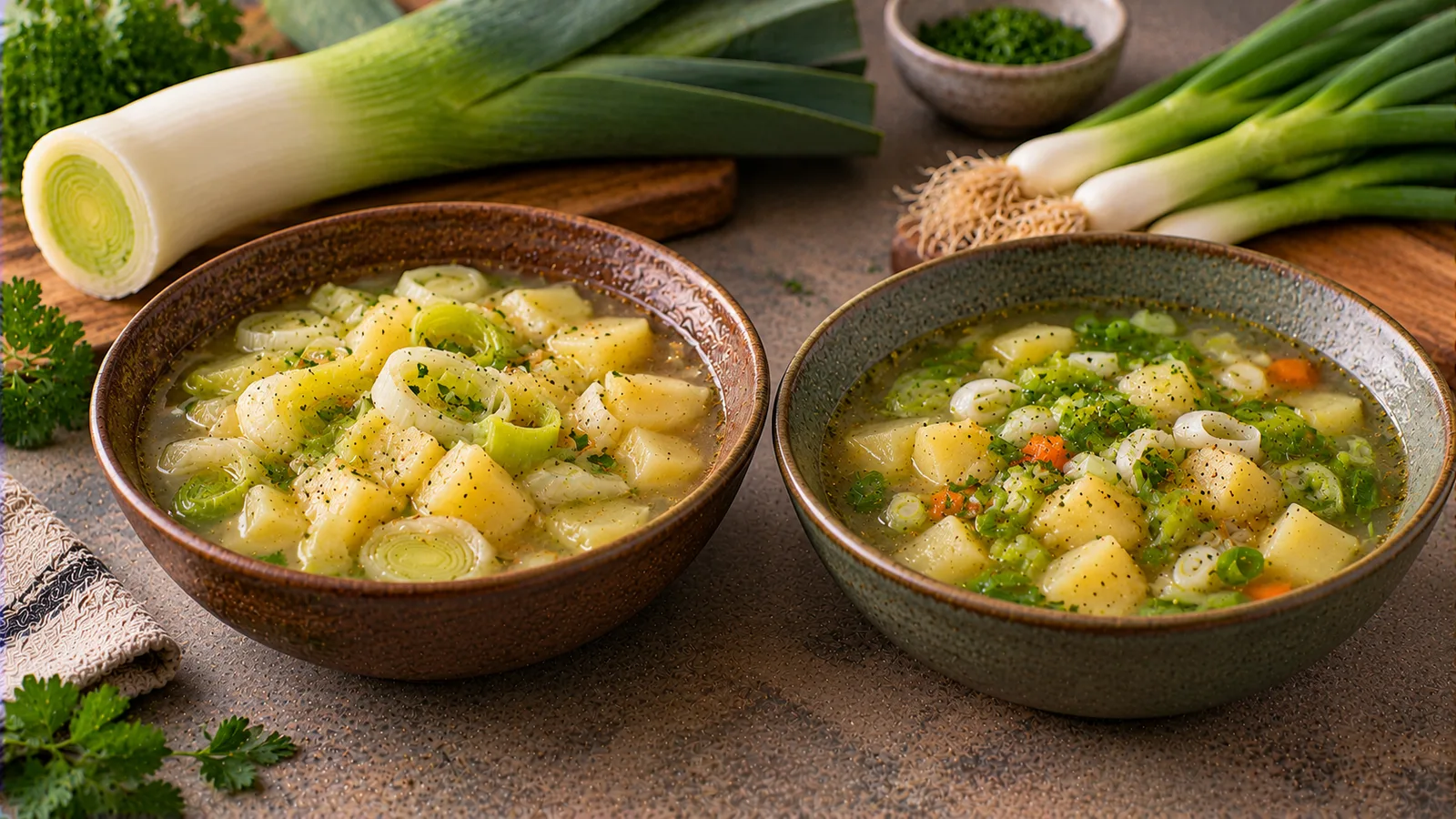
A leek and a bunch of spring onions can look like inexpensive ingredients for the same vegetable soup. But the labels on the shelf describe what you buy, not necessarily what goes into the pot. The thick dark-green end of a leek is often set aside in a silky soup, while much of a fresh scallion bunch can be cooked. That difference changes the real price of a usable gram.
Here is the actionable comparison: in a clearly hypothetical German shopping example, a 500 g leek purchase costs €1.00, yields 300 g trimmed for this soup (60%), and supplies two bowls using 150 g each. Its allium contribution is €0.50 per cooked bowl. Two 200 g bunches of slim spring onions cost €2.40 at checkout, give 320 g usable (80%), and contribute €1.13 per bowl for the same 150 g edible amount. The extra 20 g is left for another dish. Those are model assumptions, not universal trimming percentages, tested supermarket prices, or a promise that the cooked vegetable itself still weighs 150 g.
Which onion is being compared?
Here leek means the broad, layered Allium ampeloprasum sold as leek or porree. Spring onion means the slender scallion/green-onion type, with a narrow white base and hollow green leaves. In some English-speaking markets, “spring onion” instead describes a larger immature onion with a developing bulb. These products have different sale weights and cooking behaviour: check the label and photograph before applying the example. Purdue Extension distinguishes scallions from spring onions with larger bulbs.
Leeks provide a substantial, soft aromatic body in potato, bean and creamy soups. Scallions work as a lighter base, but their tender green tops are often best added nearer the end. Illinois Extension notes that scallions need little cooking. This article does not calculate leek calories or serving-size nutrition—that belongs in our guide to calories and serving sizes for leeks. It also does not reproduce the finished recipe in leek and potato soup recipe. The decision here is how to buy, trim, substitute and cost the same soup role.
Start with purchased weight, not the number of stalks
The roots, withered ends and tough or damaged outer leaves are not normally part of a smooth soup. For a leek, some darker tops may still be used in a long-cooked stock, but this example excludes them from the measured soup ingredient. Spring onions have smaller roots and a larger share of tender greens; bruised or slimy material is discarded. Oregon State University Extension explains removing leek roots and dark tops and washing between its layers.
After trimming, weigh the cleaned, drained ingredient: that is the denominator for your useful yield. The USDA Food Buying Guide is a useful framework for thinking in terms of purchased amounts and prepared portions, but 60% and 80% below are illustrative kitchen assumptions, not yield factors quoted from that guide.
| Model input | Leek | Slim spring onions |
|---|---|---|
| Purchased weight | 500 g | 2 × 200 g = 400 g |
| Checkout price | €1.00 | 2 × €1.20 = €2.40 |
| Assumed trimmed edible share | 60% | 80% |
| Cleaned edible quantity | 300 g | 320 g |
| Trim/discard or reserve | 200 g | 80 g |
| Effective price per 1 kg trimmed | €3.33 | €7.50 |
A 60% leek yield means 500 × 0.60 = 300 g. The effective kilogram price is €1 ÷ 0.300 kg = €3.33/kg. For the scallions, 400 × 0.80 = 320 g and €2.40 ÷ 0.320 kg = €7.50/kg. Even if the price on the display looks reasonable, the effective rate after cleaning can be very different. Your actual yields may be higher or lower depending on cultivar, bunch size, freshness and the part of the plant you choose to eat.
The cost per cooked soup portion
Our test soup is two finished bowls, with 150 g cleaned raw leek or spring onion allocated to each bowl. This is a costing basis: it does not claim that each bowl contains 150 g of dry, drained, cooked vegetable. Moisture leaves the vegetable and enters the cooking liquid, which remains in the soup. If you want cooked drained yield, weigh that separately after cooking; it is not needed to calculate the ingredient cost of each finished bowl.
| For one finished bowl | Leek version | Spring-onion version |
|---|---|---|
| Cleaned raw allium going into the pot | 150 g | 150 g |
| Ingredient cost per usable 100 g | €0.33 | €0.75 |
| Allium ingredient cost per bowl | €0.50 | €1.13 |
| Allium ingredient cost for 2 bowls | €1.00 | €2.25 |
| Full onion/leek checkout basket | €1.00 | €2.40 |
| Cleaned amount unused after cooking | 0 g | 20 g |
Unrounded scallion cost is 150 ÷ 320 × €2.40 = €1.125 per bowl; it rounds to €1.13. For two bowls, 300 ÷ 320 × €2.40 = €2.25, leaving 20 g with an allocated value of €0.15. The leek costs €0.50 per bowl, so the two-bowl difference is €1.25 on the actual quantity cooked; the difference calculated from rounded single-bowl prices would be €1.26. Keep unrounded values for totals.
Checkout expense and ingredient expense are not the same
A shopper has to pay €2.40 for two bunches even if the soup uses only €2.25 of them. If the remaining 20 g wilts in the fridge and is discarded, your realised cost for these two portions rises to €1.20 per bowl. If you use those tops to finish an omelette, €1.13 remains the appropriate allium allocation for a bowl and €0.15 is assigned to the next meal. In contrast, the illustrative leek basket is fully used for this soup. Neither figure includes potatoes, oil, broth, electricity or labour: this is deliberately the allium share, not a complete dinner price.
One simple two-bowl soup test
To compare like with like, keep everything apart from the onion family ingredient unchanged. For either pot, use 300 g cleaned allium, 250 g potato, 450 ml water or unsalted vegetable stock, 5 g oil and pepper to taste. That makes two approximately similar soup portions; final volume can vary with simmering and blending. Cook the potato thoroughly and check consistency before serving. The other ingredients cost the same in both versions, so they do not change the difference in allium cost.
For the leek pot, slice and rinse the leek, soften it over low heat in the measured oil for around 7–9 minutes, add potato and liquid, then simmer until the potato is tender, commonly another 12–18 minutes, depending on cut size. For the spring-onion pot, soften the cleaned white and light-green sections for roughly 3–4 minutes; add potato and liquid, and stir in most of the tender green tops during the last 2–3 minutes. These times are kitchen guidance, not validated food-safety endpoints. Both soups can be blended; expect a difference in colour and onion aroma.
If the spring-onion version seems thinner or less velvety, resist adding extra scallions immediately. Potato, stock volume and blending technique all affect mouthfeel. The purpose of the controlled test is to evaluate the swap at equal cleaned weights, not claim the two vegetables have identical flavour intensity.
Why 1:1 by number is misleading
“One leek equals four spring onions” may help you shop quickly, but it is unreliable without measuring the actual vegetables. Large leeks vary widely in the tender stem length; spring-onion bunches can be small or heavy. The same number of stems can correspond to very different edible grams. If the recipe specifies 300 g cleaned leeks, begin by buying enough alternative allium to supply approximately 300 g cleaned, then adjust flavour in the pot. For spring onions, adding the greens late preserves some freshness and colour; for leek, gentler longer cooking makes its layers tender.
| Soup job | Better starting choice | Adjustment when substituting |
|---|---|---|
| Thick, blended potato soup | Leek | Use the white/light-green scallion portions early; hold tender tops back |
| Brothy noodle or egg-drop soup | Spring onion | Add most greens near serving, not during a long simmer |
| Rustic bean or lentil soup | Either | Match cleaned weight, then taste and adjust aromatic intensity |
| Pale cream soup | Leek | Spring-onion greens can noticeably tint the soup |
The Iowa State Extension leek guide notes that soil can lodge between leek layers. A sandy soup is not solved by long cooking. Wash before the pot, not after.
How to measure your own supermarket deal
Write down the actual shelf price and whether it applies to one bunch, 100 g or a kilogram. Weigh everything you bought, then trim consistently for the soup you intend to cook. For leeks, separate and wash the layers thoroughly; for spring onions, remove roots and unusable tips. Drain the vegetables before weighing the usable portion. Divide checkout price by edible grams, then multiply by the grams allocated to your finished soup portions. If you saved tough clean leek greens for stock, do not silently count them twice: assign them a separate use or give them zero value in this conservative soup calculation.
A fast calculator example: if a leek costs €1.60 and provides 320 g cleaned, its usable price is €0.50 per 100 g, and 150 g in a bowl costs €0.75. If a bunch of spring onions costs €0.89 and yields 110 g, its usable cost is about €0.81 per 100 g; 150 g requires more than one bunch and has a proportional cost of about €1.21. These extra figures are alternative examples, not additional market observations. Do not combine them with the first basket table.
Food safety and waste, without false precision
Wash fresh produce under clean running water. Do not wash it with detergent; FDA produce-safety guidance recommends rinsing and discarding spoiled portions. Leeks are particularly prone to grit between leaves, so open them and rinse the layers. Clean scallions too, especially where the leaves join the white stem. Refrigerate washed, cut items promptly if not cooking them immediately. Quality loss and spoilage alter the amount you can actually use; no fixed 60% or 80% factor can capture that.
The darker leek tops are not inherently poisonous. Clean, sound pieces can flavour strained stock, although fibrous sections may be undesirable in a smooth soup. Saving them does not lower the price of the soup bowl automatically unless you explicitly allocate part of the checkout cost to that second use. If a recipe needs the greens blended in, count their mass as edible and recalculate the yield. Likewise, tender scallion greens are a valid edible part, not obligatory waste.
Practical verdict
In this illustrative example, leeks win on ingredient cost per equal 150 g cleaned allotment: €0.50 versus €1.13 per bowl, a €1.25 difference across two bowls before other soup ingredients. But the lesson is not that leeks always cost less. A discount on spring onions, a different trimming strategy or using dark leek greens can change the comparison. Buy for the soup texture you want, check the bunch weight, and calculate from the actual edible fraction.
Sources
- Oregon State University Extension — Leek Basics — selection, trimming and cleaning.
- University of Illinois Extension — Scallions/green onions — edible parts and short cooking.
- Purdue Extension — Green onion versus spring onion — terminology and bulb sizes.
- FDA — Selecting and Serving Produce Safely — cleaning and handling.
- USDA — Food Buying Guide — approach to purchased versus served quantities.
- Iowa State University Extension — Leeks — washing grit from layers.
Prices, percentages and cooked-portion allocations are worked hypothetical examples, not measurements or published standard yields.