
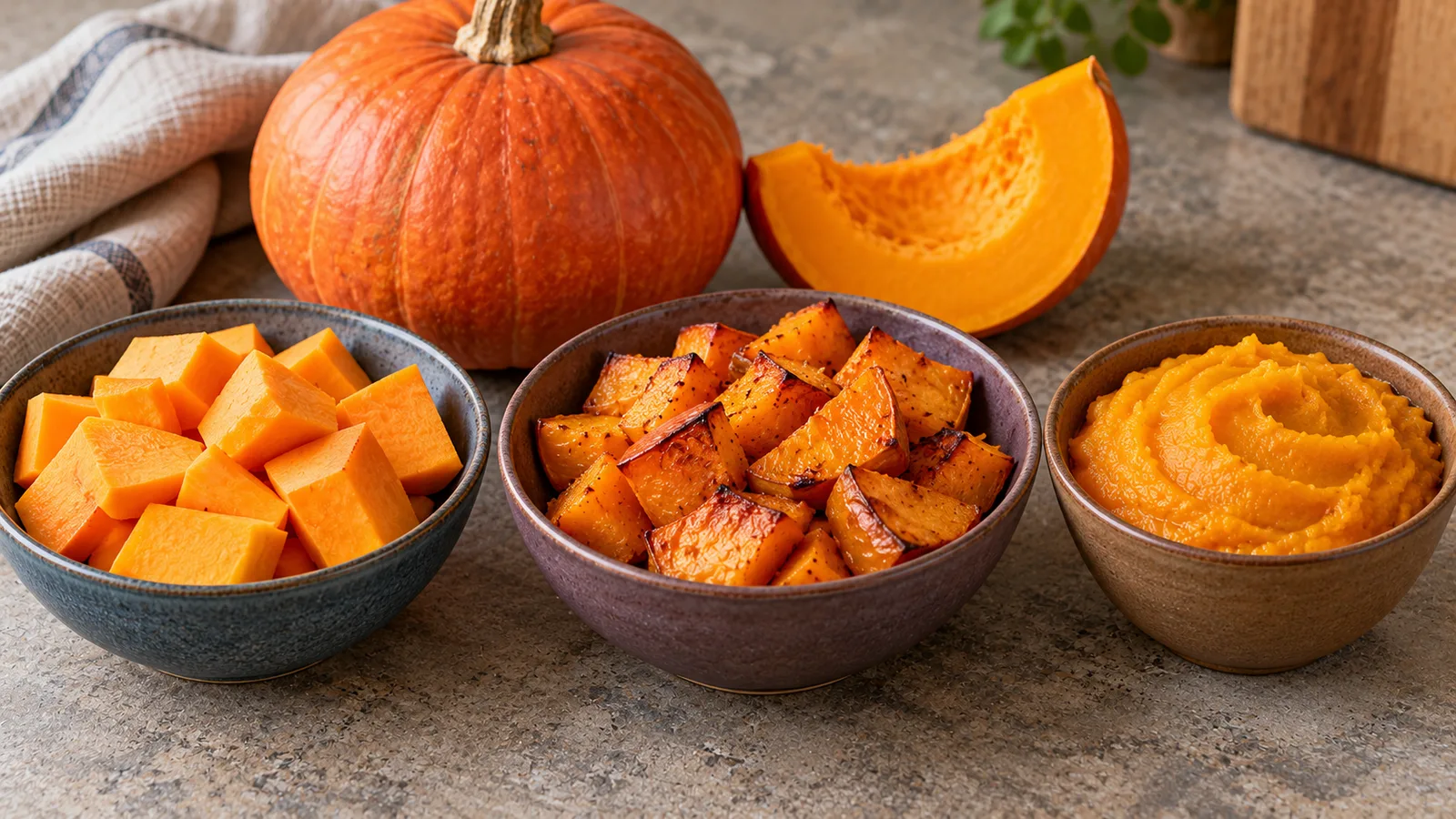
Pumpkin is often described as a low-calorie vegetable, but an accurate number depends on which pumpkin you mean, how it was prepared and which part you weighed. A piece of raw edible flesh, a tray of roasted cubes and a spoonful of concentrated canned purée are not interchangeable entries. For everyday calorie tracking, the practical starting point is 26 kcal per 100 g of raw pumpkin flesh, using the USDA SR Legacy reference for pumpkin, raw (FDC 168448). This refers to edible flesh, not a whole pumpkin including seeds, stem and rind.
Pumpkin calories: raw, cooked and plain purée
Three separate USDA entries show why a label such as “pumpkin” is not enough. The values below are for 100 g of the named edible product. They should not be applied to 100 g of a different preparation.
| Form and reference | Calories per 100 g | Carbohydrate | Protein | Fat |
|---|---|---|---|---|
| Raw edible pumpkin flesh, FDC 168448 | 26 kcal | 6.5 g | 1.0 g | 0.1 g |
| Boiled and drained, no salt, FDC 168449 | 20 kcal | 4.9 g | 0.7 g | about 0.1 g |
| Plain canned pumpkin, no salt, FDC 168450 | 34 kcal | 8.1 g | 1.1 g | 0.3 g |
The cooked reference is boiled and drained, not roasted. The canned entry describes plain pumpkin with no added salt; it is not the same as sweetened pumpkin pie filling. The differences can reflect moisture, preparation and the specific material tested. You cannot infer that cooking always adds or removes a fixed number of calories. Likewise, “fresh versus canned” is not a direct comparison unless both products have the same ingredients and water content.
How many calories are in 150 g of pumpkin?
If you weigh 150 g of raw edible flesh, the calculation is `150 × 26 ÷ 100 = 39 kcal`. The same weight of the USDA boiled-and-drained food is `150 × 20 ÷ 100 = 30 kcal`. For 150 g of plain canned pumpkin, `150 × 34 ÷ 100 = 51 kcal`. These results do not describe the same original quantity before cooking: they are calculations for 150 g weighed in each stated condition.
| Weighed portion | Raw pumpkin | Boiled, drained | Plain canned purée |
|---|---|---|---|
| 100 g | 26 kcal | 20 kcal | 34 kcal |
| 150 g | 39 kcal | 30 kcal | 51 kcal |
| 200 g | 52 kcal | 40 kcal | 68 kcal |
A tablespoon of purée is less dependable because spoon sizes and how firmly a purée is packed differ. If you need a reliable portion, put the bowl on a scale, tare it and add the purée. A stated 150 g serving is a calculation example, not a recommended intake.
Why roasting can change kcal per 100 g
Roasting usually evaporates some water. The total energy in pumpkin does not rise just because water leaves, but the remaining food weighs less, so kcal per 100 g can increase. Rather than assigning every roasted pumpkin a universal database number, weigh and calculate the actual tray.
Here is a hypothetical, clearly measured example. Start with 500 g of raw edible pumpkin flesh at 26 kcal/100 g: it contains about 130 kcal. Roast it without oil. If the finished pumpkin weighs 400 g, the same estimated 130 kcal spread over 400 g equals 32.5 kcal per 100 g. That 400 g is an illustrative yield, not a guaranteed oven outcome or a USDA roasted-pumpkin food entry. Different varieties, cut sizes and oven conditions change how much water is lost.
Now add 10 g of oil that actually ends up in the food. Using the customary approximation of 9 kcal per gram of fat, it contributes about 90 kcal. The tray then contains approximately 220 kcal before any other ingredients. Four equal shares would have 55 kcal each. If oil remains on the baking sheet, the actual amount eaten is less; measuring what went into the dish is usually the conservative practical estimate. Do not divide by the original 500 g to describe 100 g of the cooked meal: weigh the finished edible food when a per-100-g number is required.
Homemade purée versus canned pumpkin
Homemade purée starts as cooked pumpkin flesh; blending changes texture but does not itself create calories. The result depends on whether the pumpkin was steamed, boiled, roasted and drained, and how much water remains. A watery blended pumpkin soup and a dense roasted purée should not share the same value per 100 g simply because both are orange and smooth.
If you purée plain boiled, drained pumpkin, the USDA 20 kcal/100 g entry may be a better starting point than the canned 34 kcal/100 g entry, provided the water content and ingredients are comparable. If you roast the flesh until concentrated, your own weighed yield is more meaningful. For plain canned pumpkin, 34 kcal/100 g is a useful reference, but the actual package label takes priority. For pumpkin pie filling, sweetened dessert purée, or a jar with oil or cream, use the specific nutrition declaration and ingredient list. A pumpkin-flavoured drink or pastry is not a serving of plain pumpkin.
The edible part of a whole pumpkin
The weight printed on a shop label can be the whole fruit. A large pumpkin has seeds, fibrous strands, stem and often a tough rind. The USDA raw-food entry represents edible flesh; it does not count all the parts you discard. To avoid overestimating your portion, weigh the flesh after removing inedible material. If you buy a whole pumpkin, the price per kilogram of whole fruit is not the price per kilogram of edible flesh either.
For a household recipe, write down the whole weight if it helps with budgeting, then weigh the peeled and cleaned pieces before cooking. A simple example: a 900 g bowl of cleaned raw pumpkin pieces would contain approximately `900 × 26 ÷ 100 = 234 kcal` before toppings. Once baked, weigh the edible dish separately. This method works regardless of whether you cut cubes, wedges or thin slices.
Carbs, fibre and what varieties change
In the USDA raw pumpkin reference, 100 g contains about 6.5 g carbohydrate, 1.0 g protein, 0.1 g fat and 0.5 g fibre. For the boiled-and-drained entry, the figures include about 4.9 g carbohydrate and 1.1 g fibre per 100 g; plain canned pumpkin lists roughly 8.1 g carbohydrate and 2.9 g fibre. These are different product records, not proof that boiling generates fibre or that processing is healthier. Food-composition measurements and water content differ.
Pumpkin names can also be confusing across countries. “Pumpkin” in the United States is not always the same cultivar sold as Hokkaido, kabocha, butternut or other winter squash in European supermarkets. Their nutrient profiles differ. Do not automatically apply the USDA pumpkin value to butternut squash: Mealisa treats that as a separate food. For packaged cut pumpkin or purée, verify the exact name and label rather than forcing a broad database entry.
Related but distinct guidance: raw versus cooked weight · butternut squash calories · pumpkin-seed nutrition.
How to log a real pumpkin portion
Start by choosing the matching state of the food: raw flesh, cooked plain flesh, plain canned purée or a complete recipe. Record the edible grams and avoid mixing pre-cooking weight with post-cooking values. For homemade roasted pumpkin, calculate the raw edible ingredients plus added oil and divide the total by the actual portions. If the oven dish contains onion, garlic, cheese, syrup or butter, those ingredients belong in the full recipe calculation too.
Be especially careful with cooking oil: some recipes call for tablespoons, but the oil used and the oil retained by the food are not always equal. If accuracy matters, weigh it in grams and state whether the estimate assumes all oil was eaten. For soup, count the full pot first, then divide by the number of equal servings or use the final soup weight; do not treat watered-down soup as 100 g of undiluted purée. These small choices matter more than arguing over a single calorie in a database table.
Which pumpkin entry should you choose?
Choose 26 kcal/100 g for raw edible pumpkin when you weighed uncooked flesh; 20 kcal/100 g for the specified boiled-and-drained reference when the preparation matches; and 34 kcal/100 g for plain canned pumpkin without salt when the package is comparable. For roasted pumpkin, use your measured raw weight, cooking yield and additives. These are practical reference values, not interchangeable guarantees across every cultivar and brand.
Sources
- USDA FoodData Central — SR Legacy entries: Pumpkin, raw (FDC 168448); Pumpkin, cooked, boiled, drained, without salt (FDC 168449); Pumpkin, canned, without salt (FDC 168450). Use the FoodData Central search and match the stated preparation.
- USDA food-yield handbook — edible yield is separate from whole-pumpkin weight; yields vary by preparation.