
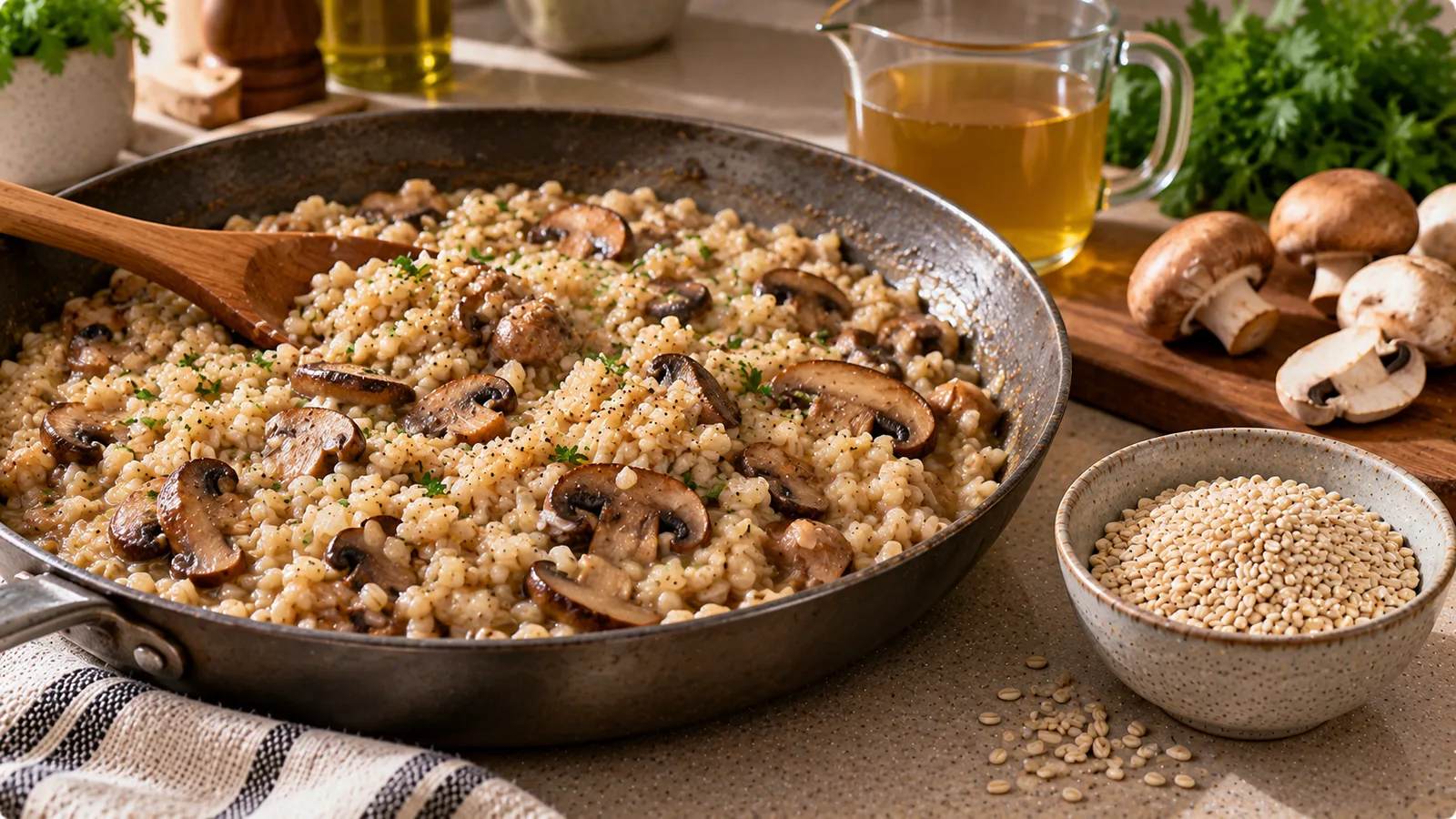
Mushroom and barley risotto combines the earthy flavor of browned mushrooms with the satisfying, slightly chewy texture of pearl barley. Unlike traditional risotto made with Arborio rice, this version uses barley, which holds its shape while gradually absorbing a flavorful broth.
The result is a comforting vegetarian main course with a creamy consistency, without needing a large amount of cream.
This recipe serves four and takes approximately 55–65 minutes, including preparation.
Recipe at a glance
| Detail | Amount |
|---|---|
| Servings | 4 |
| Preparation time | 15 minutes |
| Cooking time | 40–50 minutes |
| Total time | 55–65 minutes |
| Main grain | Pearl barley |
| Main flavor | Mushrooms, garlic, thyme and Parmesan |
| Diet | Vegetarian if using vegetarian hard cheese and stock |
| Difficulty | Easy to moderate |
The dish can be served as a complete light meal or alongside vegetables and a separate protein source.
Ingredients for four servings
| Ingredient | Quantity |
|---|---|
| Dry pearl barley | 240 g |
| Fresh mushrooms | 400 g |
| Onion | 150 g |
| Garlic | 3 cloves, approximately 12 g |
| Olive oil | 25 g |
| Unsalted butter | 15 g |
| Vegetable stock | 1,000–1,200 ml |
| Parmesan or vegetarian hard cheese | 50 g |
| Fresh thyme | 4–5 sprigs, or 1 tsp dried |
| Lemon juice | 15 ml |
| Fresh parsley | 15 g |
| Black pepper | To taste |
| Salt | To taste, depending on stock |
Choose cremini, chestnut or button mushrooms, or combine them with a smaller quantity of shiitake or oyster mushrooms.
Use pearl barley rather than whole hulled barley for the cooking times given here. Hulled barley generally requires longer cooking and may need additional liquid.
The recipe uses approximately 1 liter of stock initially, with extra stock available as needed.
How to make mushroom barley risotto
1. Prepare the ingredients
Wipe the mushrooms clean and slice them into pieces approximately 5–7 mm thick.
Finely dice the onion, mince the garlic and chop the parsley.
Keep the vegetable stock warm in a saucepan.
Check the pearl barley package for any specific rinsing instructions. Rinse if recommended, then drain thoroughly.
2. Brown the mushrooms
Heat approximately 15 g olive oil in a wide, heavy-bottomed pan over medium-high heat.
Add the mushrooms in batches if necessary.
Cook for approximately 7–10 minutes, stirring occasionally, until their moisture evaporates and the edges become golden brown.
Avoid overcrowding the pan. Mushrooms steam rather than brown when too much moisture accumulates.
Transfer the mushrooms to a plate.
3. Soften the onion and garlic
Reduce the heat to medium.
Add the remaining 10 g olive oil and the butter.
Cook the onion for approximately 4–5 minutes until softened.
Add the garlic and thyme and cook for another 30–60 seconds.
Do not allow the garlic to burn.
4. Toast the barley
Add the drained pearl barley to the pan.
Stir for approximately 1–2 minutes to coat the grains in the aromatic fat.
This step helps distribute flavor, although barley does not behave exactly like traditional risotto rice.
5. Add stock and simmer
Pour in approximately 700 ml warm vegetable stock.
Bring to a gentle simmer, then reduce the heat.
Cook uncovered or partially covered for approximately 30–40 minutes, stirring every few minutes.
Add more warm stock in portions as the liquid is absorbed.
Unlike Arborio rice, pearl barley does not require constant stirring.
The finished barley should be tender but retain a pleasant bite.
Cooking time depends on the brand, grain size and whether the barley has been pre-soaked.
6. Finish with mushrooms and cheese
Return the browned mushrooms to the pan.
Stir in the grated Parmesan or vegetarian hard cheese.
Add the lemon juice and most of the parsley.
Cook for another 2–3 minutes.
If the mixture is too thick, add a splash of warm stock.
If it is too loose, simmer briefly while stirring.
Season with black pepper and taste before adding salt, since stock and cheese may already contain substantial sodium.
7. Serve immediately
Divide the risotto between four bowls.
Garnish with the remaining parsley and, if desired, a small amount of extra grated cheese.
The ideal texture is creamy and spoonable rather than dry or stiff.
How to get a creamy texture without cream
Creaminess comes from several factors:
- Gradual hydration of the barley.
- Soluble fibers and starch released during cooking.
- A small amount of butter.
- Finely grated cheese.
- Enough stock to keep the final mixture loose.
Pearl barley contains beta-glucan, a type of soluble fiber, but its final fiber content varies with processing and the product used.
A creamy barley risotto will still have more bite than a classic rice risotto.
For a looser consistency, add 50–100 ml warm stock immediately before serving.
For a richer finish, an additional 5–10 g butter can be stirred into the full recipe, with a corresponding increase in calories.
Estimated nutrition per serving
The following estimates are based on dividing the complete recipe into four equal servings, using typical food composition values.
Actual results vary by ingredient brand, stock, cheese and portion size.
| Nutrient | Approximate amount per serving |
|---|---|
| Calories | 420–470 kcal |
| Protein | 15–19 g |
| Carbohydrates | 56–65 g |
| Fat | 14–18 g |
| Fiber | 9–13 g |
These values are estimates, not laboratory measurements.
The weight of the cooked dish will change depending on evaporation and the amount of stock absorbed.
For more accurate tracking, record the ingredient quantities and divide the completed dish into four equal portions.
Ingredient composition can be checked using USDA FoodData Central.
Why use pearl barley instead of risotto rice?
Pearl barley and Arborio rice produce different results.
| Feature | Pearl barley | Arborio rice |
|---|---|---|
| Texture | Chewy, distinct grains | Softer, creamy |
| Cooking time | Often 30–45 minutes | Often 18–25 minutes |
| Fiber | Typically higher | Typically lower |
| Gluten | Contains gluten | Naturally gluten-free |
| Liquid requirement | Depends on processing | Depends on method |
| Flavor | Nutty, earthy | Mild |
Pearl barley is not suitable for people who need to avoid gluten, including those with celiac disease.
If gluten avoidance is necessary, use an appropriate gluten-free grain and follow a recipe designed for it rather than assuming identical cooking times.
Ingredient substitutions
Mushrooms
Use a mix of brown mushrooms and shiitake for a stronger savory flavor.
Dried porcini can also be used. Rehydrate them thoroughly and strain the soaking liquid before adding it to the stock.
Cheese
A vegetarian hard cheese is suitable when you want a vegetarian version.
Traditional Parmesan made with animal rennet is not always suitable for vegetarians.
For a dairy-free version, omit butter and cheese, use additional olive oil and finish with nutritional yeast if desired.
The flavor and nutrition will change.
Stock
Low-sodium vegetable stock gives more control over seasoning.
Mushroom stock creates a more intense mushroom flavor.
Herbs
Thyme is a natural pairing with mushrooms.
Rosemary or sage can also work, but use smaller amounts because their flavors are stronger.
Extra vegetables
Add peas, spinach or finely chopped kale near the end of cooking.
These additions change the final weight and nutrition.
Common cooking problems
The barley is still hard
Continue simmering and add more warm stock.
Pearl barley may take longer than expected, particularly if the grains are large or the cooking temperature is low.
The risotto is dry
Add warm stock in small amounts and stir.
Barley continues to absorb liquid after cooking, so the dish may thicken while standing.
The mushrooms taste watery
Brown them separately over sufficiently high heat.
Avoid adding all the mushrooms to a small pan at once.
The dish tastes flat
Check the seasoning and add a little lemon juice.
Browning the mushrooms properly also improves the depth of flavor.
The dish is too salty
Use unsalted or low-sodium stock next time.
Cheese and prepared stock can contribute significant amounts of salt.
Adding water may reduce salt concentration but also dilute flavor.
Can you prepare it ahead?
Yes, but barley risotto thickens as it cools.
For meal preparation:
- Cook the recipe as directed.
- Cool promptly in shallow containers.
- Refrigerate within two hours.
- Store in the refrigerator at 4°C or below.
- Reheat thoroughly, adding a little water or stock to restore the texture.
As a conservative home-storage guideline, consume refrigerated leftovers within 3–4 days.
Freeze in individual portions if you need longer storage. The texture may soften after thawing.
Follow applicable food-safety guidance and avoid leaving cooked grains at room temperature for extended periods.
The USDA Food Safety and Inspection Service provides guidance on cooling and storing leftovers.
What to serve with mushroom barley risotto
The risotto works well with a simple side dish.
Ideas include:
- A green salad with lemon dressing.
- Roasted broccoli.
- Steamed green beans.
- Roasted carrots.
- Grilled tofu for additional plant protein.
- A poached egg, if suitable for your diet.
The recipe already contains a substantial portion of barley, so adding bread or another starch may not be necessary unless it fits your appetite and energy needs.
Shopping and portion planning
For four servings, the main ingredients are 240 g dry pearl barley, 400 g mushrooms and approximately 1–1.2 liters of stock.
If cooking for two people, halve the ingredients.
If preparing eight servings, double the ingredients but use a sufficiently large pan and add stock according to the texture rather than assuming every batch absorbs liquid at exactly the same rate.
You can weigh the finished dish and divide its total cooked weight by the number of portions for more consistent serving sizes.
Sources
- USDA FoodData Central — Food Composition Database
- USDA FSIS — Leftovers and Food Safety
- Celiac Disease Foundation — What Is Gluten?
Recipe summary: brown the mushrooms separately, simmer pearl barley gradually in warm stock, then finish with cheese, herbs and lemon. The result is a satisfying mushroom barley risotto with a creamy sauce and pleasantly chewy grains.