
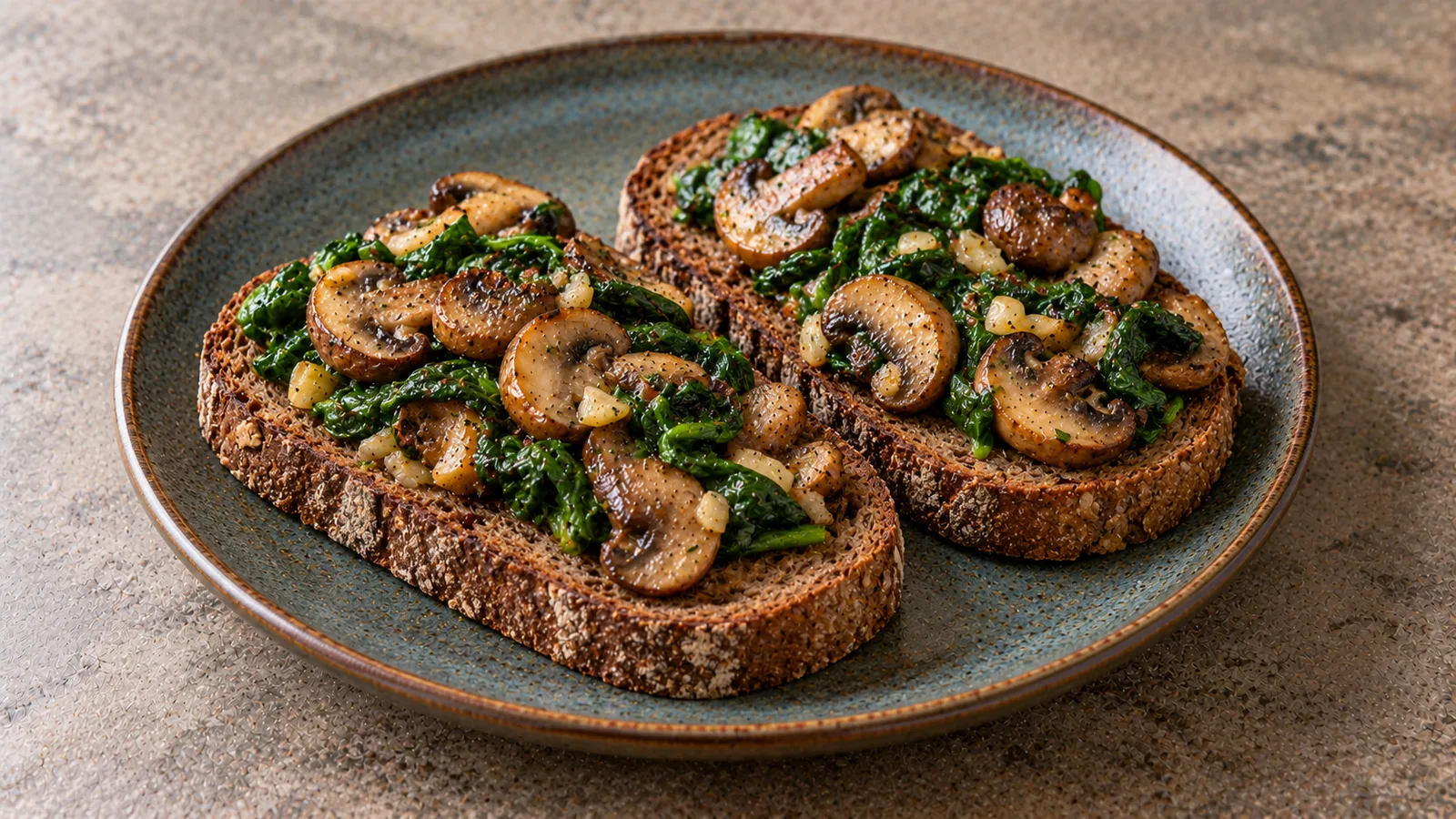
A good mushroom-and-spinach toast is built in the pan, not merely assembled on bread. The mushrooms need enough space to lose moisture and brown, the garlic needs only a brief turn in the heat, and the spinach should wilt without becoming a puddle. This recipe makes four open-faced rye toasts for two people with a weighed amount of oil and a transparent ingredient-cost and nutrition calculation. It does not use beans, cheese, eggs or a protein powder to make a straightforward vegetable topping sound like a high-protein meal.
The base is 160 g of wholegrain rye bread, 300 g of raw button mushrooms, 120 g of raw spinach, 12 g of peeled garlic and 18 g of olive oil. The finished dish is a light lunch or substantial snack. With the stated inputs, the estimated total is about 574 kcal, 20.5 g protein and 20.3 g fibre for the entire recipe—or 287 kcal, 10.3 g protein and 10.1 g fibre per person. Actual values depend especially on the bread and how much oil remains in the pan. These are ingredient-based estimates, not a laboratory test of the plated food.
What to buy for two people
The quantities below are edible starting weights, measured before cooking. Bread is weighed as sold; mushrooms are weighed after trimming away any damaged pieces; spinach is weighed after removing unsuitable leaves; garlic is weighed after peeling. Neither cooking evaporation nor a change in the weight of the toast creates or removes calories by itself.
| Ingredient | Amount for four toasts | What it does |
|---|---|---|
| Wholegrain rye bread | 160 g, four slices of about 40 g | Firm base and most of the recipe's fibre |
| White button mushrooms | 300 g raw | Savoury, browned topping |
| Fresh spinach | 120 g raw | Tender greens that wilt quickly |
| Garlic | 12 g peeled | Aroma, added late to avoid scorching |
| Olive oil | 18 g weighed | Helps distribute heat and carries flavour |
You also need black pepper and, if wanted, a little lemon juice or chilli flakes. Salt is optional and should be added only after tasting; the selected bread already contains salt. Optional garnishes are excluded from the calculation because their exact amounts are not fixed. This is a vegetarian and vegan recipe when the bread is vegan. Rye contains gluten, so it is not suitable for people who need to avoid gluten.
Choose ordinary cultivated edible mushrooms from a reputable seller. The recipe is not a guide to identifying wild mushrooms. If buying spinach frozen rather than fresh, thaw it safely, press out excess water and recognize that both weight and pan timing will change. Use four slices of similar thickness so they toast at roughly the same rate. Very thin bread may soften under the topping; an exceptionally thick slice changes the bread component of the calculation.
Equipment and preparation in five minutes
Use a large frying pan, a second dry skillet or toaster for the bread, a knife, board, spatula and a kitchen scale. A wide pan is more useful than a non-stick coating claim: crowded mushrooms release water faster than it can evaporate. If your pan is narrow, cook the mushrooms in two batches and split the oil between them, keeping the 18 g total unchanged.
Wipe the mushrooms clean or briefly rinse them if needed, then dry them well. Slice into pieces around 5–7 mm thick. Thick, reasonably even slices remain noticeable on toast after cooking. Remove tough spinach stems if necessary; wash the leaves and dry them in a spinner or clean towel. Finely chop the peeled garlic. Measure the oil into a small bowl before heating the pan, rather than pouring directly from a bottle.
The meal is ready in approximately 20–25 minutes, depending on your hob, pan width and how wet the mushrooms are. Timing is a practical range, not a promise that every stove cooks identically. Preheat the toast pan during the last few minutes of mushroom cooking, not at the start, to avoid serving cold or hardened bread.
Step-by-step: get browning before you add the greens
1. Heat the pan. Set the frying pan over medium-high heat. Add roughly 12 g of the measured olive oil and warm it until it flows easily but does not smoke. Keep the other 6 g for later. Spread the sliced mushrooms across the surface in a shallow layer.
2. Let moisture escape. Leave the mushrooms mostly undisturbed for the first 2–3 minutes, then stir. Continue cooking for roughly 6–9 minutes, until the initial pool of liquid evaporates and several surfaces turn golden brown. They do not need to become dry or brittle. If a large amount of liquid remains, let it simmer off rather than immediately adding more oil. A packed pan may need longer or separate batches.
3. Reduce the heat before the garlic. Lower to medium, add the remaining 6 g oil and the chopped garlic. Stir for 30–60 seconds until fragrant. Garlic can turn bitter when scorched; do not treat the mushroom cooking time as the garlic cooking time. If the pan is excessively hot, lift it briefly off the heat.
4. Wilt the spinach. Add the 120 g spinach in two handfuls and turn it with the mushrooms for roughly 1–2 minutes. It should collapse and look bright, not swim in a large amount of green liquid. If the spinach releases water, continue briefly until it no longer threatens to soak the bread. Season with pepper. Taste before adding salt.
5. Toast and serve immediately. Toast the four rye slices in a dry skillet or toaster until the surface feels firm. Place two slices on each plate and divide all of the cooked mushroom-spinach mixture evenly over the four slices. If needed, spoon the topping onto the centre rather than spreading it across the crust, which helps maintain crunch. Eat while warm.
The goal is browned mushrooms, tender greens and crisp bread. A darker, more caramelized appearance is not essential; smoking oil or burnt garlic does not improve the dish. If mushrooms turn soft before colouring, use a hotter pan next time or give them more surface area, not an automatically larger oil allowance.
How the measured oil changes the result
An informal instruction like “a splash of oil” can double the energy of a modest vegetable topping. Here the recipe uses exactly 18 g of olive oil for two people, or 9 g per person. At the standard budgeting factor of approximately 9 kcal per gram of fat, that is about 162 kcal for the batch, 81 kcal per serving. Some oil may stay in the pan, but unless it is actually collected and measured, the transparent approach is to count all 18 g.
The selected dmBio olive oil label gives its nutrition per 100 ml, not per 100 g. Volume and weight are different units; do not read 18 g as exactly 18 ml. For the grocery-cost example below, an explicitly approximate oil density of 0.92 g/ml turns a 500 ml bottle into about 460 g of oil. You can also weigh the bottle before and after cooking for a more precise personal cost calculation. Product label: dmBio extra-virgin olive oil.
For a lighter version, reduce oil to 12 g total. That removes roughly 54 kcal from the whole recipe, or 27 kcal per person, if all other quantities stay the same. Do not subtract oil calories simply because visible oil is absent; oil can coat vegetables in a thin layer. Conversely, adding cheese, butter, mayonnaise or a second pour of oil changes the recipe and should be logged separately.
Estimated calories, protein and fibre
We use a specific packaged bread rather than an imaginary universal “rye toast”: dmBio Roggen Vollkornbrot, which declares 188 kcal, 4.4 g protein and 9 g fibre per 100 g. For raw mushrooms, spinach and garlic, we use the USDA SR Legacy food profiles white mushrooms (169251), spinach (168462) and garlic (169230). The oil calculation uses approximately 9 kcal/g. No sauce or optional garnish is included.
| Ingredient in full recipe | Estimated kcal | Protein | Fibre |
|---|---|---|---|
| Rye bread, 160 g | 300.8 | 7.04 g | 14.40 g |
| Raw mushrooms, 300 g | 66.0 | 9.27 g | 3.00 g |
| Raw spinach, 120 g | 27.6 | 3.43 g | 2.64 g |
| Raw garlic, 12 g | 17.9 | 0.76 g | 0.25 g |
| Olive oil, 18 g | 162.0 | 0 g | 0 g |
| Whole batch | 574.3 | 20.51 g | 20.29 g |
| Per person, half batch | 287.1 | 10.25 g | 10.15 g |
The arithmetic uses ingredient amounts before cooking: 160/100 × bread label value, 300/100 × mushroom profile, and so on. Rounding in individual rows can create a 0.01 difference from totals calculated using unrounded values. The fibre here largely comes from the chosen wholegrain bread. Another “rye” loaf made chiefly from refined flour may have materially less fibre; “dark” colour is not proof of wholegrain content. For an overview of how to identify useful fibre sources across meals, see Mealisa's high-fibre foods guide.
This is not a claim that 10 g protein is sufficient as a full meal for everyone. Protein needs vary, and the recipe is designed primarily for flavour, practical vegetable portions and crunchy texture. If a larger or higher-protein meal is your goal, pair these toasts with another suitable food and calculate the complete plate separately; Mealisa's balanced-meal guide can help with that distinction.
Cost per used portion versus checkout cost
Costs are a hypothetical EUR grocery scenario, not current German retail quotations, even though the bread and oil nutrition sources identify actual products. Suppose you pay €1.69 for 500 g bread, €1.99 for 400 g mushrooms, €1.59 for 200 g spinach, €0.49 for 40 g usable garlic and €6.49 for a 500 ml oil bottle. The oil cost is apportioned using the approximate 460 g weight described above. All other pack sizes in this model are assumed usable weights; real packages may contain trimming waste.
| Grocery item | Assumed pack and price | Amount used | Estimated cost used |
|---|---|---|---|
| Wholegrain rye bread | 500 g / €1.69 | 160 g | €0.54 |
| Mushrooms | 400 g / €1.99 | 300 g | €1.49 |
| Fresh spinach | 200 g / €1.59 | 120 g | €0.95 |
| Peeled garlic | 40 g / €0.49 | 12 g | €0.15 |
| Olive oil | 500 ml / €6.49, about 460 g | 18 g | €0.25 |
| Total used | — | Four toasts | €3.39 |
| Per person | — | Two toasts | €1.69 |
The entire checkout basket is €12.25, because all five complete packs must be bought if there is nothing in your kitchen. The roughly €8.86 difference is food and oil you still own, not a hidden discount or necessarily waste. The €3.39 recipe figure comes from summing unrounded proportional ingredient costs, then rounding once. If you already have bread and oil, the money you spend today will differ from the cost of ingredients consumed. For a broader method of counting reusable pantry items, see the budget grocery-list guide.
A cheaper local mushroom offer may matter more than using half a clove less garlic. Prices are not permanent facts: compare edible pack weight, storage life and how much of each food you are likely to use. Buying a huge tub of spinach only to discard most of it can be more expensive than a smaller pack. The calculation is there to let you substitute your own receipt prices without changing the recipe.
Why the mushrooms sometimes steam instead of brown
Fresh mushrooms contain a high proportion of water. The USDA profile describes raw white mushrooms as around 92% water. In a crowded skillet, moisture evaporates slowly and bubbles around the pieces. The mushrooms may soften and shrink yet remain pale. This is not inherently unsafe or inedible, but it gives a different texture and can make the toast damp.
Three changes help: dry the sliced mushrooms, allow visible gaps between pieces, and avoid stirring constantly during the initial minutes. When browning develops, stir to expose other sides. Mushrooms should not be deliberately left unattended until the pan dries out completely. If the pan sticks, lower heat slightly, move the pieces and keep an eye on the garlic.
Do not confuse cooked weight with raw nutrient density. A 300 g pile of mushrooms may shrink substantially in the pan, but the starting mushrooms do not suddenly contain three times as much protein. Much of the change is water evaporation. Calculate this recipe from the weighed raw ingredients or from a verified cooked recipe yield—not from a raw-per-100-g entry applied to the cooked mass.
Keep the rye toast crisp
Assemble only after both the bread and topping are ready. If preparing the topping slightly ahead, hold it separately, then toast bread immediately before eating. Thick-cut slices provide structure, but the chosen dense wholegrain rye loaf can still soften if covered with a very wet topping. Brief toasting helps; pouring watery pan juices over the slices works against the desired texture.
For an open-faced lunchbox, carry dry bread and cold mushroom-spinach topping in separate containers and reheat the topping thoroughly when suitable equipment is available. Do not rely on the bread as a safe way to store warm cooked vegetables. FoodSafety.gov advises refrigerating perishable cooked food promptly, generally within two hours, at 4°C or below, and using refrigerated leftovers within about 3–4 days; a more conservative short holding time may improve mushroom and spinach quality. Read the cold-storage guidance and the two-hour rule.
If cooked leftovers have been held warm for a prolonged period, an attractive smell is not a safety test. Refrigerate in shallow containers, label the date, and discard food handled or stored unsafely. The finished assembled toast is best eaten fresh; storing the components separately also keeps the texture better.
Easy variations that preserve the idea
To bring acidity, finish with a squeeze of lemon just before serving; quantify it if you need a precise calorie log. For heat, add chilli flakes with the garlic. Thyme is a natural companion to mushrooms, while parsley adds brightness without turning the recipe into a pesto toast. These changes can alter taste without changing the central method.
For extra energy, use a larger bread portion or add a measured spread. For more protein, serve a separate side of cottage cheese, tofu, a bean salad or another preferred protein source. Each addition requires its own nutrition and cost entry; it would be misleading to keep displaying the original 287 kcal per serving after adding substantial toppings. If the desired meal is specifically a toast with beans as the main component, use the separate Mealisa recipe for white-bean and mushroom toast, which answers a different recipe intent.
Switching from rye to wheat sourdough is possible for flavour, but it changes the bread's fibre and protein composition. Replacing the fresh spinach with thawed frozen spinach can be economical, yet frozen spinach must be drained thoroughly. With very young spinach leaves, add them after turning off the heat and let residual warmth wilt them; with tougher leaves, the full 1–2 minutes may be needed.
A practical timing checklist
At minute 0, wipe and slice mushrooms; measure and prepare the spinach and garlic. By about minute 5, the mushrooms should be in the hot pan. Around minutes 12–15, if surface moisture has evaporated and brown edges have formed, lower the heat and add garlic. Immediately afterwards fold in spinach. While it wilts, toast bread. Assemble just before serving. Treat these as cues, not fixed machine instructions: colour, smell, moisture and safe handling determine what to do next.
The larger lesson from this small recipe is that weighing bread and oil, drying the mushrooms and assembling at the end produce more reliable results than chasing a single cooking minute. A simple five-ingredient toast can be inexpensive, vegetable-forward and satisfying without inflated nutrition claims.
Sources
- dmBio Roggen Vollkornbrot — ingredients and nutrition label.
- USDA FoodData Central — mushrooms, white, raw, SR Legacy 169251.
- USDA FoodData Central — spinach, raw, SR Legacy 168462.
- USDA FoodData Central — garlic, raw, SR Legacy 169230.
- dmBio extra-virgin olive oil — nutrition by volume.
- German Nutrition Society — vegetables, wholegrains and plant oils.
- FoodSafety.gov — cold storage chart.
- FoodSafety.gov — two-hour rule and leftovers.