
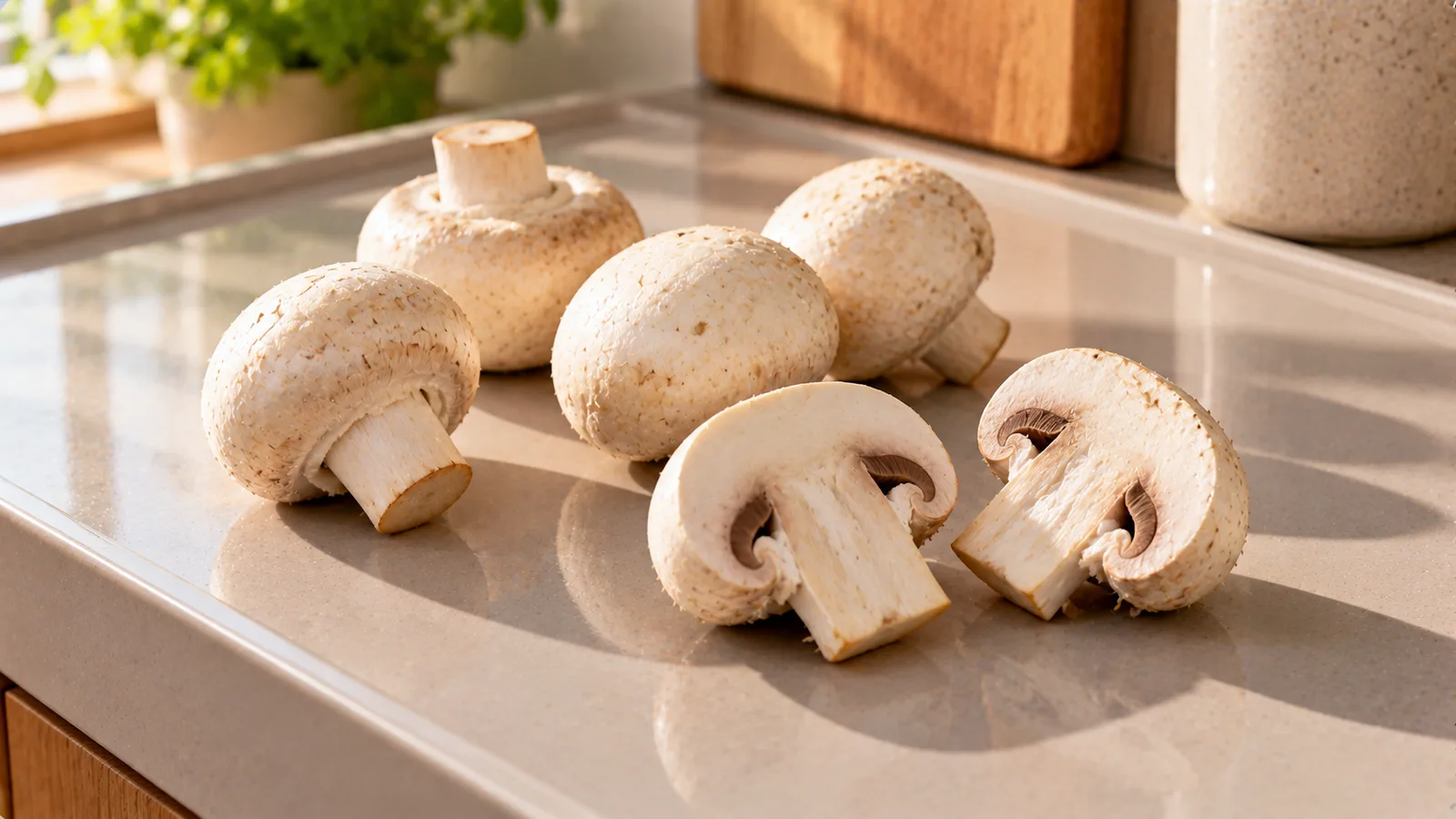
Mushrooms are naturally low in calories, but the final calorie count can change substantially depending on how they are cooked.
As a practical reference, raw white mushrooms contain about 22 kcal per 100 g. A large portion of mushrooms can therefore contribute relatively few calories before oil, butter, cream or other ingredients are added.
Mushroom nutrition per 100 g
A typical 100 g portion of raw white mushrooms provides approximately:
| Nutrient | Approx. amount |
|---|---|
| Calories | ~22 kcal |
| Protein | ~3.1 g |
| Carbohydrates | ~3.3 g |
| Fat | ~0.3 g |
| Fiber | ~1 g |
Values vary somewhat between mushroom varieties and products.
Calories in common mushroom portions
Using approximately 22 kcal per 100 g for raw white mushrooms:
| Portion | Approx. calories |
|---|---|
| 50 g | 11 kcal |
| 75 g | 17 kcal |
| 100 g | 22 kcal |
| 150 g | 33 kcal |
| 200 g | 44 kcal |
| 250 g | 55 kcal |
| 300 g | 66 kcal |
For any weighed portion:
grams × calories per 100 g ÷ 100
For example:
180 g × 22 ÷ 100 ≈ 40 kcal
How many calories are in one mushroom?
“One mushroom” is not a reliable serving size because mushrooms vary considerably in size.
A small mushroom may weigh only a few grams, while a large mushroom can weigh several times as much.
If a mushroom weighs 18 g and the reference value is 22 kcal per 100 g:
18 × 22 ÷ 100 ≈ 4 kcal
Five mushrooms of the same size would provide approximately:
5 × 4 = 20 kcal
For accurate tracking, weighing the mushrooms is more useful than counting them.
Calories in 200 g of mushrooms
At approximately 22 kcal per 100 g:
200 × 22 ÷ 100 = 44 kcal
This illustrates why plain mushrooms are relatively low in calorie density.
However, 200 g of mushrooms cooked in oil or butter can contain substantially more calories.
Raw versus cooked mushrooms
Cooking changes the weight of mushrooms because they contain a large amount of water.
As mushrooms cook, water evaporates and the final portion becomes lighter.
This means a cooked mushroom entry can show more calories per 100 g than a raw entry even when no calorie-containing ingredients were added.
The total energy in the mushrooms has not suddenly increased. It has simply become concentrated into a smaller cooked weight.
Example: weight loss during cooking
Suppose you start with:
300 g raw mushrooms
At 22 kcal per 100 g:
300 × 22 ÷ 100 = 66 kcal
After cooking without added fat, the mushrooms weigh only 180 g.
The whole cooked batch still contains approximately 66 kcal.
Calories per 100 g cooked:
66 ÷ 180 × 100 ≈ 37 kcal
This is why raw and cooked database entries should not automatically be used interchangeably.
The simplest way to track mushrooms
If you weigh mushrooms before cooking, use a raw mushroom entry.
For example:
- raw mushrooms: 250 g;
- reference: 22 kcal per 100 g.
Calories:
250 × 22 ÷ 100 = 55 kcal
If you then cook those mushrooms without calorie-containing ingredients, the batch still contains approximately 55 kcal even though its final weight is lower.
Tracking a cooked batch
If you prepare mushrooms for several meals, you can calculate the full batch.
Example:
- 500 g raw mushrooms;
- 22 kcal per 100 g.
Total mushroom calories:
500 × 22 ÷ 100 = 110 kcal
After cooking, the mushrooms weigh 310 g.
Calories per cooked gram:
110 ÷ 310 ≈ 0.355 kcal
A 120 g cooked portion contains:
120 × 0.355 ≈ 43 kcal
This approach is useful when water loss varies from one cooking session to another.
White mushrooms
White button mushrooms are among the most common varieties used in nutrition databases.
A typical raw reference is approximately 22 kcal per 100 g.
Their exact nutrient composition can vary with growing conditions, maturity and database source.
Cremini mushrooms
Cremini mushrooms, also called brown or baby bella mushrooms in some markets, are closely related to white button mushrooms.
Their calorie density is similarly low, although exact values can differ slightly.
If your package provides nutrition information, use that value rather than assuming it is identical to a generic white mushroom entry.
Portobello mushrooms
Portobello mushrooms are mature forms of the same species commonly sold as white and cremini mushrooms.
A single portobello can be much heavier than a small button mushroom, so “one mushroom” is especially misleading as a portion measure.
Weighing the edible mushroom is more accurate.
Other mushroom varieties
Shiitake, oyster, enoki and other mushrooms have their own nutrient profiles.
They are all mushrooms, but they should not necessarily be assigned exactly the same calories per 100 g.
When available, choose a database entry for the specific variety you are eating.
Protein in mushrooms
Raw white mushrooms provide approximately 3 g of protein per 100 g.
Using 3.1 g per 100 g:
| Portion | Approx. protein |
|---|---|
| 100 g | 3.1 g |
| 150 g | 4.7 g |
| 200 g | 6.2 g |
| 300 g | 9.3 g |
Mushrooms can contribute some protein to a meal, but they are not nutritionally equivalent to concentrated protein sources such as meat, fish, eggs, legumes, dairy or tofu.
Carbohydrates in mushrooms
Raw white mushrooms contain only a few grams of carbohydrate per 100 g.
At approximately 3.3 g per 100 g:
- 100 g → ~3.3 g carbohydrate
- 150 g → ~5.0 g
- 200 g → ~6.6 g
- 300 g → ~9.9 g
Exact carbohydrate and fiber labeling can vary between regions because nutrition-label conventions are not identical.
Sautéed mushrooms can be very different
The mushrooms themselves may contain relatively few calories, but sautéing often involves oil or butter.
Suppose you cook:
- 300 g mushrooms;
- 15 g olive oil.
Mushrooms:
300 × 22 ÷ 100 = 66 kcal
Olive oil at approximately 884 kcal per 100 g:
15 × 884 ÷ 100 ≈ 133 kcal
Total:
66 + 133 = approximately 199 kcal
In this example, the oil contributes about twice as many calories as the mushrooms.
Mushrooms cooked with butter
Suppose you use:
- 250 g mushrooms;
- 15 g butter.
Mushrooms:
250 × 22 ÷ 100 = 55 kcal
If butter provides approximately 717 kcal per 100 g:
15 × 717 ÷ 100 ≈ 108 kcal
Total:
55 + 108 = approximately 163 kcal
The cooking fat is therefore important when estimating the complete dish.
Do mushrooms absorb oil?
Mushrooms can retain some of the fat used during cooking.
Exactly how much remains in the finished food depends on the method, pan, cooking time and whether oil is left behind.
For home tracking, a practical method is to count the amount of oil added to the recipe unless you can reliably measure how much remains unused.
This avoids assuming that sautéed mushrooms have the same calorie value as mushrooms cooked without fat.
Mushrooms cooked in a non-stick pan
If mushrooms are cooked without meaningful amounts of oil or butter, the total calories remain close to those of the mushrooms themselves.
Their weight may fall significantly because of water loss.
For this reason, calculate the original mushroom amount or use a cooked entry that matches the preparation method.
Mushrooms with cream
Cream-based mushroom dishes can have a much higher calorie density than plain mushrooms.
A sauce may contain:
- cream;
- butter;
- oil;
- cheese;
- flour;
- stock.
A generic “mushrooms” entry should not be used for the entire weight of a creamy mushroom dish.
Track the recipe ingredients or use nutrition information specific to the prepared dish.
Mushrooms with cheese
Cheese can also contribute substantially to the total calories.
For example, mushrooms stuffed with cheese, breadcrumbs and oil should be treated as a complete recipe rather than as plain mushrooms.
The weight of the final stuffed mushroom includes ingredients with very different calorie densities.
Canned mushrooms
Canned mushrooms may have a somewhat different weight and nutrient profile from fresh mushrooms.
Check whether the label values refer to:
- the full contents;
- drained mushrooms;
- a specified serving size.
If you drain the mushrooms before eating, a value based on drained weight is preferable when available.
Frozen mushrooms
Plain frozen mushrooms can generally be tracked using their package information.
Products containing sauces, butter, herbs in oil or other ingredients should be treated as prepared products rather than plain mushrooms.
Grilled mushrooms
Grilling mushrooms without added fat does not introduce meaningful calories by itself.
However, marinades can contain oil, sugar or sauces.
If the mushrooms are brushed generously with oil before grilling, include that oil in the meal calculation.
Air-fried mushrooms
Plain mushrooms cooked in an air fryer remain relatively low in calories.
But breaded or oil-coated air-fried mushrooms are different.
A breaded coating may add:
- flour;
- breadcrumbs;
- egg;
- oil;
- cheese.
Use the complete recipe rather than a plain mushroom value.
Mushrooms in an omelet
If an omelet contains 100 g mushrooms, the mushrooms themselves contribute roughly:
100 × 22 ÷ 100 = 22 kcal
The eggs, cheese, butter or oil must be added separately.
This prevents the low calorie density of mushrooms from obscuring the energy contribution of the rest of the meal.
Mushrooms on pizza
The mushrooms on a pizza usually contribute only a small fraction of the pizza's total calories.
The dough, cheese, sauce, meat toppings and oil are usually much more important.
For a homemade pizza, include mushrooms as one recipe ingredient. For restaurant or packaged pizza, use information for the whole pizza when available.
Mushroom soup
Mushroom soup can range from a light broth-based soup to a rich cream soup.
Its calorie value cannot be estimated accurately from mushroom calories alone.
Ingredients such as cream, milk, butter, flour and oil may account for much of the total energy.
Are mushrooms low in calories?
Plain mushrooms have low calorie density because a large proportion of their weight is water.
At roughly 22 kcal per 100 g, a 200 g raw portion contains only around 44 kcal.
This does not mean every mushroom dish is low in calories. Preparation can change the total dramatically.
A useful distinction is:
plain mushrooms = low calorie density
mushroom dish = depends on all ingredients
A practical meal example
Suppose a meal contains:
- 200 g mushrooms;
- 150 g chicken;
- 10 g olive oil;
- vegetables.
The mushrooms contribute approximately:
200 × 22 ÷ 100 = 44 kcal
The oil contributes approximately:
10 × 884 ÷ 100 = 88 kcal
Chicken and the remaining vegetables are calculated separately.
Tracking each major component produces a more realistic result than applying the mushroom value to the entire meal.
Package-label example
Suppose a packaged mushroom product states:
- 25 kcal per 100 g;
- 3.2 g protein;
- 3.5 g carbohydrate;
- 0.4 g fat.
You eat 180 g.
Calories:
180 × 25 ÷ 100 = 45 kcal
Protein:
180 × 3.2 ÷ 100 = 5.8 g
Carbohydrate:
180 × 3.5 ÷ 100 = 6.3 g
Fat:
180 × 0.4 ÷ 100 = 0.7 g
When a reliable package label is available, use it instead of replacing it with a generic reference value.
Common tracking mistakes
Mushrooms are often logged inaccurately when people:
- count mushrooms instead of weighing them;
- weigh cooked mushrooms but select a raw entry without accounting for water loss;
- forget oil or butter used for sautéing;
- log creamy mushrooms as plain mushrooms;
- treat stuffed mushrooms as plain mushrooms;
- assume every mushroom variety has identical nutrition;
- use the total weight of a mixed dish with a plain mushroom entry;
- ignore the label on a packaged mushroom product.
Quick reference
For raw white mushrooms at approximately 22 kcal per 100 g:
- 50 g: ~11 kcal
- 100 g: ~22 kcal
- 150 g: ~33 kcal
- 200 g: ~44 kcal
- 250 g: ~55 kcal
- 300 g: ~66 kcal
The calorie count of cooked mushrooms depends heavily on water loss and, more importantly, any added oil, butter, cream, cheese or other ingredients.
For accurate tracking, weigh the mushrooms and include calorie-containing cooking ingredients separately.