
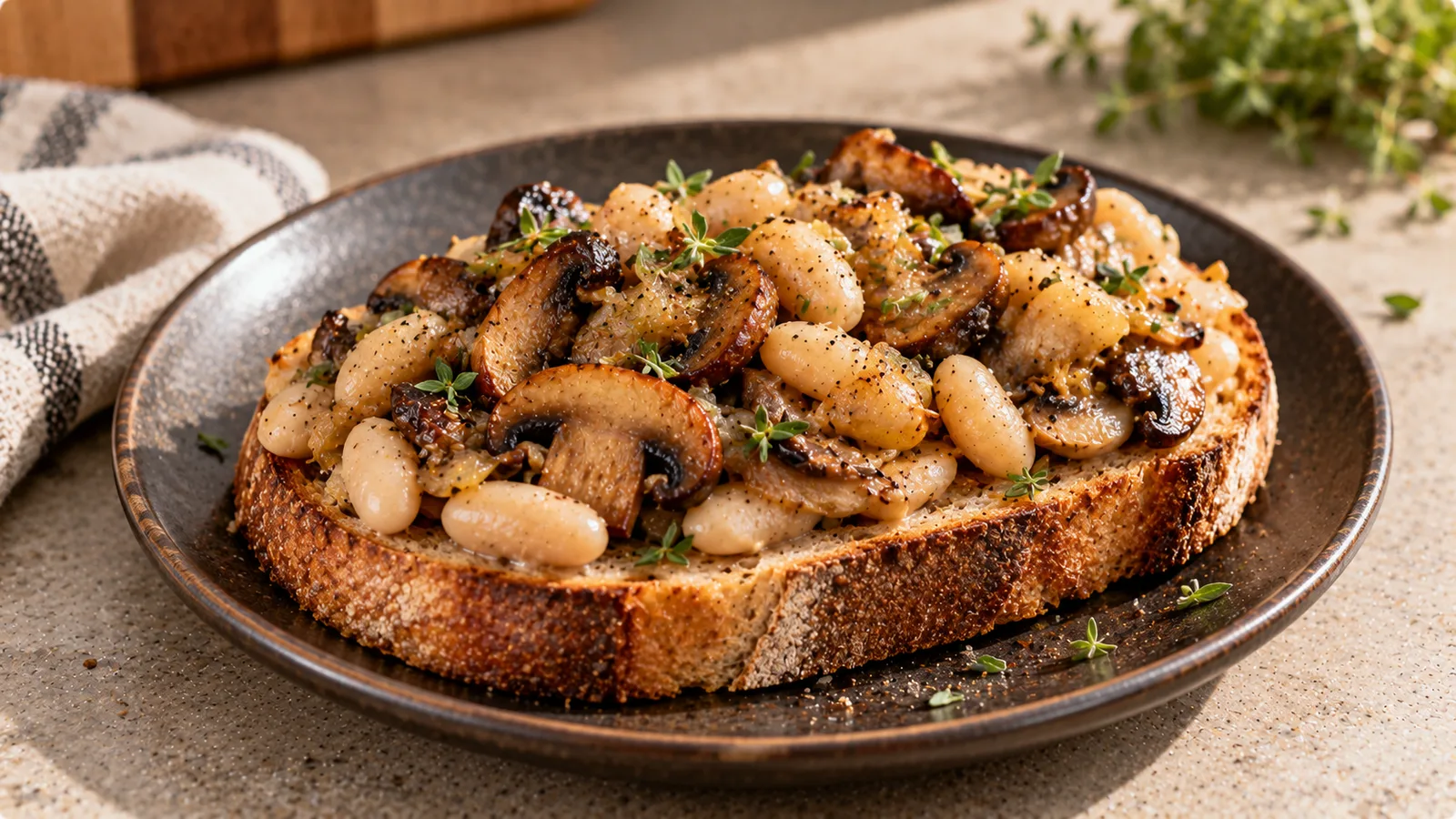
White bean and mushroom toast is a simple way to turn everyday ingredients into a substantial breakfast, lunch or light dinner.
The recipe combines creamy white beans, browned mushrooms, garlic, thyme and lemon on toasted whole-grain bread. The beans provide body and protein, while the mushrooms contribute a deep savory flavor. For a different mushroom toast with spinach, garlic and rye bread, see mushroom and spinach rye toasts.
Unlike a basic mushroom toast with a few beans scattered on top, this version uses a warm, lightly mashed white bean mixture as the foundation. The mushrooms are cooked separately until browned and then arranged over the beans. This keeps the two textures distinct and prevents the bread from becoming unnecessarily soggy.
Recipe overview
| Detail | Amount |
|---|---|
| Servings | 2 |
| Preparation time | 10 minutes |
| Cooking time | 15–20 minutes |
| Total time | Approximately 25–30 minutes |
| Difficulty | Easy |
| Equipment | Large skillet, small saucepan or second skillet, toaster |
Each serving consists of two slices of toast topped with warm white beans and sautéed mushrooms.
The recipe can be scaled for one person or prepared in larger quantities for a shared meal.
Ingredients for two servings
| Ingredient | Quantity |
|---|---|
| Cooked white beans, drained | 240 g |
| Fresh button or cremini mushrooms | 250 g |
| Whole-grain bread | 120 g |
| Olive oil | 15 g |
| Garlic | 2 cloves |
| Lemon juice | 15 ml |
| Water or low-sodium vegetable stock | 40–60 ml |
| Fresh or dried thyme | 1 teaspoon fresh or 1/2 teaspoon dried |
| Black pepper | To taste |
| Salt | To taste |
| Fresh parsley, optional | Small handful |
Use cannellini beans, navy beans or another mild white bean variety.
If using canned beans, drain and rinse them. The 240 g refers to the drained weight, not the weight of the beans together with their packing liquid.
Choose bread that is sturdy enough to support the topping. A dense whole-grain loaf or sourdough works particularly well.
Step 1: Prepare the ingredients
Clean the mushrooms with a brush or a slightly damp cloth and trim the stem ends if necessary.
Slice them approximately 5–7 mm thick.
Finely chop the garlic.
Drain and rinse the beans.
Measure the lemon juice and prepare the thyme.
Keeping the ingredients ready before heating the pan helps prevent overcooking.
Step 2: Brown the mushrooms
Heat a large skillet over medium-high heat.
Add approximately 10 g of the olive oil.
Place the sliced mushrooms in the skillet in a reasonably even layer.
Allow them to cook without stirring constantly.
After a few minutes, they will release moisture. Continue cooking until much of that moisture evaporates and the surfaces begin to brown.
The process usually takes 7–10 minutes, depending on the pan size and mushroom variety.
Add half the garlic and the thyme during the final minute.
Season lightly with black pepper.
Transfer the mushrooms to a warm plate.
Why browning matters
Mushrooms contain a substantial amount of water.
If the skillet is overcrowded, they tend to steam rather than brown.
A wider pan allows moisture to evaporate more efficiently.
Browning develops a more concentrated savory flavor and helps prevent the finished toast from becoming watery.
Step 3: Prepare the creamy white beans
Reduce the heat to medium.
Add the remaining 5 g olive oil and the rest of the garlic to a small saucepan or the cleaned skillet.
Cook for approximately 20–30 seconds, just until fragrant.
Add the drained white beans and 40 ml of water or low-sodium vegetable stock.
Warm for 3–4 minutes.
Use a fork or potato masher to crush approximately half the beans.
Leave the remaining beans mostly intact for texture.
Add the lemon juice and stir.
If the mixture is too thick, add another small splash of water.
The goal is a soft, spreadable mixture rather than a completely smooth purée.
Season with black pepper and a modest amount of salt if needed.
Step 4: Toast the bread
Toast the four slices of bread until the surfaces are crisp and lightly golden.
You can use a toaster, a dry skillet or an oven.
For the best texture, toast the bread shortly before assembling the meal.
Bread that sits under a moist topping for too long gradually loses its crispness.
Step 5: Assemble and serve
Place two slices of toast on each plate.
Divide the warm white bean mixture evenly between the four slices.
Spoon the browned mushrooms over the beans.
Add chopped parsley if desired.
Serve immediately.
A little extra lemon juice can be added at the table, but taste the dish first to avoid making the topping excessively acidic.
How to get the best texture
This recipe works particularly well when three textures remain distinct:
- Crisp bread underneath.
- Soft, creamy beans in the middle.
- Browned mushrooms on top.
If the beans are too liquid, simmer them briefly to reduce excess moisture.
If the mushrooms are watery, continue cooking them uncovered until the liquid evaporates.
If the bread becomes soft too quickly, use thicker slices or toast them more thoroughly.
Assemble only when ready to eat.
Can you use dried white beans?
Yes, but dried beans must be cooked before following the recipe.
Soak and cook them according to the instructions appropriate for the bean variety.
Do not assume that soaking alone makes dried beans safe to eat.
Cook beans thoroughly until tender. Some dried bean varieties contain naturally occurring lectins that require adequate cooking.
For convenience, canned cooked beans are a practical option.
If preparing dried beans in advance, refrigerate the cooked beans promptly and follow appropriate storage guidance.
Can you use frozen mushrooms?
Frozen mushrooms can be used, but their texture may differ from fresh mushrooms.
They often release more water during cooking.
For better browning, cook them uncovered until excess moisture evaporates before adding garlic and thyme.
The final flavor can still be pleasant, although the mushroom pieces may be softer.
Estimated nutrition per serving
The following estimates are based on half the complete recipe:
- 120 g cooked white beans.
- 125 g mushrooms.
- 60 g whole-grain bread.
- 7.5 g olive oil.
- Half the garlic, lemon juice and seasonings.
| Nutrient | Approximate amount |
|---|---|
| Energy | 380 kcal |
| Protein | 17 g |
| Fat | 11 g |
| Carbohydrates | 55 g |
| Fiber | 13 g |
These are rounded recipe estimates, not laboratory measurements.
Actual values depend on the bread, bean variety, drained weight, oil used and ingredient labels.
Whole-grain breads differ considerably in calories and fiber content.
For accurate food tracking, use the nutrition information of your specific bread and beans.
Reference: USDA FoodData Central.
Why white beans work well in this recipe
White beans have a mild flavor and a soft texture when cooked.
They can be lightly mashed without requiring cream, butter or cheese.
Their starch helps create a spreadable consistency when combined with a small amount of liquid.
They also contribute protein, fiber and carbohydrates, making the toast more substantial than bread topped with mushrooms alone.
However, white beans are not nutritionally identical to meat, eggs or dairy products. Their protein content and amino acid profile differ.
A varied overall diet remains important.
Ingredient substitutions
Different mushrooms
Button mushrooms, cremini mushrooms and oyster mushrooms can all work.
Cooking times may change because different varieties contain different amounts of moisture.
Use a hot pan and allow excess liquid to evaporate.
Different beans
Cannellini beans are particularly creamy.
Navy beans also work well.
Butter beans provide larger pieces and a softer, more substantial texture.
If you substitute chickpeas, the topping will be less creamy unless you mash them more thoroughly.
Different bread
Whole-grain sourdough, rye bread and sturdy wheat bread are suitable.
Very soft sandwich bread may become soggy quickly.
Gluten-free bread can be used if required, but its texture and nutritional values may differ.
Without lemon
A small amount of mild vinegar can provide acidity.
Start with less than the specified lemon juice and adjust gradually.
Without garlic
Use a little extra thyme, black pepper or another suitable herb.
The flavor will be milder but the recipe will still work.
Variations for different meals
With spinach
Add 60–80 g fresh spinach to the mushrooms near the end of cooking.
Allow it to wilt and cook off excess moisture.
The additional vegetables increase the volume without fundamentally changing the recipe.
With a poached egg
Place one poached egg on top of each serving.
This increases the protein and calorie content.
Calculate the egg separately when tracking nutrition.
With chili flakes
Add a small pinch of chili flakes to the mushrooms.
This gives the topping a gentle heat without requiring a different sauce.
With grated cheese
Add approximately 15–20 g grated hard cheese per serving.
The cheese changes the flavor and increases calories, protein, fat and sodium.
With roasted tomatoes
Serve a few roasted cherry tomatoes alongside the toast.
Keep their cooking liquid separate so the bread remains crisp.
Is this recipe suitable for meal preparation?
The bean mixture and mushrooms can be prepared in advance.
However, it is better to store the components separately.
Keep the cooked beans and mushrooms in covered containers in the refrigerator.
Toast the bread shortly before serving.
Warm the toppings thoroughly and assemble immediately.
Preparing fully assembled toast several hours ahead is less successful because moisture gradually softens the bread.
Storage and food safety
Refrigerate cooked toppings promptly in shallow containers.
Keep refrigerated food at approximately 4°C or below.
Use cooked leftovers within 3–4 days.
For reheating, heat the bean and mushroom mixture thoroughly until steaming hot; a target of 74°C is a conservative food-safety approach for leftovers.
Do not leave cooked bean toppings at room temperature for extended periods.
Food-safety reference: FoodSafety.gov — Cold Food Storage Chart.
Grocery planning and cost
This recipe uses a short ingredient list and works well when you already have canned beans, bread and basic seasonings.
For two servings, you need approximately:
- One can or equivalent quantity of cooked white beans, providing at least 240 g drained.
- 250 g mushrooms.
- 120 g bread.
- A small quantity of olive oil, garlic, lemon and herbs.
Compare bean prices using the drained weight, not simply the total weight of the can.
For example, a 400 g can may contain substantially less than 400 g of beans after draining.
The most useful price comparison is the cost per 100 g of edible drained beans.
For mushrooms, compare the price per kilogram and consider how quickly you plan to use them.
Buying a larger package is not necessarily economical if some mushrooms spoil.
How to scale the recipe
For one serving, halve the ingredient quantities.
For four servings, double them:
| Ingredient | Four servings |
|---|---|
| Cooked drained white beans | 480 g |
| Mushrooms | 500 g |
| Whole-grain bread | 240 g |
| Olive oil | 30 g |
| Garlic | 4 cloves |
| Lemon juice | 30 ml |
| Water or stock | 80–120 ml |
When doubling the mushrooms, use a larger skillet or cook them in batches.
Overcrowding can prevent proper browning.
You may also need to adjust the liquid in the beans gradually rather than adding the entire amount at once.
Common mistakes
The mushrooms are pale and watery. The pan may be overcrowded or insufficiently hot. Cook in batches and allow moisture to evaporate.
The beans are too dry. Add a small amount of water or stock and stir until spreadable.
The beans are too thin. Simmer uncovered for a few minutes.
The toast becomes soggy. Assemble immediately before serving and avoid excess liquid.
The dish tastes flat. Check the balance of lemon, garlic, thyme, pepper and salt.
The topping slides off the bread. Mash more of the beans to create a thicker base.
A practical everyday meal
White bean and mushroom toast is useful because it combines pantry ingredients with fresh produce in a relatively short cooking time.
The key is to prepare the beans and mushrooms as two distinct components rather than cooking everything together into a wet mixture.
Brown the mushrooms thoroughly, mash only part of the beans and keep the bread crisp.
This creates a satisfying savory toast that can be adjusted for breakfast, lunch or a light dinner without requiring a complicated recipe.