
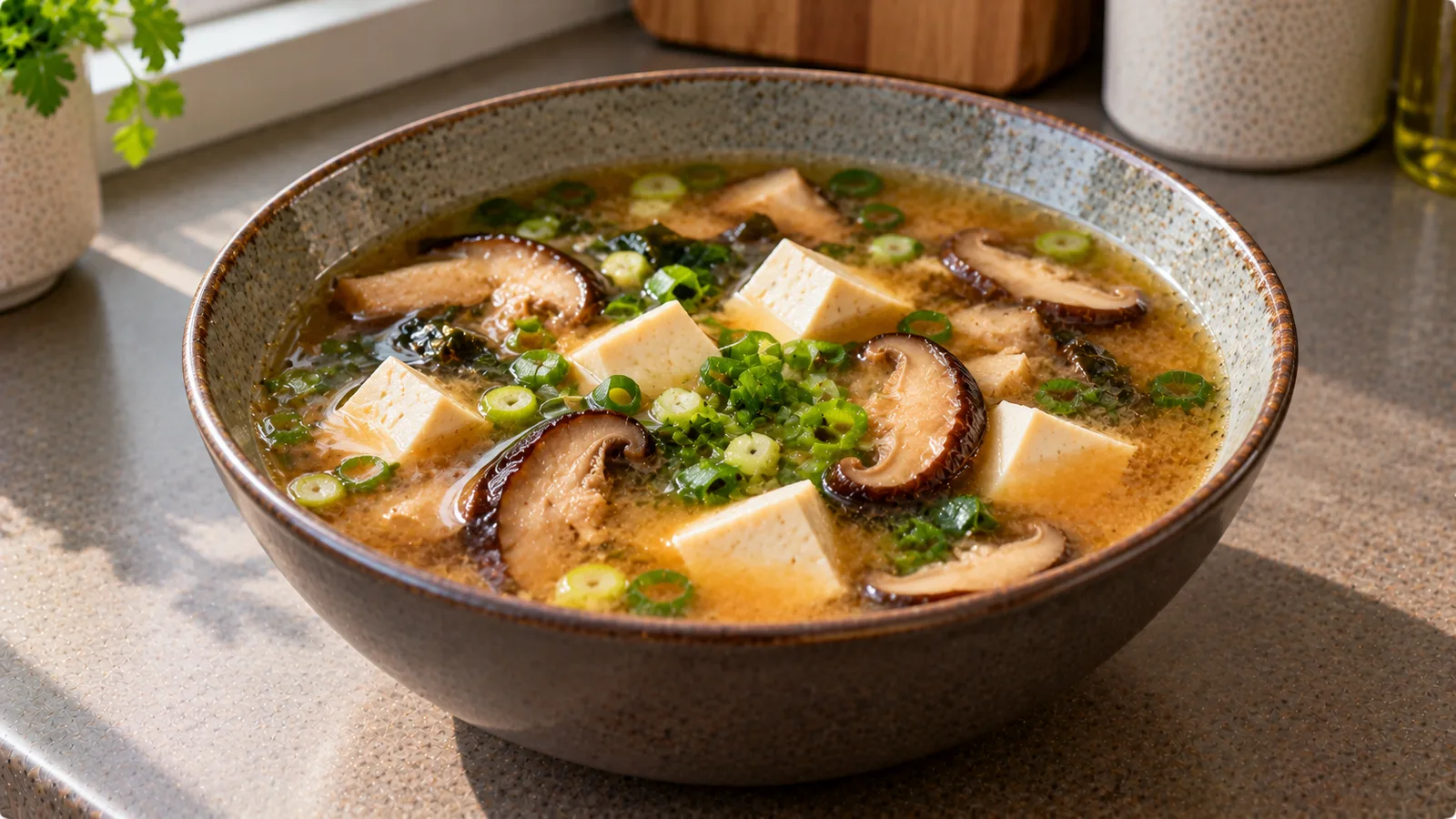
Mushroom and tofu miso soup is a savory Japanese-inspired soup made with mushrooms, tofu, miso paste, wakame seaweed and spring onions.
It is quick to prepare and works as a light meal, a starter or part of a larger dinner.
The mushrooms provide a substantial texture, the tofu contributes protein, and the miso gives the broth its characteristic fermented soybean flavor.
The most important technique is simple: dissolve the miso in warm broth near the end of cooking rather than boiling it vigorously for a long time.
This recipe makes four portions of approximately 400–450 ml, depending on evaporation and the final volume of the ingredients.
Recipe overview
| Detail | Amount |
|---|---|
| Servings | 4 |
| Preparation time | 10 minutes |
| Cooking time | 15–20 minutes |
| Total time | 25–30 minutes |
| Difficulty | Easy |
| Main ingredients | Mushrooms, tofu, miso |
| Cooking method | Stovetop |
| Serving style | Light soup or starter |
The recipe is intentionally specific about the quantity of miso, tofu and water so that the flavor and nutritional estimates can be reproduced.
Ingredients for four servings
| Ingredient | Quantity |
|---|---|
| Firm tofu, drained | 400 g |
| Shiitake mushrooms, fresh | 150 g |
| Button or cremini mushrooms | 200 g |
| White or yellow miso paste | 60 g |
| Water | 1,400 ml |
| Dried wakame seaweed | 5 g |
| Spring onions | 60 g |
| Fresh ginger | 10 g |
| Low-sodium soy sauce, optional | 10 ml |
The recipe does not require added cooking oil.
Choose plain tofu without a flavored marinade.
For the miso, white or yellow varieties produce a relatively mild soup. Red miso generally has a stronger flavor, so you may prefer to begin with a smaller quantity and adjust.
The soy sauce is optional because miso already contains substantial sodium.
Choosing mushrooms
A combination of shiitake and button or cremini mushrooms creates a broth with more depth than using only one type.
Shiitake contributes a pronounced savory flavor.
Button or cremini mushrooms are widely available and add body.
If fresh shiitake is unavailable, use 350 g of another suitable fresh mushroom variety.
The flavor will change, but the basic method remains the same.
Do not substitute 150 g dried shiitake for 150 g fresh shiitake: dried mushrooms are far more concentrated by weight and require rehydration.
Equipment
You need a medium or large saucepan, a knife, a chopping board, a ladle and a small bowl.
A fine-mesh strainer is useful for dissolving miso smoothly, but it is not essential.
Step 1: Prepare the ingredients
Drain the tofu and cut it into cubes approximately 1.5–2 cm wide.
Gently clean the mushrooms and remove any tough stems.
Slice the shiitake and button mushrooms into pieces of similar thickness.
Finely slice the spring onions, separating the white and green parts if desired.
Peel and finely grate or slice the ginger.
Measure the miso paste before cooking.
This prevents having to estimate the quantity while the soup is hot.
Step 2: Rehydrate the wakame
Place 5 g dried wakame in a bowl of cool water.
Let it soak according to the package instructions, generally for several minutes.
Drain thoroughly.
Wakame expands considerably after hydration, so the dry quantity may look small.
Use the package directions if they specify a different preparation method.
Do not use a large handful of dried seaweed without weighing it.
Seaweed can contain considerable and variable amounts of iodine.
Step 3: Build the mushroom broth
Pour 1,400 ml water into a saucepan.
Add the ginger and the white parts of the spring onions.
Bring to a gentle simmer.
Add the sliced shiitake and button mushrooms.
Simmer for approximately 8–10 minutes, until the mushrooms are tender and have flavored the liquid.
Avoid reducing the broth aggressively.
A gentle simmer is sufficient.
If too much water evaporates, add a small amount of hot water to restore the intended volume.
Step 4: Add the tofu and wakame
Add the cubed tofu and drained wakame.
Continue cooking gently for another 3–4 minutes, until the tofu is heated through.
Stir carefully to avoid breaking the tofu.
The soup should be hot, but vigorous boiling is unnecessary.
If you are using the optional soy sauce, add it at this stage.
Taste the broth before adding extra salt.
Step 5: Dissolve the miso separately
Turn the heat to low or temporarily remove the saucepan from the burner.
Place the 60 g miso paste in a small bowl.
Add approximately 100–150 ml hot broth from the saucepan.
Stir until the paste dissolves into a smooth liquid.
Pour this mixture back into the soup and stir gently.
Warm the soup briefly if necessary, but avoid prolonged vigorous boiling after the miso has been added.
This technique helps preserve the miso's aroma and avoids undissolved lumps.
It does not mean the soup must remain raw or that heating miso is inherently unsafe.
Step 6: Taste and serve
Taste the finished soup.
If the flavor is too strong, add a little hot water.
If it tastes too mild, dissolve a small additional amount of miso in a separate bowl of broth before adding it.
Remember that adding more miso also increases sodium.
Divide the soup into four bowls.
Garnish with the green parts of the spring onions.
Serve hot.
Estimated nutrition per serving
The estimates below are based on the ingredient quantities in this recipe and representative food composition data.
They are approximate planning values, not laboratory-tested results.
The calculation assumes:
- 400 g plain firm tofu.
- 350 g fresh mushrooms in total.
- 60 g miso paste.
- 5 g dried wakame.
- 60 g spring onions.
- 10 g ginger.
- No cooking oil.
- Four equal servings.
- Optional soy sauce excluded from the main estimate.
Nutrition estimate
| Nutrient | Whole recipe | Per serving |
|---|---|---|
| Calories | Approximately 680 kcal | Approximately 170 kcal |
| Protein | Approximately 61 g | Approximately 15 g |
| Fat | Approximately 33 g | Approximately 8 g |
| Carbohydrates | Approximately 39 g | Approximately 10 g |
| Fiber | Approximately 10 g | Approximately 2.5 g |
The exact values can vary substantially with the tofu.
Firm tofu products differ in water content and protein concentration. Some contain approximately 80 kcal per 100 g, while others provide considerably more.
The type of miso also affects energy, carbohydrate and sodium values.
For more accurate results, use the nutritional information on the actual tofu and miso packages.
Reference database: USDA FoodData Central.
Why tofu changes the nutrition so much
Tofu is made from soybeans, but products differ in firmness and moisture content.
Silken tofu is generally softer and often contains more water.
Firm tofu usually holds its shape better in soup.
Extra-firm tofu can be denser and may contain more protein per 100 g.
Two brands of firm tofu may therefore provide noticeably different calories and protein.
For accurate tracking, weigh the drained tofu and use its label.
Calories per bowl
If the entire recipe is divided equally into four bowls, each bowl contains approximately 170 kcal using the assumptions above.
The final liquid volume may vary because mushrooms release moisture and some water evaporates.
A bowl containing 450 ml is not necessarily more caloric than one containing 400 ml if both represent the same fraction of the recipe.
The most reliable approach is to divide the finished soup into four equal portions, including approximately equal amounts of tofu and mushrooms.
If you serve unequal portions, distribute the solid ingredients as evenly as possible or weigh the finished portions.
Is miso soup high in sodium?
Miso is a fermented soybean paste that typically contains substantial salt.
The sodium content varies by brand and type.
In this recipe, 60 g miso is distributed across four servings, giving 15 g miso per serving.
If your miso contains 4,000 mg sodium per 100 g, the miso alone would contribute:
15 × 40 = 600 mg sodium per serving.
This is an illustrative calculation, not a universal value for all miso products.
The tofu, mushrooms and any soy sauce may add additional sodium.
The World Health Organization recommends adults consume less than 2,000 mg sodium per day, equivalent to less than 5 g salt.
Source: WHO — Sodium reduction.
If sodium intake is a concern, choose a lower-sodium miso when available, omit soy sauce and use a measured amount of paste.
Do not assume that a soup is low in sodium simply because it contains vegetables.
What is miso paste?
Miso is a fermented paste commonly made from soybeans, salt and a fermentation culture, sometimes with rice or barley.
Its flavor depends on the ingredients, fermentation time and production method.
White miso often has a milder taste.
Red miso is frequently stronger and more robust.
However, color alone does not determine sodium content or nutrition.
Check the product label.
Is miso gluten-free?
Not always.
Some miso products contain barley or other gluten-containing ingredients.
Soy sauce may also contain wheat.
If you need to avoid gluten, choose products specifically labeled gluten-free and check all ingredients.
Is miso vegetarian?
Many miso pastes are plant-based.
However, prepared miso soup mixes and restaurant broths may contain fish-based dashi.
This recipe uses water and mushrooms rather than fish stock.
Check packaged ingredients if following a vegetarian or vegan diet.
Is tofu a good protein source?
Tofu contributes protein to the soup.
The amount depends on the specific product.
Using 400 g firm tofu across four portions gives approximately 100 g tofu per bowl.
A tofu product containing 12 g protein per 100 g would therefore provide approximately 12 g protein from tofu alone in each serving.
Mushrooms and miso contribute additional smaller amounts.
Soy is also a major food allergen.
Anyone with a soy allergy should avoid conventional soy tofu and soy-based miso unless advised otherwise by an appropriate healthcare professional.
Why add wakame?
Wakame is an edible seaweed that adds a delicate marine flavor and soft texture.
Only 5 g dried wakame is used in the complete recipe.
That is approximately 1.25 g dry seaweed per serving before hydration.
Seaweed iodine levels can vary greatly by species, growing conditions and product.
Excess iodine intake can be a concern, particularly for people with thyroid conditions.
For this reason, follow package directions and avoid increasing the amount substantially without considering the product's iodine content.
The European Food Safety Authority has evaluated tolerable upper intake levels for iodine.
Reference: EFSA — Dietary Reference Values.
How to prevent cloudy or gritty miso soup
Miso paste contains fine particles that may remain suspended in the broth.
Some cloudiness is normal.
However, large undissolved lumps can make the soup unevenly salty.
To prevent them:
- Measure the miso before adding it.
- Place it in a small bowl.
- Mix with a little hot broth until smooth.
- Return the mixture to the saucepan.
- Stir gently.
A small strainer can also be used.
Avoid dropping a large block of miso directly into a boiling saucepan and expecting it to dissolve evenly.
Can you use silken tofu?
Yes.
Silken tofu creates a softer, more delicate soup.
Cut it into larger pieces and handle gently.
Add it toward the end of cooking to reduce breakage.
The nutrition estimate must be recalculated using the actual product.
Silken tofu and firm tofu are not nutritionally interchangeable on a gram-for-gram basis.
Can you use dried mushrooms?
Yes, but the method changes.
Rehydrate dried mushrooms according to the package instructions.
Drain them and slice if necessary.
If using the soaking liquid, strain it carefully to remove grit and ensure it has been handled safely.
Dried mushrooms are concentrated by weight, so do not substitute them for fresh mushrooms in equal gram quantities.
Use a recipe-specific amount and recalculate the nutrition.
Flavor variations
With spinach
Add approximately 100 g fresh spinach during the final minutes of cooking.
Allow it to wilt before adding the miso.
With napa cabbage
Add 150 g thinly sliced napa cabbage with the mushrooms.
Simmer until tender.
With carrots
Add 100 g thinly sliced carrots before the mushrooms or at the same time, depending on thickness.
They may require additional cooking time.
With noodles
Add cooked noodles to make a more substantial meal.
Measure the noodles separately and include them in the calorie calculation.
With rice
Serve the soup alongside a measured portion of cooked rice.
The rice is not included in the soup's estimated nutrition.
With chili
Add a small amount of chili flakes or fresh chili for heat.
This changes the flavor without requiring a different basic cooking method.
What to serve with mushroom tofu miso soup
The soup can be eaten alone as a light meal or starter.
For a larger meal, consider pairing it with:
- Steamed rice.
- A vegetable side dish.
- A simple salad.
- Noodles.
- Another protein-containing dish if your meal requires more protein.
The soup itself provides a moderate amount of protein, but its approximately 170 kcal per serving may be insufficient as a complete meal for many adults.
The appropriate meal size depends on individual needs and what else is eaten during the day.
Preparing the soup ahead
You can prepare the mushroom broth in advance.
For the best texture, store the broth and tofu appropriately and add miso close to serving.
However, fully assembled miso soup can also be refrigerated.
Cool the soup promptly after cooking and place it in shallow, covered containers.
Refrigerate at a safe temperature.
USDA guidance recommends using most cooked leftovers within 3–4 days.
Source: USDA — Leftovers and Food Safety.
Reheating
Reheat leftovers thoroughly.
USDA guidance recommends reheating leftovers to 74°C / 165°F.
Once safely heated, avoid keeping the soup at a vigorous boil for an extended period.
The miso flavor may become less delicate after repeated heating.
Freezing
Freezing is possible, but tofu may change texture after thawing.
It can become more porous and spongy.
For the best consistency, freeze the mushroom broth separately and add fresh tofu and miso when preparing the soup.
Common cooking questions
Can I make miso soup without dashi?
Yes.
This recipe uses mushrooms, ginger and water to build a savory broth.
It does not require fish-based dashi.
Can I use vegetable stock?
Yes.
Choose a low-sodium stock because miso already contributes salt.
If using stock, update the sodium calculation based on the product label.
How much miso should I use per serving?
This recipe uses 15 g miso per serving.
You can adjust the amount to taste, but the sodium and calorie totals will change.
Why should miso be added near the end?
Adding it near the end helps maintain its characteristic aroma and makes it easier to control the final flavor.
It also prevents prolonged vigorous boiling after the paste has been incorporated.
Can I omit wakame?
Yes.
The soup will have a slightly different flavor and texture.
Omitting wakame also changes the iodine contribution.
Can I use only one mushroom variety?
Yes.
Use approximately 350 g fresh mushrooms in total.
The flavor may be less complex, but the recipe will still work.
Recipe checklist
Before serving:
- The tofu is cut into evenly sized cubes.
- The mushrooms are tender.
- The wakame has been prepared according to its package.
- The miso has been measured and dissolved smoothly.
- The broth has been tasted before adding extra salt.
- The soup is divided into four portions if using the estimated nutrition.
- Any noodles, rice or other additions are tracked separately.
This method produces a straightforward mushroom and tofu miso soup with clearly measured ingredients, a savory broth and a practical basis for calculating nutrition.
Sources
- USDA FoodData Central — representative ingredient nutrient values.
- WHO — Sodium reduction — recommended sodium intake.
- EFSA — Dietary Reference Values — nutrient reference information, including iodine.
- USDA — Leftovers and Food Safety — safe storage and reheating of cooked leftovers.
Nutritional values are estimates. Product-specific tofu, miso and seaweed labels should be used whenever available.