
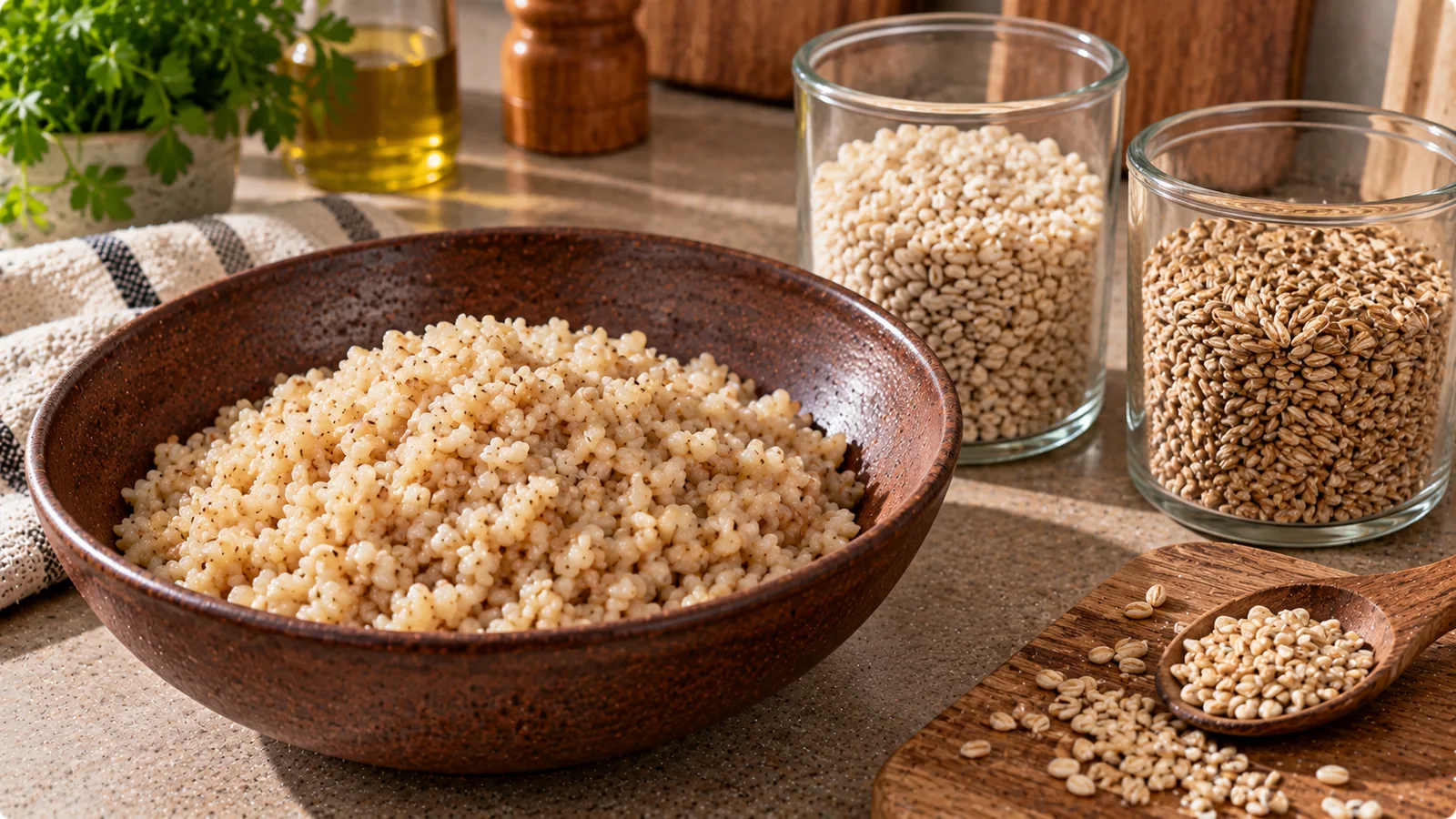
Barley is a versatile cereal grain used in soups, grain bowls, salads, stews and traditional side dishes. It provides carbohydrates, some protein and dietary fiber.
But the calorie content of barley can look surprisingly different depending on whether the grain is weighed dry or after cooking.
Cooked pearl barley contains approximately 123 calories per 100 g, while dry pearled barley contains around 352 calories per 100 g.
Both figures are reasonable reference values for plain barley. The large difference is mainly caused by water absorbed during cooking.
Barley calories at a glance
| Barley form | Calories |
|---|---|
| Dry pearled barley, 100 g | About 352 kcal |
| Cooked pearl barley, 100 g | About 123 kcal |
| Cooked pearl barley, 150 g | About 185 kcal |
| Cooked pearl barley, 200 g | About 246 kcal |
| Dry pearled barley, 50 g | About 176 kcal |
| Dry pearled barley, 75 g | About 264 kcal |
These are approximate values based on standard food-composition data. Different barley varieties, processing methods and cooking yields can change the numbers.
The values refer to plain barley without oil, butter, cream or sauce.
How many calories are in 100 g of cooked barley?
A reference value for cooked pearl barley is approximately 123 kcal per 100 g.
A typical nutritional profile per 100 g of cooked pearl barley is:
| Nutrient | Approximate amount |
|---|---|
| Energy | 123 kcal |
| Carbohydrates | 28.2 g |
| Protein | 2.3 g |
| Fat | 0.4 g |
| Fiber | 3.8 g |
Values are rounded and can vary with cooking water, barley type and database methodology.
Cooked barley is primarily a carbohydrate source. It also contributes fiber, although the amount depends on how the grain was processed.
How many calories are in dry barley?
Dry pearled barley provides approximately 352 kcal per 100 g.
Its reference nutritional composition is roughly:
| Nutrient | Per 100 g dry pearled barley |
|---|---|
| Energy | 352 kcal |
| Carbohydrates | 77.7 g |
| Protein | 9.9 g |
| Fat | 1.2 g |
| Fiber | 15.6 g |
Dry barley is energy-dense because it contains very little water compared with the cooked grain.
The values do not mean that barley loses most of its calories during cooking.
Cooking mainly changes the grain's weight through water absorption.
Why does cooked barley have fewer calories per 100 g?
Imagine starting with 75 g of dry pearled barley.
At approximately 352 kcal per 100 g, that dry portion provides:
75 × 352 ÷ 100 = 264 kcal.
During cooking, the barley absorbs water and becomes heavier.
If the cooked yield is 215 g, the entire cooked portion still contains approximately 264 kcal, assuming no meaningful calorie-containing ingredients were added or lost.
Its calculated energy density is then:
264 ÷ 215 × 100 = approximately 123 kcal per 100 g.
The calories are distributed across a larger weight.
Actual cooking yield depends on the grain and preparation method, so 215 g is an illustrative yield rather than a guaranteed result.
Calories by cooked portion size
Using the reference value of 123 kcal per 100 g:
| Cooked portion | Approximate calories |
|---|---|
| 50 g | 62 kcal |
| 100 g | 123 kcal |
| 125 g | 154 kcal |
| 150 g | 185 kcal |
| 175 g | 215 kcal |
| 200 g | 246 kcal |
| 250 g | 308 kcal |
| 300 g | 369 kcal |
A smaller serving may work as an ingredient in soup or salad.
A larger portion can serve as the main grain component of a meal.
The appropriate amount depends on the rest of the meal, energy needs and personal preferences.
Pearl barley vs hulled barley
Barley is sold in several forms.
Pearl barley
Pearl barley has been polished to remove the outer hull and some or much of the bran.
It generally cooks faster than hulled barley and has a softer texture.
Its fiber content may be lower than that of less processed barley.
Hulled barley
Hulled barley has had the inedible outer hull removed while retaining more of the grain's bran and germ.
It usually requires longer cooking.
Its nutrient profile can differ from pearl barley, so a database entry for cooked pearl barley should not automatically be used for every barley product.
Barley flakes and barley flour
Barley flakes and flour have different preparation methods and typical serving sizes.
Use the specific product's nutrition label or a matching food-composition entry.
Does barley contain a lot of carbohydrates?
Yes. Barley is a cereal grain and carbohydrates are its main macronutrient.
Cooked pearl barley contains roughly 28 g of total carbohydrate per 100 g in common US food-composition data.
A 150 g serving therefore provides approximately 42 g of carbohydrate.
A 200 g serving provides approximately 56 g.
These estimates use the same cooked-barley reference entry.
Be careful when comparing US and EU nutrition information: US total carbohydrate commonly includes dietary fiber, while EU carbohydrate declarations generally exclude fiber.
For consistent tracking, use one clearly defined data source rather than combining carbohydrate figures from different systems.
How much protein is in barley?
Cooked pearl barley provides approximately 2.3 g of protein per 100 g.
That means:
- 100 g cooked: about 2.3 g protein.
- 150 g cooked: about 3.5 g protein.
- 200 g cooked: about 4.5 g protein.
Barley contributes protein, but it is not particularly protein-dense compared with eggs, fish, poultry, tofu or legumes.
For a more protein-rich meal, combine barley with beans, lentils, yogurt-based sauces, tofu, fish or meat according to your preferences.
What about fiber?
Barley contains dietary fiber, including beta-glucans.
Beta-glucans are soluble fibers also found in oats.
Their amounts depend on the barley variety, processing and preparation.
Pearled barley typically retains some fiber, while less processed barley may provide more.
Do not assume that every barley product contains the same beta-glucan quantity.
Specific health claims concerning beta-glucans are subject to regulatory conditions, including minimum amounts and required wording.
Is barley good for weight management?
Barley can fit into a weight-management diet.
Its usefulness depends on portion size, preparation and the complete meal.
Plain cooked barley has a lower energy density than dry barley because it contains absorbed water.
Fiber-containing grain dishes may help make meals satisfying, particularly when combined with vegetables and adequate protein.
However, barley does not cause weight loss by itself.
A large portion with generous amounts of oil, butter or cheese can contain substantially more calories than plain cooked barley.
Calories in barley with common additions
Barley is often prepared with other ingredients.
Here are illustrative calorie additions:
| Addition | Approximate extra calories |
|---|---|
| Olive oil, 1 teaspoon (5 g) | 44 kcal |
| Olive oil, 1 tablespoon (15 g) | 133 kcal |
| Butter, 10 g | 72 kcal |
| Parmesan, 15 g | 65 kcal |
| Cooked mushrooms, 100 g | Around 28 kcal |
These are approximate ingredient values, not complete recipe calculations.
For example, 200 g of plain cooked barley provides about 246 kcal.
Adding 15 g of olive oil raises the estimated total to approximately 379 kcal before accounting for other ingredients.
When tracking a prepared barley dish, include all calorie-containing additions.
Barley in soup: how should calories be calculated?
Barley soup can be difficult to log because the grain absorbs liquid and the finished dish contains multiple ingredients.
The most reliable approach is to calculate the recipe.
For example:
- 100 g dry pearl barley: approximately 352 kcal.
- 200 g carrots: approximately 82 kcal.
- 150 g onions: approximately 60 kcal.
- 10 g olive oil: approximately 88 kcal.
- Water, herbs and other ingredients: account for their actual contributions.
These example ingredients total approximately 582 kcal before any additional ingredients.
If the completed soup weighs 1,600 g, its estimated energy density is:
582 ÷ 1,600 × 100 = approximately 36 kcal per 100 g.
A 400 g serving would provide approximately 146 kcal.
This is only an illustrative calculation. A real soup may contain stock, meat, beans or other ingredients that change the result.
Use the actual cooked yield and complete ingredient list.
How to log barley accurately in a calorie tracker
Method 1: Weigh the barley dry
This is usually the simplest method when cooking a measured quantity.
- Weigh dry barley before cooking.
- Select a matching dry-barley entry.
- Record the dry amount.
- If preparing multiple portions, divide the total recipe calories among the portions.
This avoids uncertainty about water absorption.
Method 2: Weigh the barley after cooking
If you only know the cooked weight:
- Select a cooked-barley database entry.
- Check whether it describes pearl barley or another form.
- Weigh the plain cooked portion.
- Add sauces, fats and other ingredients separately.
Never enter 200 g of cooked barley using a dry-barley value.
That would substantially overestimate calories.
Method 3: Calculate the cooked batch yield
For the most consistent home-cooking record:
- Weigh the total dry barley.
- Cook it in water.
- Weigh the entire cooked batch.
- Divide the total dry-barley calories by the final cooked weight.
- Use that calculated value for each cooked serving.
Example:
80 g dry barley × 352 ÷ 100 = 281.6 kcal.
If the batch weighs 240 g after cooking:
281.6 ÷ 240 × 100 = approximately 117 kcal per 100 g.
This differs from the generic 123 kcal reference because the batch absorbed a different amount of water.
Does cooking barley in broth change its calories?
It can.
Water adds no calories, but broth may contain small amounts of energy from fat, protein or carbohydrate.
Rich stocks, butter, oil and cream can contribute more.
If the cooking liquid is absorbed, include its relevant nutrient contribution in the recipe.
If some liquid is discarded, the final calculation becomes less exact.
For ordinary meal tracking, using the complete recipe ingredients and final cooked weight is a practical method.
Is barley gluten-free?
No.
Barley contains gluten and is not suitable for people with celiac disease.
Barley malt and some products containing barley-derived ingredients may also be unsuitable.
Anyone who must avoid gluten for medical reasons should choose appropriately labeled gluten-free alternatives and follow clinical guidance.
Rice, quinoa and certified gluten-free buckwheat are possible alternatives, depending on individual needs.
Frequently asked questions
How many calories are in 100 g of barley?
Approximately 123 kcal for plain cooked pearl barley or 352 kcal for dry pearled barley, depending on the form.
How many calories are in 200 g of cooked barley?
Approximately 246 kcal, using the reference value of 123 kcal per 100 g.
Does boiling barley remove calories?
Boiling mainly adds water and increases weight. It does not remove most of the grain's energy.
Is barley higher in calories than rice?
The comparison depends on the type of rice, barley processing and cooking water absorbed. Compare cooked with cooked or dry with dry using matching reference entries.
Is barley a protein food?
It contains some protein but is primarily a carbohydrate-rich cereal grain.
Can I eat barley every day?
Barley can be part of a varied diet if it suits your nutritional needs and you do not need to avoid gluten. Variety across grains and other food groups remains useful.
Sources and data notes
- USDA FoodData Central — standard reference food-composition data for raw and cooked barley.
- USDA MyPlate: Grains — guidance on grain foods.
- Celiac Disease Foundation: Gluten Sources — barley as a gluten-containing grain.
- EU Regulation No 1169/2011 — EU nutrition labeling conventions.
All nutrition figures are approximate and rounded. Specific products and cooking methods can differ.
The bottom line
For everyday tracking, remember the distinction:
100 g cooked pearl barley: approximately 123 kcal.
100 g dry pearled barley: approximately 352 kcal.
The difference comes mainly from water absorption.
Weigh barley in the same state as the database entry, account for added fats and sauces, and use your own cooked-batch yield when greater precision is needed.