
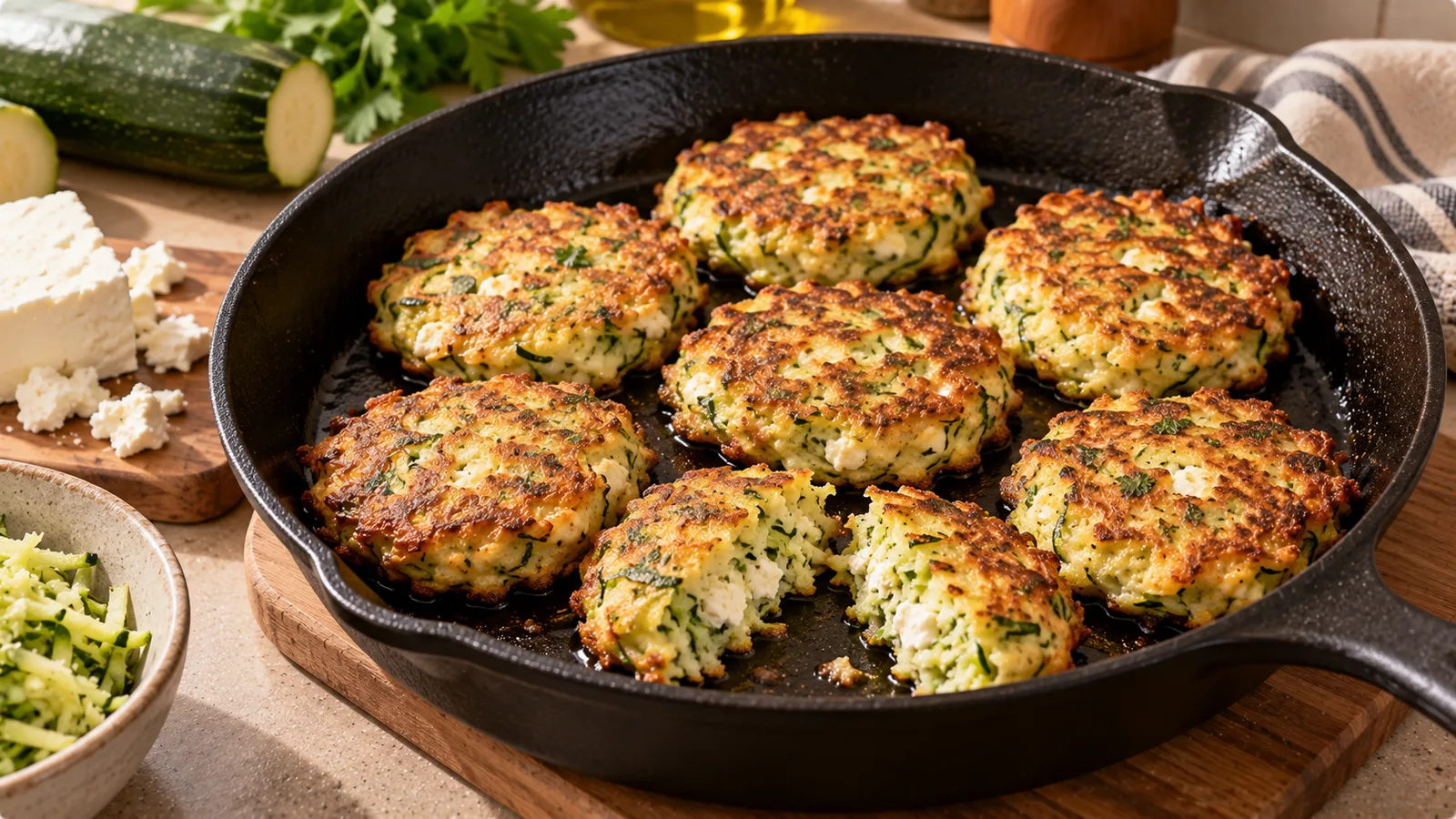
These zucchini and feta fritters have golden edges, a tender center and a savory flavor from feta, herbs and garlic. They work as a light main course, a side dish or a make-ahead lunch.
The most important step is removing excess water from the zucchini before mixing the batter. Without it, the mixture becomes loose and the fritters tend to steam rather than brown.
This recipe makes approximately 12 medium fritters, or four servings of three fritters each.
Recipe at a glance
| Detail | Amount |
|---|---|
| Preparation time | 20 minutes |
| Resting and draining | 10 minutes |
| Cooking time | 15–20 minutes |
| Total time | Approximately 45–50 minutes |
| Yield | 12 medium fritters |
| Servings | 4 |
| Cooking method | Pan-frying |
| Difficulty | Easy |
Cooking time depends on pan size and how many batches you prepare.
Ingredients
For approximately 12 fritters:
| Ingredient | Quantity |
|---|---|
| Zucchini, before trimming | 600 g |
| Feta cheese | 150 g |
| Large eggs | 2 |
| Plain wheat flour | 70 g |
| Fresh dill or parsley, chopped | 15 g |
| Garlic | 2 cloves, approximately 6 g |
| Fine salt for draining | 1/2 teaspoon, approximately 3 g |
| Black pepper | 1/4 teaspoon |
| Olive oil for frying | 30 g measured into the pan |
Optional for serving: plain Greek yogurt, lemon wedges or a simple cucumber salad. These accompaniments are not included in the nutrition estimate.
Use ordinary fresh zucchini. There is no need to peel it unless the skin is damaged or unusually tough.
Feta is already salty, so the draining salt should not automatically be replaced with additional salt in the batter.
Step 1: Grate and drain the zucchini
Wash the zucchini, trim the ends and grate it using the coarse side of a box grater.
Place the grated zucchini in a colander and toss it with approximately half a teaspoon of salt.
Leave it for 10 minutes. The salt helps draw moisture from the shredded vegetable.
Transfer the zucchini to a clean kitchen towel or several layers of sturdy cheesecloth.
Gather the cloth and squeeze firmly over the sink until very little liquid comes out.
This step is essential. A watery mixture needs more flour, and excess flour can make the finished fritters heavy.
The exact drained weight varies with zucchini size, freshness and how firmly you squeeze.
For this recipe, expect approximately 400–450 grams of squeezed zucchini from 600 grams before trimming, but treat that as a working estimate rather than a guaranteed yield.
Step 2: Prepare the fritter mixture
Crumble the feta into a large mixing bowl.
Add the squeezed zucchini, two eggs, chopped herbs, finely minced garlic and black pepper.
Stir until the ingredients are evenly distributed.
Add the flour and mix gently until no dry patches remain.
The mixture should hold together when lifted with a spoon. It does not need to be perfectly smooth.
If it releases visible liquid after mixing, squeeze the zucchini more thoroughly next time. For the current batch, add flour in small increments of approximately 5 grams only if necessary.
Adding too much flour changes the texture and increases the calories.
Step 3: Shape the portions
Divide the mixture into 12 approximately equal portions.
A kitchen scale is useful if you want consistent cooking times and a more reliable nutrition estimate per fritter.
Shape each portion into a small patty approximately 1.5 centimeters thick.
Avoid making very thick fritters: the outside may brown before the middle cooks through.
The patties can be shaped directly with a spoon as they enter the pan, provided the mixture is firm enough.
Step 4: Pan-fry until golden
Heat a large nonstick or well-seasoned frying pan over medium heat.
Measure the olive oil before cooking. Use it across the batches rather than pouring an unknown amount into the pan each time.
Add several fritters, leaving enough space to turn them.
Cook for approximately 3–4 minutes on the first side, until the underside is golden and the edges look set.
Turn carefully and cook for another 3–4 minutes.
Adjust the heat if the surface browns too quickly.
The centers should be set, not wet or visibly raw. Because the batter contains eggs, cook the fritters thoroughly; a food thermometer reading of 74°C in the center is a conservative safety target for this mixed egg dish.
Transfer the cooked fritters to a plate lined with kitchen paper or a wire rack.
Repeat with the remaining mixture.
How to keep the fritters crisp
Three decisions have the greatest effect on texture.
First, remove enough water from the zucchini. Draining makes a larger difference than simply increasing the flour.
Second, use medium heat. Very high heat can darken the outside while leaving the center soft.
Third, avoid crowding the pan. A crowded pan loses heat and traps moisture.
For the crispest result, serve the fritters shortly after cooking.
A yogurt sauce can be served on the side instead of poured over the fritters, helping preserve their surface texture.
Estimated calories and macronutrients
Nutrition depends on the feta brand, egg size, flour and the amount of frying oil retained by the food.
The following calculation uses approximate ingredient values and assumes all 30 grams of measured olive oil are included in the finished dish. This is a conservative accounting assumption; some oil may remain in the pan.
| Ingredient | Quantity | Estimated calories |
|---|---|---|
| Zucchini | 600 g before draining | 102 kcal |
| Feta | 150 g | 398 kcal |
| Eggs | 2 large | 144 kcal |
| Wheat flour | 70 g | 255 kcal |
| Olive oil | 30 g | 265 kcal |
| Herbs and garlic | 21 g | Approximately 15 kcal |
| Whole recipe | 12 fritters | Approximately 1,179 kcal |
Using these assumptions:
| Portion | Calories | Protein | Fat | Carbohydrates |
|---|---|---|---|---|
| 1 fritter | Approximately 98 kcal | 4.2 g | 6.5 g | 5.7 g |
| 3 fritters | Approximately 295 kcal | 12.6 g | 19.5 g | 17.1 g |
| Whole recipe | Approximately 1,179 kcal | 50 g | 78 g | 68 g |
Macronutrients are rounded estimates based on generic food-composition data, not laboratory analysis.
Draining removes water and some dissolved substances, so the precise finished composition may differ. The table is intended for practical recipe logging rather than exact nutrient certification.
If you use less oil or some remains in the pan, the actual calories may be lower. If you add more flour, cheese or sauce, the totals increase.
Serving ideas
Three fritters make a useful starting portion for a light meal.
For a more substantial plate, combine them with a protein-rich yogurt dip and a fresh vegetable salad.
They also work beside roasted chicken, lentils or a grain-based salad.
If you serve them with yogurt, count the yogurt separately when tracking nutrition.
Lemon juice adds acidity without significantly changing the recipe's calorie total.
Can you bake the fritters instead?
Yes, although the texture will be different from pan-fried fritters.
Preheat the oven to 210°C conventional heat, or approximately 190°C fan.
Place the shaped fritters on a lined baking tray and lightly brush or spray them with a measured amount of oil.
Bake for approximately 18–25 minutes, turning halfway through, until browned and fully cooked.
Oven performance and fritter thickness affect the cooking time.
Baking can reduce oil use if you actually use less oil. It does not automatically make the dish lower in calories if the same quantity of oil is added.
Common recipe adjustments
For a stronger herb flavor, increase the dill or parsley without changing the basic batter structure.
For a brighter taste, add a little finely grated lemon zest.
If using a particularly wet zucchini, prioritize squeezing rather than adding large quantities of flour.
For a gluten-free version, use a suitable gluten-free flour blend. Different blends absorb moisture differently, so start with a similar weight and adjust gradually.
Do not assume that every flour substitution will produce identical binding or browning.
For a milder flavor, replace part of the feta with another suitable cheese, but recalculate the nutrition because fat, protein and sodium can change substantially.
Storage and reheating
Cool cooked fritters promptly and refrigerate them in a covered container.
Use within 3–4 days when handled and stored safely at 4°C or colder.
Reheat in a skillet, oven or air fryer until thoroughly hot throughout. Reheating in a microwave is possible but usually produces a softer texture.
For longer storage, freeze cooled fritters in a single layer before transferring them to a freezer-safe container.
Frozen fritters are best reheated in an oven or air fryer for a firmer exterior.
Do not leave cooked fritters at room temperature for extended periods.
Recipe troubleshooting
| Problem | Likely cause | Practical fix |
|---|---|---|
| Mixture falls apart | Excess water or insufficient binding | Squeeze zucchini thoroughly and measure eggs and flour |
| Fritters are soggy | Wet zucchini or crowded pan | Drain more and cook in smaller batches |
| Outside burns | Pan too hot | Reduce to medium heat |
| Fritters are dense | Too much flour | Add flour gradually and avoid overmixing |
| Fritters taste too salty | Feta plus additional salt | Use salt primarily for draining and taste before adding more |
The key to this recipe is controlling moisture rather than compensating for it with a large amount of flour.
Sources and nutrition notes
- USDA FoodData Central — reference food-composition data used for ingredient-based nutrition estimates.
- USDA Food Safety and Inspection Service: Leftovers and Food Safety — general guidance on cooling, refrigerating and reheating leftovers.
- US FDA: Safe Food Handling — guidance on cooking and storing perishable foods.
Ingredient weights, yield and nutrition estimates are specific to this recipe. Actual results vary with the ingredients, the amount of oil retained, portion sizes and cooking conditions.