
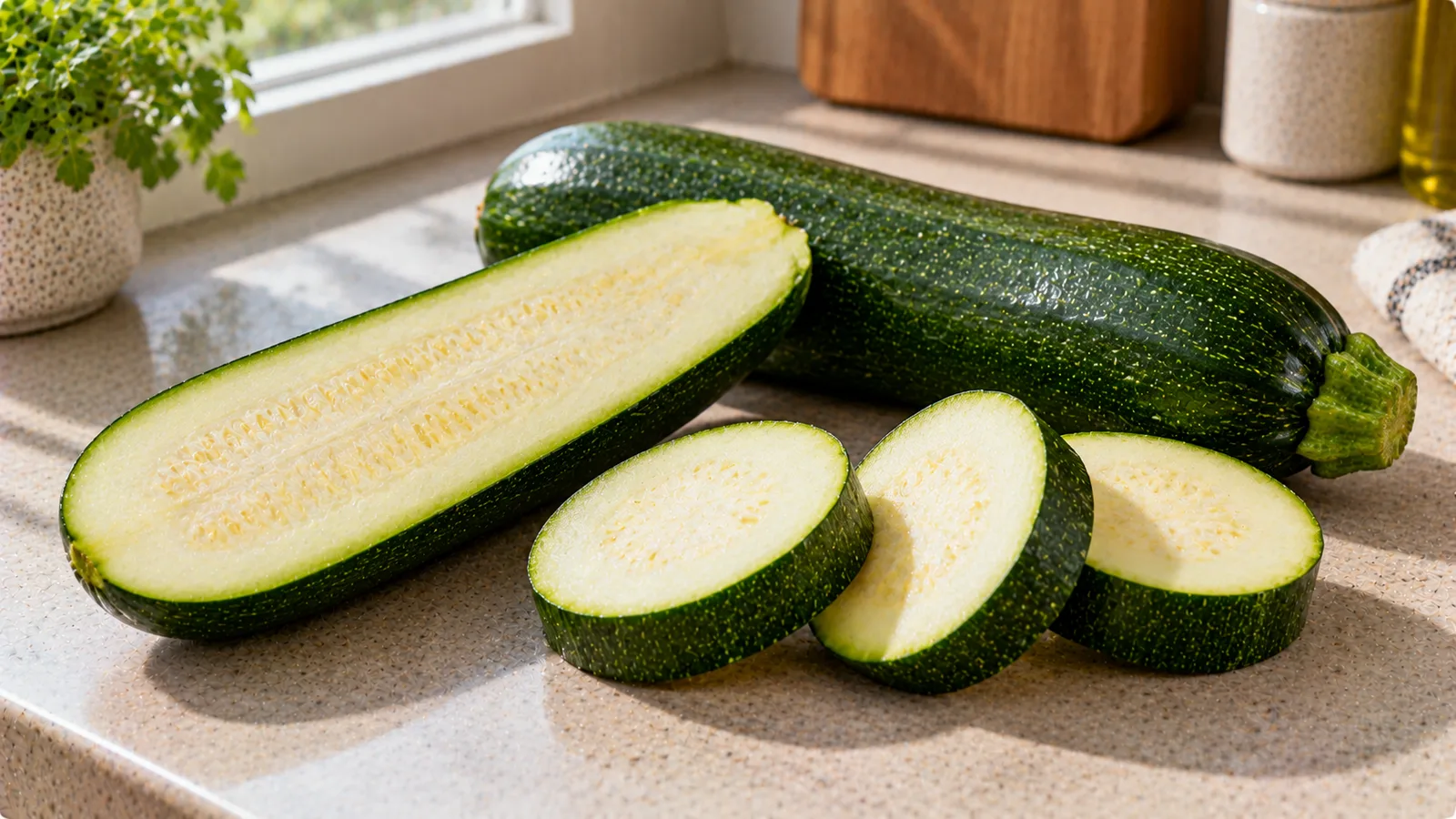
Zucchini is a low-calorie vegetable that can be eaten raw, steamed, boiled, grilled, roasted or sautéed. Its calorie content is relatively simple to estimate when you know the weight of the edible vegetable. The calculation becomes more complicated when oil, cheese, sauces or other ingredients are added.
Raw zucchini with its skin contains approximately 17 kcal per 100 g, according to a commonly used USDA food composition reference. A 200 g edible portion therefore provides approximately 34 kcal before adding other ingredients.
This article focuses on the calories and nutritional composition of zucchini itself, the difference between raw and plain cooked portions, and how to calculate realistic values for everyday meals.
How many calories are in zucchini?
The following table uses approximately 17 kcal per 100 g of raw zucchini, including the skin.
| Raw zucchini, edible weight | Approximate calories |
|---|---|
| 50 g | 9 kcal |
| 100 g | 17 kcal |
| 150 g | 26 kcal |
| 200 g | 34 kcal |
| 250 g | 43 kcal |
| 300 g | 51 kcal |
| 400 g | 68 kcal |
| 500 g | 85 kcal |
Values are rounded. They apply to the edible zucchini, not a prepared dish containing additional ingredients.
For example, 250 g of raw zucchini provides approximately 42.5 kcal, rounded to 43 kcal.
A larger portion remains relatively low in calories because zucchini contains a high proportion of water.
Reference: USDA FoodData Central, zucchini, raw, includes skin.
Zucchini nutrition per 100 g
A commonly used USDA reference for raw zucchini with skin gives the following approximate composition.
| Nutrient | Per 100 g raw zucchini |
|---|---|
| Energy | 17 kcal |
| Protein | 1.21 g |
| Total fat | 0.32 g |
| Total carbohydrate, US definition | 3.11 g |
| Dietary fiber | 1.0 g |
| Total sugars | 2.5 g |
| Water | 94.8 g |
| Potassium | 261 mg |
| Vitamin C | 17.9 mg |
These are reference values, not guaranteed measurements for every zucchini.
Cultivar, growing conditions, maturity and food composition methodology can influence the results.
Why carbohydrate values may differ between databases
USDA's total carbohydrate value generally includes dietary fiber.
European nutrition labels ordinarily report available carbohydrate separately from fiber.
For this reference zucchini, subtracting approximately 1.0 g fiber from 3.11 g total carbohydrate gives an indicative value of about 2.1 g available carbohydrate per 100 g.
This subtraction is a simplified comparison, not a replacement for a laboratory measurement using European analytical methods.
When entering zucchini in a tracking app, avoid adding fiber to carbohydrate a second time if the database already includes it.
References: USDA FoodData Central and Regulation (EU) No 1169/2011.
Calories in one whole zucchini
Zucchini varies considerably in size. A small zucchini and a large garden-grown zucchini cannot be assigned the same calorie value.
The most accurate approach is to weigh the edible vegetable.
For a quick estimate, consider these illustrative weights:
| Example zucchini size | Edible weight | Approximate calories |
|---|---|---|
| Small | 120 g | 20 kcal |
| Medium | 200 g | 34 kcal |
| Large | 300 g | 51 kcal |
| Very large | 450 g | 77 kcal |
These are example weights, not official size categories.
A supermarket zucchini weighing 240 g would contain approximately 41 kcal if all 240 g were edible.
If the ends are removed, the edible weight may be slightly lower.
Should you weigh zucchini before or after trimming?
For the raw reference, use the weight of the part you actually eat.
The skin is normally edible and included in the raw reference.
If you discard the ends, subtract their weight.
If you peel the zucchini, the nutritional composition may differ slightly from the reference for zucchini with skin.
For ordinary home cooking, weighing the prepared edible zucchini before cooking provides a practical starting point.
Raw versus cooked zucchini: do calories change?
Cooking does not create calories in zucchini. However, cooking changes water content and therefore the calories measured per 100 g of the finished vegetable.
The key distinction is between:
- The total calories in the zucchini you started with.
- The calories per 100 g after its weight changes during cooking.
If you cook 300 g of raw zucchini without adding caloric ingredients, the starting vegetable contains approximately 51 kcal.
If it loses water and weighs 240 g after cooking, those approximately 51 kcal are now distributed across 240 g rather than 300 g, assuming negligible loss of energy-containing solids.
That gives approximately 21 kcal per 100 g of the cooked portion.
This is an illustrative mass-balance calculation, not a universal nutrient value for all cooked zucchini.
Example: zucchini loses water in the oven
| Measurement | Amount |
|---|---|
| Raw edible zucchini | 300 g |
| Estimated starting calories | 51 kcal |
| Finished weight after cooking | 210 g |
| Estimated calories remaining | About 51 kcal |
| Calories per 100 g finished | About 24 kcal |
The calculation is 51 ÷ 210 × 100 = approximately 24 kcal per 100 g.
In reality, some solids and juices may be lost during preparation. That can change the total slightly.
The important lesson is that a higher value per 100 g cooked zucchini does not necessarily mean that cooking added energy.
Calories in boiled or steamed zucchini
Boiled and steamed zucchini usually requires no added fat.
When prepared without oil, butter or calorie-containing sauces, the total energy remains close to the energy supplied by the original vegetable, allowing for losses during cooking.
Water uptake or loss can alter the finished weight.
For example, 200 g of raw zucchini contains approximately 34 kcal.
If the finished edible portion weighs 190 g, a rough mass-balance estimate is still approximately 34 kcal for the portion, assuming minimal losses.
For more accurate tracking, use a food composition entry matching the actual cooked preparation when available.
Do not automatically assume that 100 g of boiled zucchini has exactly the same composition as 100 g of raw zucchini.
Calories in roasted zucchini
Roasting zucchini without oil mainly changes its moisture content.
Roasting zucchini with oil adds energy from the oil.
This is often the largest difference between a plain zucchini portion and a prepared roasted zucchini dish.
Example: 300 g zucchini roasted without oil
Starting zucchini:
300 × 17 ÷ 100 = 51 kcal.
Even if the zucchini becomes lighter as water evaporates, the vegetable's starting energy is approximately 51 kcal.
Example: 300 g zucchini with 10 g olive oil
Using approximately 884 kcal per 100 g olive oil:
- Zucchini: 51 kcal.
- Olive oil: approximately 88 kcal.
- Combined: approximately 139 kcal.
This calculation assumes the full 10 g of oil is consumed with the dish.
If some oil remains on the baking tray, the actual consumed amount may be lower.
Example: 300 g zucchini with 20 g olive oil
- Zucchini: 51 kcal.
- Olive oil: approximately 177 kcal.
- Combined: approximately 228 kcal.
The oil adds substantially more energy than the zucchini itself.
Oil energy reference: USDA FoodData Central.
Calories in sautéed zucchini
Pan-fried or sautéed zucchini can be a relatively light side dish, but the amount of fat matters.
A nonstick pan with a small measured quantity of oil can produce a very different calorie total from a pan containing several tablespoons.
Consider 250 g raw zucchini:
| Preparation | Approximate total calories |
|---|---|
| Plain zucchini, no added oil | 43 kcal |
| With 5 g olive oil | 87 kcal |
| With 10 g olive oil | 131 kcal |
| With 15 g olive oil | 175 kcal |
These totals assume all added oil is consumed.
The table uses 17 kcal per 100 g zucchini and approximately 8.84 kcal per gram of olive oil.
When tracking, weigh the oil before cooking rather than estimating it from how shiny the finished zucchini looks.
If cooking several portions in one pan, divide the total recipe calories by the actual number of servings or by the fraction eaten.
Grilled zucchini calories
Grilled zucchini can be prepared without added fat, brushed with oil or marinated before grilling.
For plain grilled zucchini, the total calories are approximately those of the edible zucchini used, with adjustments for material lost during cooking.
A marinade containing olive oil, honey or other caloric ingredients changes the total.
If 200 g zucchini is grilled with 8 g olive oil:
- Zucchini: approximately 34 kcal.
- Oil: approximately 71 kcal.
- Total: approximately 105 kcal.
This assumes the oil is consumed rather than left on the grill or in the marinade bowl.
A commercial grilled zucchini product may contain additional ingredients, so its package information is preferable to a generic vegetable estimate.
Zucchini noodles: calories compared with pasta
Zucchini noodles, sometimes called zoodles, are strips of zucchini cut to resemble noodles.
They are much lower in calories than conventional dry pasta when compared by the same weight because they contain much more water.
However, the comparison needs a consistent basis.
For example:
- 200 g raw zucchini noodles: approximately 34 kcal.
- 200 g cooked wheat pasta: often roughly 300 kcal, depending on product and preparation.
The pasta value is illustrative; consult the specific product or a reliable food database.
These foods also have different carbohydrate, protein and fiber profiles.
Zucchini noodles are not nutritionally identical to pasta, and replacing pasta with zucchini changes the composition of the meal.
Sauce, cheese, oil and other toppings can contribute far more calories than the zucchini noodles themselves.
Are yellow and green zucchini different in calories?
Green and yellow zucchini are both forms of summer squash.
Their composition can vary by cultivar, maturity and growing conditions.
For ordinary calorie tracking, the difference between two similar fresh zucchini varieties is usually less important than the edible portion weight and the amount of oil or sauce added.
However, it would be inaccurate to claim that every green and yellow zucchini has exactly identical nutrient values.
When a reliable database offers an entry for the specific variety, use it.
Otherwise, a generic raw zucchini reference is a reasonable approximation, clearly identified as such.
Zucchini with skin or peeled
The skin of ordinary zucchini is edible and is included in the common USDA raw zucchini reference.
Peeling changes the edible weight and removes some of the vegetable's outer tissue.
The calorie difference is generally small compared with adding oil, butter or cheese.
However, fiber and some micronutrients can also be affected.
If you eat the zucchini with its skin, use the corresponding raw reference.
If you peel it, weigh the remaining edible flesh and use a suitable peeled-food entry if one is available.
Zucchini in mixed dishes
The calorie value of zucchini alone should not be applied to an entire recipe.
Stuffed zucchini
A stuffed zucchini dish may contain meat, rice, cheese, breadcrumbs, oil or sauces.
These ingredients can account for most of the calories.
For a realistic estimate, calculate each ingredient separately.
Zucchini fritters
Fritters may contain flour, eggs, cheese and frying oil.
The finished calories depend on the recipe, especially the quantity of oil absorbed or retained.
Zucchini soup
A vegetable soup with zucchini, water and herbs may be relatively low in energy.
Adding cream, potatoes, cheese or oil changes the calculation.
Zucchini bread or cake
Zucchini adds moisture and some nutrients, but baked goods may contain substantial flour, sugar and fat.
The presence of zucchini does not make a cake equivalent to eating plain zucchini.
Zucchini casserole
Cheese, cream, breadcrumbs and oil can make a casserole considerably more energy-dense than the zucchini itself.
The correct entry is the finished recipe, not the raw vegetable.
How to calculate calories in a zucchini recipe
The most reliable home method is to calculate energy from each ingredient.
Suppose a simple recipe contains:
| Ingredient | Weight | Estimated calories |
|---|---|---|
| Raw zucchini | 500 g | 85 kcal |
| Olive oil | 15 g | 133 kcal |
| Garlic | 10 g | 15 kcal |
| Total | 233 kcal |
Garlic and oil values are rounded reference estimates.
If the finished dish is divided into two equal servings:
233 ÷ 2 = approximately 117 kcal per serving.
If one person eats 60% of the recipe, their portion is approximately:
233 × 0.60 = 140 kcal.
The calculation assumes all ingredients are consumed.
If significant cooking juices or oil are discarded, the result may differ.
Why cooked weight can mislead calorie tracking
Consider two preparations made from the same 400 g of raw zucchini.
Both begin with approximately 68 kcal from the vegetable.
One is steamed and finishes at 380 g.
The other is roasted without oil and finishes at 260 g.
| Preparation | Finished weight | Approximate total calories | Calories per 100 g finished |
|---|---|---|---|
| Steamed, illustrative | 380 g | 68 kcal | 18 kcal |
| Roasted, illustrative | 260 g | 68 kcal | 26 kcal |
The roasted zucchini has more calories per 100 g because the finished food contains less water.
It does not necessarily contain more total calories.
For food diaries, recording the raw ingredient weights and the entire recipe can avoid this confusion.
If you instead use a cooked-food database entry, ensure that it matches the actual preparation.
Do not mix raw ingredient weights with cooked calorie values without accounting for the difference.
Is zucchini a good source of protein?
Zucchini contains some protein, but it is not a concentrated protein source.
At approximately 1.21 g per 100 g, a 250 g raw portion provides around 3 g protein.
This can contribute to the day's total, but zucchini alone is unlikely to provide the main protein component of a meal.
A balanced dish might combine zucchini with beans, lentils, tofu, fish, eggs or another suitable protein source.
The nutritional contribution of the entire meal depends on all ingredients and their amounts.
Zucchini carbohydrates and fiber
Using the USDA reference, 100 g raw zucchini contains approximately 3.11 g total carbohydrate under the US definition and 1.0 g dietary fiber.
A 250 g portion therefore provides approximately:
- 7.8 g US total carbohydrate.
- 2.5 g fiber.
- 5.3 g available carbohydrate by simplified subtraction.
These are approximate values.
For people tracking carbohydrate intake, it is important to know whether the database uses US total carbohydrate or European available carbohydrate.
Comparing entries without checking that distinction can create apparent discrepancies.
Does zucchini help with weight management?
Zucchini is low in energy density because of its high water content.
It can add volume to soups, vegetable dishes and mixed meals without contributing many calories on its own.
That does not mean zucchini directly causes weight loss.
Weight management depends on overall dietary intake, activity and other individual factors.
A large zucchini dish with substantial oil or cheese may contain many more calories than the vegetable alone.
The useful distinction is between the low energy density of plain zucchini and the energy content of the complete prepared dish.
Quick answers
How many calories are in 100 g of zucchini?
Approximately 17 kcal for raw zucchini with skin using the cited USDA reference.
How many calories are in 200 g?
Approximately 34 kcal before adding oil or other ingredients.
How many calories are in a medium zucchini?
If its edible weight is 200 g, approximately 34 kcal. Actual zucchini weights vary.
Does cooking zucchini increase calories?
Cooking without caloric additions does not create energy. Water loss can increase calories per 100 g of the finished vegetable.
How many calories does zucchini absorb from oil?
There is no universal amount. It depends on how much oil is used, retained and consumed.
Is zucchini skin included in the reference?
Yes. The common raw USDA entry used here includes the skin.
Sources
- USDA FoodData Central — raw zucchini, edible composition and reference values for ingredients.
- Regulation (EU) No 1169/2011 — European nutrition labeling definitions.
- USDA MyPlate — general guidance on including vegetables in a varied diet.
All calorie values are estimates. Actual values depend on the vegetable, edible weight, preparation and added ingredients.