
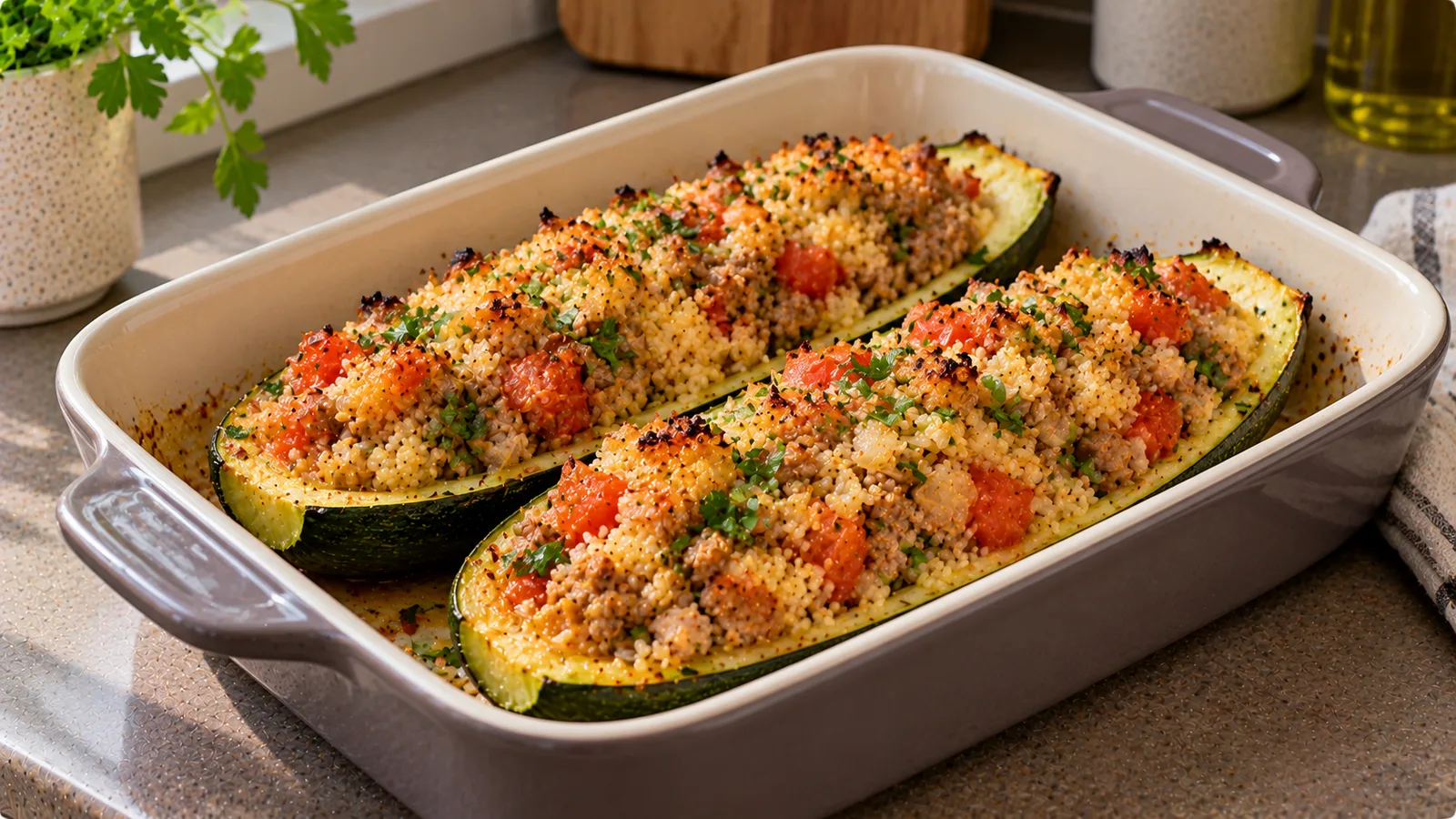
Turkey and couscous stuffed zucchini combines lean ground turkey, fluffy couscous, tomatoes and herbs in tender baked zucchini boats.
It is a practical dinner when you want a meal containing vegetables, protein and a carbohydrate source without preparing several separate dishes.
The filling is cooked before it goes into the zucchini, making it easier to control both the texture and the final oven time.
This recipe makes four main-course servings, with two stuffed zucchini halves per serving.
Recipe at a glance
| Detail | Amount |
|---|---|
| Servings | 4 |
| Preparation | 20 minutes |
| Stovetop cooking | 15 minutes |
| Oven cooking | 25–30 minutes |
| Total time | Approximately 60–65 minutes |
| Oven temperature | 200°C / 392°F conventional |
| Main protein | Lean ground turkey |
| Main carbohydrate | Couscous |
| Serving | 2 stuffed zucchini halves |
Cooking times are estimates. Actual results depend on zucchini size, oven performance and the temperature of the filling.
Ingredients
| Ingredient | Quantity |
|---|---|
| Medium zucchini | 4, approximately 1,000 g total |
| Lean ground turkey, approximately 5% fat | 500 g |
| Dry couscous | 160 g |
| Water or unsalted stock for couscous | 200 ml |
| Chopped tomatoes, canned | 300 g |
| Onion | 120 g |
| Garlic | 3 cloves, approximately 9 g |
| Olive oil | 15 g |
| Tomato paste | 25 g |
| Fresh parsley | 15 g |
| Dried oregano | 1 teaspoon |
| Sweet paprika | 1 teaspoon |
| Black pepper | To taste |
| Salt | To taste |
| Lemon juice | 1 tablespoon |
Use plain, uncooked couscous for the stated quantity. The recipe calls for 160 g dry couscous, not 160 g cooked couscous.
Choose ground turkey with a known fat percentage when possible. Turkey mince containing 5% fat and turkey mince containing 15% fat will produce different calorie and fat totals.
The estimated nutrition later in this article assumes approximately 5% fat turkey.
Equipment
You will need a baking dish large enough for eight zucchini halves, a frying pan, a saucepan or heatproof bowl for the couscous, a knife and a spoon.
A food thermometer is recommended for checking the turkey filling.
Step 1: Prepare the zucchini
Preheat the oven to 200°C conventional heat.
Wash the zucchini and dry them.
Cut each zucchini lengthwise into two equal halves.
Using a teaspoon, scoop out the soft center, leaving a border of approximately 8–10 mm around the sides and bottom.
Do not cut through the skin.
Finely chop the scooped-out flesh and reserve it for the filling.
Place the eight hollowed zucchini halves in a baking dish, cut side facing upward.
Lightly season with pepper.
If the zucchini are particularly large or firm, pre-bake the empty halves for 8–10 minutes while preparing the filling.
For smaller, tender zucchini, this preliminary baking is usually unnecessary.
Step 2: Prepare the couscous
Put 160 g dry couscous into a heatproof bowl.
Bring 200 ml of water or unsalted stock to a boil.
Pour the hot liquid over the couscous, cover and leave for approximately 5 minutes, or follow the package instructions.
Fluff with a fork.
The couscous should be tender but not excessively wet.
If the brand requires a different liquid ratio, use the package directions while keeping the dry couscous quantity unchanged.
This matters for nutrition calculations: water increases the finished weight but does not add calories.
Step 3: Cook the turkey filling
Heat the olive oil in a large frying pan over medium heat.
Add the finely chopped onion and cook for approximately 3–4 minutes, stirring occasionally.
Add the garlic and cook for another 30 seconds.
Add the ground turkey.
Break it into small pieces with a wooden spoon and cook until it is no longer visibly pink on the surface.
Add the reserved zucchini flesh, chopped tomatoes, tomato paste, oregano, paprika and black pepper.
Simmer for approximately 7–10 minutes, stirring occasionally.
The mixture should become thick enough to sit inside the zucchini boats without excessive liquid running into the baking dish.
If the tomatoes release a lot of water, continue simmering uncovered.
For food safety, the ground turkey filling must ultimately reach an internal temperature of 74°C / 165°F.
Source: USDA Food Safety and Inspection Service — Safe Temperature Chart.
Step 4: Combine the filling
Remove the frying pan from the heat.
Stir in the cooked couscous, chopped parsley and lemon juice.
Mix until the turkey, vegetables and couscous are evenly distributed.
Taste and adjust salt and pepper.
The filling should be moist but not watery.
If it looks too dry, add one or two tablespoons of water.
If it is too wet, return it to the heat briefly before stuffing the zucchini.
Step 5: Fill the zucchini boats
Divide the filling evenly among the eight zucchini halves.
Press it gently into each hollow without compacting it excessively.
Some filling may sit above the cut surface.
If the zucchini are smaller than expected, place any remaining filling around the boats in the baking dish rather than discarding it.
For consistent portioning, divide the complete recipe into four equal servings after cooking.
Step 6: Bake
Place the baking dish in the preheated oven.
Bake for approximately 25–30 minutes, until the zucchini are tender and the filling is hot throughout.
Check the center of the turkey filling with a food thermometer.
It must reach at least 74°C / 165°F.
If the zucchini begin browning too quickly, loosely cover the dish with foil.
The finished zucchini should be soft enough to pierce with a fork but firm enough to hold the filling.
Let the dish rest for 5 minutes before serving.
Estimated nutrition per serving
The following estimates are calculated from the specified raw ingredient quantities, using representative food composition values.
They are recipe estimates, not laboratory-tested values.
The calculation assumes:
- Four zucchini totaling approximately 1,000 g before hollowing.
- All scooped-out edible zucchini flesh is included in the filling.
- 500 g ground turkey containing approximately 5% fat.
- 160 g dry couscous.
- 15 g olive oil.
- No cheese or additional oil.
- Four equal servings.
Estimated nutrition
| Nutrient | Whole recipe | Per serving |
|---|---|---|
| Calories | Approximately 1,650 kcal | Approximately 413 kcal |
| Protein | Approximately 138 g | Approximately 34.5 g |
| Fat | Approximately 45 g | Approximately 11.3 g |
| Carbohydrates | Approximately 178 g | Approximately 44.5 g |
| Fiber | Approximately 24 g | Approximately 6 g |
These are rounded planning estimates.
Actual values depend on the ground turkey's fat content, the specific couscous product, zucchini size, tomato products and other ingredient variations.
For precise tracking, calculate the recipe using the nutrition labels of the actual products.
Reference food database: USDA FoodData Central.
Why the finished weight does not determine calories
Dry couscous absorbs water while cooking.
The zucchini and tomato filling may also lose water in the oven.
Consequently, the weight of the finished dish can differ considerably from the total weight of the raw ingredients.
Water absorption and evaporation do not independently add or remove the energy originally present in the ingredients.
If the recipe is divided into four equal portions, the estimated calories per portion remain based on one-quarter of the complete ingredient total.
How much does one serving weigh?
The exact cooked weight cannot be guaranteed in advance.
It depends on:
- The amount of water absorbed by the couscous.
- Moisture released by the zucchini.
- Liquid evaporated during cooking.
- The thickness of the tomato filling.
- The size and water content of the vegetables.
For example, if the finished dish weighs 2,200 g, four equal portions would weigh 550 g each.
If it weighs 2,400 g, four equal portions would weigh 600 g each.
These are examples, not verified finished yields.
For accurate logging, weigh the entire cooked recipe after subtracting the baking dish, then divide that weight by four.
Choosing the right ground turkey
The fat percentage of the ground turkey has a meaningful effect on the final recipe.
A lean product is useful when you want a relatively high protein-to-calorie ratio.
However, extremely lean turkey can dry out if cooked too long.
The tomatoes, zucchini flesh and couscous help retain moisture.
If you use turkey containing more fat than the recipe specifies, update the nutrition calculation.
Do not assume all products labeled ground turkey have the same calories.
Check the label per 100 g.
Can you use ground chicken?
Yes.
Ground chicken works with the same preparation method.
Its nutritional values depend on the cut and fat percentage.
The filling should still reach a safe internal temperature of 74°C / 165°F.
Can you use ground beef?
Yes, but the taste and nutritional composition will change.
Choose the fat percentage that suits your needs and calculate the recipe accordingly.
Why dry couscous must be measured before cooking
Couscous absorbs water and becomes heavier after preparation.
If you accidentally substitute 160 g cooked couscous for 160 g dry couscous, you will use much less grain.
That changes the filling volume, calories, carbohydrates and texture.
For consistent results, measure the couscous dry.
Then prepare it using the appropriate amount of water.
The same principle applies to many grains and pasta products: dry and cooked weights are not interchangeable.
How to avoid watery stuffed zucchini
Watery filling is one of the most common practical problems with stuffed vegetables.
Zucchini contains a large amount of water, and canned tomatoes add additional moisture.
Three adjustments help:
- Simmer the turkey and tomato mixture uncovered until excess liquid evaporates.
- Avoid adding more water than needed when preparing the couscous.
- Do not cover the baking dish tightly throughout cooking unless the surface is drying out.
If the zucchini are very large, briefly pre-baking them can help soften the flesh before the filling is added.
However, pre-baking is not a substitute for reducing excess liquid in the filling.
What if the zucchini remain too firm?
Zucchini thickness affects cooking time.
If the filling is hot and safely cooked but the zucchini are still firm, continue baking until the vegetable texture is suitable.
Cover loosely with foil if the top begins drying out.
For very large zucchini, extending the cooking time or pre-baking the empty shells may be necessary.
Avoid removing the dish solely because the top looks browned.
Check both the zucchini texture and the turkey filling temperature.
Easy ingredient variations
Add spinach
Stir approximately 100 g chopped spinach into the turkey filling near the end of stovetop cooking.
Allow excess moisture to evaporate before stuffing the zucchini.
Add mushrooms
Finely chop 150 g mushrooms and cook them with the onion.
Mushrooms release water, so the filling may need a few extra minutes of simmering.
Add feta
Sprinkle a measured amount of crumbled feta over the zucchini before baking.
This adds flavor but also changes calories, fat, protein and sodium.
Use whole-wheat couscous
Whole-wheat couscous can replace regular couscous.
Follow the package instructions and use the product label for nutrition calculations.
Make the recipe vegetarian
Replace turkey with cooked lentils, chickpeas or a suitable plant-based mince.
The cooking method and nutrient profile will change.
A vegetarian filling does not automatically provide the same protein content as the turkey version.
Serving ideas
The stuffed zucchini already contain vegetables, protein and couscous.
They can be served on their own.
For a larger meal, consider adding a green salad or other vegetables.
A yogurt-based sauce with lemon and herbs can complement the filling.
If you add bread, sauce, cheese or oil, include those ingredients when calculating the meal's total nutrition.
Meal preparation and storage
This recipe can be prepared in advance.
Allow the cooked zucchini to cool promptly.
Refrigerate in covered containers and use within 3–4 days, following standard leftover-storage guidance.
Reheat until thoroughly hot; USDA guidance recommends reheating leftovers to 74°C / 165°F.
Source: USDA — Leftovers and Food Safety.
For freezing, cool the cooked portions, pack in suitable containers and freeze promptly.
Thawed zucchini may be softer because freezing affects the vegetable's texture.
Reheat thoroughly before serving.
Best way to reheat
For an oven, place the stuffed zucchini in a baking dish, cover loosely and heat until hot throughout.
For a microwave, use a microwave-safe container and rotate or rearrange the food if necessary to avoid cold spots.
Verify that the center reaches a safe reheating temperature.
Common recipe questions
Can I prepare the filling the day before?
Yes. Cook the turkey filling, cool it promptly and refrigerate it safely.
Prepare the zucchini and bake the assembled dish when ready.
Can I use leftover cooked couscous?
Yes, provided it has been stored safely.
However, you must adjust the quantity to replace the amount obtained from 160 g dry couscous.
Do not assume 160 g cooked couscous is equivalent.
Can I make the recipe without tomato paste?
Yes. The tomato flavor will be less concentrated.
Simmer the chopped tomatoes until the filling reaches the desired consistency.
Can I add cheese?
Yes. Feta, mozzarella or another suitable cheese can be added in a measured quantity.
Update the nutrition estimate to include it.
Are the zucchini skins edible?
Yes. The skin of ordinary zucchini is edible and helps the boats hold their shape.
Wash the vegetables before preparation.
Final cooking checklist
Before serving, confirm that:
- The couscous was measured dry.
- The turkey filling is cooked safely.
- The zucchini are tender.
- The filling is moist rather than watery.
- The whole recipe is divided into four portions if using the stated nutrition estimate.
- Any added cheese, oil or sauce is included in your food log.
The result is a practical stuffed-zucchini dinner with a substantial protein contribution and a clear method for tracking portions.
Sources
- USDA FoodData Central — ingredient nutrient composition and recipe estimation.
- USDA FSIS — Safe Temperature Chart — safe cooking temperature for ground poultry.
- USDA FSIS — Leftovers and Food Safety — storage and reheating guidance.
Nutrition estimates are illustrative and should be recalculated using the exact products and quantities used.