
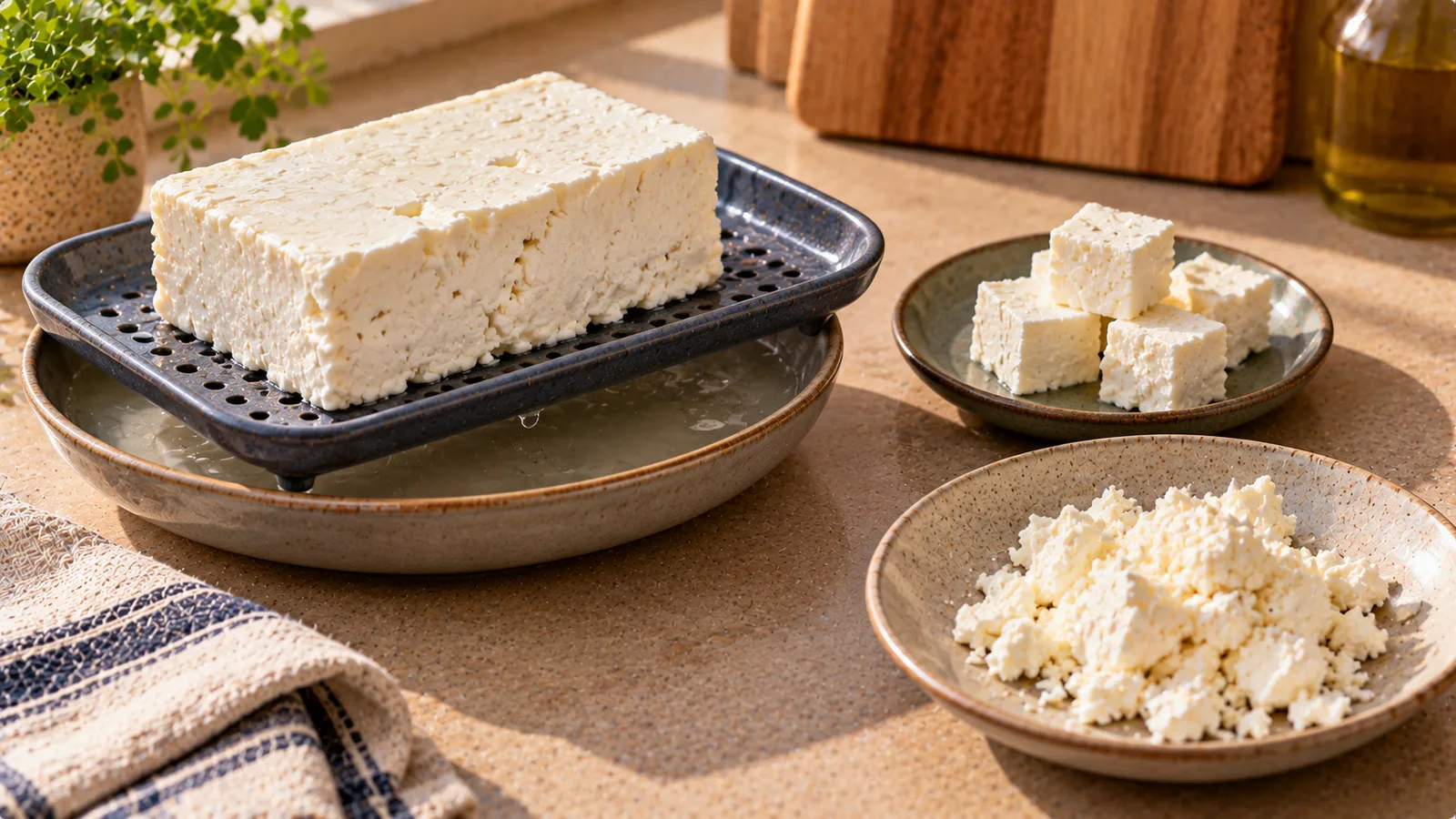
Feta is a brined cheese with a relatively high calorie density, so the amount you use can make a noticeable difference to the calories in a salad, wrap or cooked dish.
A useful reference point for whole-milk feta is about 265 calories per 100 g. A smaller 30 g portion is roughly 80 calories.
The exact number on your package may be different. Feta varies by milk, fat content, moisture, producer and whether the weight refers to the drained cheese itself.
Feta calories at a glance
| Feta amount | Approximate calories |
|---|---|
| 20 g | 53 kcal |
| 30 g | 80 kcal |
| 40 g | 106 kcal |
| 50 g | 133 kcal |
| 75 g | 199 kcal |
| 100 g | 265 kcal |
| 150 g | 398 kcal |
These are reference estimates for whole-milk feta. For packaged feta, use the nutrition information on that specific product whenever available.
Nutrition in 100 g of feta
A typical whole-milk feta reference provides approximately:
| Nutrient | Per 100 g |
|---|---|
| Calories | 265 kcal |
| Protein | 14 g |
| Fat | 21 g |
| Carbohydrate | 4 g |
Most of feta's calories therefore come from fat, while it also provides a meaningful amount of protein.
The values should be treated as reference figures rather than a universal profile for every feta product.
Calories in a 30 g serving of feta
Thirty grams is a practical portion for sprinkling feta over a salad, vegetables, eggs or a grain bowl.
Using 265 kcal per 100 g:
30 g of feta ≈ 80 kcal
A 30 g portion would also provide roughly:
- 4 g protein;
- 6 g fat;
- about 1 g carbohydrate.
Small differences are normal because nutrition databases and individual products do not all contain exactly the same amount of fat and water.
Calories in 50 g of feta
A larger 50 g portion contains approximately:
133 kcal
That amount is easy to reach when feta is a major ingredient rather than a garnish.
For example, a salad may contain vegetables that contribute relatively few calories but 50–70 g of feta plus oil can substantially increase the total energy of the meal.
Calories in 100 g of feta
For comparison between foods, 100 g is usually the easiest reference quantity.
Whole-milk feta is approximately:
265 kcal per 100 g
The 100 g value is useful for comparing different feta packages because serving sizes printed by manufacturers can vary.
If one package lists 240 kcal per 100 g and another lists 280 kcal per 100 g, the difference may reflect fat content, moisture, milk composition or formulation.
Use the number printed on the package for that specific product when logging it.
Why feta calorie values vary
There is no single calorie value that applies to every feta cheese.
Several factors can change the nutrition per 100 g.
Fat content
Fat is energy-dense, so feta with more fat will generally contain more calories.
Reduced-fat versions can therefore have a lower calorie value than full-fat feta.
However, do not assume the difference from the words on the front of the package alone. Compare the nutrition table.
Moisture
Cheese containing more water has less dry matter in the same 100 g weight.
This can reduce the concentration of calories and nutrients.
Two authentic-looking feta products can therefore have noticeably different values even if their ingredient lists appear similar.
Milk and production method
Feta products can differ in their milk composition and manufacturing process.
Those differences affect the final proportions of fat, protein and water.
Brand and formulation
Packaged products can also differ between manufacturers.
For accurate tracking, the product label is normally more useful than a generic database entry when you know exactly which feta you ate.
Feta in brine: weigh the cheese, not the liquid
Many feta products are sold submerged in brine.
If the nutrition information is for the cheese itself, the edible drained cheese is the relevant weight.
For example, a package might contain:
- 200 g feta;
- additional brine;
- a much higher total package weight including liquid.
If you eat 40 g of drained feta, logging the combined cheese-and-brine weight would overstate the amount of cheese consumed.
A practical method is:
- remove the feta from the brine;
- allow excess liquid to drain briefly;
- weigh the portion you will eat;
- use the product's nutrition value for that amount.
Follow the label if it explicitly defines a different basis.
Drained weight vs package weight
The front of a feta package may show both net weight and drained weight.
For nutrition tracking, these numbers should not automatically be treated as interchangeable.
Suppose a container has:
- net contents including liquid: 350 g;
- drained feta: 200 g.
If the package contains 265 kcal per 100 g of drained cheese, the cheese contributes approximately:
200 × 265 ÷ 100 = 530 kcal
Using 350 g as though all of it were feta would incorrectly produce:
928 kcal
The basis of the nutrition declaration matters as much as the number itself.
Block feta vs crumbled feta
Feta may be sold as a block or already crumbled.
The physical form does not automatically make one version higher in calories.
What matters is the composition and the amount by weight.
For example:
- 30 g block feta;
- 30 g crumbled feta
from the same cheese would contain essentially the same nutrition.
The problem arises when portions are estimated by volume.
A spoon or cup of loosely crumbled feta can weigh differently depending on how finely it is crumbled and how densely it is packed.
For calorie tracking, grams are more reliable than visual volume.
How much does a tablespoon of feta contain?
A tablespoon is not a precise weight measurement for crumbled cheese.
The amount changes depending on:
- crumble size;
- how tightly the spoon is filled;
- whether it is level or heaped;
- moisture.
If precision matters, weigh the feta once instead of relying on a spoon estimate.
For everyday tracking, you can also create a personal reference.
For example, if your usual level tablespoon weighs 10 g, then with a feta containing 265 kcal per 100 g:
10 g ≈ 27 kcal
A 20 g portion would be about:
53 kcal
How to calculate calories from the package
If your feta label gives calories per 100 g, use:
calories eaten = grams eaten × calories per 100 g ÷ 100
Example:
Your feta contains 270 kcal per 100 g.
You eat 35 g.
35 × 270 ÷ 100 = 94.5 kcal
You can log approximately 95 kcal.
This is more accurate than using a generic 30 g serving when you know the actual weight.
Example: feta in a Greek-style salad
Suppose a salad contains:
- tomatoes;
- cucumber;
- peppers;
- onion;
- 50 g feta;
- olive oil.
If the feta contains 265 kcal per 100 g:
50 × 265 ÷ 100 = 133 kcal from feta
The vegetables, feta and oil should be counted separately when estimating the complete meal.
This is especially useful because the calorie contribution of feta and oil can be much larger than their visual size suggests.
Example: feta in an omelet
Suppose you crumble 30 g feta into an omelet.
At 265 kcal per 100 g:
30 × 265 ÷ 100 = 79.5 kcal
So the feta adds approximately 80 kcal.
The eggs, cooking fat and any other ingredients are separate parts of the recipe total.
Example: feta in a recipe
You make a dish containing 180 g feta.
The package lists 250 kcal per 100 g.
The entire feta contribution is:
180 × 250 ÷ 100 = 450 kcal
If the finished recipe makes four equal portions:
450 ÷ 4 = 112.5 kcal of feta per portion
That does not mean the complete serving contains only 113 calories. It is only the feta contribution; all other ingredients must also be included.
Full-fat vs reduced-fat feta
Reduced-fat feta can contain fewer calories than standard feta, but the difference varies considerably between products.
For example, imagine two labels:
| Product | Calories per 100 g |
|---|---|
| Standard feta | 270 kcal |
| Reduced-fat feta (illustrative example) | 190 kcal |
The 190 kcal per 100 g value in this comparison is illustrative, not a verified value for every reduced-fat feta. Check the nutrition label of the particular cheese.
For a 40 g serving:
Standard:
40 × 270 ÷ 100 = 108 kcal
Reduced-fat:
40 × 190 ÷ 100 = 76 kcal
Difference:
32 kcal
This is only an illustrative comparison. Use the actual labels of the products you are comparing.
Feta protein
Feta typically provides around 14 g of protein per 100 g, although individual products vary.
Using that reference:
- 30 g provides about 4 g protein;
- 50 g provides about 7 g protein;
- 100 g provides about 14 g protein.
Feta can therefore contribute protein to a meal, but it is not correct to treat the entire weight of the cheese as protein.
A 100 g portion of feta is 100 g of food, not 100 g of protein.
Feta fat
Whole-milk feta commonly contains roughly 21 g fat per 100 g.
At that reference value:
- 30 g contains about 6 g fat;
- 50 g contains about 11 g fat;
- 100 g contains about 21 g fat.
Because fat provides more energy per gram than protein or carbohydrate, differences in feta's fat content can noticeably affect its calorie value.
Feta carbohydrates
Feta is generally relatively low in carbohydrate compared with foods such as bread, pasta or grains.
A generic whole-milk feta reference is around 4 g carbohydrate per 100 g.
That would be approximately:
- 1 g in 30 g;
- 2 g in 50 g;
- 4 g in 100 g.
Again, the package label is the better source when tracking a specific product.
Does cooking feta change its calories?
Heating feta does not create calories.
If feta is baked or melted, its total energy does not suddenly increase simply because it was heated.
However, water can be lost during cooking. That can make the cooked food more calorie-dense per 100 g.
The complete dish may also contain added ingredients such as:
- olive oil;
- pastry;
- pasta;
- honey;
- sauces.
Those additions change the calories of the meal even though the feta itself has not gained energy from heat.
Raw vs baked feta
If you start with 100 g of feta containing 265 kcal and bake it without adding anything, the original cheese still contributes approximately 265 kcal to the dish.
If it loses water and weighs only 90 g afterward, the calorie concentration per 100 g of the cooked cheese would be higher.
For recipe tracking, it is often simpler to log the original amount of feta used rather than trying to find a separate generic value for "baked feta."
Is feta high in calories?
Feta is calorie-dense compared with many vegetables and fruits, but whether a food is "high" in calories depends on the quantity eaten and the comparison being made.
A 20 g garnish is about 53 kcal using the reference value.
A 100 g portion is about 265 kcal.
The serving size therefore matters considerably.
Rather than classifying feta as simply good or bad, use the amount and the rest of the meal to understand its contribution.
A practical way to log feta
For the most useful estimate:
- identify the exact feta product when possible;
- check calories per 100 g on the package;
- use drained weight if the cheese is stored in brine and the label refers to the drained product;
- weigh the amount eaten in grams;
- calculate the value for that portion;
- include oils, dressings or other recipe ingredients separately.
If you do not have the package information, a generic food-composition value can provide a reasonable estimate.
Quick reference
Using approximately 265 kcal per 100 g:
| Portion | Calories | Protein | Fat | Carbs |
|---|---|---|---|---|
| 20 g | 53 kcal | 3 g | 4 g | 1 g |
| 30 g | 80 kcal | 4 g | 6 g | 1 g |
| 50 g | 133 kcal | 7 g | 11 g | 2 g |
| 75 g | 199 kcal | 11 g | 16 g | 3 g |
| 100 g | 265 kcal | 14 g | 21 g | 4 g |
Values are approximate and should not replace the nutrition label for the specific feta you are eating.
The most important point is simple: use the nutrition value for the specific feta and match it to the amount of drained cheese you actually eat.
Nutrition data sources and product differences
The records below describe only the named foods, fat levels and preparation states. USDA figures are per 100 g; manufacturer figures retain their stated unit. These sources do not independently prove every approximate figure in the article.
The USDA entry supports standard feta only; it does not establish the reduced-fat feta example at 190 kcal per 100 g.
USDA FoodData Central (search by FDC ID):
- FDC 173420 — Cheese, feta (265 kcal/100 g)