
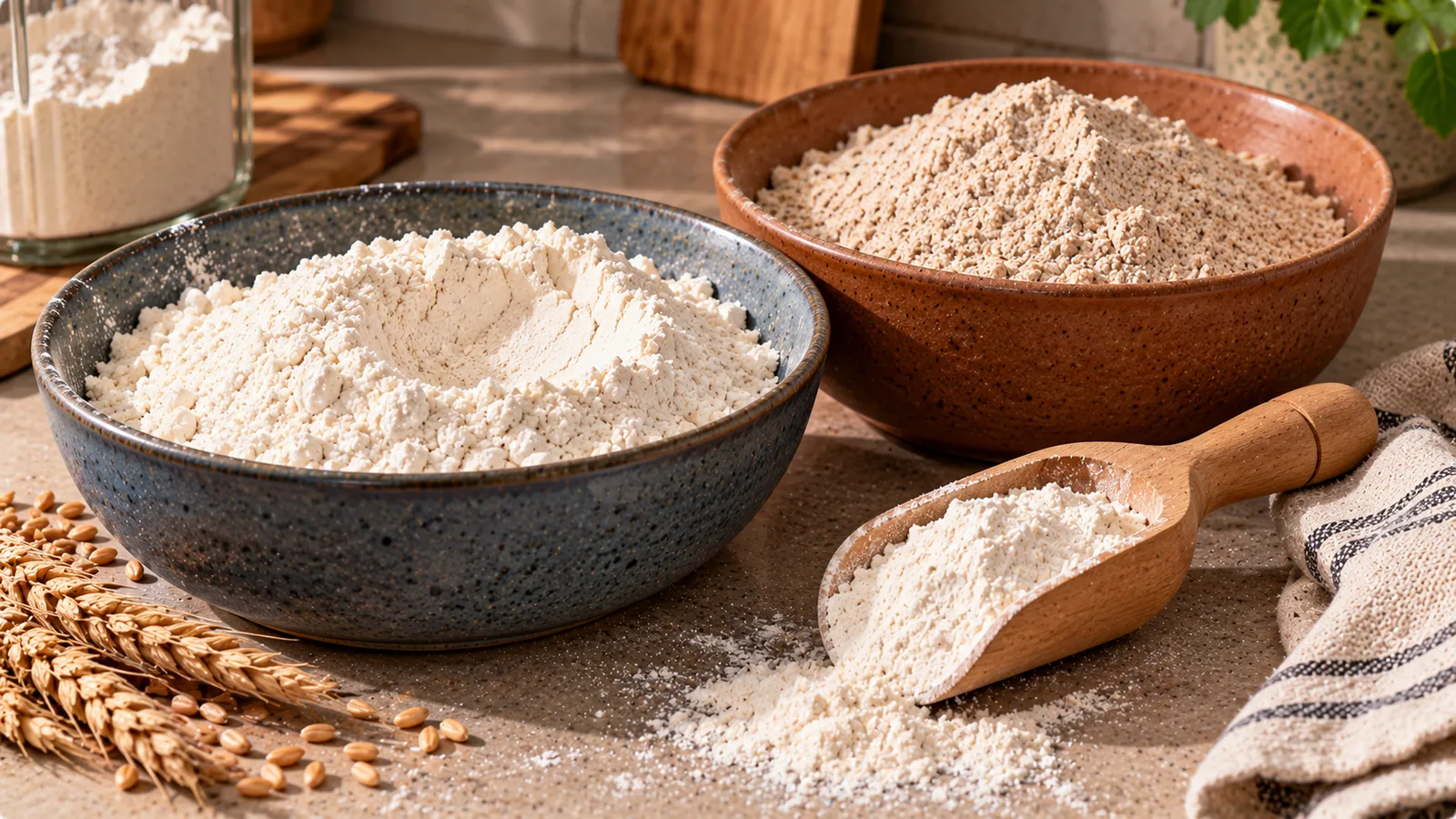
Flour is a common ingredient in bread, pancakes, cakes, sauces and many other foods. But how many calories does it contain, and does whole-wheat flour have fewer calories than white flour?
Most ordinary dry wheat flours provide approximately 340–370 kcal per 100 g, depending on the type and product. Whole-wheat flour is not necessarily dramatically lower in calories than refined white flour, although the two differ in fiber content and other nutrients.
For accurate calorie tracking, the most important details are the type of flour, the amount weighed and whether the nutrition information refers to dry flour or a finished food.
How many calories are in flour?
The following table gives approximate values for common dry wheat flours.
| Flour type | Approximate calories per 100 g |
|---|---|
| Refined white wheat flour | 350–370 kcal |
| Whole-wheat flour | 330–360 kcal |
| Bread flour | 350–370 kcal |
| Self-raising wheat flour | 340–370 kcal |
These are illustrative ranges, not guaranteed values for every product.
The energy content can differ because of moisture, protein, fat, fiber and the specific milling process.
Self-raising flour also contains raising agents, so its composition differs from plain flour.
For an exact packaged product, use the nutrition declaration printed on its packaging.
Calories in common flour portions
Suppose a flour contains 364 kcal per 100 g.
| Dry flour weight | Calories |
|---|---|
| 10 g | 36 kcal |
| 20 g | 73 kcal |
| 30 g | 109 kcal |
| 40 g | 146 kcal |
| 50 g | 182 kcal |
| 75 g | 273 kcal |
| 100 g | 364 kcal |
| 150 g | 546 kcal |
| 200 g | 728 kcal |
These numbers are calculated examples using 364 kcal per 100 g.
A different flour label will produce slightly different results.
The calculation is straightforward:
Calories = flour weight in grams × calories per 100 g ÷ 100.
For example, 65 g of flour containing 355 kcal per 100 g provides:
65 × 355 ÷ 100 = 230.75 kcal, or approximately 231 kcal.
White flour versus whole-wheat flour
White and whole-wheat flour are both made from wheat, but their milling processes differ.
Refined white flour generally contains primarily the endosperm of the grain.
Whole-wheat flour includes the bran, germ and endosperm in proportions intended to represent the whole grain.
This affects fiber, micronutrients, texture and baking behavior.
Typical nutrition comparison
The following values are broad reference ranges per 100 g of dry flour.
| Nutrient | White wheat flour | Whole-wheat flour |
|---|---|---|
| Calories | 350–370 kcal | 330–360 kcal |
| Protein | 9–12 g | 11–15 g |
| Carbohydrates | 72–78 g | 65–73 g |
| Fat | 1–2 g | 2–3 g |
| Fiber | 2–4 g | 9–13 g |
Individual products vary. Carbohydrate figures can also depend on regional labeling conventions, particularly whether fiber is included in the reported carbohydrate figure.
The most consistent difference is generally fiber: whole-wheat flour usually provides substantially more.
However, it is misleading to assume that replacing white flour with whole-wheat flour automatically makes a recipe low-calorie.
Does whole-wheat flour have fewer calories?
Sometimes, but the difference is often modest.
Consider two illustrative products:
- White flour: 364 kcal per 100 g.
- Whole-wheat flour: 340 kcal per 100 g.
For 100 g, the difference is 24 kcal.
For 50 g, the difference is only 12 kcal.
The choice between white and whole-wheat flour should therefore consider more than calories.
Whole-wheat flour may contribute more dietary fiber and different amounts of vitamins and minerals.
White flour may provide a lighter texture in certain baked goods.
The nutritional effect of the finished recipe also depends on sugar, oil, butter, eggs and other ingredients.
How many calories are in one tablespoon of flour?
Tablespoons measure volume, not weight.
A level tablespoon of wheat flour may weigh roughly 7–10 g, depending on the spoon and how the flour is handled.
At 364 kcal per 100 g, that corresponds to approximately 25–36 kcal.
A heaped tablespoon can contain considerably more flour.
Therefore, tablespoon estimates are useful only when a scale is unavailable.
For consistent recipe calculations, weigh the flour in grams.
How many calories are in one cup of flour?
A cup of flour does not have a universal weight.
Different measuring systems use different cup volumes, and the amount of flour depends on whether it is spooned, sifted or packed.
A commonly used reference for one US cup of all-purpose flour is approximately 120–125 g.
At 364 kcal per 100 g:
- 120 g contains approximately 437 kcal.
- 125 g contains approximately 455 kcal.
A densely packed cup can weigh more.
Use the weight stated in the recipe whenever possible.
If a recipe only specifies cups, the conversion is an estimate unless the recipe author defines the intended weight.
Calories in flour used for baking
Flour calories should be calculated from the amount added to the complete recipe.
For example, consider a simple batter containing:
| Ingredient | Amount | Illustrative calories |
|---|---|---|
| Wheat flour | 200 g at 364 kcal/100 g | 728 kcal |
| Milk | 300 ml at 50 kcal/100 ml | 150 kcal |
| Eggs | 2 eggs at 72 kcal each | 144 kcal |
| Oil | 20 g at 9 kcal/g | 180 kcal |
| Total | 1,202 kcal |
If the batter produces eight equal pancakes, the approximate energy is:
1,202 ÷ 8 = 150 kcal per pancake.
This is an ingredient-based example, not a tested recipe nutrition analysis.
Actual values depend on the products used, cooking losses, oil remaining in the pan and the number and size of portions.
Any toppings should be calculated separately.
Does flour lose calories when cooked?
Cooking does not simply remove the energy contained in flour.
When flour is mixed with water and baked, the total weight and moisture content change.
A finished food may therefore have a different calorie value per 100 g from dry flour.
For example, adding water to flour increases the mixture's weight without adding calories from the water.
During baking, some water evaporates, reducing the final weight.
These changes affect calories per 100 g of the finished food.
They do not mean that the original flour calories disappear.
Other ingredients, such as oil or sugar, add their own energy.
Flour and protein
Wheat flour contains protein, including proteins involved in gluten formation.
The amount varies by wheat variety and product.
Bread flour is often selected for its relatively high protein content, which can help dough develop structure.
Whole-wheat flour may also contain substantial protein, but the presence of bran changes how dough behaves.
Protein content alone does not determine whether a flour is healthier or better for every recipe.
For precise tracking, use the protein value printed on the specific package.
Flour and carbohydrates
Most of the energy in ordinary wheat flour comes from carbohydrates, primarily starch.
Dry refined wheat flour often contains roughly 72–78 g of carbohydrates per 100 g under labeling systems that exclude fiber from the carbohydrate figure.
Whole-wheat flour may show a lower available-carbohydrate value because it contains more fiber.
When comparing databases from different countries, confirm how carbohydrate and fiber are defined.
For European packaged foods, use the declared carbohydrate value on the product label.
Flour and dietary fiber
Fiber is an important difference between refined and whole-wheat flour.
Whole-wheat flour retains more of the grain's bran and typically supplies considerably more fiber.
This can influence the texture and composition of the finished food.
However, the amount of fiber in a pancake or loaf depends on how much flour is used, which type is chosen and the size of the portion.
A product containing some whole-wheat flour is not automatically high in fiber.
Check the actual nutrition information.
Does the flour type affect weight management?
Flour can be included in a weight-management eating pattern.
The relevant factors include total calorie intake, serving size, food composition and the overall dietary pattern.
Whole-wheat flour can be useful when you want to increase dietary fiber.
However, a cake made with whole-wheat flour may still contain substantial calories from sugar, butter or oil.
Likewise, white flour is not inherently responsible for weight gain.
Evaluate the finished food and the quantities eaten rather than judging one ingredient in isolation.
Common calorie-counting mistakes
Using cup estimates as exact weights
A cup can contain different amounts depending on the measuring method.
A kitchen scale provides more reliable results.
Confusing dry flour with cooked food
100 g of dry flour is not nutritionally equivalent to 100 g of bread or pancakes.
The finished foods contain water and additional ingredients.
Ignoring flour in sauces
Even small quantities of flour used to thicken a sauce contribute calories.
For example, 20 g of flour at 364 kcal per 100 g adds approximately 73 kcal to the entire sauce.
Recording only flour calories
Baked goods may also contain significant amounts of oil, butter, sugar, milk and eggs.
The full recipe matters.
Assuming whole-wheat flour is calorie-free or very low-calorie
Whole-wheat flour contains substantial energy, even though its fiber content is generally higher.
How to calculate flour calories accurately
For homemade foods, follow a simple process:
- Weigh the dry flour.
- Read calories per 100 g from the package.
- Multiply by the amount used.
- Calculate the other ingredients separately.
- Add the ingredient totals.
- Divide by the actual number of servings or weigh the finished food.
If you weigh the finished recipe, you can also calculate its calories per 100 g.
Finished recipe kcal per 100 g = total recipe calories ÷ finished weight × 100.
This is especially useful for homemade bread, pancakes and baked goods with irregular portions.
Sources
- USDA FoodData Central — food-composition information for different wheat flours.
- EU Regulation 1169/2011 — nutrition-labeling requirements.
- WHO: Healthy Diet — general dietary guidance.
Key takeaway
Most ordinary dry wheat flours provide roughly 340–370 kcal per 100 g.
Whole-wheat flour is usually higher in fiber than refined white flour, but it is not dramatically lower in calories.
For accurate calculations, weigh dry flour, use the nutrition values of the specific product and include every ingredient in the finished recipe.