
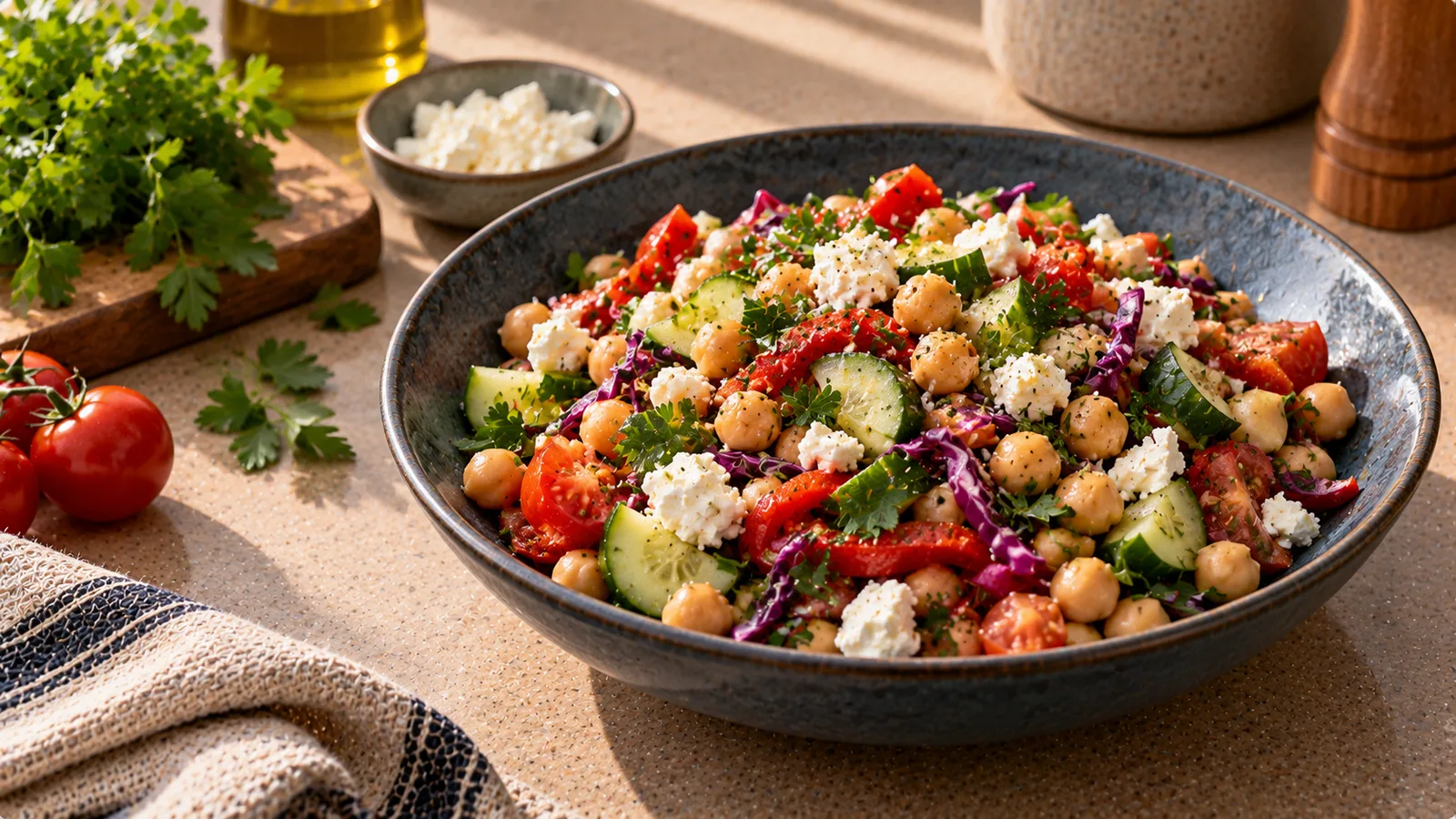
This chickpea salad combines chickpeas, feta and fresh vegetables with a simple lemon and olive oil dressing.
It works well as a cold lunch because there is no reheating required, and the chickpeas and feta make it more substantial than a vegetable-only salad.
The recipe makes 2 main-meal servings.
Ingredients
For 2 servings:
- 240 g drained chickpeas
- 120 g cucumber
- 150 g cherry tomatoes
- 100 g red bell pepper
- 50 g red onion
- 60 g feta
- 15 g olive oil
- 20 g lemon juice
- 10 g fresh parsley
- 1 small garlic clove, finely grated or minced
- black pepper to taste
- dried oregano to taste
Salt is optional. Feta is already salty, so taste the salad before adding any.
How to make the chickpea salad
1. Drain the chickpeas
Drain the chickpeas thoroughly.
If using canned chickpeas, rinse them under cold water and allow excess water to drain before adding them to the salad.
The 240 g in this recipe refers to drained weight, not the total weight of the can including liquid.
2. Prepare the vegetables
Cut the cucumber, tomatoes and bell pepper into bite-sized pieces.
Finely slice or dice the red onion.
Chop the parsley.
3. Make the dressing
Combine:
- 15 g olive oil;
- 20 g lemon juice;
- garlic;
- black pepper;
- oregano.
Whisk or stir until combined.
4. Assemble the salad
Add the chickpeas, cucumber, tomatoes, pepper, onion and parsley to a large bowl.
Pour over the dressing and toss gently.
Crumble the feta over the salad and fold it through without breaking it down too much.
5. Divide into portions
Divide the finished salad into 2 approximately equal servings.
Because vegetables can vary in water content and trimming loss, the exact finished weight will vary slightly.
Approximate nutrition
Nutrition depends on the exact chickpeas, feta and other products used.
Using typical values, one half of the recipe provides approximately:
| Per serving | Approximate amount |
|---|---|
| Calories | 450–480 kcal |
| Protein | 18–20 g |
| Fat | 22–25 g |
| Carbohydrates | 45–50 g |
| Fiber | 11–13 g |
These are estimates rather than laboratory values.
For precise tracking, use the nutrition information from the specific products you actually use.
Where the calories come from
The main calorie-containing ingredients are chickpeas, feta and olive oil.
Vegetables add considerably more volume than calories.
That makes the salad a useful example of why two bowls of similar physical size can have very different calorie totals depending on the quantities of oil, cheese and other energy-dense ingredients.
Chickpeas
Chickpeas provide most of the carbohydrate and a substantial share of the protein and fiber.
The recipe uses 240 g drained chickpeas, or about 120 g per serving.
Feta
The recipe uses 60 g feta, which is 30 g per serving.
Feta adds protein, fat, saltiness and flavor.
Using substantially more feta will increase both calories and fat.
Olive oil
The recipe contains 15 g olive oil in total.
That is about 7.5 g per serving if the dressing is divided evenly.
Oil is energy-dense, so pouring it freely instead of measuring it can noticeably change the final calorie estimate.
Why drained chickpea weight matters
A can might be labeled as 400 g, but that does not necessarily mean it contains 400 g of chickpeas.
Part of the weight is the packing liquid.
If a recipe calls for 240 g drained chickpeas, use the weight after the liquid has been removed.
For food tracking, this also means choosing a database entry that matches the form you actually measured whenever possible.
Can you use dried chickpeas?
Yes.
Cook dried chickpeas until tender, drain them and then weigh 240 g cooked chickpeas for this recipe.
Do not substitute 240 g of dry chickpeas directly.
Dry chickpeas absorb water during cooking, so 240 g dry and 240 g cooked represent very different quantities of food.
Can you make it without feta?
Yes, but the finished dish will have a different nutritional profile and flavor.
If you simply remove the 60 g feta without replacing it, the salad will contain fewer calories, less fat and less protein.
If you replace feta with another ingredient, calculate the nutrition using the amount and product actually used rather than assuming the values remain the same.
Adding more protein
If you want a higher-protein meal, possible additions include:
- chicken;
- tuna;
- eggs;
- tofu;
- additional legumes.
However, these additions change the recipe's calories and macronutrients.
For example, adding tuna is not nutritionally equivalent to simply increasing the chickpea quantity.
Treat additions as ingredients rather than assuming the original nutrition estimate still applies.
How to make the salad more filling
The recipe already contains chickpeas, vegetables, feta and fat from olive oil.
If you need a larger meal, you can add a measured portion of:
- whole-grain bread;
- potatoes;
- cooked grains;
- fruit;
- yogurt on the side.
Which addition makes sense depends on the rest of your day and your personal needs.
There is no single portion that is correct for everyone.
How to reduce the calories
If you want a lighter version, the easiest ingredients to adjust are usually feta and olive oil because they are relatively energy-dense.
For example, you could reduce:
- feta from 60 g to 40 g;
- olive oil from 15 g to 10 g.
Keep the vegetables and chickpeas unchanged if you want to preserve most of the volume.
The exact calorie reduction depends on the products used.
How to increase the calories
For a more energy-dense meal, you could add:
- more olive oil;
- additional feta;
- avocado;
- bread;
- cooked grains;
- nuts or seeds.
Again, measure the additions if you are tracking intake.
Meal-prep version
This salad can be prepared in advance.
For the best texture, keep the dressing separate until shortly before eating, especially if the salad will be stored for more than a few hours.
You can prepare:
- chickpeas and chopped vegetables in the main container;
- feta in the same container or separately;
- dressing in a small sealed container.
Combine before eating.
Storage
Store the salad refrigerated in a covered container.
For practical meal prep, it is best eaten within about 2 days, particularly once all ingredients and dressing have been mixed.
If the salad has been left at room temperature for an extended period, normal food-safety considerations apply. Perishable ingredients such as feta should not be left warm unnecessarily.
Packing it for work
Because this is a cold lunch, it can work well when no microwave is available.
Keep it chilled during transport and storage.
If refrigeration is not available at your destination, use an insulated lunch bag with an appropriate cold source and follow normal food-safety guidance for perishable foods.
A larger batch for four servings
To make four main-meal servings, double the ingredients:
- 480 g drained chickpeas
- 240 g cucumber
- 300 g cherry tomatoes
- 200 g red bell pepper
- 100 g red onion
- 120 g feta
- 30 g olive oil
- 40 g lemon juice
- 20 g parsley
- 2 small garlic cloves
Divide the finished salad into four equal portions.
Doubling the recipe does not change the estimated nutrition per serving as long as you also double the number of servings.
How to log the homemade salad
For the most accurate estimate:
- Enter each ingredient and its actual amount.
- Use drained weight for the chickpeas.
- Use the nutrition label from your feta and other packaged ingredients.
- Include the olive oil rather than treating the dressing as calorie-free.
- Save the complete recipe as 2 servings.
- Log one half of the finished recipe for one serving.
If you change the ingredient quantities, update the saved recipe rather than continuing to use the original nutrition values.
Practical recipe summary
For two servings, combine 240 g drained chickpeas, 120 g cucumber, 150 g cherry tomatoes, 100 g red pepper, 50 g red onion and 60 g feta.
Dress with 15 g olive oil, 20 g lemon juice, garlic, parsley, black pepper and oregano.
Divide into two portions.
One serving provides roughly 450–480 kcal and 18–20 g protein, depending on the exact ingredients used.
The result is a complete cold lunch rather than simply a side salad, with chickpeas providing the main carbohydrate and fiber base, feta contributing protein and fat, and fresh vegetables adding volume and variety.