
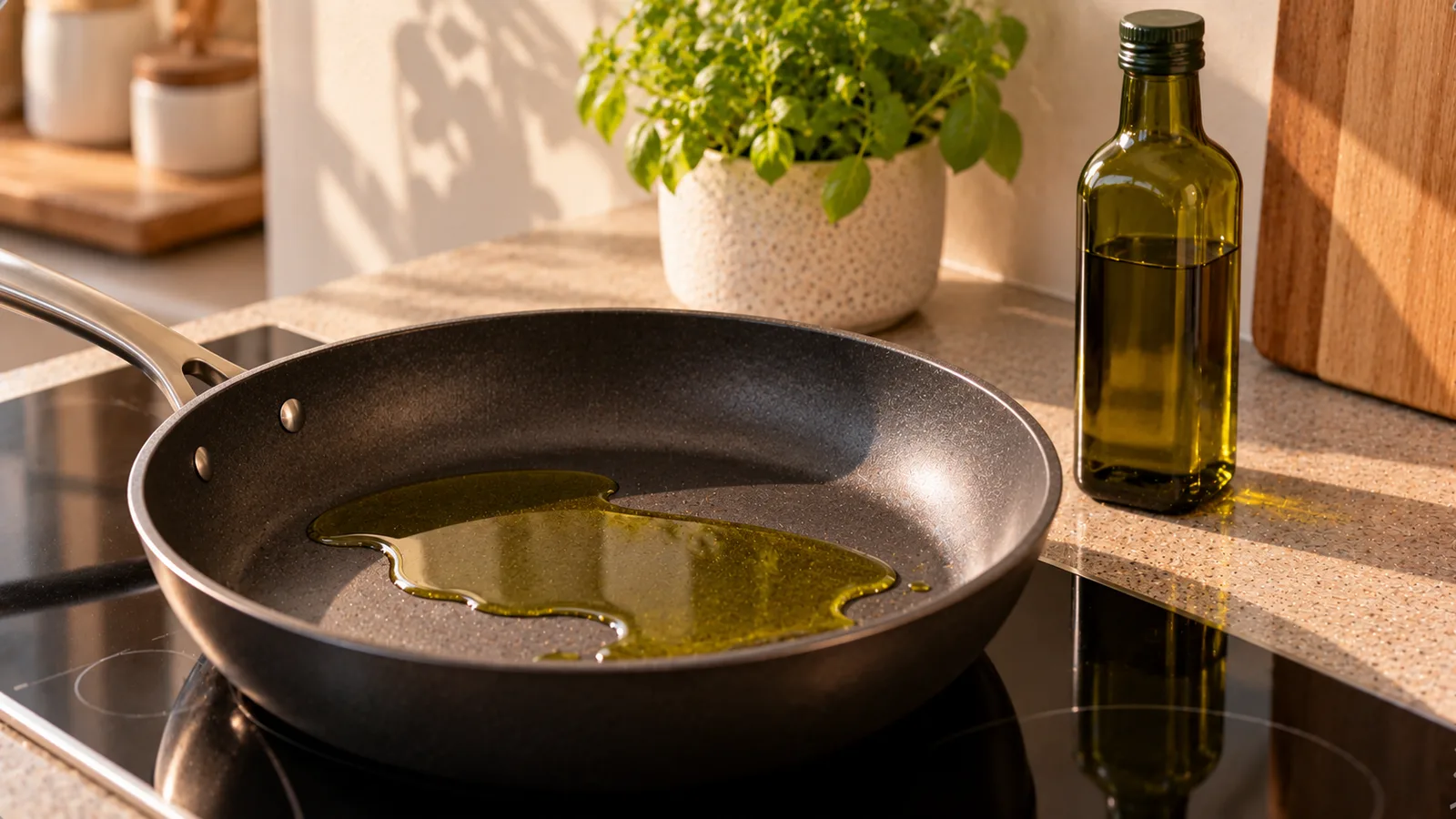
Olive oil is almost entirely fat, so it has a high energy density. A relatively small amount can therefore contribute a noticeable number of calories to a meal.
As a practical reference, olive oil provides approximately 884 kcal per 100 g. Exact values can vary slightly between products, so use the nutrition label on your bottle when available.
For calorie tracking, the main challenge is usually not choosing the right type of olive oil. It is measuring how much oil was actually used and how much ended up in the food.
Olive oil nutrition per 100 g
A typical olive oil provides approximately:
| Nutrient | Per 100 g |
|---|---|
| Calories | 884 kcal |
| Fat | 100 g |
| Protein | 0 g |
| Carbohydrates | 0 g |
| Fiber | 0 g |
Most of the fatty acids in olive oil are unsaturated, with monounsaturated fat representing a large share.
Because olive oil is essentially pure fat, it contains roughly 8.8 kcal per gram.
Calories in common olive oil portions
Using 884 kcal per 100 g:
| Amount | Approx. calories |
|---|---|
| 1 g | 9 kcal |
| 5 g | 44 kcal |
| 10 g | 88 kcal |
| 15 g | 133 kcal |
| 20 g | 177 kcal |
| 25 g | 221 kcal |
| 30 g | 265 kcal |
| 50 g | 442 kcal |
| 100 g | 884 kcal |
The calculation is:
grams of olive oil × 884 ÷ 100
For example:
12 g × 884 ÷ 100 = about 106 kcal
If your bottle lists a different calorie value, use that number instead.
How many calories are in a teaspoon of olive oil?
A teaspoon measures volume rather than weight.
A standard teaspoon is approximately 5 ml, but the amount actually poured can differ.
Because olive oil has a density below 1 g per ml, 5 ml does not weigh 5 g. A practical estimate is around 4.5–4.6 g for 5 ml.
Using 884 kcal per 100 g:
4.6 g × 884 ÷ 100 ≈ 41 kcal
So one level 5 ml teaspoon of olive oil is roughly 40 kcal.
For everyday tracking, the bottle's own serving information should take priority when available.
How many calories are in a tablespoon of olive oil?
A tablespoon is commonly treated as 15 ml in many nutrition contexts.
About 15 ml of olive oil weighs roughly 13.5–14 g.
At 884 kcal per 100 g:
13.6 g × 884 ÷ 100 ≈ 120 kcal
So a 15 ml tablespoon contains roughly 120 kcal.
However, household spoons are not standardized measuring tools. A generous pour can contain substantially more than a level measured tablespoon.
Volume and weight are not the same
One of the easiest mistakes when tracking oil is treating milliliters and grams as interchangeable.
They are not.
Because olive oil is less dense than water:
- 10 ml of olive oil weighs less than 10 g;
- 15 ml weighs roughly 13.5–14 g;
- 30 ml weighs roughly 27 g.
If the nutrition label provides values per 100 ml, calculate from milliliters.
If it provides values per 100 g, calculate from grams.
Avoid mixing the two systems unless you convert using an appropriate density.
Quick volume reference
Approximate values for olive oil are:
| Volume | Approx. weight | Approx. calories |
|---|---|---|
| 5 ml | 4.6 g | 41 kcal |
| 10 ml | 9.1 g | 80 kcal |
| 15 ml | 13.6 g | 120 kcal |
| 20 ml | 18.2 g | 161 kcal |
| 30 ml | 27.3 g | 241 kcal |
| 45 ml | 40.9 g | 362 kcal |
These are practical estimates. Product density and measurement precision can cause small differences.
Extra virgin vs regular olive oil calories
Extra virgin olive oil and other edible olive oils generally have very similar calorie values because all are primarily fat.
The differences between olive oil categories concern factors such as processing, sensory characteristics and composition of minor compounds rather than a large difference in energy content.
Do not assume that extra virgin olive oil is substantially lower or higher in calories than another olive oil.
For tracking, use the specific bottle's label.
Does cooking change the calories in olive oil?
Heating olive oil does not make its calories disappear.
If you add 20 g of oil to a pan, that oil contributes energy to the cooking process.
The more difficult question is how much of it is ultimately eaten.
Some oil may:
- remain in the pan;
- stay on cooking utensils;
- be absorbed by food;
- become part of a sauce;
- be left behind on a plate.
That makes exact tracking harder than simply measuring the amount poured.
How to track olive oil used for frying
If you are cooking one serving and almost all of the oil becomes part of the food, logging the measured amount added can be a practical estimate.
For example, if you add 10 g:
10 g × 8.84 kcal/g ≈ 88 kcal
If a substantial amount remains in the pan, assuming that every gram was eaten may overestimate intake.
At the same time, guessing that only a tiny fraction was absorbed can underestimate it.
For routine tracking, consistency is often more useful than pretending to know an exact absorption percentage.
Tracking oil in a recipe
For a multi-serving recipe, include the oil with the other ingredients.
Suppose a recipe contains:
- 500 g vegetables;
- 300 g chicken;
- 20 g olive oil;
- other ingredients.
The 20 g of olive oil contributes approximately:
20 × 884 ÷ 100 = 177 kcal
If the finished recipe is divided into four equal portions, the oil contributes about:
177 ÷ 4 = 44 kcal per portion
This assumes the oil remains distributed through the finished dish.
For better recipe tracking, calculate the entire recipe first and divide according to the actual portions eaten.
Olive oil in salad dressing
Oil can be easy to underestimate in salad dressing because it spreads over a large volume of vegetables.
Suppose you add:
- 15 g olive oil;
- vinegar;
- herbs;
- mustard.
The oil alone contributes approximately:
15 × 884 ÷ 100 = 133 kcal
Vinegar, herbs and mustard may add additional calories depending on their amounts and products.
Track each ingredient separately if you want the most accurate estimate.
Olive oil poured directly over food
A freehand drizzle is difficult to estimate visually.
A thin-looking stream can add more oil than expected, particularly when poured over:
- salad;
- bread;
- pasta;
- vegetables;
- hummus;
- soup.
If you regularly use olive oil this way, measuring a typical pour once can improve future estimates.
You can use a measuring spoon, a scale or weigh the bottle before and after pouring.
Weighing the bottle before and after
A convenient method is to weigh the bottle.
For example:
Bottle before pouring: 742 g
Bottle after pouring: 729 g
Difference:
742 − 729 = 13 g olive oil used
Calories:
13 × 884 ÷ 100 ≈ 115 kcal
This method can be especially useful when pouring oil directly into a pan.
Measuring with a kitchen scale
Another method:
- place the pan, bowl or plate on the scale;
- tare to zero;
- add the olive oil;
- record the weight before adding other ingredients.
If the display shows 8 g:
8 × 884 ÷ 100 ≈ 71 kcal
This avoids estimating a pour by sight.
Cooking spray is not automatically calorie-free
Oil sprays may display very small serving sizes on their labels.
A tiny stated serving can round to a very low calorie number under applicable labeling rules, but using the spray for several seconds may deliver more than that reference serving.
If accurate tracking matters, check:
- the serving definition;
- the total product weight;
- the ingredient list;
- whether the manufacturer provides nutrition per 100 g or 100 ml.
Do not automatically treat an oil-based spray as having zero energy.
Olive oil versus olives
Olive oil and whole olives are nutritionally different foods.
Olive oil is essentially concentrated fat extracted from olives.
Whole olives also contain water, fiber and other components, so they have far fewer calories per 100 g than pure oil.
Do not use an olive entry when tracking olive oil or vice versa.
Is olive oil healthy even though it is high in calories?
Calorie density and nutritional quality are different questions.
Olive oil is rich in unsaturated fat, particularly monounsaturated fatty acids. It is widely used in Mediterranean dietary patterns.
At the same time, it remains energy-dense.
A food can fit within a balanced diet and still be important to measure when total energy intake is being tracked.
There is no contradiction between these two facts.
Common tracking errors
Olive oil estimates often become inaccurate when people:
- forget cooking oil entirely;
- record a teaspoon after pouring a tablespoon;
- treat grams and milliliters as identical;
- assume extra virgin olive oil has fewer calories;
- count oil spray as automatically calorie-free;
- forget oil in marinades and dressings;
- add the full recipe's oil to every individual serving;
- use a generic entry when the bottle provides clearer data.
Measuring the amount used solves many of these problems.
Quick reference
Using approximately 884 kcal per 100 g:
- 5 g: ~44 kcal
- 10 g: ~88 kcal
- 15 g: ~133 kcal
- 20 g: ~177 kcal
- 30 g: ~265 kcal
- 50 g: ~442 kcal
- 100 g: ~884 kcal
Approximate volume equivalents:
- 5 ml: ~41 kcal
- 10 ml: ~80 kcal
- 15 ml: ~120 kcal
- 30 ml: ~241 kcal
Use the nutrition label on your olive oil when available, and match the unit on the label to the unit you measure.
For cooking, measuring the amount added and dividing it across the portions of the finished recipe is usually a practical and repeatable approach.
Sources
- USDA FoodData Central, nutrient data for olive oil.
- U.S. Food and Drug Administration, Nutrition Facts labeling guidance.
- European Food Information and food-labeling reference materials for fats and oils.