
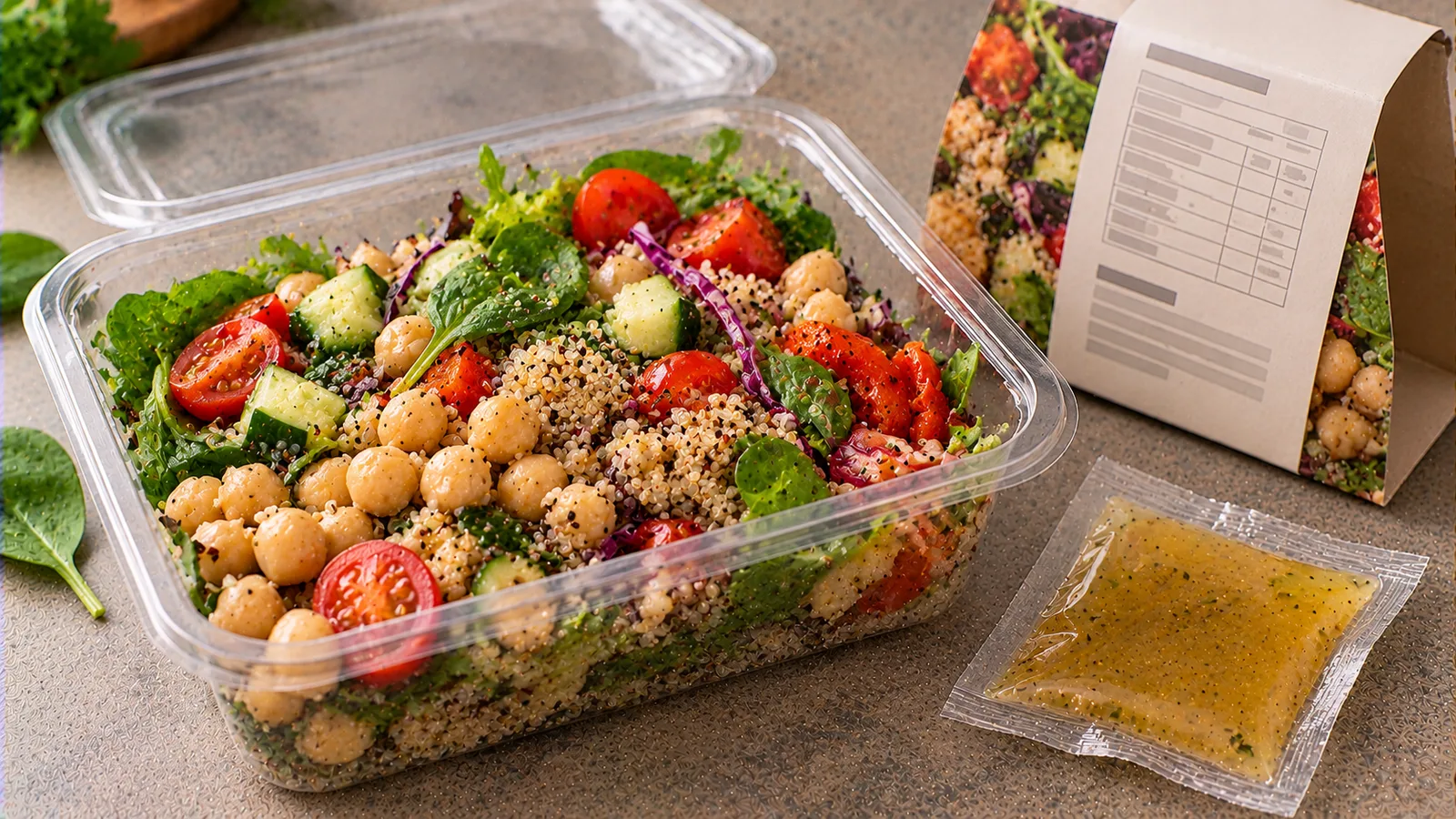
A ready-made salad can be a useful supermarket lunch, but the front of the box is a poor substitute for reading the label. A container filled with leaves may supply very little protein; another with grains, beans, chicken or tofu may offer a more substantial meal. The answer depends on the actual edible package and dressing, not whether the photograph looks healthy.
This guide is specifically for chilled, prepacked, ready-to-eat supermarket salads sold in the EU. It offers a repeatable checklist for choosing one lunch by protein, fibre, energy, salt, allergens and storage information. It is not a general explanation of every nutrition-label symbol, and it does not rank unnamed products using invented brand values.
The 60-second shelf checklist
| Look at | Question to answer | What to record |
|---|---|---|
| Pack and serving | Is this one full lunch or several stated servings? | Total edible grams and serving count |
| Nutrition basis | Does the table cover the complete salad including dressing? | Whole-meal or components-only basis |
| Protein | How many grams will I actually eat? | Protein per complete meal |
| Fibre | Is fibre declared? | Stated grams, or unknown if absent |
| Salt | What is the salt for the complete pack? | Grams per meal, including dressing |
| Ingredients and allergens | What provides substance and which allergens are present? | Main ingredients and allergen warnings |
| Date and cold storage | Can it be safely eaten when planned? | Use-by date and label instructions |
Do the calculations on the whole meal you intend to eat, then compare options on that same basis. A salad described as “two servings” is still two servings on the manufacturer's label even when you intend to eat the whole container yourself.
Start with the correct label basis
EU rules require the majority of prepacked foods to give nutrition information per 100 g or per 100 ml. A manufacturer can additionally give numbers per portion. The mandatory declaration normally covers energy, fat, saturates, carbohydrate, sugars, protein and salt. Fibre can be supplied voluntarily, so its absence does not mean that a salad contains zero fibre. See the European Commission explanation of nutrition declarations for the actual legal framework.
First check the net weight and portion statement, and find out what the nutrition table covers. Some products declare values for the salad including the enclosed dressing; others present components separately. Read the qualifying words around the numbers rather than silently assuming either format.
When a full-product panel already includes dressing, multiplying the whole-package weight by its per-100-g figures gives the meal total. Do not add the sachet again: that would double-count it. When the salad base and dressing have separate panels, calculate each component from the relevant weight and sum them only if you plan to consume both.
Worked example: a salad and a separate dressing sachet
Consider an illustrative pair of fictional labels, not products currently sold in a named shop. The salad base weighs 250 g and the separate dressing sachet weighs 30 g. Their two nutrition tables explicitly refer to the two separate components.
| Fictional component | Per 100 g | Weight eaten | Whole component |
|---|---|---|---|
| Salad base: energy | 90 kcal | 250 g | 225 kcal |
| Salad base: protein | 7 g | 250 g | 17.5 g |
| Salad base: fibre | 2 g | 250 g | 5 g |
| Salad base: salt | 0.32 g | 250 g | 0.80 g |
| Dressing: energy | 420 kcal | 30 g | 126 kcal |
| Dressing: protein | 1 g | 30 g | 0.3 g |
| Dressing: fibre | 0 g | 30 g | 0 g |
| Dressing: salt | 2 g | 30 g | 0.60 g |
For the entire 280 g meal when you use all the dressing, the calculated totals are 351 kcal, 17.8 g protein, 5 g fibre and 1.40 g salt. These are made-up arithmetic inputs, not measured values, product recommendations or target intake levels.
The method for each component is: per-100-g label value × grams eaten ÷ 100. For example, dressing salt is 2 × 30 ÷ 100 = 0.60 g. Adding that to the salad-base 0.80 g gives 1.40 g salt. The sachet adds relatively little protein here but changes energy and salt noticeably. Other real dressings may have completely different figures.
If you use only half the sachet, replace the dressing weight with 15 g and calculate again. Do not halve the entire salad's values. Conversely, if the packaging gives one combined nutrition table for a 280 g complete meal, calculate from the combined panel once, not from these fictional component tables.
Compare protein in grams for the meal, not a claim on the front
A label reading 6 g protein per 100 g does not tell you whether the lunch contains 6 g or 18 g. A 300 g product with that verified value provides 18 g protein for the complete pack. A 150 g product with the same per-100-g value provides 9 g. Pack size therefore matters as much as the figure in the small table.
For a ready-to-eat salad, check which ingredients contribute to protein: beans, lentils, eggs, fish, poultry, tofu, cheese or grains may be included, but their presence alone does not establish the pack's total. A few decorative chickpeas are not equivalent to a measured serving. Prefer the actual declared protein number when comparing two products.
The regulated EU claims “source of protein” and “high protein” are not simply synonyms for “contains 12 g” or “contains 20 g”. Under the rules, at least 12% of a food's energy must come from protein for “source of protein”, and at least 20% for “high protein”. Those are percentages of energy, not fixed grams per pack. Read the European Commission claim conditions before treating marketing language as a numeric promise.
There is no one protein amount that every person needs from every lunch. Your needs and the rest of the day's meals matter. Use whole-meal grams as a comparison tool, not a universal pass/fail cutoff.
Check fibre without inventing missing values
Vegetables alone do not prove that a packaged lunch contains a particular amount of fibre. Beans, whole grains, vegetables and seeds may contribute, but the proper starting point is the number on the label if fibre is declared. Fibre is optional in the ordinary EU nutrition declaration, and an undeclared number must be marked unknown, not zero.
For a 250 g product stating 2 g fibre per 100 g, the pack contains 5 g if all 250 g are eaten. For a 200 g product stating 3 g per 100 g, the pack gives 6 g. The second pack is smaller but provides more declared fibre. Do not compare 2 g/100 g with 6 g/pack without aligning the bases.
In the EU, “source of fibre” may be claimed at 3 g per 100 g OR 1.5 g per 100 kcal; “high fibre” at 6 g per 100 g OR 3 g per 100 kcal. These are legal criteria for marketing claims, not recommendations that every lunch should satisfy. A salad can contribute useful fibre without carrying either claim. The precise conditions are listed by the European Commission.
If fibre is missing and important for your choice, use the ingredient list to identify plausible sources, but do not assign a gram value from appearance. You can also look for a manufacturer-provided fuller specification. If no credible fibre value is available, compare the products using the facts that are actually known.
Salt, energy and the dressing decision
Protein and fibre alone do not describe the entire lunch. The mandatory EU declaration includes salt, so compare the amount in the complete meal, including sauces and toppings. In the fictional worked example, the salad base contains 0.80 g salt and the dressing contributes another 0.60 g. Ignoring the sachet would undercount the planned meal.
The same problem applies to energy. The salad base in the example gives 225 kcal, and the dressing adds 126 kcal when all 30 g are eaten. That yields 351 kcal for the full meal, not 225 kcal. Both figures are correct for different consumption choices; neither should be presented without its basis.
Compare salads by their role in your meal. A small, very low-energy bag of leaves may work as a side, while a complete lunch may benefit from more substance. Higher energy is not automatically bad, and lower energy is not automatically sufficient. Avoid defining a “healthy salad” by a single calorie threshold.
Ingredients, allergens and actual contents
Look at the ingredient list to understand whether most of the container consists of leafy greens or whether meaningful portions of beans, grains, proteins and vegetables are included. Under EU rules, prepacked foods must show their ingredients and emphasise relevant allergens in the list. The food name, quantity and storage instructions also matter. See the Commission's mandatory food-information page.
Common salad components can introduce allergens: eggs, milk-containing cheese, fish, wheat or other cereals containing gluten, sesame, soy and mustard in dressings are examples. These are possible ingredients, not a statement that every prepared salad contains them. Check the specific pack and every sachet instead of relying on the meal's generic name.
The ingredient list is not a replacement for a nutrient table: an ingredient can appear without telling you the number of grams of protein it contributes. Equally, two salads with similar protein totals can be made from different ingredients and suit different preferences or dietary restrictions.
The use-by date is a safety gate, not a nutrition score
Many chilled ready-to-eat salads use a “use by” date. That date concerns food safety, not just peak flavour. EFSA explicitly notes that ready-to-eat salads with such labels should not be eaten after the use-by date, even if they look and smell normal. Follow the packaging's cold-storage instructions from purchase until lunch. See EFSA's food-date guidance.
Read the actual instructions for transport, refrigeration and after-opening storage. A salad bought in the morning for a later lunch should not be left on a warm desk all day. Damaged packs, leaking dressing and uncertain cold storage deserve attention before nutrition comparisons.
Do not confuse “best before”, which primarily concerns quality, with “use by”, which concerns safety. The label on the specific food governs. If a counter-prepared salad is sold without conventional prepackaging, the information supplied can differ from the full prepacked-food label; ask the seller about allergens and ingredients rather than assume a complete per-100-g panel will always be available.
Compare two candidates fairly in the supermarket
When choosing between ready-made lunch salads, record a few comparable numbers in your phone: pack size, protein per whole meal, declared fibre per whole meal, salt per whole meal and energy with the dressing you intend to eat. Check whether the pack is one portion or two and whether the sachet is included in its nutrition panel.
For example, a fictional 300 g salad labelled 6 g protein per 100 g contains 18 g protein if you finish it. A different fictional 200 g salad labelled 7 g protein per 100 g contains 14 g protein. The second looks higher on a per-100-g basis, yet the first gives more protein across the whole pack. This does not by itself determine which is better: price, fibre, salt, ingredients, energy and the user's appetite still matter.
Use the same calculation for a stated fibre figure. If one product has no fibre figure, keep it as unknown. Do not label the other product an absolute fibre winner. If separate dressing is optional, compare using the amount of dressing you will actually consume instead of automatically adding a full sachet to one candidate and none to the other.
A lunch decision you can repeat next week
Choose the package whose measured whole-meal characteristics fit your needs, check its ingredients and allergens, and make sure it will still be within the use-by date and correctly chilled when eaten. The checklist works whether the salad contains lentils, rice, chicken, tofu, cheese or only vegetables; it does not require any particular brand.
If you want to build the same type of lunch at home, our guide to our balanced-meal guide explains how vegetables, protein foods and carbohydrate sources can be combined. For a broader explanation of nutrition panels beyond supermarket salads, see our general nutrition-label guide. To compare protein and fibre in a different packaged category, see our protein-and-fibre packaged-snack label comparison. Those guides cover different decisions rather than repeating this lunch-specific method.
A good supermarket lunch choice is one whose numbers you can actually verify for the food you will eat, without treating missing fibre as zero, overcounting dressing or assuming a “high protein” front-of-pack claim provides a fixed number of grams.
Sources
- European Commission — Nutrition labelling. Mandatory energy, protein and salt entries, optional fibre and the per-100-g basis.
- European Commission — Authorised nutrition claims. Conditions for “source/high in protein” and “source/high in fibre”.
- European Commission — Mandatory food information. Ingredient, allergen, net quantity, date and storage requirements for prepacked foods.
- European Food Safety Authority — Food date labelling. Distinguishing use-by from best-before, including chilled ready-to-eat salads.
All food-label values used in the calculations are explicitly hypothetical, not measurements of a named retail product. The mathematics illustrates how to use a real package label; it is not a suggested daily intake or clinical nutrition advice.