
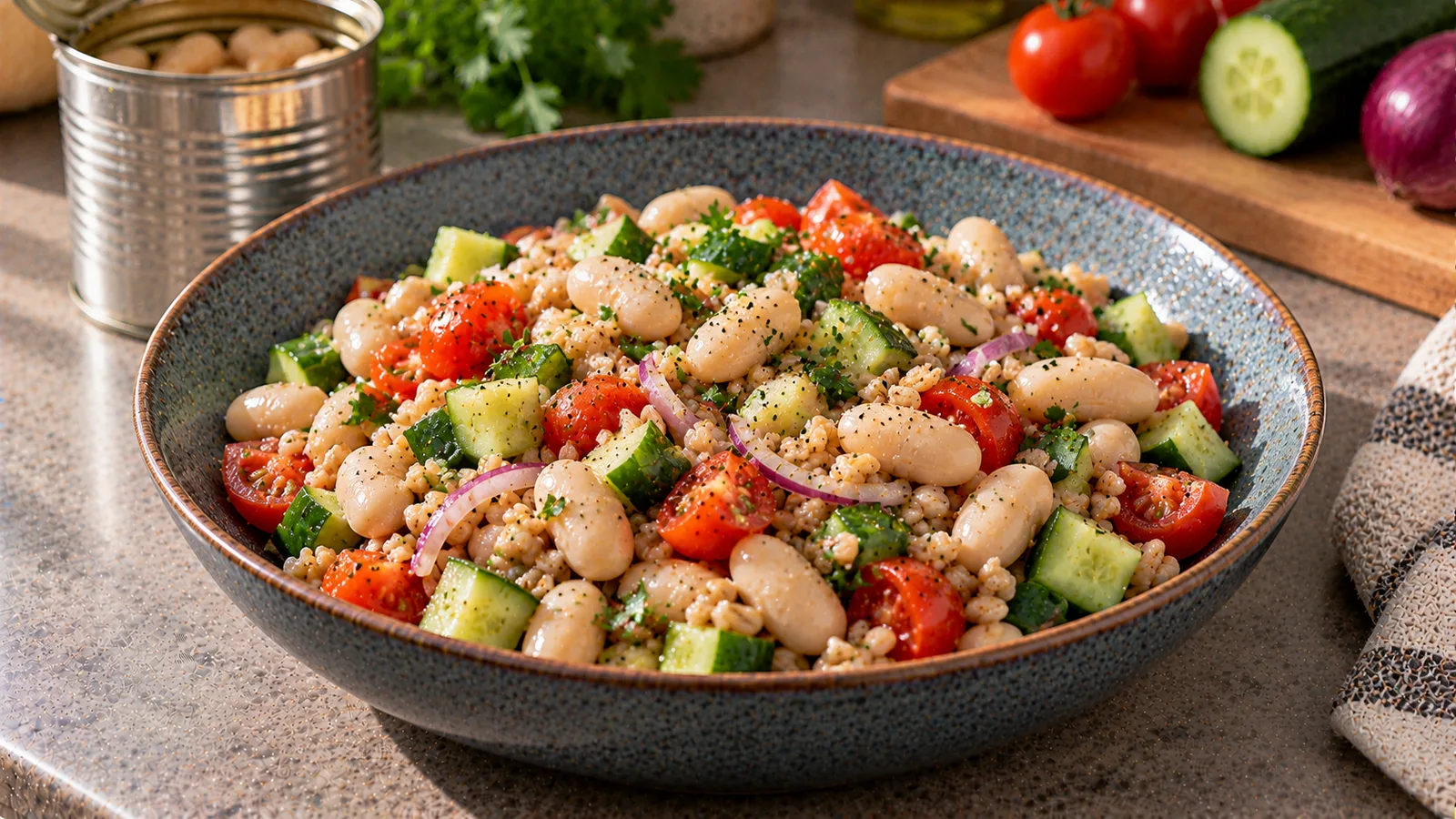
A balanced packed lunch does not require expensive ready-made salads. Four lunches can use one 240 g drained can of kidney beans and one 240 g drained can of cannellini beans, with exactly 120 g of beans assigned to each portion. Add a different grain, starchy vegetable or bread, plus produce and a modest dressing, and the four containers need not taste like repeated copies of one bean salad.
The practical complications are not the beans themselves but what the label counts, how much salt remains after draining, the cost of partly used groceries and food safety. This article keeps those separate. It compares two named products sold in Germany, gives measured recipes for one adult lunch each and prices every item in an illustrative shopping basket. It is not a replacement for the general guide to why rinsing canned legumes can change sodium; Mealisa guide to rinsing canned legumes covers that mechanism in detail.
The cans and the numbers that belong to them
The examples are dmBio Kidneybohnen and dmBio Cannellini Bohnen, each with 240 g drained weight. At the time the product pages were checked, kidney beans were listed at €0.85 and cannellini beans at €1.15 per can. These are German product examples rather than a promise that every shop will use those prices later.
Both labels state 0.35 g salt per 100 g of beans. Kidney beans list 101 kcal, 7.7 g protein and 6.4 g fiber per 100 g; cannellini list 93 kcal, 6.4 g protein and 5.9 g fiber per 100 g. The figures below therefore describe those products, not every generic canned bean. The nutrient labels may use the product as sold, while the recipe weight is drained; the approximation is explicitly based on the label because a separate laboratory analysis of the drained-and-rinsed solids is not available.
Salt and sodium are not interchangeable units: an EU salt declaration is calculated using sodium × 2.5. That is why the table reports the label's salt in grams, without presenting a lab-tested amount after rinsing.
| Reference bean | kcal/100 g | Protein/100 g | Fiber/100 g | Salt/100 g | Drained can | Posted price |
|---|---|---|---|---|---|---|
| dmBio kidney beans | 101 | 7.7 g | 6.4 g | 0.35 g | 240 g | €0.85 |
| dmBio cannellini beans | 93 | 6.4 g | 5.9 g | 0.35 g | 240 g | €1.15 |
Four actual lunch portions, not four vague ideas
Each build is one lunch. Weigh the beans after draining; use the listed dry weight for rice and couscous; and count oil that ends up in the eaten portion. If the final lunch is too large or too small for your needs, adjust the starchy ingredient or add food alongside it rather than assuming that every adult must eat an identical amount.
Lunch A — Kidney bean and couscous salad. Cover 65 g dry couscous with the amount of hot water indicated on the package and fluff. Cool promptly. Toss with 120 g kidney beans, 130 g chopped tomato, 80 g cucumber, 8 g olive oil and 10 g lemon. Pack the tomato separately if preparing in advance and add the dressing at serving time. The lemon and vegetable flavor help avoid needing additional salt; season with salt-free herbs if desired.
Lunch B — Cannellini tomato-spinach toast. Gently mash 120 g cannellini beans with 8 g oil and 10 g lemon. Add 100 g tomatoes and 60 g spinach. Pack the bean spread and vegetables separately from 90 g wholegrain bread, then assemble just before eating so the bread stays crisp. This is a cold lunch; the beans are pre-cooked.
Lunch C — Kidney, pea and carrot rice bowl. Cook 65 g dry rice as directed. Briefly heat 100 g frozen peas until cooked and soften 100 g diced carrot. Combine with 120 g drained kidney beans and 8 g oil. Cool in shallow containers promptly before refrigerating. Eat as a chilled bowl if transported cold, or reheat thoroughly when a microwave is available. Do not leave cooked rice at room temperature while the rest of lunch is prepared.
Lunch D — Cannellini, potato and yogurt box. Cook 200 g potatoes until tender; cool promptly. Add 120 g cannellini beans, 70 g carrot, 50 g spinach, 70 g plain yogurt, 8 g olive oil and 10 g lemon. Mix the yogurt, oil and lemon as a separate dressing. Keep the assembled box refrigerated; dairy makes an ice pack important when carrying it.
| Lunch | Ingredients, edible or dry g |
|---|---|
| A — Kidney bean and couscous salad | dmBio kidney beans 120 g; dry couscous 65 g; tomatoes 130 g; cucumber 80 g; olive oil 8 g; lemon edible portion 10 g |
| B — Cannellini tomato-spinach toast | dmBio cannellini beans 120 g; wholegrain bread 90 g; tomatoes 100 g; baby spinach 60 g; olive oil 8 g; lemon edible portion 10 g |
| C — Kidney, pea and carrot rice bowl | dmBio kidney beans 120 g; dry rice 65 g; carrots 100 g; frozen peas 100 g; olive oil 8 g |
| D — Cannellini, potato and yogurt box | dmBio cannellini beans 120 g; potatoes 200 g; carrots 70 g; baby spinach 50 g; plain yogurt 70 g; olive oil 8 g; lemon edible portion 10 g |
Bean fiber and bean salt per box
The calculation below deliberately shows fiber supplied by the beans alone. It does not pretend to be the full recipe's fiber or calorie declaration. Bread, potatoes, vegetables, rice and couscous also contribute nutrients, and the exact totals depend on the products chosen.
For either brand, 120 g × 0.35 g salt ÷ 100 = 0.42 g of declared salt from beans before any draining/rinsing effect and before other ingredients or table salt. Kidney beans supply 120 × 6.4 ÷ 100 = 7.68 g, or about 7.7 g fiber; cannellini supply 120 × 5.9 ÷ 100 = 7.08 g, or about 7.1 g. Across all four lunches, the two cans supply 29.6 g bean fiber when adding the four separately rounded one-decimal entries, or 29.52 g before rounding. The bean-label salt sum is 1.68 g, not the final salt across four fully prepared meals.
| Lunch | Drained beans | Fiber from beans only | Label salt from beans only | Used-ingredient cost |
|---|---|---|---|---|
| A — Kidney bean and couscous salad | dmBio kidney beans 120 g | 7.7 g | 0.4 g | €1.44 |
| B — Cannellini tomato-spinach toast | dmBio cannellini beans 120 g | 7.1 g | 0.4 g | €1.90 |
| C — Kidney, pea and carrot rice bowl | dmBio kidney beans 120 g | 7.7 g | 0.4 g | €1.00 |
| D — Cannellini, potato and yogurt box | dmBio cannellini beans 120 g | 7.1 g | 0.4 g | €1.66 |
Does rinsing make a lunch low in salt?
Rinsing may help, but one cannot apply a universal subtraction to the numbers above. A 2011 published study measured canned beans in liquid, after draining, and after draining plus rinsing; both steps reduced sodium in the tested products. Different brands, salt levels, liquids and rinse techniques mean the percentage is not a reliable multiplier for the two particular dmBio cans. Do not label these four completed meals “low salt” without measuring or calculating salt from every ingredient.
The practical sequence is to read the salt value per 100 g, drain into a sieve, rinse under cool potable water if you want to remove some surface brine, and let the beans drain again before weighing the recipe portion. Use no-salt-added cans when available; compare salt per 100 g, not just the front-of-pack description. If you rinse, the label salt computation becomes a conservative pre-rinse reference, not a precise post-rinse measurement.
The EU Regulation (EC) No 1924/2006 specifies conditions for nutrition claims such as “source of fiber” and “high fiber”. That does not by itself allow a brand or recipe author to make a blanket medical or “low salt” claim about a homemade lunch. A practical packed lunch can be reasonable for someone watching salt without pretending that rinsing makes its sodium content exactly known.
One basket: checkout versus the food actually eaten
This basket uses 14 ingredient lines. The cans use the posted dmBio prices above. All other package prices are illustrative German budgeting assumptions, not live shop quotations. The model assumes a 300 g edible cucumber and a 100 g edible lemon, both of which should be checked by actual weighing. Herbs, tap water, cooking energy, any salt, transport, equipment and delivery fees are excluded; adding them would raise spending.
The two sorts of costs answer different questions. Checkout cost is the money needed to buy full packages when the cupboard is empty. Ingredient-use cost assigns to these four lunches only the proportion of each product used. They cannot be exchanged with one another: the unused bread, rice, potatoes, vegetables and olive oil are available for later meals.
For a workplace budget, this distinction can be decisive. A pantry already containing olive oil, rice or spices has lower cash spending today than the full-shopping figure, but the oil or rice still has a useful unit cost in comparing lunches. Product shrinkage, spoilage, regional offers and changing prices shift the real result; re-enter your actual till prices if you need an accurate shopping plan.
| Item | Pack size | Assumed/posted pack price | Used for four lunches | Pro-rated use cost | Unused weight |
|---|---|---|---|---|---|
| dmBio kidney beans | 240 g | €0.85 | 240 g | €0.85 | 0 g |
| dmBio cannellini beans | 240 g | €1.15 | 240 g | €1.15 | 0 g |
| dry couscous | 500 g | €1.29 | 65 g | €0.17 | 435 g |
| dry rice | 1000 g | €1.99 | 65 g | €0.13 | 935 g |
| wholegrain bread | 500 g | €1.69 | 90 g | €0.30 | 410 g |
| potatoes | 2000 g | €2.49 | 200 g | €0.25 | 1800 g |
| tomatoes | 500 g | €1.69 | 230 g | €0.78 | 270 g |
| cucumber | 300 g | €0.99 | 80 g | €0.26 | 220 g |
| baby spinach | 200 g | €1.79 | 110 g | €0.98 | 90 g |
| carrots | 1000 g | €1.29 | 170 g | €0.22 | 830 g |
| frozen peas | 750 g | €1.69 | 100 g | €0.23 | 650 g |
| plain yogurt | 500 g | €1.09 | 70 g | €0.15 | 430 g |
| lemon edible portion | 100 g | €0.59 | 30 g | €0.18 | 70 g |
| olive oil | 500 g | €5.49 | 32 g | €0.35 | 468 g |
| Check | Result |
|---|---|
| Full-package checkout | €24.08 |
| Ingredients consumed | €6.00 |
| Value left in other food | €18.08 |
| Average used cost per lunch | €1.50 |
| Four lunches: beans-only fiber (unrounded) | 29.52 g |
| Four lunches: beans-label salt (pre-rinse reference) | 1.68 g |
Packing and storage without extending a can beyond its label
Open the cans when you intend to prepare the two paired bean portions, and transfer anything not used straight away into a clean non-metallic sealed food container. The named dmBio product pages indicate 3–4 days refrigerated after opening; follow the package instructions if they change. For the most cautious workflow, prepare lunches A and B on one day, and open fresh cans for C and D in a later session only if buying extra cans; that changes the purchase cost. With exactly two cans, prepare all four bean components close together, chill promptly, and eat within the most restrictive ingredient limit or freeze suitable components instead of holding a finished yogurt salad for four days.
A simpler four-lunch schedule is to prepare A and B now, portion beans for C and D into clean containers immediately and freeze those bean portions on day one. Defrost safely in the fridge before cooking rice or potatoes fresh on the later day. The vegetables and yogurt dressing are best prepared close to the day they are eaten. Do not freeze the assembled toast or yogurt-based box and expect unchanged texture.
FoodSafety.gov advises refrigerating perishable leftovers within two hours, using shallow containers, and eating refrigerated cooked leftovers within three to four days; transport chilled lunches with insulated bags and cold packs. Pay particular attention to cooked rice. If food has been held unrefrigerated too long, reheating is not a reliable repair. The one-day meal-prep layout is a convenience example, not an exception to safe handling.
Adjusting the plan when the label or package changes
If a can says 400 g total contents but 240 g drained beans, the bean quantity available for the recipes is 240 g, not 400 g. Each half-can used here is 120 g drained. A bag of beans that is a different size changes the arithmetic; do not quietly carry over these figures. Likewise, a supermarket can containing a different brine or a seasoned sauce can have a very different salt value.
Someone aiming for a higher-protein lunch could add a verified portion of egg, tofu or plain yogurt and recalculate the cost and salt; someone needing more energy could increase bread, rice or potatoes. The recipes are building blocks, not a clinical nutrition prescription. If your actual can differs, the decisive inputs are its drained weight, label fiber, protein, calories, salt and the price actually paid.
For related reading, our guide to calories in white beans describes white beans as a food on their own, while guide to high-fiber foods covers where to find fiber across a whole diet. portion size versus serving size explains why a printed serving size is not the same as the grams you really ate. Those pages serve different search tasks: this page is specifically about four prepared canned-bean lunches, with measured components and a workable budget.
Sources and scope
Product labels and prices: dmBio Kidneybohnen and dmBio Cannellini Bohnen. Research on draining/rinsing: Duyff, Mount and Jones, Sodium Reduction in Canned Beans After Draining, Rinsing (2011). Preparing pre-cooked pulses: Germany's BZfE. Safe leftovers: FoodSafety.gov. Nutrition claims: Regulation (EC) No 1924/2006.
The four lunch costs and shopping list are arithmetic from the explicitly assumed package prices. The fiber and salt calculations use the beans' label data only and are not independently analyzed full meals. Product listings and regulatory interpretations should be reconfirmed at publication time.