
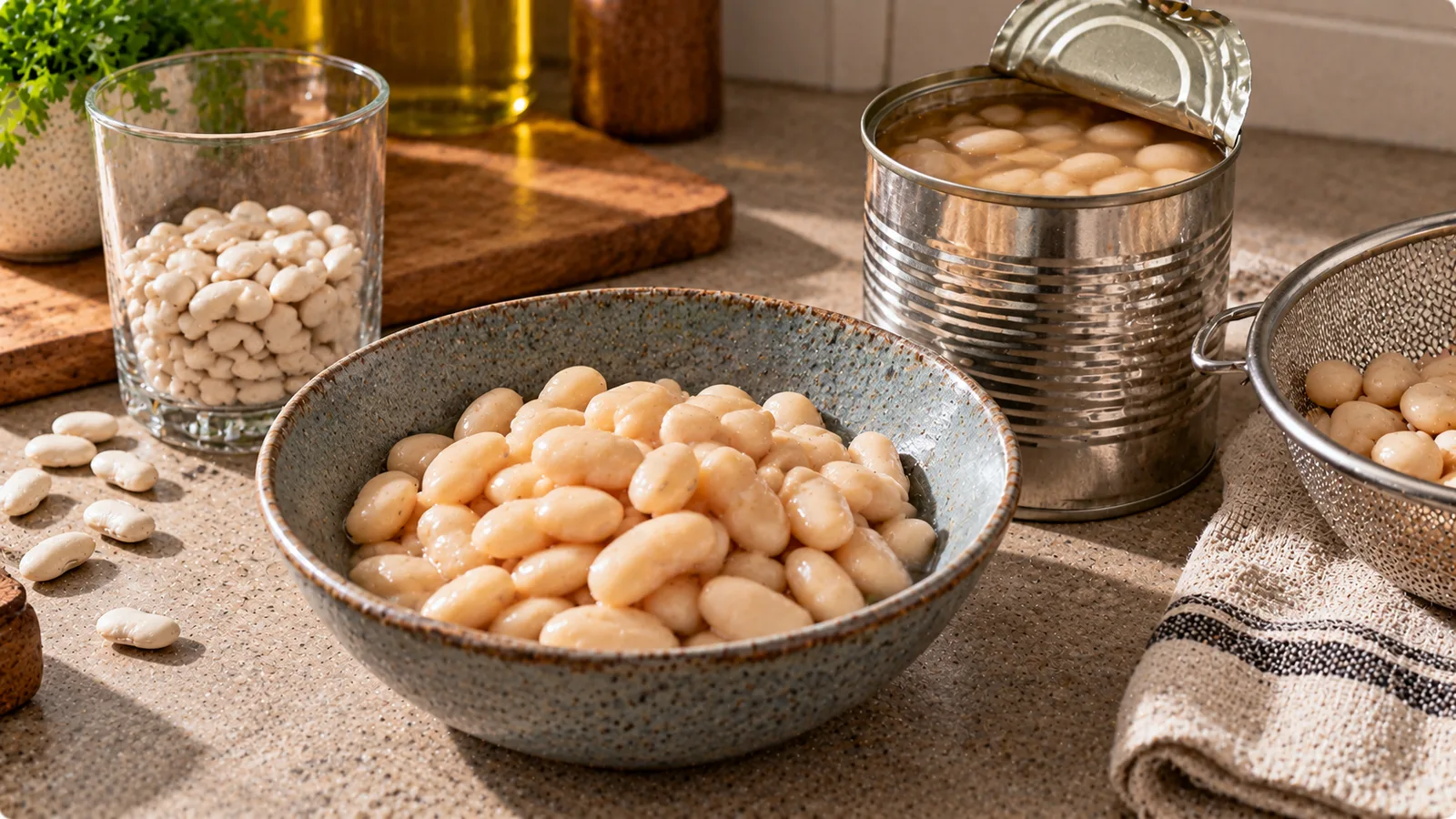
White beans are a useful source of plant protein, carbohydrates and fiber. But their calorie content can look surprisingly different depending on whether you weigh them dry, cooked or drained from a can.
The most important distinction is water content.
Dry beans are concentrated. During cooking, they absorb water and become heavier, so the calories per 100 g decrease. Canned beans are already hydrated, but their exact nutritional values depend on the variety and processing.
For calorie tracking, always match the nutritional data to the form of beans you actually weighed.
How many calories are in white beans?
A practical reference for plain white beans is:
| Form of white beans | Calories per 100 g | Protein | Carbohydrates | Fat | Fiber |
|---|---|---|---|---|---|
| Dry, uncooked | ~333 kcal | ~23.4 g | ~60.3 g | ~0.9 g | ~15.2 g |
| Cooked, boiled without added fat | ~139 kcal | ~9.7 g | ~25.1 g | ~0.4 g | ~6.3 g |
| Canned, drained | ~95–125 kcal | Varies | Varies | Usually low | Varies |
The dry and cooked figures are rounded reference values for USDA white beans. The canned range is illustrative because brands, bean varieties and draining methods differ.
Carbohydrate values in US databases generally include fiber. They should not be interpreted as directly equivalent to every European label's carbohydrate declaration.
For a packaged product, use its own nutrition label when available.
Calories in common portions
Using approximately 139 kcal per 100 g of plain cooked white beans:
| Cooked portion | Calories | Protein |
|---|---|---|
| 50 g | ~70 kcal | ~4.9 g |
| 100 g | ~139 kcal | ~9.7 g |
| 125 g | ~174 kcal | ~12.1 g |
| 150 g | ~209 kcal | ~14.6 g |
| 200 g | ~278 kcal | ~19.4 g |
| 250 g | ~348 kcal | ~24.3 g |
These calculations refer to the weight of the cooked beans, not the original dry weight.
A cup or ladle is less precise because bean size, packing and liquid content affect the weight.
For accurate tracking, weighing the edible portion is more reliable.
Dry versus cooked white beans
Dry and cooked beans contain broadly the same underlying nutrients before accounting for preparation losses, but the concentration per gram changes substantially.
Consider 100 g of dry beans.
At approximately 333 kcal, that dry quantity contains around 333 kcal before cooking.
After soaking and boiling, it may weigh substantially more because it has absorbed water.
If the cooked yield were 240 g, the calculation would be:
333 kcal ÷ 240 g × 100 = approximately 139 kcal per 100 g cooked.
The 240 g yield is an example, not a guaranteed conversion.
Actual yield depends on the bean variety, soaking, cooking time, water absorption and handling.
Why this matters when logging food
Suppose you weigh 180 g of cooked white beans.
Using cooked values:
180 × 139 ÷ 100 = 250 kcal, approximately.
If you mistakenly select a dry-bean entry:
180 × 333 ÷ 100 = 599 kcal, approximately.
That is a difference of about 349 kcal caused by selecting the wrong food state.
The beans have not magically lost calories during cooking. Water has changed their weight.
Calories in canned white beans
Canned white beans are convenient because they are already cooked.
However, nutrition labels may refer to different quantities:
- The entire contents of the can.
- The product including liquid.
- The drained beans.
- A specified serving size.
Read the label carefully before calculating calories.
Example: a drained can
Imagine a can labeled:
- Net weight: 400 g.
- Drained weight: 240 g.
- Energy: 110 kcal per 100 g of drained beans.
If you eat all the drained beans:
240 × 110 ÷ 100 = 264 kcal.
If you eat half:
120 × 110 ÷ 100 = 132 kcal.
These are example label values, not a claim about a particular brand.
Does rinsing change the calories?
Rinsing canned beans can remove some of the liquid and dissolved sodium.
It does not remove a large proportion of the beans' internal starch or protein.
The effect on calories is generally much smaller than the difference between dry and hydrated weights.
For precise tracking, use the applicable label and the drained edible weight.
Are cannellini beans the same as white beans?
Cannellini beans are a type of white bean, commonly used in soups, salads and Italian cooking.
The term white beans can also refer to navy beans, great northern beans and other pale-colored varieties.
Their nutritional profiles are similar but not identical.
| Variety | Typical culinary use | Nutrition consideration |
|---|---|---|
| Cannellini | Salads, soups, stews | Use cannellini-specific data when available |
| Navy beans | Baked beans, soups | Values can differ from cannellini |
| Great northern | Soups and casseroles | Serving weight and preparation matter |
| Generic white beans | Mixed recipes and canned products | Check the actual product or database entry |
A separate calorie calculation for every naming variation is not necessary if the actual product information is available.
For packaged cannellini beans, the label is the most relevant starting point.
White beans: protein, carbohydrates and fiber
Plain cooked white beans provide approximately:
- 9.7 g protein per 100 g.
- 25.1 g total carbohydrates per 100 g under the US database convention.
- 6.3 g fiber per 100 g.
- Less than 1 g fat per 100 g.
A 150 g cooked portion therefore provides approximately 14.6 g protein and 9.5 g fiber.
These are useful amounts, although white beans should not be treated as equivalent to a concentrated protein source such as fish, eggs or protein isolate.
They provide a combination of protein, starch and fiber.
That combination makes them useful in mixed meals.
Why carbohydrates and fiber need careful interpretation
Nutrition labels in the European Union generally list carbohydrates separately from fiber.
US food-composition databases often report total carbohydrate by difference, which includes fiber.
Therefore, the carbohydrate figures from the two systems may appear inconsistent even when they describe similar foods.
Do not subtract fiber twice when using a European carbohydrate value.
For routine tracking, use one consistent database or the product label.
Do white beans help with fullness?
White beans contain protein and fiber, both of which can contribute to satiety as part of a balanced meal.
They can also replace some refined starches in dishes or add substance to soups and salads.
However, no single food guarantees weight loss.
Total energy intake, meal composition, appetite, activity and individual circumstances remain important.
For example, 150 g of plain cooked white beans contains approximately 209 kcal.
Adding 15 g of olive oil contributes roughly another 133 kcal.
The resulting dish is not equivalent in calories to plain beans.
When tracking a prepared meal, count oils, sauces and other ingredients separately.
Calories in white bean dishes
The following examples demonstrate how additions change the final calorie count.
| Meal | Illustrative calculation | Approximate calories |
|---|---|---|
| Plain cooked white beans, 150 g | 150 × 1.39 | 209 kcal |
| White beans, 150 g + olive oil, 10 g | 209 + 88 | 297 kcal |
| White beans, 200 g + tomatoes, 100 g | 278 + ~18 | 296 kcal |
| White beans, 150 g + tuna in water, 100 g | 209 + ~116 | 325 kcal |
Values for added ingredients are approximate. Use the actual brand and preparation method for accurate logging.
The examples exclude additional seasonings or ingredients unless stated.
How to log white beans correctly
Use this simple sequence:
- Identify whether the beans are dry, cooked or canned.
- If canned, check whether the label uses drained weight.
- Weigh the portion in the same state described by the nutrition entry.
- Use the product label or a suitable food-composition record.
- Add cooking oil, sauces, meat and other ingredients separately.
- If preparing a batch, record the total ingredients and the final edible yield.
Example: homemade white bean soup
Suppose a soup contains:
- 300 g cooked white beans.
- 200 g carrots.
- 150 g onions.
- 15 g olive oil.
- Water, herbs and spices.
Using illustrative energy values:
| Ingredient | Calculation | Calories |
|---|---|---|
| Cooked white beans | 300 × 1.39 | 417 |
| Carrots | 200 × 0.41 | 82 |
| Onions | 150 × 0.40 | 60 |
| Olive oil | 15 × 8.84 | 133 |
| Total | 692 |
If the finished soup is divided into four equal servings, each contains approximately 173 kcal.
If you add bread or another topping, count it separately.
Water changes the soup's weight and calories per 100 g, but not its total energy.
How much white beans should you eat?
There is no single correct portion for everyone.
A serving depends on whether beans are the main part of the meal, a side dish or one ingredient in a larger recipe.
For practical planning:
- 75–100 g cooked can work as a small addition.
- 125–150 g cooked can be a substantial side.
- 180–250 g cooked can form the main carbohydrate-and-legume component of a meal.
These are examples, not medical or dietary prescriptions.
If you are increasing your intake of beans, doing so gradually may help reduce digestive discomfort associated with higher fiber intake.
What about canned beans with sauce?
Beans in tomato sauce, baked beans and seasoned canned products should not be logged as plain white beans. For edible yields and costs rather than calories alone, see canned versus dried beans.
The sauce may contain sugar, oil, salt or other ingredients.
Even when the beans are similar, the finished product can have a different calorie density.
Use the specific label.
The same applies to restaurant dishes and homemade bean stews.
Sources and data interpretation
- USDA FoodData Central — reference food-composition database for dry and cooked white beans.
- USDA MyPlate — Beans, Peas and Lentils — food-group context for legumes.
- European Commission — Food Information to Consumers — European nutrition-labeling framework.
The reference values are rounded and should not be interpreted as laboratory measurements of every white-bean variety or brand.
For most everyday calorie tracking, the essential rule is simple: approximately 139 kcal per 100 g of plain cooked white beans is a useful reference, but dry beans and canned products require their own matching values.