
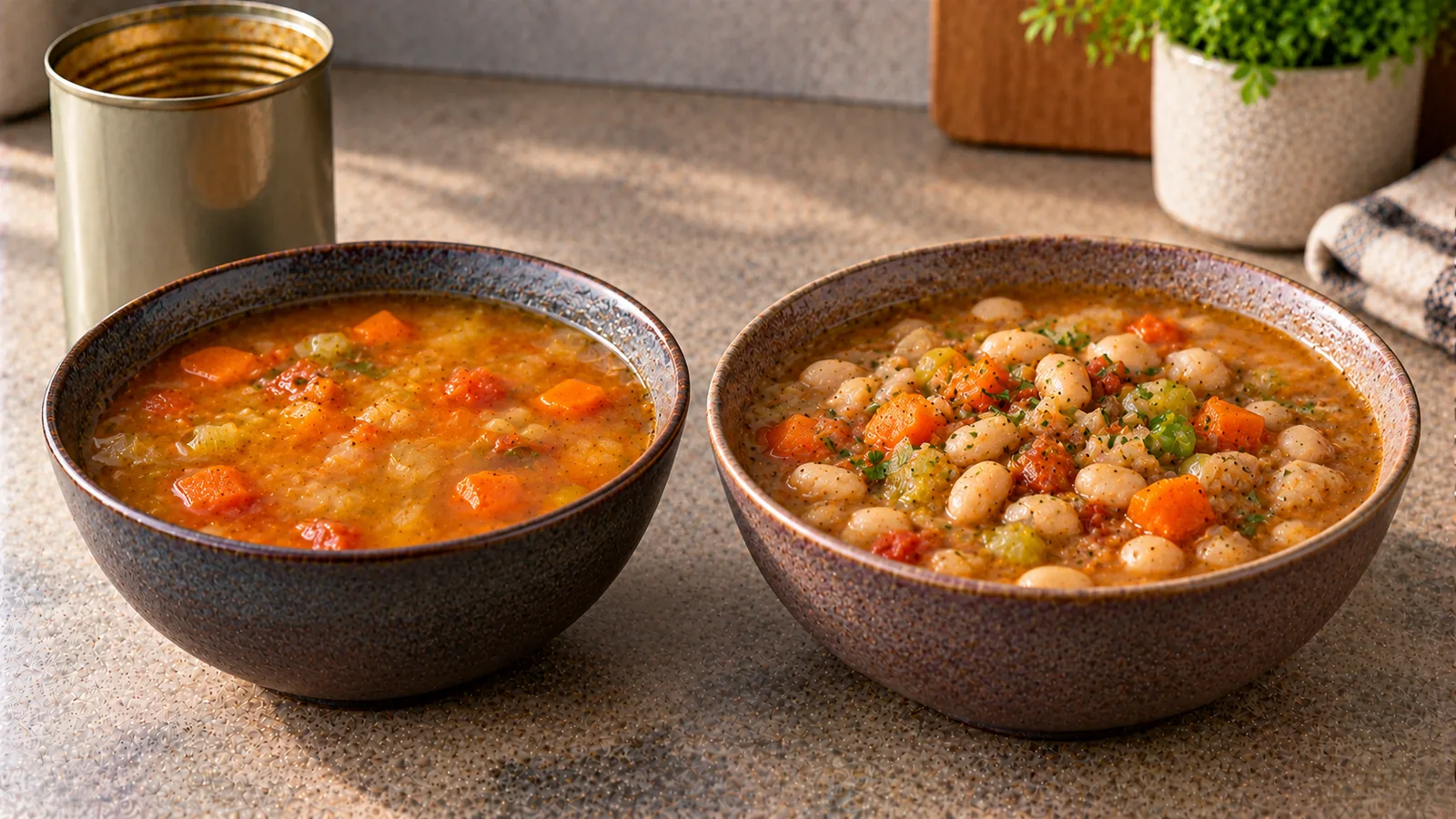
The useful comparison is salt per bowl, not the claim on the front
A supermarket soup can be convenient and still contribute a surprising amount of salt. A home-cooked bean soup gives you more control, but it is not automatically salt-free: canned beans, tomatoes, stock and seasonings can contribute salt before you touch the shaker. The practical question is how much you actually eat, what it costs and which ingredient is responsible for the sodium. This guide compares two specified Erasco products with a transparent four-serving cannellini soup model. It is a label comparison, not a promise that every packaged soup or every homemade recipe behaves the same way.
The two commercial examples are Erasco Serbian Bean Stew, 400 g and Erasco Serbian Bean Soup with smoked bacon, 750 ml. Their published labels report respectively 0.72 g salt per 100 g and 1.00 g salt per 100 ml. We compare a 350 g bowl of the first and a 350 ml bowl of the second; grams and millilitres are not interchangeable without a density measurement, so these are two explicitly different serving conventions. For an equal weighed comparison, put both portions on kitchen scales. Erasco 400 g label and Erasco 750 ml label provide the figures.
At a glance: three soup choices
| Comparison | Erasco bean stew | Erasco bacon bean soup | Home bean soup model |
|---|---|---|---|
| Salt on label or calculated basis | 0.72 g/100 g | 1.00 g/100 ml | ≈0.15 g/100 g finished |
| 350 g or 350 ml bowl | 2.52 g salt | 3.50 g salt | ≈0.52 g tracked salt |
| Calories at that size | 228 kcal | 228 kcal | Not directly matched |
| Price for that bowl | €2.00 assumed | €1.77 assumed | ≈€0.97 model |
For the homemade calculation, 0.52 g is an estimate from the labelled salt in beans and tomatoes divided into four 350 g bowls; it is not a laboratory-tested salt figure. Small amounts naturally present in other vegetables are not included. Commercial prices are hypothetical scenarios, not verified REWE shelf prices. We do not compare calories of dissimilar recipes as if they were nutritionally equivalent.
Why “less salty” does not necessarily mean legally low-salt
In everyday language, the 0.72 g example contains less salt per 100 g than a soup labelled 1.00 g per 100 ml. This does not grant either soup the regulated EU nutrition claim “low sodium/salt.” Under Regulation (EC) 1924/2006, that claim normally requires no more than 0.12 g sodium, equivalent to approximately 0.30 g salt, per 100 g or 100 ml. “Very low” has an even stricter sodium limit. A marketing statement needs to satisfy the applicable conditions; a home calculation or a comparison between brands cannot certify it. Read the actual nutrition panel, including its measurement unit, instead of inferring a legal status from package colours or shelf placement. See the EU regulation.
The same issue arises with “reduced salt.” It is a comparative regulated claim with its own conditions, not another way to say that a product happens to have the smallest number of two products you selected. Do not use a 0.72 g/100 g label to advertise a legally low-salt soup. For the homemade model, even if the calculated 0.15 g/100 g is numerically below the familiar 0.30 g threshold, the entire recipe, naturally occurring sodium and finished yield have not been analytically verified. We describe it as a lower-salt recipe approach, not a legally substantiated claim for a retail product.
Calculate the amount in the bowl
The formula is straightforward: `salt per bowl = salt per 100 g × edible serving in g ÷ 100`. When the label uses millilitres, retain millilitres in the denominator and numerator unless you have measured density. This is why “per can” is misleading if the container holds 400 g but you only eat 250 g, or if two people split a 750 ml pack unevenly. For example, the Erasco 400 g stew has 0.72 × 3.5 = 2.52 g salt in 350 g; eating the entire 400 g would provide 2.88 g. The 750 ml product has 1.00 × 3.5 = 3.50 g salt in 350 ml, and 7.50 g in the whole pack. These figures come from the labels, not from seasoning added at the table.
| Quantity | Erasco 400 g (0.72 g/100 g) | Erasco 750 ml (1.00 g/100 ml) | Why it matters |
|---|---|---|---|
| 250 g or 250 ml | 1.80 g | 2.50 g | Label-size example |
| 350 g or 350 ml | 2.52 g | 3.50 g | Our practical bowl |
| Whole container | 2.88 g (400 g) | 7.50 g (750 ml) | Total if fully eaten |
| 100 g or 100 ml | 0.72 g | 1.00 g | Only like-for-like in label unit |
The WHO recommends adults consume less than 5 g of salt per day, corresponding to less than 2 g sodium. That is a population health recommendation, not a personalised prescription. One 350 ml bowl from the higher-salt example supplies 70% of that 5 g reference before bread, cheese, stock or other meals. WHO sodium reduction guidance explains why packaged foods deserve attention.
The homemade comparison: ingredients and yield
For four filling bowls, use two 400 g cans of dmBio cannellini beans, giving 480 g drained beans, plus 400 g dmBio plain chopped tomatoes, 200 g carrots, 120 g onion, 10 ml olive oil, water, garlic and herbs. Avoid salted stock and do not add table salt in the base scenario. Simmer vegetables in water, then add the drained beans and tomatoes. Top up with water and weigh the finished soup. Our worked model assumes a final yield of 1,400 g, divided into four 350 g bowls. If you actually get 1,250 or 1,600 g, do not pretend the same 350 g scoop contains one quarter of the recipe. Divide the recipe totals by the real final weight.
The dmBio cannellini label specifies 0.35 g salt per 100 g and states a 240 g drained weight per can. The dmBio chopped tomatoes label specifies 0.10 g salt per 100 g. These products are not salt-free. Beans contribute 480 × 0.35 / 100 = 1.68 g labelled salt, and tomatoes contribute 400 × 0.10 / 100 = 0.40 g. The tracked total is 2.08 g, or 0.52 g per quarter-batch, or 0.149 g per 100 g if the finished soup weighs exactly 1,400 g. Other vegetables can add some natural sodium; the real total will not be known exactly from this simplified calculation.
A practical no-added-salt cooking method
Start by softening finely chopped onion and carrot in the measured oil over medium heat. Use a splash of water to prevent sticking rather than doubling the oil. Add garlic, pepper, thyme, bay leaf or smoked paprika, then the chopped tomatoes and water. Simmer until carrots are nearly tender. Drain the beans; rinsing can help remove some packing liquid, but do not assume a fixed percentage of salt disappears, because the label's edible-weight basis and actual retention vary. Add the beans at the end and heat through. Lemon juice, parsley and acidity can make a bowl taste lively without extra salt. Taste only after the bean and tomato components are mixed.
The cooking method helps the comparison remain honest: if you replace plain water with regular stock cubes, salty miso or a commercial sauce, the soup will not retain the lower-salt profile. Likewise, choosing beans packed in saltier liquid may change the total. Keep the original nutrition labels or photograph them for the calculation, and count any salt you deliberately add. If you need strict sodium management for a diagnosed condition, use a clinician's advice rather than relying on an online soup estimate.
The salt sensitivity calculation
A recipe is easy to modify, but the math matters. Add 1.00 g of table salt to the four-bowl pot and the tracked total becomes 3.08 g, or 0.77 g per bowl. Add 2.00 g and it becomes 4.08 g, or 1.02 g per bowl. If a stock cube contributes another 4.00 g of salt to the whole pot, the tracked total reaches 6.08 g and 1.52 g per bowl. This illustrates why a supposedly homemade “healthy soup” can end up much closer to a canned soup once the broth is seasoned. Measuring added salt once is easier than trying to reconstruct it after cooking.
Do not confuse sodium with salt in different countries' label tables. Salt is approximately sodium multiplied by 2.5, but the EU panel typically already shows salt in grams. Multiplying the printed salt entry by 2.5 again would greatly overstate intake. The WHO also provides a salt and sodium converter. For small portions, always keep a reasonable number of decimal places: a difference of 0.1 g is not a laboratory precision guarantee.
Cost comparison: eaten food versus full shopping basket
REWE asks shoppers to select a store before revealing a concrete price for the Erasco products, so €2.29 for a 400 g stew and €3.79 for a 750 ml soup are illustrative prices, not verified offers. Their cost at our comparison sizes is €2.29 × 350/400 = €2.00 and €3.79 × 350/750 = €1.77. The second assumes that a proportional 350 ml share of a larger package is used; buying the pack requires the full €3.79 outlay. Heating costs and leftovers are excluded.
| Homemade ingredient | Amount used | Example cost | Basis |
|---|---|---|---|
| dmBio cannellini beans | Two cans, 480 g drained | €2.30 | Verified €1.15 each |
| Chopped tomatoes | 400 g | €0.79 | Assumed |
| Carrots and onion | 200 g + 120 g | €0.50 | Assumed |
| Olive oil and herbs | 10 ml + small amounts | €0.30 | Assumed |
| Total / four 350 g bowls | Finished 1,400 g | €3.89 | €0.97 per bowl |
The bean price is directly visible on dm's product page. Other amounts are an example grocery scenario and must be replaced with your till receipt. €3.89 estimates consumed ingredients; an initial shopping trip that buys a full oil bottle, a whole bag of carrots and spices can cost substantially more. That is why our grocery budget planning guide separates portion cost from cash paid at checkout.
Compare protein, vegetables and satisfaction too
Reducing salt is useful, but do not declare one bowl nutritionally superior based on salt alone. The Erasco labels differ in beans, vegetables, fat and fibre. One is a bean stew; the other includes smoked-bacon-style soup ingredients. The homemade model deliberately contains a larger proportion of whole beans and visible vegetables, but its protein and calorie totals depend on edible drained weight and the final amount of water. If you add bread, rice or a large spoon of cheese, count those foods separately. Our white-bean nutrition guide helps with the difference between cooked beans and the liquid in their can.
Aim for a meal that makes sense as a whole: adequate calories, food variety, enough protein for your needs, and vegetables you actually enjoy. A smaller amount of a regular soup alongside a substantial unsalted side may be preferable to a large bowl of any one product. Learn to distinguish a listed serving from the quantity you personally eat in the serving-size guide. No single packaged item defines the healthfulness of an entire day's diet.
Allergens, additives and potassium caveat
The labelled Erasco bean stew lists wheat/gluten and celery-containing flavourings and uses potassium chloride as a salt substitute. The 750 ml product also lists wheat and possible traces of several allergens. Read the current package because recipes change. Some people with kidney disease or prescribed medicines need specific potassium advice; a reduced-sodium substitute is not automatically suitable for everyone. Do not assume a soup is vegetarian simply because beans dominate the description: check for meat or bacon ingredients. Homemade soup provides more direct control over ingredients and possible allergens but can still contain celery or gluten if you add stock.
For a meal prepared for multiple people, make a separate ingredient note rather than relying on the word “natural.” Allergies and medical sodium restrictions deserve individual evaluation. The existing kale and white bean soup recipe is another cooking idea, not an identical low-salt comparator; recalculate its salt if you alter its broth or seasoning.
Does adding water fix a salty soup?
Adding water lowers salt per 100 g, but it does not remove salt from the pot. Suppose your purchased stew contains 2.88 g salt in 400 g. Adding 200 g water brings the mixture to about 600 g at 0.48 g salt per 100 g, but eating all 600 g still gives you 2.88 g salt. If you eat a smaller portion of the diluted soup, the amount in that serving can fall; if you finish it all, it cannot. Dilution can also make the soup less satisfying unless vegetables, pulses or other ingredients are added and counted. Rinsing a canned soup is generally not a sensible method because it changes the recipe and does not yield a reliable sodium number.
For homemade soup, the same principle explains the difference between a recipe's salt total and the concentration on a label. Weighing the finished pot is the only straightforward way to express your own recipe per 100 g with reasonable consistency. Evaporation produces the opposite effect: the soup gets more concentrated without new salt entering it.
Shopping checklist for a lower-salt bowl
Begin with the nutrition panel. Check whether the value is per 100 g, per 100 ml or per ready-to-eat serving. Multiply by the amount you plan to eat. Look at the whole container in case it represents several nominal portions. Compare the type and amount of beans, vegetables and added fat; otherwise you may be comparing a chunky meal with a thin broth. Check the unit price and calculate your own bowl cost, including any leftovers. Look for allergens, stock powders, salty seasonings and potassium salt substitutes if relevant to you. Finally, decide whether saving cooking time justifies a higher price for your circumstances.
If you regularly eat packaged soup, your strongest intervention may be portion awareness and choosing a genuinely lower salt value for a similar product. If you enjoy cooking, start with unsalted water, labelled beans and simple herbs; then measure, taste and adjust deliberately. Both options can fit a practical food routine without declaring either one universally best.
Storage and food safety
Cooked bean soup is perishable even when no salt is added. Divide leftovers into shallow containers, cool promptly and refrigerate; follow established food-safety guidance and use or freeze leftovers within the recommended window. The USDA FSIS leftovers guidance describes safe refrigeration, reheating and handling. Follow package instructions for heating unopened commercial soup and for storing an opened container. Avoid repeatedly reheating a large pot; portion it before storing.
Sources and assumptions
- Erasco Serbian Bean Stew, 400 g: salt and nutrients.
- Erasco Bean Soup with smoked bacon, 750 ml: salt and nutrients.
- dmBio cannellini beans: drained weight, price and 0.35 g salt/100 g.
- dmBio chopped tomatoes: 0.10 g salt/100 g.
- WHO: sodium reduction and daily intake reference.
- EU nutrition-claim conditions for low sodium/salt.
- USDA FSIS: leftovers and food safety.
Product labels are point-in-time references. Model prices for REWE soup, tomatoes and vegetables are assumptions, not current shop quotations. The homemade calculation tracks declared salt for beans and tomatoes only, assumes a 1,400 g finished batch and excludes other small natural sodium contributions. There is no promise of a legally established low-salt claim or a medical outcome.