
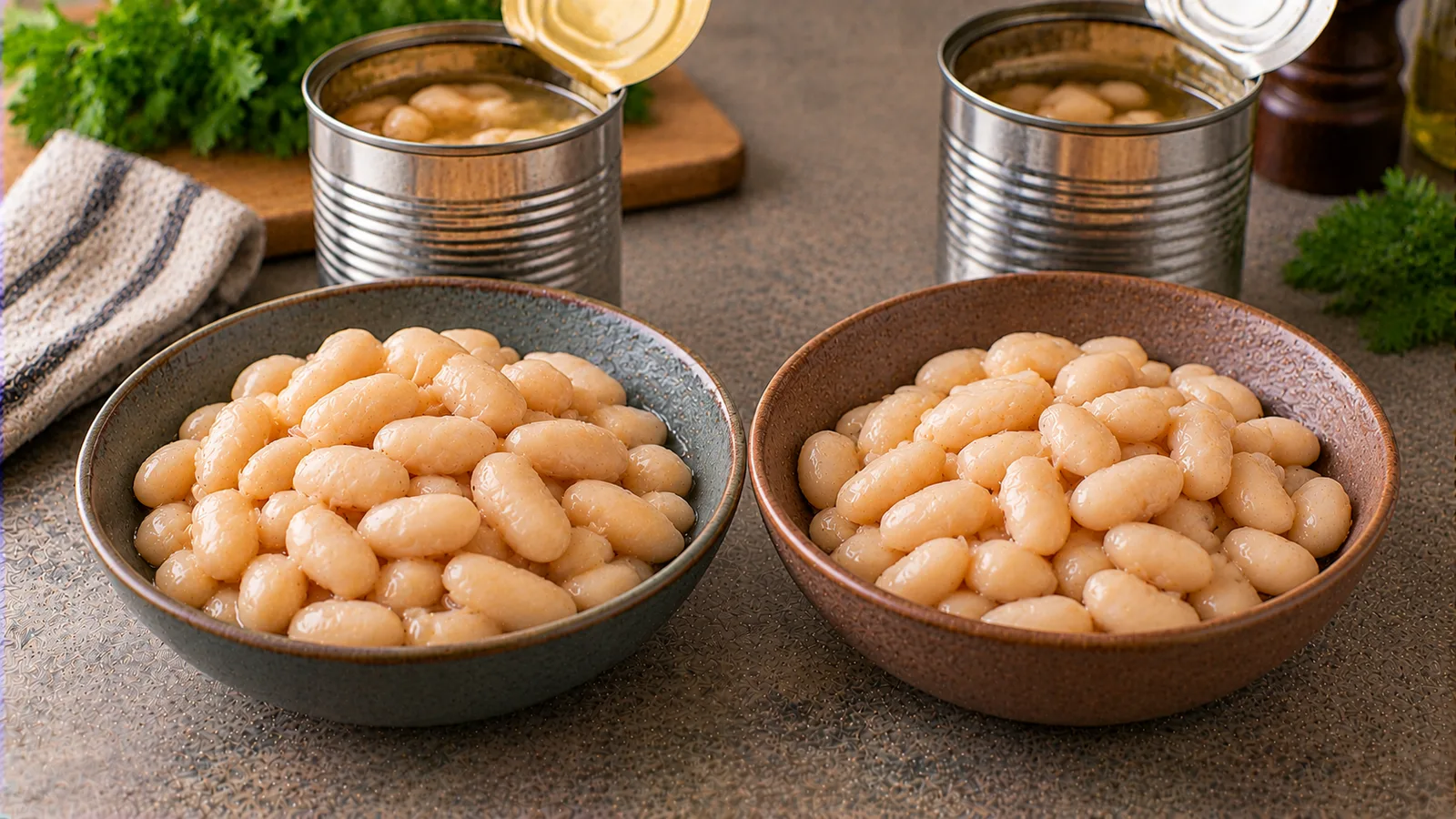
A can marked “no salt added” does not necessarily cost less—or contain literally zero sodium. For a sensible comparison, choose the same bean species, set the edible amount to 150 g drained red kidney beans, and distinguish nutrition-label figures from the weight printed on the front of a can. This is a portion comparison, not a test of what rinsing removes. For rinsing specifically, see what draining and rinsing canned beans may change.
Two traceable German-market listings illustrate the method. The Biona organic red kidney beans list kidney beans and water, with 0.03 g salt per 100 g, a 400 g net can and 240 g drained weight. REWE Beste Wahl kidney beans list beans, water and salt, 0.50 g salt per 100 g and 285 g drained weight. These are different brands: their variety, firmness and labeling basis may differ. The figures below are calculations from the published declarations, not laboratory assays of a matched pair.
Compare like with like: what 150 g drained means
The water in a can is not the same as edible drained bean weight. In the Biona example the can weighs 400 g including liquid, but yields 240 g beans after draining; the regular REWE example specifies 285 g drained. Drain both through the same sieve, for the same duration, without rinsing, and weigh the beans. If you rinse either product, you change the method and can no longer attribute differences solely to the absence or addition of salt.
The nutrition declarations say per 100 g on the retailer pages. They do not establish that a laboratory sample of precisely 150 g drained solids has these concentrations. Our 150 g values are therefore label-derived estimates conditional on the printed numbers applying to the edible drained portion. Check the physical can: if its declaration instead refers to beans plus packing liquid, obtain a drained-solids value from the producer or avoid presenting the extrapolation as measured sodium in your bowl. That distinction matters especially when evaluating medical sodium limits.
| Reference and declared basis | No salt added: Biona kidney beans | Salted: REWE kidney beans |
|---|---|---|
| Ingredients | Kidney beans, water | Kidney beans, water, salt |
| Total can contents | 400 g | 400 mL pack; use the stated drained amount |
| Drained beans in can | 240 g | 285 g |
| Label salt per 100 g | 0.03 g | 0.50 g |
| Label-derived salt at 150 g | 0.045 g | 0.75 g |
| Sodium-equivalent at 150 g | 18 mg | 300 mg |
The difference is 0.705 g salt or 282 mg sodium equivalent per 150 g, assuming the same label basis. This is a 94% lower label-salt figure in the no-added-salt example, not a universal reduction for all unsalted beans. Sodium and salt are different units: for EU labels, approximately salt = sodium × 2.5. See the European Commission's nutrition-declaration guidance.
“No added salt,” “low salt” and “salt free” are different
The EU nutrition-claims rules distinguish three ideas. “No added sodium/salt” concerns ingredients and requires no added sodium/salt or ingredients containing added sodium/salt, with sodium not exceeding 0.12 g per 100 g (or the salt equivalent). “Low sodium/salt” is also tied to the 0.12 g sodium per 100 g limit, but does not by itself prove salt was never added. “Sodium-free/salt-free” has a much lower limit of 0.005 g sodium per 100 g. Do not infer the last claim from the first.
Beans naturally contain some sodium, and labels contain average values subject to rounding and recipe revisions. A product with 0.03 g salt per 100 g is not zero-sodium: using the standard conversion, it represents about 12 mg sodium per 100 g, or 18 mg for 150 g. Conversely, a salted product can still be suitable for an ordinary meal depending on its serving size and the rest of the diet. A shopper should read the numeric salt line rather than trusting the front-of-pack wording alone.
How to calculate sodium from a European salt label
Use the same grams and the same unit in each comparison. For an edible weight of 150 g, multiply a 100 g salt declaration by 1.5. Then divide grams of salt-equivalent by 2.5 to get grams of sodium-equivalent; multiply by 1,000 to get milligrams. The Biona example is 0.03 × 1.5 = 0.045 g salt, which is 18 mg sodium. The REWE example is 0.50 × 1.5 = 0.75 g salt, or 300 mg sodium. Their calculated gap is 282 mg sodium.
These calculations use label salt equivalent, not the mass of salt sprinkled into the can during processing. Other sodium-containing ingredients can also contribute to a label declaration. With kidney beans from these two ingredient lists, the comparison is unusually transparent, but changes in crop, packing medium and labeling conventions still matter. Do not treat the arithmetic as direct chemical measurement of drained beans.
The WHO's sodium-reduction guidance recommends adults consume less than 2,000 mg sodium per day, equivalent to less than 5 g salt per day. That is a total-diet benchmark, not a target for a single side dish. If your doctor has prescribed a sodium or potassium restriction, follow individual advice instead of using a general can-to-can comparison as a meal plan.
Cost per drained 150 g: avoid dividing by the net liquid weight
Prices move by shop, delivery zone and date. To demonstrate the arithmetic transparently, assume the Biona 400 g net/240 g drained can costs €1.90 and the REWE 285 g drained can costs €0.99. The €0.99 price is hypothetical, not a checked current REWE quote; €1.90 is also treated as a modeling input rather than a live universal price. The two price assumptions are intentionally independent of the nutrition declarations.
| Price model, not a current store quotation | No salt added | Regular salted |
|---|---|---|
| Hypothetical price paid for one can | €1.90 | €0.99 |
| Edible drained contents | 240 g | 285 g |
| Cost per 100 g drained | €0.79 | €0.35 |
| Cost of 150 g drained | €1.19 | €0.52 |
| Beans left after one 150 g portion | 90 g | 135 g |
The €0.67 estimated portion-cost gap is not a claim that the regular product is always cheaper. It describes only these entered prices. If you use all the beans, the cash register still charges €1.90 or €0.99; the €1.19 and €0.52 amounts allocate that purchase to one 150 g portion. Used-ingredient cost must not be confused with total checkout spend. Two 150 g portions require 300 g drained beans, more than either modeled can; you would need more than one can of either example.
To replace the numbers, use: can price ÷ declared drained grams × 150. Use the actual drained weight on the package and your store's real ticket, including any relevant discounts only when actually received. A large can is not necessarily cheaper per edible 100 g if the liquid share is large. For a broader low-cost bean lunch rather than a matched can comparison, see balanced lunch ideas using canned beans.
Does the lower-salt option save meaningful sodium in dinner?
Imagine a grain bowl with 150 g drained kidney beans, a grain, fresh vegetables, herbs and an unsalted oil-and-lemon dressing. The salt difference attributed to the beans alone is the label-based 0.705 g, equivalent to 282 mg sodium, assuming the concentration is appropriate for the drained portion. Other ingredients can greatly change the whole meal: cheese, cured meat, ready sauces, bouillon or salty seasoning may outweigh the beans' contribution.
The choice is especially worthwhile to investigate when beans are eaten often. It is not an argument to eliminate all salt from cooking or to replace balanced meals with plain beans. Beans contribute protein and fiber, but the two products do not promise identical levels of every nutrient: the manufacturer values are recipe-specific. Compare the full labels as well if fiber, energy or carbohydrate matters to you.
For a useful sensory comparison, heat 150 g drained beans from each can separately in a splash of plain water, with identical unsalted spices. Taste after heating, then season the finished dish only if needed. Salted beans may taste stronger on their own, while herbs, acid and onions change perceived saltiness. Preference is not a substitute for reading sodium values.
Draining is not rinsing: keep the question narrow
The phrase “drained 150 g” defines the portion after pouring away packing liquid. It does not claim that draining removes a fixed percentage of salt. The effect of adding a water rinse varies with bean type, packing liquid, time and measurement. This article deliberately does not reuse a rinse percentage, because no paired measurement of these exact brands is available. what draining and rinsing canned beans may change treats rinsing as its own question.
If the regular can includes salted liquid, discarding that liquid may change the sodium you consume, yet the labeled nutrients can be based on a different declared state. Without a manufacturer assay for drained solids, we cannot assign a reliable numerical reduction. For an apples-to-apples store decision, record both the packaging's claimed salt basis and the drained edible weight rather than extrapolating an unsupported rinse effect.
Storage and practical buying checks
Before purchase, confirm red kidney beans versus red kidney beans; a green-bean can is a different food. Confirm water-only ingredients if seeking no added salt, the salt value per 100 g, the drained weight, the total pack size and the actual price. Check whether the nutrition figures refer to the beans as sold, a prepared product or the drained portion. If unclear, ask the manufacturer; do not manufacture a lab result from an ambiguous label.
After opening, transfer unused beans into a clean covered container and refrigerate promptly. USDA food-storage guidance gives generally 3–4 days refrigerated for low-acid canned foods such as beans; a brand's shorter instruction takes priority. Discard containers with bulging, leakage or signs of spoilage. Commercially cooked canned kidney beans are ready to use; raw dried kidney beans are a different preparation task and must not be substituted without full safe cooking.
What the calculation can and cannot decide
For this explicit pair, the unsalted example shows much lower label salt at equal assumed edible weight, while the hypothetical price inputs give a higher cost per 150 g. This means there is a salt-versus-cost trade-off in the model, not a declaration that one can is universally healthier or better value. The trade-off can reverse with promotions or another regular product that contains little salt.
If the label actually refers to the can's entire contents rather than drained beans, the 0.045 g and 0.75 g values are not verified consumed amounts: retain them as estimates and rely on manufacturer clarification for stricter uses. To make your own decision, use the same bean species, your real checkout price and the correct edible state on both labels.
Sources
- Biona red kidney beans: ingredients, 400 g net, 240 g drained and 0.03 g salt per 100 g.
- REWE Beste Wahl kidney beans: ingredients, 285 g drained and 0.50 g salt per 100 g.
- European Commission: permitted sodium/salt nutrition claims.
- EU nutrition declaration and per-100 g labeling requirements.
- WHO sodium reduction recommendation.
- USDA FSIS storage of opened canned foods.