
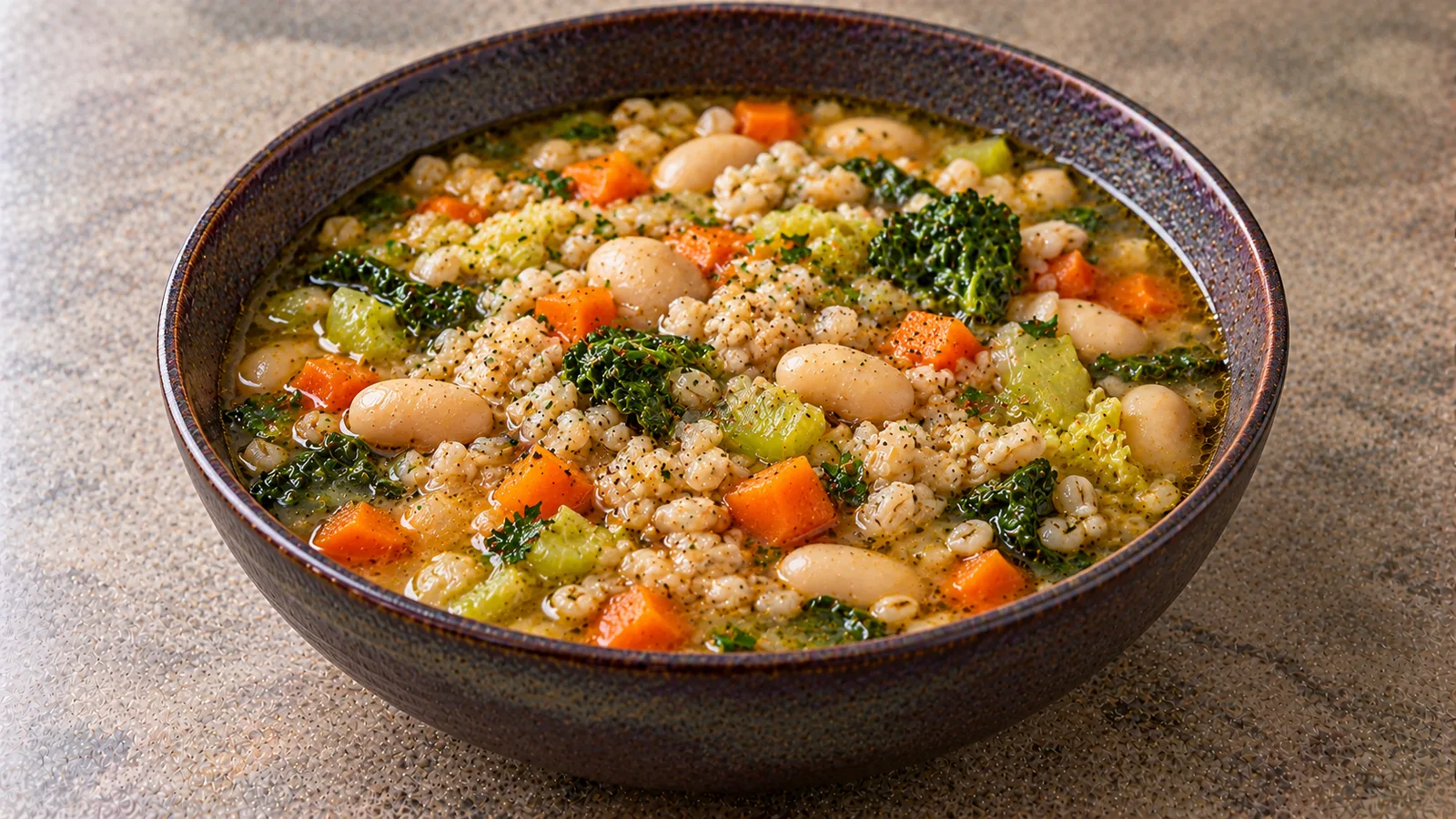
A vegetable soup can be inexpensive, comforting and genuinely substantial without turning into a heavy stew. This version combines pearl barley, drained white beans, carrots, celery, leek and tender Savoy cabbage in one pot. Barley adds a pleasantly chewy grain; beans contribute a creamy bite and a considerable share of the fibre. The important detail is how each ingredient is measured: the barley is weighed dry, the beans after draining, and the vegetables before cooking. Those definitions make both the recipe and the nutrition estimate reproducible.
This batch makes six generous bowls. Allow roughly 15–20 minutes for preparation and 40–50 minutes on the stove, depending on the size of the barley and vegetables. The resulting soup is vegan if the stock or seasoning is plant-based. It contains barley, which is not gluten-free.
Ingredients: six bowls from one pot
Choose medium pearl barley rather than quick-cooking barley if you want a clear, chewy texture. If your package specifies a substantially different cooking time, follow the package and adjust when the grain goes into the pot. Use ready-to-eat canned white beans, not uncooked dried beans.
| Ingredient | Quantity for batch | Weight definition | Role |
|---|---|---|---|
| Pearl barley | 120 g | Dry, before rinsing | Chewy grain and fibre |
| Canned white beans | 480 g | Drained edible weight; two 240 g cans | Creaminess, fibre and protein |
| Savoy cabbage | 500 g | Raw, trimmed and shredded | Tender greens and fibre |
| Carrots | 250 g | Raw edible weight | Sweetness and texture |
| Celery stalks | 180 g | Raw, trimmed | Aromatic base |
| Onion | 160 g | Peeled, raw | Sweet savoury depth |
| Leek | 150 g | Cleaned, raw | Mild onion flavour |
| Extra-virgin olive oil | 15 ml | Measured volume | Sautéing |
Also have about 1.4 litres of water or lightly seasoned vegetable stock, 2 cloves of garlic, a bay leaf, black pepper, dried thyme and chopped parsley ready. Treat garlic, herbs and unsalted water as negligible additions in the worked nutrition model. If you use stock cubes, include their energy and sodium from the label; do not assume every stock is nutritionally identical. Salt is added only after tasting the beans and stock.
What makes this a fibre-focused soup?
The two main contributors are the drained white beans and the dry barley. For the specific products used here, Wurzener fine pearl barley lists 10 g fibre per 100 g dry, while Cirio cannellini beans list 6.6 g per 100 g drained product. At 120 g barley and 480 g beans, they contribute 12.0 g + 31.68 g = 43.68 g fibre to the pot, before the vegetables are counted. See the Wurzener barley declaration and Cirio white-bean declaration.
The vegetables add bulk and more fibre, but a bowl of soup does not automatically contain the fibre shown on a dry-grain label. Serving size matters. Our six-way division produces approximately 12.41 g fibre per bowl, using the ingredient model below. That is a calculation, not a laboratory analysis of the final dish. For a broader view of what makes a varied plate, see Mealisa's balanced-meal guide.
Step 1: prepare the barley and beans correctly
Rinse the 120 g dry barley in a sieve. Pick out any visibly damaged or unusual pieces. Drain the two cans of white beans, then briefly rinse them if you prefer to remove some packing liquid. Keep the 480 g drained weight as the recipe reference: weighing the unopened cans or their liquid would exaggerate the quantity of beans actually eaten.
Barley is a cereal grain and behaves differently from canned beans. It absorbs liquid as it cooks; the cooked grain weighs more, but its original calories, protein and fibre do not multiply. In a separate test saucepan, 120 g dry barley might produce approximately 330 g cooked barley, a yield factor of 2.75, although the actual weight varies with water, simmering time and draining. This 330 g figure is a worked illustration, not a guaranteed yield or a second ingredient to add. Our soup cooks the 120 g barley directly in broth; do not add another 330 g of cooked grain on top.
Step 2: build flavour before adding liquid
Dice the onion and carrots relatively small; slice the celery and leek, washing between leek layers to remove grit. Warm 15 ml olive oil in a large, heavy pot over medium heat. Sauté onion, carrots, celery and leek for about 7–9 minutes until the onion softens but does not brown deeply. Add the crushed garlic for the final 30 seconds. The aim is a fragrant foundation, not caramelised vegetables.
Stir in the thyme and a splash of the measured water, scraping the base of the pot. Set the washed, shredded Savoy cabbage aside: it joins the simmering soup near the end, so the leaves become tender without losing all their texture. If the vegetables stick, add water instead of another uncounted spoon of oil. Olive oil is concentrated in energy: this recipe uses 15 ml, and the model uses the dmBio declaration of 824 kcal per 100 ml, not per 100 g. dmBio olive-oil nutrition.
Step 3: simmer until the grains are tender
Add the rinsed pearl barley, bay leaf and approximately 1.4 litres of liquid. Bring to a steady simmer, cover partly and cook for 25–35 minutes, stirring periodically. Refer to your barley package: some fine varieties take 25 minutes, while larger pearls can require longer. If the soup becomes too thick, add hot water in 100-ml increments; if it looks thin, cook uncovered briefly instead of adding flour.
About 12–15 minutes before the barley finishes, add the 500 g shredded Savoy cabbage. When the barley is almost tender, fold in the drained beans and simmer gently for another 8–10 minutes. Canned beans are already cooked, so long aggressive boiling is unnecessary and may break them apart. Remove the bay leaf, season with pepper and taste before adding salt. A little lemon juice or parsley at the table can brighten the flavour without obscuring the vegetables. If using pre-seasoned stock, start cautiously: canned beans may also contain appreciable salt.
Step 4: portion the finished soup consistently
Stir from the bottom before ladling, because barley and beans tend to settle. Divide the whole pot into six reasonably equal portions, distributing solids rather than filling one bowl with grains and another with broth. For accurate tracking, weigh the empty pot, weigh it again with finished soup, subtract, and divide by six. Record this actual cooked yield if you need calories per 100 g.
The initial food mass in the worked model is 1,855 g before water, garlic and herbs. Adding 1,400 g of water gives approximately 3,255 g before evaporation. A 3,000 g finished yield, for example, means six bowls averaging 500 g; it does not change the 1,363.8 kcal calculated for the ingredients. Only the kcal per 100 g changes with the water retained. If the final soup weighs 3,000 g, the example is about 45.5 kcal/100 g. See portion size versus serving size for why measuring the plated amount differs from reading a label.
Calculated nutrition: full pot and one bowl
This calculation uses the named barley, bean and olive-oil labels, plus the raw-Savoy-cabbage reference, plus approximate raw-vegetable composition data. Water is treated as zero energy. Values may differ by manufacturer, trimming, type of olive oil, seasoning and cooked yield.
| Measure | Whole pot | One of six portions | Important qualification |
|---|---|---|---|
| Energy | 1,363.8 kcal | 227.3 kcal | Ingredients only; water adds none |
| Protein | 53.16 g | 8.86 g | Not a high-protein meal by itself |
| Carbohydrate | 235.76 g | 39.29 g | Dry barley, beans and vegetables |
| Fat | 19.60 g | 3.27 g | Mainly 15 ml oil |
| Fibre | 74.48 g | 12.41 g | Estimate from input ingredients |
For orientation, the three major fibre entries are 12.0 g from barley, 31.68 g from beans and about 15.5 g from 500 g raw Savoy cabbage. Carrots, celery, onion and leek supply the remainder. The cabbage estimate uses the USDA SR Legacy raw-cabbage profile. Their raw composition values are approximate rather than current brand guarantees. For a data source and differences between raw and cooked profiles, consult USDA FoodData Central. The European Commission's nutrition-claims criteria define when commercial foods may claim to be high in fibre; a homemade calculation should not be confused with certified package labelling.
Why hydrated barley changes the numbers per 100 g
Imagine weighing the grain separately: 120 g dry barley provides 404.4 kcal, 9.24 g protein and 12 g fibre using the selected label. If it weighs 330 g cooked, its illustrative density becomes 122.5 kcal, 2.80 g protein and 3.64 g fibre per 100 g cooked. The batch still contains 404.4 kcal from the barley. The apparent reduction per 100 g is simply dilution by absorbed water.
Comparing 100 g dry barley to 100 g of finished soup, or to 100 g cooked beans, therefore answers three different questions. Count the dry barley once, the drained canned beans once, and the other measured ingredients once. Do not also add a database entry for the cooked barley unless you are replacing the dry entry in an entirely different calculation. This is particularly useful when tracking soup in an app: avoid mixing different preparation states in the same recipe.
A transparent grocery-cost example
Prices below are illustrative euro assumptions, not verified checkout prices. The package sizes are plausible for German supermarkets; actual brand, shop and promotions will change the result. Costs attributed to the soup reflect the quantity used. Buying a 500 ml oil bottle does not mean charging the full bottle to one batch.
| Ingredient | Assumed full-pack price | Quantity costed | Cost in pot |
|---|---|---|---|
| Barley, 500 g | €2.29 | 120 g | €0.55 |
| White beans, 240 g drained can | €1.79 each | 2 cans | €3.58 |
| Savoy cabbage, 500 g | €1.99 | 500 g | €1.99 |
| Carrots, 1 kg | €1.49 | 250 g | €0.37 |
| Celery, 500 g | €1.69 | 180 g | €0.61 |
| Onions, 1 kg | €1.49 | 160 g | €0.24 |
| Leek, 500 g | €1.99 | 150 g | €0.60 |
| Olive oil, 500 ml | €5.49 | 15 ml | €0.16 |
| Seasoning/water allowance | €0.20 | Whole batch | €0.20 |
That is €8.30 for the batch, or about €1.38 per serving. Buying all the listed whole packs from scratch would require approximately €20.21 upfront, leaving unused barley, vegetables and olive oil for later meals. The soup is therefore budget-friendly in a per-used-ingredient calculation, but the upfront basket is not the same as six times the serving price. If shopping for several recipes, the budget grocery-list guide explains how to make those leftovers count.
Variations that retain the point of the recipe
For a thicker stew, reduce the final water increment and simmer uncovered briefly. For a lighter bowl, add 200–300 ml extra hot water and season again; this changes calories per 100 g but not the total energy of the pot. A spoonful of beans can be mashed against the side of the pot to give a naturally creamy texture. There is no need for cream or a roux. If you replace pearl barley with another grain, the cooking schedule and fibre figures must be recalculated from that grain's label.
A handful of chopped spinach can be added in the final minutes, but weigh it if you publish a new nutrition figure. Lemon zest, rosemary or smoked paprika are worthwhile flavour changes; extra oil, cheese, bread or meat have their own calories and costs. For context on bean composition and how cooked/canned entries differ, the white-beans calorie guide complements this particular soup recipe.
Avoid these common soup calculation errors
The first error is treating 120 g dry barley as 120 g cooked barley. The second is using the full 400–410 g can weight for a product whose drained contents weigh only 240 g. The third is assuming that the final pot weight has to equal the starting ingredient mass: water and evaporation make that impossible. A fourth error is claiming one precise sodium value while stock and canned-bean brands are unspecified. Keep salt as a separate label-dependent value instead.
A final pitfall is using a tiny bowl to imply the whole recipe is high in fibre per serving. Our claim relates to one-sixth of this exact batch. A half bowl provides half the calculated amount, before any garnish. The recipe also contains barley gluten, and some seasonings or stock cubes may contain allergens. Check ingredients when serving someone with coeliac disease or another food allergy.
Cooling, storing and reheating safely
Barley continues to absorb liquid in the fridge. The next day the soup will often be thicker; add water during reheating rather than judging it spoiled from texture alone. Divide a large batch into shallow containers and refrigerate promptly, ideally within two hours. USDA FSIS advises using refrigerated cooked leftovers within 3–4 days and reheating them thoroughly; bring soup to a rolling boil when reheating. For longer storage, freeze individual portions promptly and thaw safely. USDA FSIS leftovers guidance.
If you cook for one, freeze portions rather than reheating the same large pot repeatedly. Add fresh parsley or lemon only when serving. The method is useful for weekday lunches because the ingredients can be measured once and served on different days, but neither refrigeration nor freezing makes food safe indefinitely in terms of practical quality.
Sources and calculation boundaries
- Wurzener fine pearl barley: dry product label
- Cirio cannellini white beans: nutrition and drained weight
- USDA SR Legacy: raw Savoy cabbage, FDC 170388
- dmBio Greek olive oil: per 100 ml declaration
- USDA FoodData Central: raw vegetable reference search
- European Commission: nutrition claims
- USDA FSIS: leftovers and food safety
All food-composition totals are approximations derived from the stated ingredient weights. Salt and calories from any stock cube, unmeasured seasoning, bread or topping are excluded. Adjust the model for the exact groceries you use.