
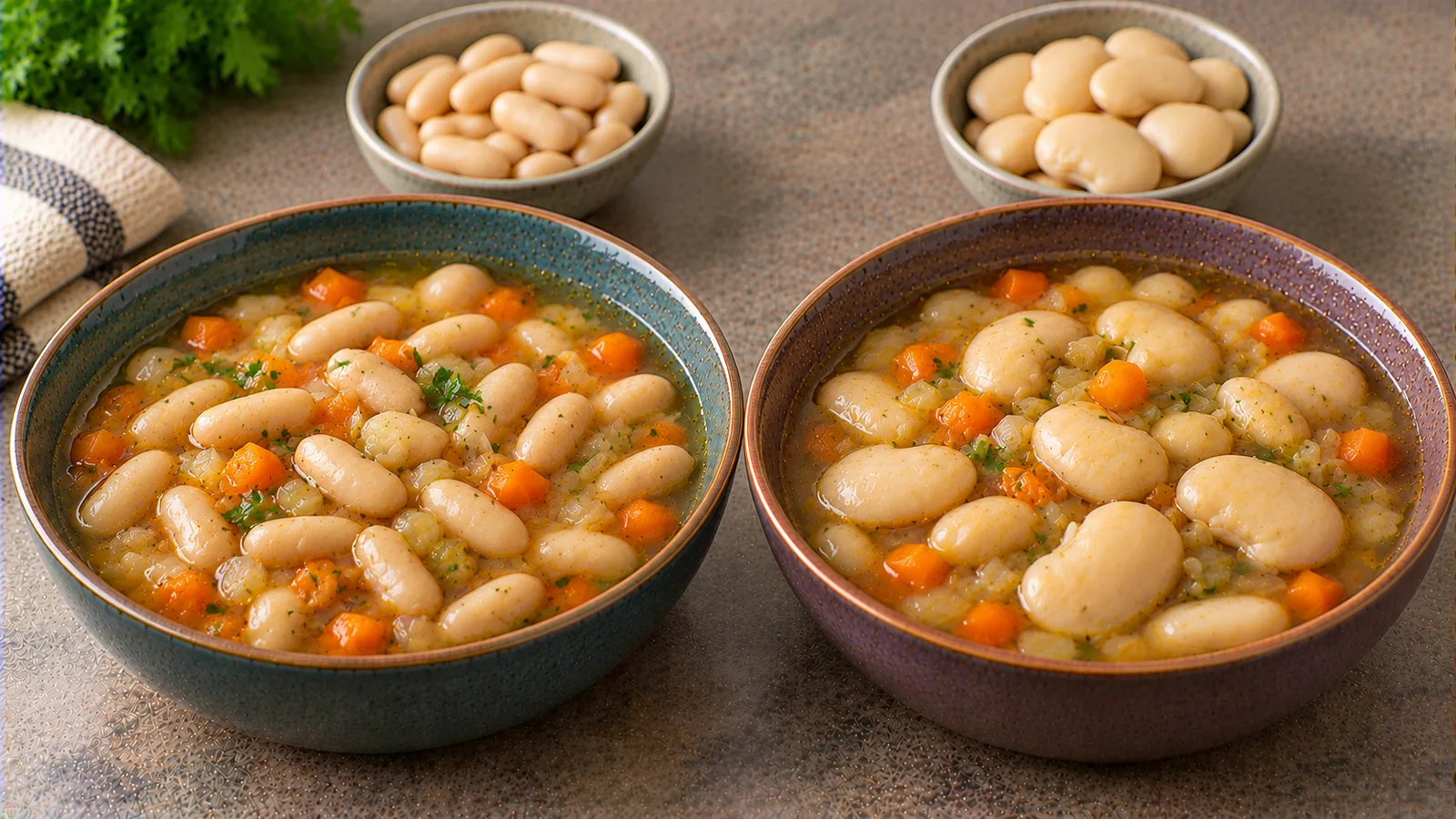
White beans and butter beans both belong in hearty soups, but asking which is better involves more than looking at two pale legumes. The name white beans can refer to several varieties; here it specifically means cannellini beans. Butter beans, often sold as large white or lima-type beans, are generally bigger and feel different on a spoon. Names vary by supplier, so the ingredient name on the package matters more than its colour.
For a reproducible German shopping comparison, we use Rapunzel organic canned cannellini beans and Davert organic canned Butter Beans. Both come in 400 g cans with 240 g drained weight. The example shelf prices at the same retailer, Paradieschen, are €1.79 for Rapunzel and €1.69 for Davert. We compare 150 g of beans, drained, added to soup—not 150 g of completed soup with broth. These are specific labelled products, not averages for every bean of that type.
The 150 g comparison
| For 150 g beans, scaled from each product label | Rapunzel cannellini | Davert Butter Beans |
|---|---|---|
| Protein | 9.74 g | 11.85 g |
| Fiber | 8.25 g | 11.70 g |
| Energy | about 146 kcal | 183 kcal |
| Salt | about 0.94 g | about 0.95 g |
| Retail price for 400 g can | €1.79 | €1.69 |
| Declared drained weight | 240 g | 240 g |
| Cost allocated to 150 g drained beans | €1.12 | €1.06 |
The Rapunzel product information states 6.49 g protein, 5.5 g fiber, 97 kcal and 0.625 g salt per 100 g. The Davert label gives 7.9 g protein, 7.8 g fiber, 122 kcal and 0.63 g salt per 100 g. Multiply each value by 1.5 for 150 g. The Rapunzel manufacturer data identifies the nutrition reference as drained product; Davert's displayed wording is per 100 g of unprepared product, without an explicit separate laboratory statement for a drained sample. This makes the table a label-based illustration, not a verified equal-basis laboratory comparison. Check the wording on the actual Davert pack if the distinction is critical.
At these declared values, Davert has 2.11 g more protein and 3.45 g more fiber per 150 g than Rapunzel, while also declaring 37 kcal more after rounding. The differences belong to the two brands and recipes. They do not demonstrate that every butter bean is naturally higher in protein than every cannellini bean.
What changes in a pot of soup?
Cannellini beans are usually medium-sized, with a thin-feeling skin and an interior that becomes soft when heated. In a tomato or vegetable broth, they can stay recognisable if stirred carefully. They also crush easily against the side of a saucepan, creating a gentle thickening effect without cream. Their smaller size distributes beans through each ladleful.
Butter beans are typically larger and flatter. Davert describes its cooked white giant beans as creamy and tender, which makes them appealing when the beans themselves are meant to be noticeable. A bowl with butter beans can feel more substantial even at the same measured bean weight, because there are fewer, larger pieces. That is a culinary description, not a measured satiety advantage.
Neither bean is guaranteed to keep exactly the same structure after a long simmer. Canned beans are already cooked; another prolonged boil or forceful stirring can split their skins. In a smooth blended soup, the distinction in individual bean shape largely disappears. In a clear broth, the size and texture remain part of the eating experience.
For a soup with visible beans, choose cannellini for evenly dispersed, modest-sized pieces or butter beans for broad, creamy bites. For a blended soup, choose using the actual available price and the flavour you prefer; blend only part of the pot if you want creaminess without losing all the beans' shape.
Does either choice make the soup higher in protein?
First identify how much of the finished bowl is actually beans. The 9.74 g versus 11.85 g figures refer to 150 g beans alone. A 400 g bowl of broth, vegetables and 100 g beans does not contain the same bean protein as a 150 g bean portion. Other soup ingredients also contribute their own nutrients.
The listed numbers scale directly from the stated label values. At 100 g, Rapunzel provides 6.49 g protein and Davert 7.9 g. At 150 g, the calculated values are 9.735 g, rounded to 9.74 g, and 11.85 g. The difference is approximately 2.11 g. If you use a different brand of butter beans, the label may be lower or higher.
Fiber follows the same calculation: 5.5 g × 1.5 = 8.25 g in the Rapunzel portion and 7.8 g × 1.5 = 11.7 g in the Davert portion. These are the bean components before adding carrots, onions, barley or other ingredients. A soup that uses more vegetables or whole grains may have a higher total amount of fiber, but you should not attribute that entire total to its beans.
For meal planning, the more useful question is: How many grams of drained beans will be in each bowl? Weigh them before they go into the broth. Avoid treating the weight of a whole can or the weight of the finished soup as the serving's bean quantity.
Cost per usable portion—not per gram of can liquid
The Rapunzel shelf listing was shown at €1.79 per 400 g can, while the Davert listing showed €1.69 per 400 g can. Each has 240 g drained weight. These are reference online prices viewed 22 October 2026, not a promise of availability or a national lowest price. Shipping charges, local assortment and promotions are excluded.
Price per edible serving follows one formula: package price ÷ drained grams × portion grams. For Rapunzel, €1.79 ÷ 240 × 150 = €1.11875, approximately €1.12. For Davert, €1.69 ÷ 240 × 150 = €1.05625, approximately €1.06. The modelled difference is €0.06 per 150 g after rounding.
The widely displayed supermarket unit price for a 400 g can may be based on full contents, including water. If that shelf price is €1.79, dividing by 400 g would give €0.67 for 150 g—not the cost of 150 g of drained beans. Use the actual 240 g edible drained weight for a comparison that assumes the liquid is discarded.
A shopping basket is different from a theoretical serving allocation. You still pay €1.79 or €1.69 for a whole can, not €1.12 or €1.06 at checkout. One 240 g drained can can supply one 150 g bean portion with 90 g left over. If the remaining beans are not used, the actual waste-adjusted household cost is higher.
Example: four servings of soup
Suppose four bowls each include 120 g drained beans, or 480 g drained beans in total. Exactly two 240 g-drained cans provide that amount. At the stated prices, the bean purchase is €3.58 for two Rapunzel cans or €3.38 for two Davert cans. Across four bowls that is roughly €0.90 or €0.85 per bowl, respectively, for the beans only. Broth, vegetables, oil, energy and any bread are additional. This calculation is a repeatable recipe-budget example, not a fixed soup price.
How to use either bean in a simple soup
For approximately four bowls, use 480 g drained beans (two cans), one onion, two carrots, one celery stalk if desired, 600–800 ml water or unsalted stock, a small amount of oil and herbs or tomatoes to taste. The liquid range controls whether the result feels more like a stew or a brothy soup; it is not a nutrition claim.
- Drain the two cans and, if desired, rinse the beans. Keep the 480 g drained amount for the four-serving calculation. Rinsing may affect surface salt, but do not assign an exact percentage reduction without testing the product.
- Softly cook the chopped onion, carrot and optional celery in a saucepan with a little oil until beginning to soften. Add herbs or chopped tomatoes if using them.
- Add 600–800 ml liquid and simmer until the vegetables are tender. Use unsalted stock if you want to control the salt independently from the beans.
- Add the cooked beans near the end and heat them thoroughly. Stir gently, particularly with large butter beans, to limit broken skins.
- For a creamier soup, mash a few beans against the side of the pan or blend one ladleful and return it to the pot. Taste before adding more salt, because both specified canned products already contain salt.
The same base works with either bean, so texture rather than cooking time should guide the substitution. Canned beans are already heat-processed; this method does not describe how to make dry, uncooked lima or cannellini beans safe. Follow validated preparation instructions for dry legumes instead of putting raw dry beans straight into a short soup simmer.
Reading the names correctly
The phrase white beans is a broad colour-based market description. Cannellini is a more specific bean type and is the type named on the Rapunzel can. Butter beans often refers to large lima beans in English-language recipes, while German packets may say weiße Riesenbohnen and identify a commercial large-white-bean product. Davert's product is specifically marketed as Butter Beans and described as white giant beans; its public description does not independently verify a botanical species name. Do not assume all white giant beans have identical nutrients or that every product called white beans is cannellini.
When you shop, check the named bean, the ingredient list, the full weight and the drained weight. A jar labelled giant beans in tomato sauce may have added oil or sugar, so it is not the same baseline as plain beans in water and salt. If price is the deciding factor, compare plain versions at equal edible weight before adding recipe-specific sauces.
For a wider soup idea, our vegetable soup with barley and white beans article uses white beans with barley and vegetables. It is a distinct mixed-ingredient meal, not an isolated cannellini-versus-butter-bean comparison. Our canned versus dried beans guide covers how dried and canned beans differ in household preparation; its cooking yields must not be substituted for these two already-cooked cans.
Storage and safe leftovers
Store unopened cans as instructed on the label. After opening, transfer unused beans to a suitable covered container and refrigerate promptly; observe any shorter time limit printed on your specific product. Refrigerate cooked soup within 2 hours. USDA guidance generally recommends using cooked leftovers within 3–4 days and reheating them to 74 °C (165 °F). For soups and sauces, its separate guidance says to bring the liquid to a full boil when reheating. See the USDA safe handling guidance.
If making soup for several lunches, divide it into shallow containers so it cools faster. Freeze spare portions if they will not be eaten during the refrigerated storage window. Thaw in the refrigerator and reheat thoroughly. Do not rely on a pleasant smell alone as evidence of microbiological safety.
Which should you choose?
If you value small, evenly distributed beans, Rapunzel cannellini suits a soup with vegetables and a clear broth. If you want larger, creamier bites, Davert Butter Beans are a good alternative. In this two-product example, the Davert label also declares somewhat more protein and fiber and the retailer shows a slightly lower price per drained portion. Neither conclusion applies automatically to all brands or to dry beans.
The practical decision is to compare the actual cans in your shop: named bean, label basis, drained weight, protein and fiber per 100 g, and today's price. The amount you add to the pot matters more than a marketing name on the front.
Sources
- Rapunzel — white cannellini beans, ingredients and nutrition.
- Davert — Butter Beans, ingredients and nutrition.
- Paradieschen — Rapunzel cannellini price and drained weight.
- Paradieschen — Davert Butter Beans price and drained weight.
- USDA FSIS — Keep Food Safe, refrigeration and reheating guidance.
Product numbers and example prices belong to the named packages and the stated comparison date. Texture descriptions are culinary guidance, not laboratory measurements; check the current packaging for updates.