
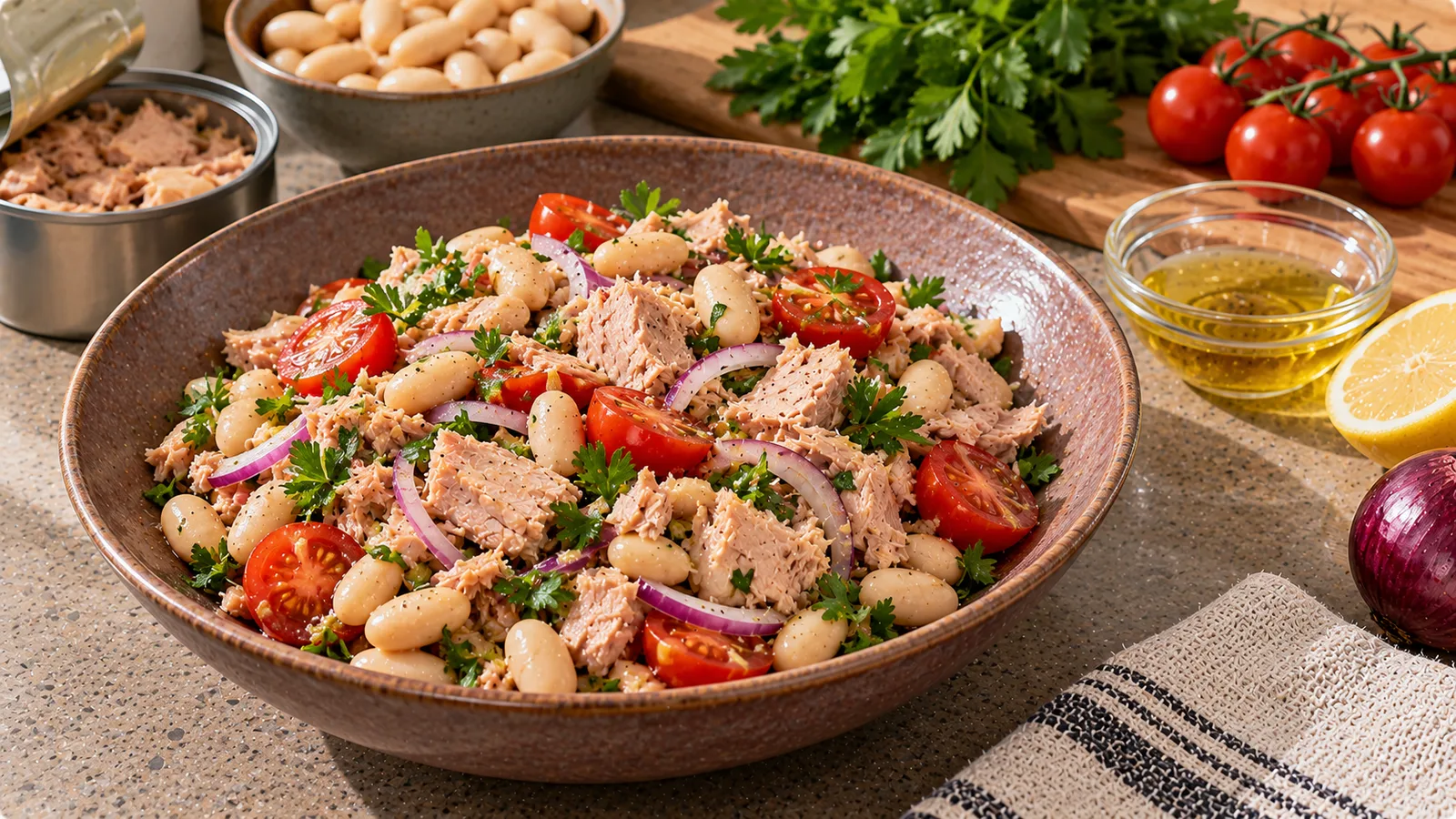
Tuna and white bean salad is a practical meal for days when you want something filling without spending much time cooking.
Canned tuna provides protein, white beans add fibre and substance, and fresh vegetables make the salad crisp and refreshing. A simple lemon and olive oil dressing brings everything together.
This version takes about 15 minutes, uses common supermarket ingredients and makes two substantial servings.
Recipe at a glance
| Detail | Amount |
|---|---|
| Preparation time | 15 minutes |
| Cooking time | None |
| Total time | 15 minutes |
| Servings | 2 main-course portions |
| Difficulty | Easy |
| Main ingredients | Tuna, white beans, vegetables |
| Serving style | Cold or lightly chilled |
The recipe uses canned tuna in water and canned white beans that have already been cooked.
No stove or oven is required.
Ingredients for 2 servings
| Ingredient | Quantity | Preparation |
|---|---|---|
| Tuna in water, drained | 160 g | Break into large flakes |
| White beans, drained and rinsed | 240 g | Drain thoroughly |
| Cherry tomatoes | 180 g | Halve |
| Cucumber | 150 g | Dice |
| Red onion | 50 g | Finely chop |
| Fresh parsley | 15 g | Chop |
| Extra-virgin olive oil | 20 g | For the dressing |
| Fresh lemon juice | 30 g | Approximately 2 tablespoons |
| Dijon mustard | 10 g | Optional for a fuller dressing |
| Black pepper | To taste | Freshly ground |
| Salt | To taste | Adjust after tasting |
Choose plain white beans such as cannellini beans, butter beans or another cooked white bean variety.
If your tuna can lists a drained weight, use that figure rather than the total weight including liquid.
Why these ingredients work together
Tuna gives the salad a savoury flavour and a substantial amount of protein.
White beans contribute carbohydrates, fibre and additional protein. Their soft texture also absorbs the dressing.
Tomatoes add juiciness, cucumber adds crunch and red onion brings a sharper flavour.
Parsley and lemon keep the dish fresh rather than heavy.
Olive oil provides richness and helps distribute the dressing across the beans and vegetables.
Step-by-step instructions
1. Prepare the beans
Open the canned beans and pour them into a sieve.
Rinse under cold running water and allow them to drain well.
Excess water can dilute the lemon dressing, so shake the sieve gently and leave the beans to drain while preparing the vegetables.
Do not mash the beans. Keeping them mostly whole gives the finished salad a better texture.
2. Prepare the vegetables
Halve the cherry tomatoes.
Dice the cucumber into small, bite-sized pieces.
Finely chop the red onion and parsley.
If you prefer a milder onion flavour, soak the chopped onion briefly in cold water, then drain it thoroughly.
3. Mix the dressing
In a small bowl, combine:
- 20 g olive oil.
- 30 g lemon juice.
- 10 g Dijon mustard, if using.
- Black pepper.
- A small amount of salt.
Whisk with a fork until the ingredients are combined.
Taste before adding more salt because canned tuna, beans and mustard may already contain sodium.
4. Combine the beans and vegetables
Place the drained beans, tomatoes, cucumber, red onion and parsley in a large mixing bowl.
Add most of the dressing.
Fold gently with a spoon so the beans remain intact.
5. Add the tuna
Drain the tuna thoroughly.
Break it into medium-sized flakes with a fork.
Add it to the bowl and fold gently into the salad.
Avoid stirring too vigorously, which can turn the tuna into a paste.
6. Finish and serve
Pour over the remaining dressing.
Taste and adjust the lemon, pepper or salt if necessary.
Divide the salad between two bowls.
Serve immediately or refrigerate briefly before eating.
Estimated nutrition per serving
The following estimates are based on the full recipe divided into two equal servings, including the optional Dijon mustard.
Values vary by tuna brand, bean variety, drained weights and exact ingredients.
| Nutrient | Per serving | Entire recipe |
|---|---|---|
| Calories | Approximately 360 kcal | Approximately 720 kcal |
| Protein | Approximately 30 g | Approximately 60 g |
| Carbohydrates | Approximately 31 g | Approximately 62 g |
| Fat | Approximately 12 g | Approximately 24 g |
| Fibre | Approximately 10 g | Approximately 20 g |
These are rounded recipe estimates, not laboratory measurements or values for a specific branded product.
For more precise tracking, use the nutrition labels on your cans and the actual weights of the ingredients.
Where the calories come from
The main energy sources are:
- White beans, which provide carbohydrates, protein and fibre.
- Tuna, which supplies much of the protein.
- Olive oil, which supplies most of the added fat.
Vegetables and lemon juice contribute comparatively little energy but add volume, flavour and texture.
The 20 g of olive oil in the complete recipe contributes approximately 180 kcal.
Reducing the oil to 10 g would lower the entire recipe by approximately 90 kcal, or around 45 kcal per serving.
That adjustment also makes the dressing lighter.
Which tuna should you use?
Tuna in water
Tuna packed in water is a convenient option for this recipe.
It lets you control the amount of added oil through the dressing.
Drain the tuna before weighing or adding it to the salad.
Tuna in olive oil
Oil-packed tuna can produce a richer salad.
However, the energy content depends on the product and how much oil remains after draining.
If using tuna in oil, check the label and consider reducing the additional olive oil.
Do not assume that drained tuna in oil has the same nutritional values as tuna packed in water.
Tuna in brine
Tuna packed in brine also works.
Its sodium content may be higher, depending on the product.
Taste the salad before adding salt.
Which white beans are best?
Cannellini beans are an especially good choice because they are creamy yet usually hold their shape.
Butter beans create a softer, more substantial texture.
Other cooked white beans can also work.
The important points are that the beans are fully cooked, drained and suitable for immediate consumption.
Canned beans are convenient because they are already cooked.
If using dried beans, soak and cook them according to appropriate instructions until fully cooked before making the salad.
Do not add raw or undercooked dried beans.
Five useful variations
Mediterranean version
Add 40 g sliced olives and a little dried oregano.
For a stronger Mediterranean flavour, replace some parsley with fresh basil.
Olives will increase the salt and fat content, so adjust the dressing accordingly.
Higher-volume vegetable version
Add another 150–200 g of cucumber, tomatoes or bell pepper.
This makes the salad larger without requiring another can of tuna.
It is useful when you want more vegetables in the meal.
With feta
Crumble 60 g feta over the complete salad.
The cheese adds a salty, creamy element.
It also increases calories, fat and sodium, so include it when calculating nutrition.
With leafy greens
Serve the tuna and bean mixture over rocket, baby spinach or mixed salad leaves.
Keep the leaves separate until serving if preparing the meal ahead.
With a yoghurt dressing
Replace part of the olive oil with plain yoghurt and a little extra lemon juice.
This produces a creamier dressing with a different nutritional profile.
Use the exact yoghurt product and quantity when calculating the final calories.
Can you make this salad ahead?
Yes, but the texture is best when the freshest ingredients are added close to serving.
For meal preparation:
- Mix the beans, onion and dressing.
- Store the tuna separately in a covered container if preferred.
- Keep chopped cucumber and tomatoes separate when possible.
- Combine everything shortly before eating.
This helps prevent the vegetables from releasing too much water into the salad.
For convenience, you can also prepare the complete salad in advance and refrigerate it promptly.
Storage and food safety
Because this recipe contains fish, refrigerate leftovers promptly.
Keep the salad in a covered food-safe container at 4°C or below.
For best quality, aim to eat it within 1–2 days, while following any stricter instructions on the tuna or other ingredients.
Do not leave the prepared salad at room temperature for extended periods.
If it has been left unrefrigerated for more than two hours, or one hour in very hot conditions above approximately 32°C, discard it.
These are general food-safety precautions; always follow applicable local guidance.
Do not freeze the completed salad if you want to preserve its fresh texture. Cucumber and tomatoes become watery after thawing.
Is tuna and white bean salad a complete meal?
For many people, the recipe works as a light main meal.
It contains protein, beans, vegetables and a source of fat.
Whether it is enough depends on individual energy needs and what else is eaten during the day.
If you need a more substantial meal, consider serving it with:
- Whole-grain bread.
- A baked potato.
- Cooked bulgur.
- Additional vegetables.
- A piece of fruit afterwards.
If you are tracking calories, record the accompaniment separately.
Example: salad with bread
One serving of the salad provides approximately 360 kcal.
Adding 80 g of whole-grain bread might contribute roughly another 180–220 kcal, depending on the bread.
The complete meal would then contain approximately 540–580 kcal.
Use the bread's actual nutrition label for a more precise total.
Tuna and mercury: how often should you eat it?
Tuna can contain mercury, and concentrations vary between species and products.
It is sensible to vary fish choices rather than relying on tuna every day.
Pregnant people, those planning pregnancy, breastfeeding people and children should follow the fish-consumption advice issued by their national health authorities, which may restrict certain tuna species or amounts.
For general guidance, see the FDA and EPA advice about eating fish.
The nutritional benefits of fish do not remove the need to consider species-specific mercury advice.
Common preparation problems
The salad tastes watery
The beans may not have drained long enough, or the tomatoes and cucumber may have released water.
Drain ingredients thoroughly and add the dressing shortly before serving.
The tuna becomes mushy
Stirring too aggressively breaks the tuna into tiny pieces.
Add it near the end and fold gently.
The flavour is too sharp
Red onion or lemon may dominate.
Reduce the onion, rinse it briefly or add a little more olive oil.
The salad tastes bland
Check the balance of lemon, herbs and seasoning.
A little more parsley, black pepper or lemon zest can improve flavour without making the dish complicated.
The salad is not filling enough
Increase the beans, add whole-grain bread or include another suitable side.
Recalculate the nutrition if you change ingredient amounts.
Ingredient quantities for different serving sizes
| Ingredient | 1 serving | 2 servings | 4 servings |
|---|---|---|---|
| Drained tuna | 80 g | 160 g | 320 g |
| Drained white beans | 120 g | 240 g | 480 g |
| Cherry tomatoes | 90 g | 180 g | 360 g |
| Cucumber | 75 g | 150 g | 300 g |
| Red onion | 25 g | 50 g | 100 g |
| Parsley | 7.5 g | 15 g | 30 g |
| Olive oil | 10 g | 20 g | 40 g |
| Lemon juice | 15 g | 30 g | 60 g |
| Dijon mustard | 5 g | 10 g | 20 g |
For larger batches, add salt gradually rather than multiplying a loosely measured amount.