
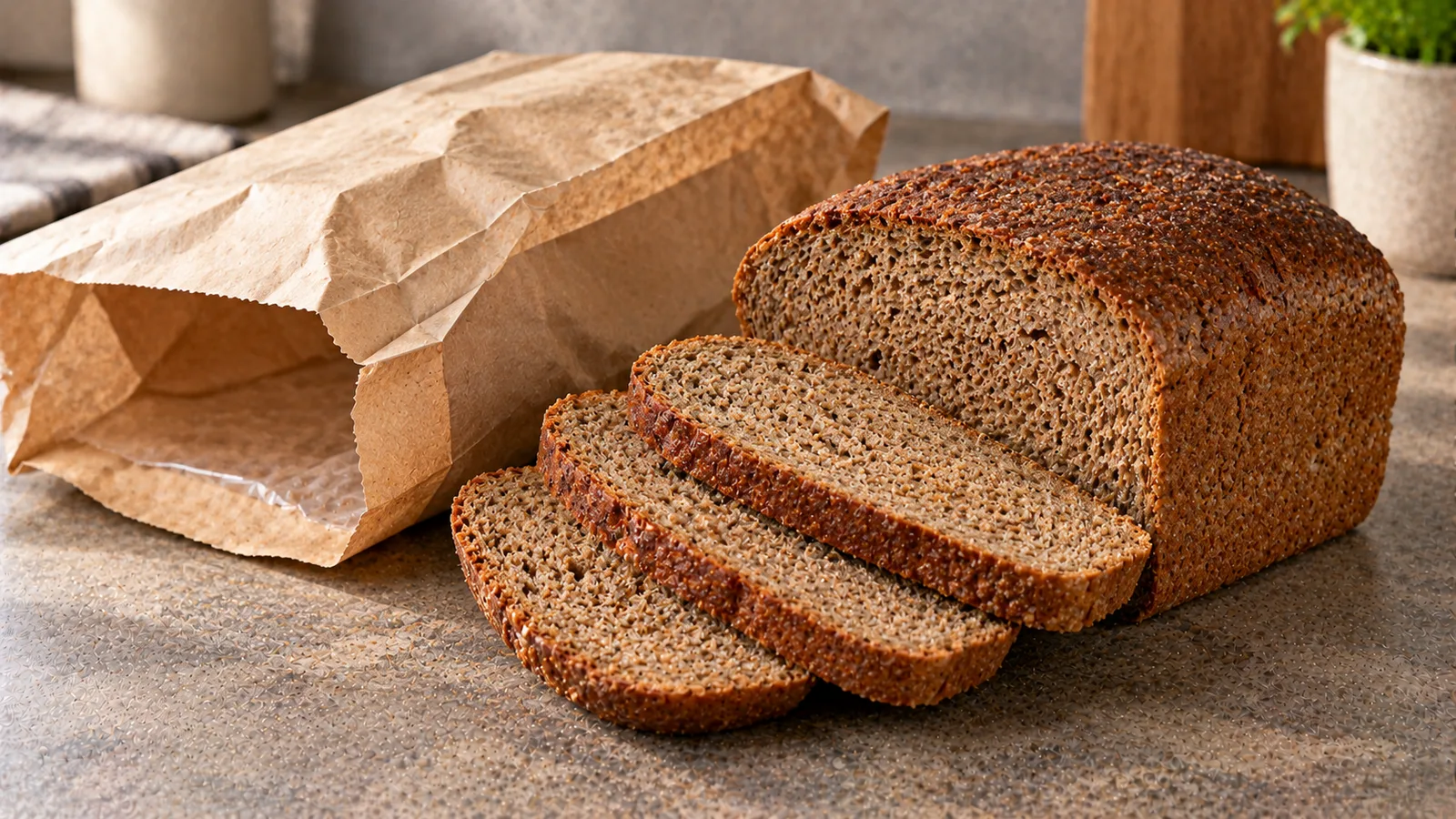
Choosing a loaf by its brown colour or a photograph of scattered seeds is unreliable. The decisive questions are what type of flour or grain was used, how much of the cereal portion is wholegrain, and what the actual ingredient and nutrition labels say. In Germany, the word Vollkornbrot is tied to an established bread standard. Elsewhere in the EU, the meaning and use of wholegrain descriptions may differ. This guide explains how to inspect a supermarket bread pack without pretending that a single printed percentage answers every question.
A practical 60-second label check
Start with the legal or descriptive product name, not the marketing slogan. Then read the ingredients, look for explicit wholegrain cereals and percentages, and finally compare fibre and salt per 100 g. A package that merely says “multigrain”, “seeded”, “brown”, or “fitness” has not yet answered the wholegrain question.
- Find the specific food name: is it actually described as wholegrain bread or only as bread with a wholegrain ingredient?
- Identify each cereal ingredient: wholegrain rye flour is different from refined wheat flour; bran and seeds are not substitutes for a wholegrain flour declaration.
- Note any declared percentages, taking care to identify exactly which ingredient and which denominator the figure describes.
- Compare the fibre, salt, and realistic slice weight only after you have examined the grain ingredients.
For a broader method of examining processed-food ingredient lists, see our ingredient-list reading guide. It explains the general layout; here we focus on the special difficulties of bread.
What “wholegrain” actually describes
A whole grain retains the bran, germ and starchy endosperm in roughly their original proportions, even when milled, cracked or flattened. A fine wholegrain flour may look smooth and produce a relatively light-coloured loaf. Conversely, a visually coarse bread can include refined flour. The European Commission's whole-grain knowledge resource outlines this distinction and the different approaches across European countries.
In ingredient lists, useful descriptions include wholegrain rye flour, wholemeal wheat flour, wholegrain spelt flour, wholegrain rye meal, and their relevant local equivalents. Plain “wheat flour”, “rye flour”, or “spelt flour” by itself does not establish that the flour is wholegrain. Whole kernels may also be present, but the ingredient list should still identify their type. A loaf can legitimately contain wholegrain ingredients without being entirely or predominantly wholegrain.
Do not infer a specific grain composition from the word “sourdough”. Sourdough refers to a fermentation method; it can be used with wholegrain or refined cereal ingredients. Equally, organic certification and a premium price do not by themselves reveal the proportion of wholegrain flour.
The German 90% rule—and its denominator
In Germany, the Leitsätze für Brot und Kleingebäck describe bread labelled Vollkornbrot or Vollkornbrötchen as containing at least 90% of its cereal ingredients in wholegrain form. The German Nutrition Society explains this explicitly and cautions against judging bread by colour or seeds: DGE guidance on wholegrain bread. The German ministry explains how the official bread descriptions reflect established consumer expectations in the German Food Code.
The key phrase is of the cereal ingredients. Water, salt, oil, yeast and non-cereal ingredients are not automatically part of that denominator. Therefore, the rule is not “at least 90 g of wholegrain in every 100 g of finished bread”. Breads lose varying amounts of water during baking, and a recipe normally starts with substantial water content. German bread descriptions are nationally specific; do not transplant this 90% test into every EU jurisdiction or turn it into a universal EU law.
Calculate the share of the cereal ingredients
Suppose a baker provides a complete recipe showing 90 g wholegrain rye flour and 10 g refined wheat flour among the cereal ingredients. The wholegrain share of cereals is 90 ÷ (90 + 10) × 100 = 90%. In a different recipe with 55 g wholegrain rye and 45 g refined wheat, the figure becomes 55 ÷ (55 + 45) × 100 = 55%. These are simplified hypothetical recipes, not actual packaged loaves, and they say nothing about the finished loaf's overall water content.
| Hypothetical cereal mix | Wholegrain cereal | Other cereal | Wholegrain share of cereal mix |
|---|---|---|---|
| Recipe A | 90 g | 10 g | 90% |
| Recipe B | 55 g | 45 g | 55% |
| Recipe C | 70 g | 30 g | 70% |
| Recipe D, all wholegrain flour | 100 g | 0 g | 100% |
The formula is always wholegrain cereal ingredients ÷ all cereal ingredients × 100. A mix of rye and wheat can still be wholegrain if the required portion is used in wholegrain form; there is no need for visible intact kernels. However, a customer usually does not possess a manufacturer's complete formulation, so this calculation illustrates the denominator rather than inviting you to invent missing ingredient weights.
What a percentage beside an ingredient tells you
The EU's Food Information to Consumers Regulation, Article 18 and Article 22 requires ingredients generally to be listed by descending weight at the time of use, subject to detailed exceptions. Article 22 requires quantitative ingredient declarations in certain situations—for example, where an ingredient appears in the food name or is emphasised—while Annex VIII sets exceptions and technical rules. This is often called QUID: quantitative ingredient declaration.
Imagine a label states “wholegrain rye flour 32%”. It indicates a proportion related to the applicable ingredient-declaration rule. It does not, without additional details, prove that only 32% of the bread's cereal ingredients are wholegrain. Another flour, water, soaking liquid and other ingredients may affect the denominator. Processing losses can also change how percentages are presented under Annex VIII. Conversely, “rye 70%” without the word wholegrain does not prove that the rye is wholegrain.
Read the exact noun after the number and distinguish percentage of the whole product or ingredients at use from percentage of the cereal ingredients. If the list does not allow the wholegrain-cereal percentage to be worked out, say “unknown from this label”—not “zero”, “probably 90%”, or “100%”.
Three fictional labels, three different conclusions
These examples are deliberately invented for teaching; they are not endorsements, real recipes or allegations about any manufacturer. Percentages and wording are simplified to make the interpretation clear.
| What the front says | What the label actually reveals | What you can conclude | What remains uncertain |
|---|---|---|---|
| “Dark farmhouse loaf” | Wheat flour, water, rye flour, malt extract | Colour/name do not certify wholegrain | Wholegrain share |
| “With wholegrain rye” | Wholegrain rye flour 18%, wheat flour, water | Some wholegrain is declared | Wholegrain share of all cereals |
| “Wholegrain rye bread” in Germany | Described as Roggenvollkornbrot | German bread standard relevant | Exact finished-loaf wholegrain weight |
| “Five-grain seeded bread” | Wheat flour, rye flour, sunflower, linseed, sesame | Multiple grains and seeds present | Whether cereal flour is wholegrain |
The German consumer organisation Verbraucherzentrale specifically warns that Mehrkorn does not automatically mean wholegrain and that malt extract can make bread appear darker. The lesson is not to distrust every bakery; it is to use descriptions that actually speak about the grain, rather than visual cues.
Fibre is useful evidence, but it is not the definition
Fibre on the nutrition panel helps compare real products. However, high fibre is a different property from a legally or conventionally recognised wholegrain bread description. Seeds, added bran and isolated fibres can increase the total fibre even if much of the cereal flour is refined. A genuine wholegrain loaf might show a lower figure than a heavily seeded specialty bread.
In the EU, the voluntary nutrition claims have defined thresholds: “source of fibre” requires at least 3 g/100 g or 1.5 g/100 kcal; “high fibre” requires at least 6 g/100 g or 3 g/100 kcal. These are alternatives—not two simultaneous requirements. The official European Commission nutrition-claims list explains the tests. Neither threshold supplies a universal mandatory percentage of wholegrain flour.
| Illustrative bread label | Fibre per 100 g | Fibre in 50 g | Fibre in 75 g |
|---|---|---|---|
| Bread X | 3.0 g | 1.5 g | 2.25 g |
| Bread Y | 6.0 g | 3.0 g | 4.5 g |
| Bread Z | 8.0 g | 4.0 g | 6.0 g |
| Bread W | 4.4 g | 2.2 g | 3.3 g |
All four rows are hypothetical arithmetic examples. The calculation is fibre per 100 g × portion in grams ÷ 100. If you eat 75 g, comparing only “per slice” values from manufacturers using different slice weights is misleading. Our portion-versus-serving guide explains why the label's serving size may differ from what is on your plate.
Read the list in the correct order
The first ingredient is generally the heaviest at the relevant time of manufacture, not necessarily the most important nutritionally. In bread, water may appear near the start. A wholegrain flour listed second can still be substantial. By contrast, a small amount of wholegrain flour near the end of a long list usually supports a limited claim about presence, not a calculated 90% of cereals.
Watch for several cereal entries: wheat flour, wholegrain rye flour, wheat gluten, oat flakes, rye malt. Their functions are not identical. Gluten provides protein and structure but is not a stand-in for a whole grain. Malt can contribute flavour and colour. Bran contains part of a kernel but, added on its own, does not demonstrate a wholegrain flour percentage. Wheat and rye ingredients also signal gluten allergens; ingredients must be labelled according to EU rules. See the European Commission's food-labelling overview for the basic mandatory label features.
If you see an unfamiliar cereal term, seek its exact translated ingredient name before making a judgement. “Rye”, “wholegrain rye” and “rye malt” should not silently be counted as the same thing in a calculation.
Why colour, seeds and names are unreliable
A dark crust can come from prolonged baking or malt. A top covered with sunflower seeds, pumpkin seeds or sesame tells you that seeds were added. It does not say how much of the bread flour used all parts of the grain. Multigrain usually speaks to the variety of cereal ingredients; it says nothing on its own about whether they are refined. High-protein refers to another measurable nutrition characteristic rather than wholegrain content. This is the same distinction between a product's ingredients and a nutrient claim that we explore in our protein-and-fibre label comparison.
Likewise, a pale-looking loaf can be made with finely milled wholegrain flour. Small air holes, large air holes, crispness, moisture and a rustic wrapper do not reveal the precise percentage. Let the actual product description and ingredient disclosures carry the evidential weight.
Does “wholegrain bread” mean the same thing everywhere?
No. The European Commission's whole-grain overview explicitly notes that the EU has no single legally endorsed definition covering all wholegrain products and that national approaches differ. Harmonised EU food-information rules still apply to ingredient presentation and misleading claims, but bread compositional descriptions can also depend on country-specific guidance and law. German Vollkornbrot is therefore a useful reference for shopping in Germany—not an automatic benchmark for products marketed in France, another EU country or outside the EU.
For a German packet, check the actual designation, rather than an attractive foreign-language translation on the front. For other markets, verify the applicable local food rules and read the manufacturer’s explanation. A percentage printed next to farine complète, wholemeal flour or Vollkornmehl still needs a clearly identified denominator before you convert it into a percentage of total cereals.
Salt, calories and allergens still matter
After verifying the wholegrain claim, compare the rest of the bread as food. The ingredient and nutrition label may show salt, fibre and energy per 100 g. A heavily salted wholegrain bread is still relatively salty. A seeded loaf may be more energy-dense because seeds add fat; that is not automatically bad, but it can change a portion calculation. Different consumers also have different allergy and gluten-related restrictions.
For instance, two hypothetical loaves provide 240 and 260 kcal per 100 g. A 50 g portion therefore provides 120 versus 130 kcal. This says very little about their wholegrain fractions. Our bread-calorie serving guide is the better place to compare calorie values and portion sizes; this article's primary question remains whether the wholegrain wording is supported.
What to ask at an unpackaged bakery counter
Bread sold without a complete retail ingredient panel can be harder to compare. Ask for the bread's exact sales designation, whether it is sold as Vollkornbrot, which grains are used as wholegrain flour or meal, and whether an ingredient or product specification is available. Staff may need to consult their product sheet. If they only answer “it is dark” or “it has lots of seeds”, you still do not know the wholegrain percentage.
Ask about allergens separately. Even when a product has no convenient front-of-pack ingredient list, relevant food-information obligations continue to exist for food sold non-prepacked, with country-specific implementation. Do not guess from appearances, especially for wheat, rye, barley, sesame or other ingredients relevant to you.
A worked shopping decision
Imagine choosing between Bread A, visibly dark with sunflower seeds and 4.4 g fibre/100 g, and Bread B, explicitly sold in Germany as Vollkornbrot with 6.0 g fibre/100 g. If your goal is a reliable German wholegrain bread, B provides a stronger naming signal, assuming the label is genuine and compliant. It also supplies 3.0 g fibre in a 50 g portion compared with 2.2 g from A. But A might still be suitable for your taste or other needs; the fibre values alone do not establish either loaf's exact recipe.
Now consider Bread C labelled “with 18% wholegrain rye flour”. You can verify that some wholegrain ingredient is present, yet you should not infer that 18% is the share of the cereal mixture. If the full denominator is missing, no rigorous computation is possible. The disciplined answer is to distinguish known label data, reasonable context, and unknown formulation details.
Your final checklist before buying
First, locate the precise bread designation; next, identify wholegrain flours or grains in the ingredient list; then interpret any percentages using their stated subject and denominator. In Germany, remember the 90% of cereals reference for Vollkornbrot, not 90% of the total loaf. Then compare fibre, salt, portion mass and allergens. Do not substitute colour, seeds, price, slogans or a single fibre figure for the wholegrain calculation. If an essential percentage is absent, choose an explicitly labelled product or request details rather than assigning an invented number.
Sources
- European Commission, Whole Grain: definitions and EU/national labelling context.
- EUR-Lex, Regulation (EU) 1169/2011, ingredient lists, QUID and food information.
- German Nutrition Society, cereals and how to recognise wholegrain bread.
- German ministry, the German Food Code and its bread descriptions.
- European Commission, authorised nutrition-claim thresholds.
- Verbraucherzentrale, colour, malt and multigrain caution.
- European Commission, basic EU food-labelling requirements.