
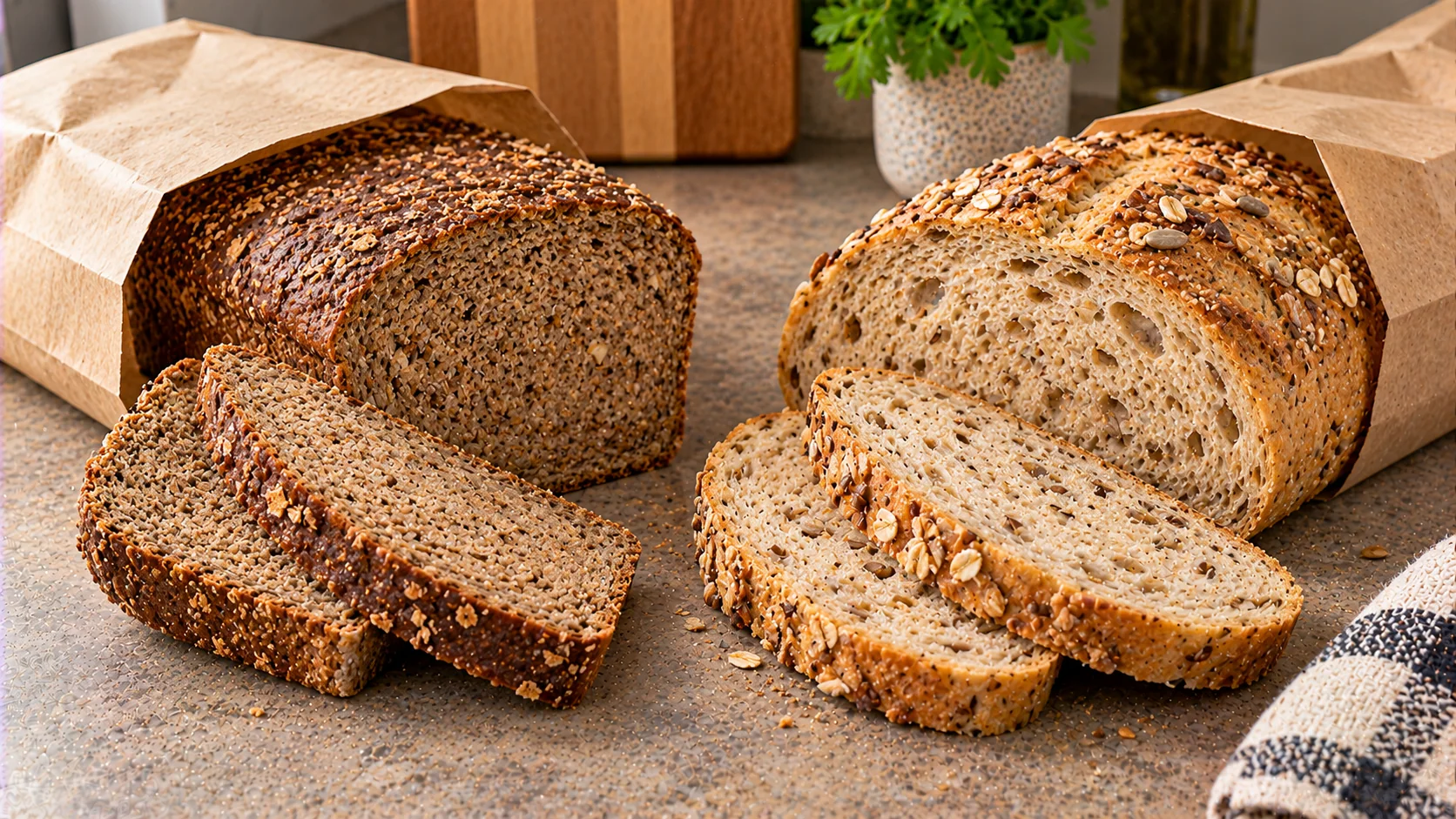
Wholegrain or multigrain bread: read the ingredients, not the colour
A brown loaf with five types of seeds can be made mostly from refined wheat flour. A plainer-looking loaf may contain a higher share of wholegrain flour. Multigrain describes a mixture of grains; wholegrain refers to the grain components retained in the ingredient. Neither the darkness of the crust nor the number of grains pictured on a wrapper establishes how much wholegrain the finished bread contains.
If you already understand front-of-pack claims, the detailed checking wholegrain claims on bread labels provides background. Here the narrower task is to compare two actual ingredient lists side by side, including added seeds, grain percentages, fibre and salt.
Start with what the grain words mean
A whole grain retains the bran, germ and endosperm in their original relative proportions, even when milled or flaked. White refined flour usually lacks much of the bran and germ. Multigrain means that more than one grain type is present, but it does not itself require any particular proportion to be whole. A wheat-and-rye loaf can therefore be multigrain while still relying on refined flour.
The European Commission's Knowledge4Policy whole-grain overview notes the absence of a single legally endorsed EU-wide definition for all wholegrain foods. Rules and customary terms can differ by country; do not assume that one global percentage threshold is legally binding for every German, French or English label. The international ISO 20810:2026 standard provides technical criteria, but a standard is not automatically the applicable local law.
Read the ingredient list in this order
- Find the first cereal ingredient. If the label opens with wholemeal wheat flour or wholegrain rye flour, that supports a different interpretation from one beginning wheat flour followed by small amounts of seeds. A first ingredient alone, however, does not tell you the exact total wholegrain percentage.
- Identify every cereal separately. Wheat, rye, oats and barley are grain types, not proof of wholegrain status. Check whether the ingredient explicitly says wholegrain/wholemeal for each.
- Look for declared percentages. Where a grain is highlighted or named, applicable EU quantitative-ingredient rules (QUID) may require a percentage declaration, with exceptions. Distinguish the percentage of one named component from the percentage of all wholegrain ingredients.
- Read the nutrition panel per 100 g. Compare fibre and salt per 100 g, not one brand's two slices against another brand's one slice.
- Then compare the price per 100 g. A larger or smaller loaf changes the apparent unit price; calculate it from the actual shelf price and bread weight.
Two hypothetical labels: the words do not tell the whole story
These are illustrative formulations, not verified commercial products. Percentages represent formulation shares of ingredients in the example; they are not lab analyses.
| Detail | Bread A: seeded multigrain | Bread B: wholegrain |
|---|---|---|
| Ingredients (illustrative, simplified) | Wheat flour 58%, water, rye flour 12%, sunflower seeds 8%, oats 4%, yeast, salt | Wholemeal wheat flour 61%, water, wholegrain rye flour 14%, yeast, salt |
| Clearly identified wholegrain cereal | None explicitly described as wholegrain | Wheat 61% + rye 14% in the example formulation |
| Fibre per 100 g (assumed label) | 4.0 g | 7.5 g |
| Salt per 100 g (assumed label) | 1.3 g | 1.0 g |
| Shelf price (assumed) | €2.49 for 500 g | €2.69 for 600 g |
| Price per 100 g | €0.50 (2.49 ÷ 5, rounded) | €0.45 (2.69 ÷ 6, rounded) |
In this example Bread B has more listed wholegrain ingredients, more fibre, less salt and a lower price per 100 g, despite the higher price per loaf. This is not a claim that every wholegrain bread has those advantages; real formulations vary. The flour fractions shown should not be converted into a legal wholegrain-content conclusion without the applicable labelling context.
The 100 g and the slice calculation
Suppose a slice weighs 40 g. The labelled fibre of Bread A gives `4.0 × 40 ÷ 100 = 1.6 g` per slice; Bread B gives `7.5 × 40 ÷ 100 = 3.0 g`. Two 40 g slices provide 3.2 g and 6.0 g fibre respectively. For salt, the same two slices provide `1.3 × 80 ÷ 100 = 1.04 g` or `1.0 × 80 ÷ 100 = 0.80 g`. These are mathematical examples using the fictional label values above, not nutritional data for a real loaf.
A loaf with larger slices could deliver more grams of fibre per slice despite a lower fibre figure per 100 g. For fair shopping comparisons use per 100 g first, then calculate your own serving. The contextual reading fibre claims on food labels explains how to read fibre information without confusing a claim with the nutrient amount per portion.
What colour, seeds and sourdough do—and do not—prove
Dark malt, caramelised ingredients or baking can change colour without increasing wholegrain content. Seeds can contribute fats, texture and some fibre while still accompanying refined flour. Sourdough describes a fermentation method; sourdough bread can be white, mixed or wholegrain. None of these cues substitutes for the ingredient list.
Beware the reverse mistake too: a light-coloured wholegrain bread is not necessarily inferior. Milling can make wholegrain flour fine while keeping its constituent parts. Grain type, flour extraction and recipe matter more than appearance.
EU label rules and a cautious interpretation
EU Regulation (EU) No 1169/2011 sets general food information rules, including ingredient ordering by weight at the time of use, nutrition declarations and rules concerning quantities of emphasised ingredients. Specific national bread definitions, marketing terms and exceptions still matter. A voluntary industry or ISO definition should not be presented as if it replaced law. For nutrition claims such as source of fibre, Regulation (EC) No 1924/2006 has specific conditions; that claim is not a certificate that a bread is wholegrain.
A sixty-second supermarket decision
Compare two breads of the same general type. Read the first three cereal ingredients, note any explicitly stated wholegrain percentages, compare fibre and salt per 100 g, then divide shelf price by weight. If wholegrain content is unclear, avoid inventing a percentage from crust colour or seed count. Prefer the loaf that best matches your preferences and dietary needs rather than assuming the most expensive or darkest bread is best.
People with coeliac disease must not assume that wholegrain or multigrain means gluten-free; wheat, rye and barley contain gluten. Check the allergen declaration and relevant gluten-free labelling. Added nuts, sesame and seeds may also be allergens. For bread kept longer than a few days, freeze slices promptly and thaw safely; discard mouldy bread rather than trimming only the visible spot.
Sources
- European Commission Knowledge4Policy: Whole Grain — definitions and EU policy context.
- ISO 20810:2026 — international technical standard; not a substitute for national law.
- Regulation (EU) No 1169/2011 — EU food information framework.
- Regulation (EC) No 1924/2006 — conditions for nutrition claims.