
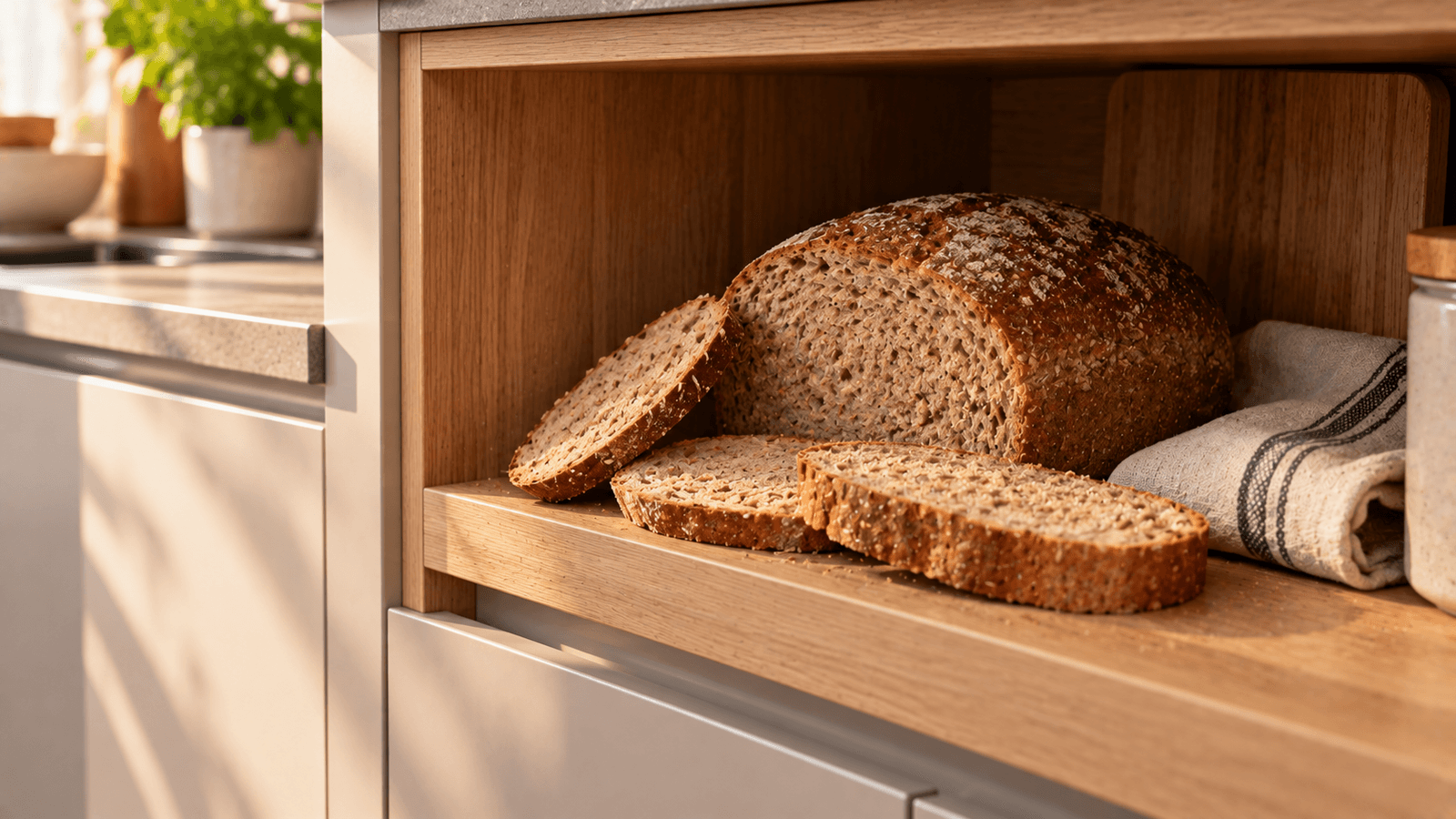
Bread does not have one universal calorie value.
Two slices that look similar can differ substantially in weight, ingredients and energy content. A thin packaged slice, a dense whole-grain slice and a thick piece cut from an artisan loaf are all "one slice," but they are not necessarily equivalent portions.
For calorie tracking, the most useful information is therefore:
- the calories per 100 g shown on the package or food database;
- the actual weight of the portion you eat.
How many calories are in bread?
Many common breads fall roughly in the mid-200-calorie range per 100 g, although individual products can be lower or higher.
A practical general range for many plain breads is approximately:
| Bread portion | Approximate calories |
|---|---|
| 25 g | 60–70 kcal |
| 30 g | 70–85 kcal |
| 40 g | 95–115 kcal |
| 50 g | 120–140 kcal |
| 75 g | 180–210 kcal |
| 100 g | 240–280 kcal |
These are estimates, not universal values.
Bread containing substantial amounts of seeds, nuts, oil, cheese, dried fruit or other energy-dense ingredients may fall outside this range. Beyond calorie differences, you can check wholegrain percentages on bread labels to understand wholegrain claims.
For packaged bread, use the nutrition label whenever possible.
Calories in one slice of bread
"One slice" is not a standardized weight across every loaf.
A slice may weigh:
- around 20–25 g if it is small or thin;
- around 30–40 g for many regular slices;
- 50 g or more when it is thick, large or cut by hand.
If a bread contains 250 kcal per 100 g:
25 g slice
250 × 25 ÷ 100 = 62.5 kcal
35 g slice
250 × 35 ÷ 100 = 87.5 kcal
50 g slice
250 × 50 ÷ 100 = 125 kcal
The bread has not changed. Only the slice weight has.
That is why an entry such as "1 slice of bread" can be inaccurate if the database slice does not match yours.
Calories in two slices
Two slices are simply twice the weight of one slice when both slices are similar.
Using the same 250 kcal per 100 g bread:
| Weight of one slice | Two-slice weight | Calories |
|---|---|---|
| 25 g | 50 g | 125 kcal |
| 30 g | 60 g | 150 kcal |
| 35 g | 70 g | 175 kcal |
| 40 g | 80 g | 200 kcal |
| 50 g | 100 g | 250 kcal |
This matters for sandwiches because large slices can make the bread portion much heavier than expected.
The simplest way to calculate bread calories
Use:
Calories eaten = calories per 100 g × portion weight in grams ÷ 100
Example:
Your bread label says:
264 kcal per 100 g
You weigh two slices together:
72 g
Calculation:
264 × 72 ÷ 100 = 190 kcal, approximately.
This method works for sliced bread, baguette, sourdough, rolls and bread cut from a loaf.
Why bread calories vary
The calorie value depends on the finished recipe and the amount of water remaining in the bread.
Important differences include:
- flour type;
- water content;
- added fats;
- seeds and nuts;
- sugar or syrups;
- dried fruit;
- cheese or other additions;
- loaf density.
A dense bread may contain more grams in the same visual volume than a lighter bread.
That is one reason visual size alone is not a reliable calorie measure.
White bread
Commercial white bread varies by recipe and slice size.
For tracking, use the package value and slice weight rather than assuming every white-bread slice has the same calories.
Example:
If white bread contains 265 kcal per 100 g and one slice weighs 30 g:
265 × 30 ÷ 100 = about 80 kcal
A 45 g slice of the same bread would provide:
265 × 45 ÷ 100 = about 119 kcal
The difference comes from portion weight.
Whole-wheat bread
Whole-wheat bread is not automatically dramatically lower in calories than white bread.
The calorie values can be relatively similar, while the nutritional composition differs.
Whole-grain breads can provide more fiber and retain more components of the grain than refined-grain breads.
For calorie tracking, however, you still need the value for the actual product.
Example:
If a whole-wheat bread contains 250 kcal per 100 g:
- 30 g = 75 kcal
- 40 g = 100 kcal
- 60 g = 150 kcal
- 100 g = 250 kcal
Multigrain bread
"Multigrain" tells you that more than one type of grain is used. It does not by itself tell you the calorie value or guarantee that the bread is entirely whole grain.
A multigrain bread containing seeds can also be more energy-dense than a plain bread.
Check:
- calories per 100 g;
- slice weight;
- ingredient list;
- fiber and other nutrition information if those matter to your goal.
Sourdough bread
Sourdough is a fermentation method, not one fixed nutritional formula.
Different sourdough loaves can use:
- refined wheat flour;
- whole-wheat flour;
- rye;
- mixed grains;
- seeds;
- different hydration levels.
A thin slice from one loaf and a thick slice from another may therefore differ substantially in calories.
Weighing the portion is particularly useful for bakery sourdough because hand-cut slices vary so much.
Rye bread
Rye breads range from relatively light loaves to very dense products.
A compact 50 g slice can visually appear smaller than a lighter 50 g slice while containing a similar amount of bread by weight.
For dense rye bread, estimating by visual slice size can therefore be especially misleading.
Use grams whenever practical.
Seeded bread
Seeds add nutrients and can also increase energy density because many seeds contain substantial amounts of fat.
That does not make seeded bread "bad."
It simply means that a seeded loaf should not automatically be assigned the calorie value of a plain loaf.
If the package lists 290 kcal per 100 g and your slice weighs 42 g:
290 × 42 ÷ 100 = about 122 kcal
Bread with nuts or dried fruit
Walnuts, sunflower seeds, raisins, cranberries and similar additions can change the energy content.
For these breads, a generic "bread" database entry may be less accurate.
Prefer:
- the product label;
- the bakery's nutrition information, if available;
- a close database match;
- a generic estimate only when better information is unavailable.
Baguette and other unsliced bread
With baguette or an unsliced loaf, "one piece" is particularly unreliable.
One person may cut a 35 g piece while another cuts 80 g.
If the bread contains 270 kcal per 100 g:
| Portion | Calories |
|---|---|
| 30 g | 81 kcal |
| 50 g | 135 kcal |
| 70 g | 189 kcal |
| 100 g | 270 kcal |
| 150 g | 405 kcal |
Weighing once can also help you learn what your usual piece looks like.
Bread rolls
Bread rolls vary widely in size.
A small roll may weigh roughly half as much as a large bakery roll.
Instead of treating every roll as one identical serving, use its weight.
Example with bread at 260 kcal per 100 g:
- 45 g roll = about 117 kcal
- 70 g roll = about 182 kcal
- 100 g roll = 260 kcal
Added seeds, cheese or fat can change the product value further.
Toasting bread does not remove the bread calories
Toasting mainly removes some water.
If you toast a slice without adding anything, the slice may weigh slightly less afterward because moisture has been lost, but the energy originally present in that slice has not disappeared.
This creates an important tracking distinction:
If you know the calories in the original slice, you can log that slice directly.
Do not assume that toasted bread becomes meaningfully lower in calories simply because it weighs less after heating.
Why calories per 100 g can appear higher after drying
Imagine bread loses water.
The total energy in the piece changes little, but the piece becomes lighter.
That means the calories become more concentrated per 100 g of the drier product.
The same principle explains why comparing foods only by post-heating weight can sometimes be confusing.
What about butter, cheese and spreads?
The calorie value of bread alone does not include toppings unless the database entry explicitly says so.
A piece of bread with:
- butter;
- peanut butter;
- cheese;
- jam;
- avocado;
- mayonnaise;
is no longer just a bread-calorie calculation.
Track the bread and toppings separately when you need a more accurate total.
Example:
Bread: 80 kcal
Spread: 60 kcal
Cheese: 90 kcal
Meal total:
80 + 60 + 90 = 230 kcal
The bread itself still contributes 80 kcal.
Sandwich calories: weigh the bread separately
A sandwich can be difficult to estimate as one visual object.
Breaking it into components is often easier:
- bread;
- protein filling;
- cheese;
- vegetables;
- sauce or spread.
If two slices weigh 76 g and the bread contains 255 kcal per 100 g:
255 × 76 ÷ 100 = about 194 kcal from bread
Then add the filling separately.
This prevents the calories of sauces, cheese or other ingredients from being incorrectly attributed to the bread.
Thick bakery slices are easy to underestimate
Packaged sliced bread trains us to think of a slice as a fairly consistent unit.
Bakery loaves do not work that way.
A thick artisan slice can weigh as much as two smaller packaged slices.
If you frequently eat the same loaf, weigh a few slices once.
You may learn that your normal slice is usually around 45 g, for example. After that, estimating repeated portions becomes easier.
How to track bread without weighing every time
You do not need to use a kitchen scale forever.
A practical approach is:
First few times
Weigh the bread.
Then
Notice the usual slice size and weight.
Save the product
If you regularly buy the same bread, save its nutrition data and typical slice weight.
Recheck when the product changes
A different bakery, loaf or slice thickness may require a new estimate.
This combines reasonable accuracy with convenience.
Package serving size vs your actual portion
A label might give nutrition information:
- per 100 g;
- per slice;
- per serving;
- or a combination.
The manufacturer's serving does not determine how much you personally ate.
If the label says one serving is 40 g but your portion is 65 g, calculate from 65 g.
Example:
Bread = 250 kcal per 100 g
Your portion = 65 g
250 × 65 ÷ 100 = 162.5 kcal
If you cannot weigh the bread
Use the best available information.
A useful order is:
- exact product serving information;
- package slice weight;
- weight of the whole loaf divided by the approximate number of equal slices;
- close database match;
- visual estimate.
For example, a 500 g loaf cut into 10 approximately equal slices averages around 50 g per slice.
Real slices may still vary, but that is more specific than assuming an arbitrary generic slice.
Nutrition beyond calories
Bread is primarily a carbohydrate-containing food, but its complete nutrition profile depends on the recipe.
Depending on the bread, it may contribute:
- carbohydrates;
- protein;
- fiber;
- small amounts of fat;
- sodium;
- vitamins and minerals.
Whole-grain breads generally retain more of the grain components than refined white bread, and fiber content can differ substantially between products.
The nutrition label is the best place to compare the breads you actually buy.
Is darker bread always whole grain?
No.
Color alone is not a reliable way to determine whether bread is whole grain.
If this distinction matters to you, check the product name and ingredient list rather than judging only by appearance.
A separate guide on reading ingredient lists can help when comparing packaged products.
Is bread high in calories?
"High" or "low" depends on the comparison and the amount eaten.
Bread contains considerably less water than foods such as many fruits and vegetables, so its calories are more concentrated by weight than in high-water foods.
But portion size matters.
A 30 g slice and a 150 g portion are very different amounts.
Rather than labeling bread generally as high-calorie or low-calorie, calculate the portion you actually eat.
Does bread fit into weight management?
Bread can be included in many different eating patterns.
For weight management, the overall energy intake and the rest of the diet matter more than the simple presence or absence of bread.
A useful practical question is not:
"Am I allowed to eat bread?"
but:
"What portion of this bread am I eating, and what else is in the meal?"
That keeps the focus on the complete meal rather than treating one food as responsible for the entire outcome.
Quick bread-calorie reference
For a bread containing 250 kcal per 100 g:
| Bread weight | Calories |
|---|---|
| 20 g | 50 kcal |
| 25 g | 63 kcal |
| 30 g | 75 kcal |
| 35 g | 88 kcal |
| 40 g | 100 kcal |
| 50 g | 125 kcal |
| 60 g | 150 kcal |
| 75 g | 188 kcal |
| 100 g | 250 kcal |
| 150 g | 375 kcal |
For a different bread, replace 250 with the calorie value on its label.
A practical tracking example
Suppose breakfast contains two slices of bread.
The package says:
247 kcal per 100 g
The slices weigh:
- first slice: 34 g
- second slice: 37 g
Total bread:
34 + 37 = 71 g
Calories:
247 × 71 ÷ 100 = about 175 kcal
You can then log the other breakfast ingredients separately.
This approach is more reliable than searching for a generic entry called "two slices of bread."
The most useful rule
For bread, grams are usually more informative than the word "slice."
When precision matters:
use the calorie value for the actual bread and multiply it by the actual portion weight.
That automatically accounts for thin slices, thick slices, baguette pieces and differently sized rolls without requiring a separate calorie rule for each shape.
Nutrition data sources and product differences
The records below describe only the named foods, fat levels and preparation states. USDA figures are per 100 g; manufacturer figures retain their stated unit. These sources do not independently prove every approximate figure in the article.
USDA entries below cover named white and whole-wheat breads, not baguettes or every other bread type.
USDA FoodData Central (search by FDC ID):
- FDC 174924 — Bread, white, commercially prepared (includes soft bread crumbs) (266 kcal/100 g)
- FDC 172688 — Bread, whole-wheat, commercially prepared (252 kcal/100 g)