
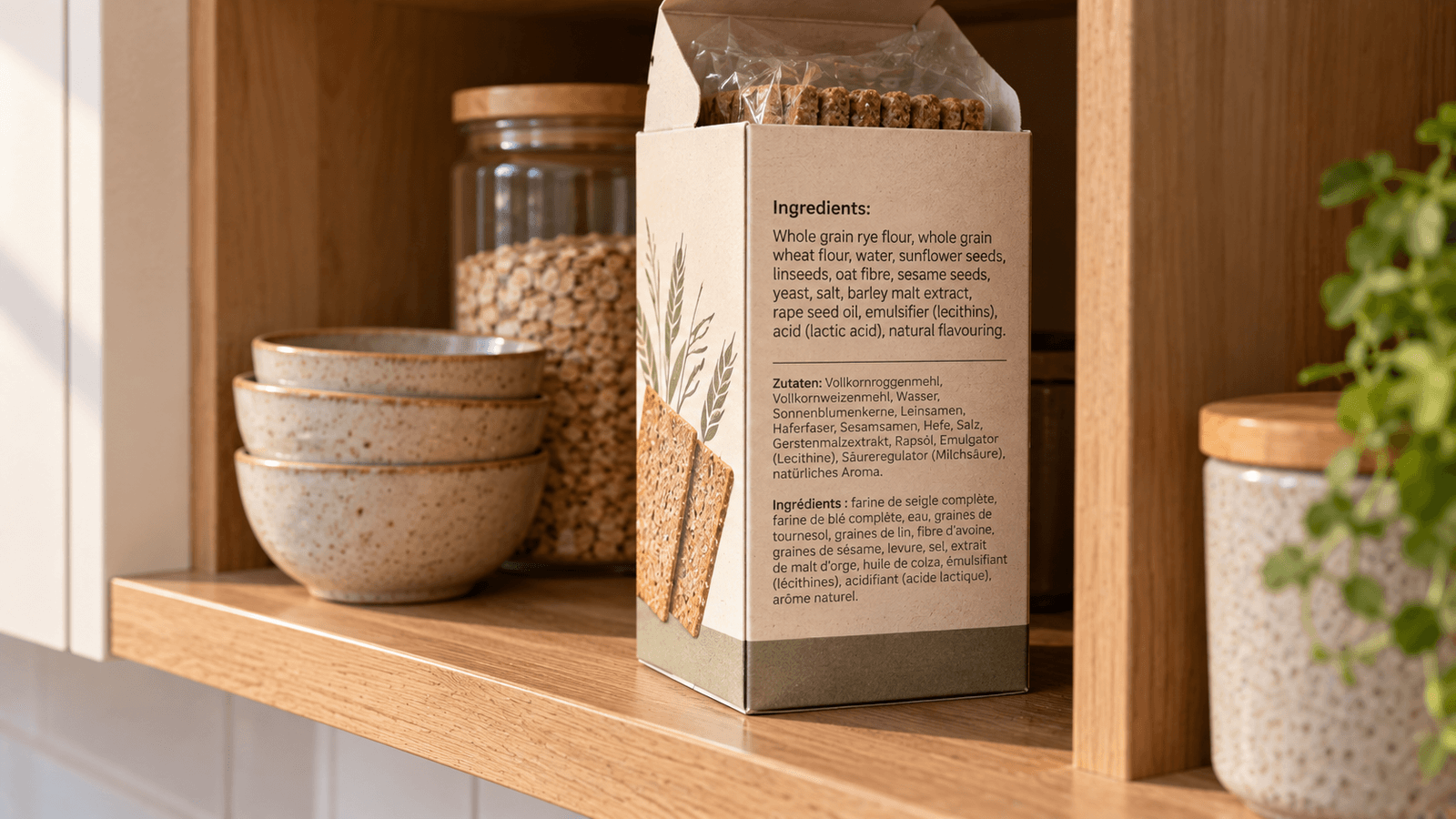
The ingredient list answers a different question from the nutrition table.
The nutrition table tells you quantities such as energy, fat, carbohydrate, sugars, protein and salt. The ingredient list tells you what the food was made from.
Reading both can be useful, but they should not be treated as interchangeable.
This guide focuses specifically on interpreting the ingredient list.
Start with the first ingredients
For prepacked foods in the European Union, ingredients are generally listed in descending order by weight as they were used when the food was manufactured.
That means the first ingredient was used in a greater amount than ingredients appearing later in the list.
Consider:
Ingredients: oats, milk, apple, sugar, sunflower seeds, cinnamon
Oats contribute more by weight at the time of manufacture than an ingredient appearing later such as cinnamon.
But there is an important limitation:
The list normally does not tell you the exact percentage of every ingredient.
You can understand the order without being able to calculate the complete recipe.
Ingredient order is useful, but do not overinterpret it
Imagine two cereal products.
Product A
Ingredients: whole-grain oats, wheat, sugar, sunflower oil, cocoa
Product B
Ingredients: sugar, wheat flour, whole-grain oats, sunflower oil, cocoa
Sugar appearing first in Product B tells you that sugar was a larger ingredient by weight at the time of manufacture than each ingredient following it.
That is useful information.
However, ingredient order alone does not tell you:
- total calories;
- grams of sugar per serving;
- fiber per 100 g;
- protein content;
- portion size;
- how filling the product will be for you.
For those questions, use the nutrition declaration as well.
Do ingredients always follow exact descending order?
There are specific exceptions to the general ordering rule.
Under EU rules, for example, ingredients making up less than 2% of the finished product may in certain circumstances be listed in a different order after the other ingredients.
There are also specific provisions for categories such as mixtures of herbs and spices, added water, concentrated ingredients and some other cases.
So the ingredient list is not a mathematical reconstruction of the recipe.
A useful interpretation is:
The beginning of the list usually tells you the major ingredients; the end should not be used to infer tiny differences with false precision.
What does a percentage next to an ingredient mean?
Sometimes you will see something like:
Ingredients: tomatoes 65%, water, onions, olive oil...
Percentages are particularly useful because they give information that ingredient order alone cannot provide.
Under EU food-label rules, the quantity of an ingredient generally has to be indicated in certain situations, including when that ingredient:
- appears in the name of the food;
- is emphasised on the label with words, pictures or graphics;
- is essential for characterising the food and distinguishing it from similar products.
This is why products often show percentages for ingredients central to their identity.
Use percentages when comparing similar products
Suppose two products are both sold as strawberry yogurt.
Product A lists:
Strawberries 12%
Product B lists:
Strawberries 7%
That is a direct piece of information you can use.
It does not automatically make Product A nutritionally superior overall, because the products may also differ in:
- sugar;
- protein;
- fat;
- calories;
- portion size;
- other ingredients.
But for the specific question "How much strawberry does this product contain?", the percentage is highly informative.
What are compound ingredients?
Some ingredients are foods made from several ingredients themselves.
For example:
Chocolate (sugar, cocoa mass, cocoa butter)
or:
Pesto (basil, oil, cheese, nuts, salt)
These are compound ingredients.
On a label, you may therefore see an ingredient followed by its own ingredients in parentheses.
Example:
Ingredients: pasta, tomato sauce (tomatoes, onions, olive oil, herbs), cheese
Do not stop reading at "tomato sauce." The information in parentheses helps explain what that component contains.
EU rules contain specific provisions and exceptions for how compound ingredients are declared, so not every label will have exactly the same structure.
How allergens appear in an EU ingredient list
In the EU, substances or products covered by the mandatory allergen rules must be clearly distinguished from the rest of the ingredient list.
Manufacturers may use formatting such as:
- bold type;
- a different font style;
- a contrasting background.
For example:
Ingredients: wheat flour, water, MILK, EGG, salt
The exact visual style varies, but the relevant allergen name must be emphasised.
If you have a diagnosed food allergy or intolerance, do not rely on a general nutrition summary or on the front of the package. Read the product's current allergen information carefully.
Formulations can change.
Allergens can appear inside compound ingredients
Suppose a product says:
Sauce (cream, cheese, herbs)
If milk is an allergen that must be declared, the relevant milk-derived ingredient should be identified and emphasised according to applicable labelling rules.
This is one reason to read the full list rather than only scanning the first few ingredients.
Ingredient list vs "may contain"
These statements serve different purposes.
The ingredient list identifies ingredients used in the product according to labelling requirements.
A statement such as:
May contain traces of nuts
is generally precautionary information about possible unintended presence, for example through cross-contact.
Do not treat "may contain" as though nuts were necessarily a deliberately added ingredient.
For allergy decisions, however, precautionary statements may still be important and should be taken seriously according to your medical guidance.
Recognise different forms of added sugars
Sugar can appear under different ingredient names depending on the product.
Examples may include:
- sugar;
- glucose syrup;
- glucose-fructose syrup;
- fructose;
- dextrose;
- honey;
- fruit juice concentrate;
- malt extract.
Seeing one of these ingredients does not by itself tell you how many grams of total sugars the food contains.
For that, check the nutrition declaration.
The ingredient list helps identify the source and position of ingredients; the nutrition table quantifies sugars.
Do not simply count the number of sugar-related ingredients
A common shortcut is to count every sugar-related ingredient and conclude that a product with more names must contain more sugar.
That does not reliably work.
For example:
Product A could contain one sugar ingredient in a large quantity.
Product B could contain several sweetening ingredients in smaller quantities.
The nutrition declaration gives the more useful quantitative information about total sugars.
Ingredient order adds context.
What about oils and fats?
Ingredient lists can help identify the type of fat used.
For example:
- olive oil;
- rapeseed oil;
- sunflower oil;
- butter;
- coconut oil.
But the presence of an oil does not tell you how much total fat is in your serving.
Again, combine the ingredient list with the nutrition table if quantity matters.
What do additives look like?
Food additives may be listed by their functional category and specific name or, where permitted, an E-number.
You might see terms such as:
- preservative;
- antioxidant;
- emulsifier;
- stabiliser;
- thickener;
- raising agent;
- sweetener.
The presence of a long or unfamiliar chemical-sounding name does not by itself tell you whether the food is nutritious or unsuitable.
An ingredient list is more useful when you interpret what ingredients are doing rather than judging them by how familiar their names sound.
A long ingredient list is not automatically a bad ingredient list
Length alone is a weak shortcut.
A product can have a long list because it contains:
- several herbs and spices;
- multiple grains;
- seeds and nuts;
- added vitamins and minerals;
- several components of a prepared sauce.
Another product can have a very short list and still contain a large proportion of sugar, fat or salt.
Instead of counting ingredients, ask more specific questions.
Five useful questions to ask
When comparing a packaged food, ask:
- What are the first few ingredients?
- Is the ingredient I expect from the product actually prominent?
- Are useful percentages provided for important ingredients?
- Are there allergens or ingredients I personally need to avoid?
- What does the nutrition table say about the quantities that matter to me?
These questions usually tell you more than simply deciding that "short = good" and "long = bad."
Example: comparing two breads
Imagine two packaged breads.
Bread A
Ingredients: whole-grain rye flour, water, whole-grain wheat flour, sunflower seeds, yeast, salt
Bread B
Ingredients: wheat flour, water, sugar, sunflower oil, yeast, salt
From the lists alone, you can identify that:
- Bread A begins with whole-grain rye flour;
- Bread B begins with wheat flour;
- Bread A contains seeds;
- Bread B contains added sugar and oil.
But you still cannot reliably determine from those lists alone:
- which has fewer calories;
- exact fiber content;
- exact protein content;
- exact salt content.
For those comparisons, use the nutrition declaration.
Example: comparing two tomato sauces
Sauce A
Tomatoes 80%, onions, olive oil, herbs, salt
Sauce B
Tomatoes 55%, water, tomato paste, sugar, modified starch, salt, herbs
If your question is which sauce contains a higher declared proportion of tomatoes, the answer is directly visible from the percentages.
If your question is which has fewer calories or less sugar per 100 g, move to the nutrition table.
This distinction makes labels much easier to interpret.
Example: yogurt
Imagine:
Yogurt A
Ingredients: yogurt, strawberries 10%, sugar
Yogurt B
Ingredients: yogurt, sugar, strawberries 5%, modified starch, flavouring
You can see differences in ingredient order and declared fruit content.
But the list still does not tell you the exact grams of sugars per 100 g.
Check the nutrition declaration before drawing a quantitative conclusion.
Do not assume the first ingredient determines whether a food is healthy
The first ingredient is important, but foods are mixtures.
For example, oats being first does not automatically tell you:
- how much sugar was added;
- how large the portion is;
- how calorie-dense the final product is;
- how much fiber or protein it provides.
Use the ingredient list as one layer of information, not as a complete health score.
Ingredient names you do not recognise
An unfamiliar ingredient is not automatically harmful.
Some ingredients have technical names because food labels need to identify them accurately.
If an ingredient matters to you because of an allergy, intolerance, dietary restriction or another specific reason, look up that particular ingredient rather than treating unfamiliarity itself as evidence of risk.
"Natural" does not make the rest of the list irrelevant
Front-of-pack marketing language can draw attention away from the actual composition.
Words and imagery on the front of a package should not replace reading:
- the product name;
- ingredient list;
- relevant percentages;
- nutrition declaration.
When comparing products, turn the package around.
Ingredient list vs nutrition table
Use each for the question it answers best.
| Question | Ingredient list | Nutrition table |
|---|---|---|
| What is the food made from? | Best source | Limited |
| Which ingredients appear in larger amounts? | Gives ordering | No |
| How many calories per 100 g? | No | Yes |
| How many grams of sugar? | Does not quantify total sugars | Yes |
| Which allergens are declared? | Important source | Usually not enough |
| What type of oil is used? | Often shows it | Usually not |
| How much protein? | Does not quantify it | Yes |
| Is a key ingredient given as a percentage? | Often | No |
For a step-by-step explanation of the nutrition declaration itself, see How to Read a Nutrition Label.
A 20-second ingredient-list check
You do not need to analyse every package for several minutes.
Try this:
1. Read the product name
What is the food actually being sold as?
2. Read the first three to five ingredients
What forms most of the product?
3. Look for percentages
Especially for ingredients central to the product.
4. Check ingredients relevant to you
For example allergens or ingredients you personally avoid.
5. Use the nutrition table for quantities
Calories, sugars, fat, protein, salt and other declared nutrients belong there.
This gives you a quick but more informative check than judging packaging claims.
When comparing two products, define the question first
There is no single "best ingredient list" independent of your goal.
You may be asking:
- Which contains more whole grain?
- Which contains more of the named fruit?
- Which uses a particular oil?
- Which avoids an allergen?
- Which has fewer ingredients I personally do not eat?
Those are ingredient-list questions.
But if your question is:
- Which has fewer calories?
- Which has more protein?
- Which has less salt?
- Which has more fiber?
you need the nutrition information as well.
Ingredient lists and highly processed foods
The ingredient list can help you understand what components a packaged food contains, but list length alone is not a reliable definition of processing level.
Processing classifications consider more than the number of ingredients.
If you want to understand that topic separately, see Ultra-Processed Foods: What the Term Means.
The practical rule
When you turn a package around, do not try to decide whether every individual ingredient is "good" or "bad."
Instead:
Use the ingredient list to identify what the product is made from and the nutrition table to understand how much energy and nutrients it provides.
Together, they give a much more useful picture than either one alone.