
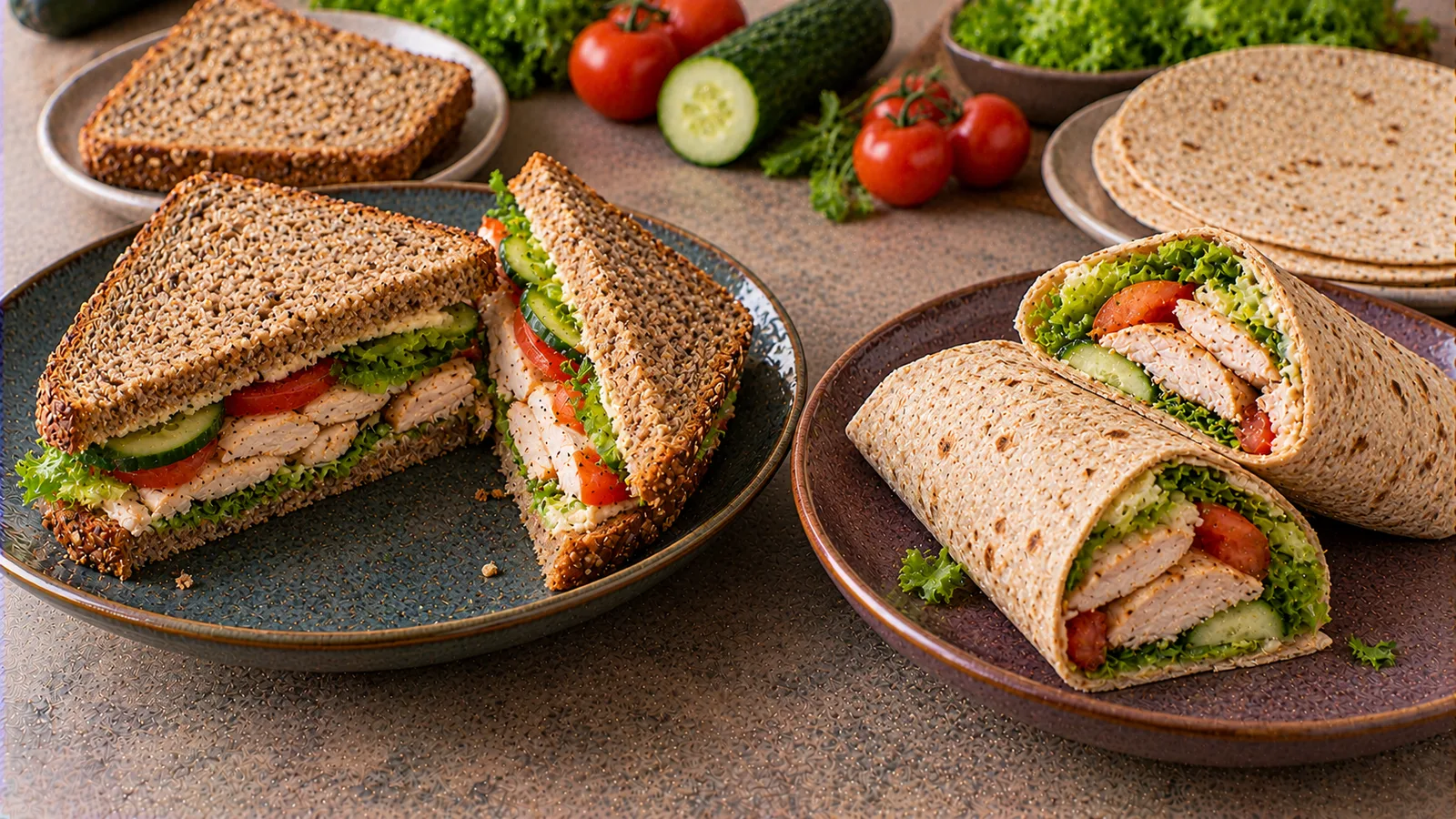
Wholegrain bread and high-fiber wraps can both make a practical packed lunch, but the words on the front of a package do not tell you which provides more fiber for your actual meal. The useful comparison is a defined amount of bread or wraps, its fiber and salt from the label, and the cost of that amount. This article compares one rye wholegrain bread with one fiber-rich tortilla sold in Germany. It does not rank all breads or all wraps, and it does not compare two kinds of wraps (the separate question covered by the wrap-to-wrap fiber comparison) or protein bread against ordinary wholegrain bread (covered by the protein-bread versus wholegrain-bread comparison).
The two products and the evidence
For a reproducible example, use ja! Roggen-Vollkornbrot, 500 g, listed by REWE, and REWE Beste Wahl High Protein Wraps, 320 g. The wrap is marketed for protein, but its published nutrition declaration also contains 6.2 g fiber per 100 g. That meets the EU's high fiber condition based on mass (at least 6 g/100 g). A marketing phrase such as “high protein” does not tell you the salt or fiber result; the numeric declaration does.
The bread label gives 7.7 g fiber, 1.15 g salt, and 201 kcal per 100 g. The tortilla label gives 6.2 g fiber, 1.0 g salt, and 308 kcal per 100 g. These are label figures, not independent lab measurements, and manufacturers may reformulate. Always check the package you actually buy. Sources: REWE rye wholegrain bread and REWE high-protein wraps.
| Declared nutrition | Rye wholegrain bread | Fiber-rich wrap |
|---|---|---|
| Reference weight | 100 g | 100 g |
| Fiber | 7.7 g | 6.2 g |
| Salt | 1.15 g | 1.0 g |
| Energy | 201 kcal | 308 kcal |
| Example package | 500 g | 320 g |
At equal 100 g, this bread provides 1.5 g more fiber and 0.15 g more salt. The wrap supplies 107 kcal more per 100 g, although the amount of filling and the finished meal matter more than a stand-alone calorie ranking. This is a comparison of these two labels, not a universal effect of making bread into a tortilla.
Compare actual lunch portions, not shapes
The REWE bread page gives a 56 g slice reference, and the wrap page gives 40 g per tortilla. A practical meal could use two bread slices (112 g) or two wraps (80 g). Those are different masses; that is why a separate equal-weight comparison above is necessary. The following table uses the exact declared per-100-g figures multiplied by the portion mass, before rounding.
| Base for one lunch | Two bread slices, 112 g | Two wraps, 80 g |
|---|---|---|
| Fiber from base alone | 8.62 g | 4.96 g |
| Salt from base alone | 1.29 g | 0.80 g |
| Energy from base alone | 225 kcal | 246 kcal |
| Difference between lunch bases | 3.66 g more fiber in bread | 0.49 g less salt in wraps |
The bread option contributes more fiber in this particular served portion, while the wrap base contributes less salt because you eat 32 g less base, even though both products contain substantial salt. Neither is automatically the best finished lunch. A thick spread of salty cheese or processed meat can overturn the salt comparison. Conversely, beans, salad, shredded carrots or a no-added-salt filling can bring fiber to either meal.
Do not treat two wraps as equivalent to two bread slices by count alone. Bread slices and tortillas vary widely in size; another brand's wrap might weigh 62 g rather than 40 g. Check the pack, use the kitchen scale if needed, and recalculate. The ingredient quantities above are bases, not complete lunch recipes.
What “high fiber” legally means
Under the European Commission's nutrition-claim conditions, a product may use the claim high fiber if it supplies at least 6 g per 100 g OR at least 3 g per 100 kcal. The first test alone is sufficient for this particular wrap because its label declares 6.2 g per 100 g. “Source of fiber” has a lower threshold: 3 g per 100 g or 1.5 g per 100 kcal. Do not confuse either claim with “wholegrain.” One describes a nutrient level, while the other describes which grain components were used.
A wrap can reach a fiber threshold by using several ingredients, such as legume flour or linseed flour, without being predominantly wholegrain. The tortilla selected here lists wheat flour, wheat protein, yellow flaxseed flour and pea flour among its ingredients. The rye bread lists wholegrain rye meal and flour. Ingredient lists, allergens and product names answer a different question from the nutrition panel. The DGE wholegrain guide explains why wholegrain grain products matter and why dark color or visible seeds alone are not proof of wholegrain status.
Fiber comparison: amount and food structure
On the two package labels, 100 g of bread offers 7.7 g of fiber and 100 g of wrap offers 6.2 g. Dividing fiber by portion weight gives a more useful packed-lunch answer: 112 g of the bread gives 8.624 g, rounded to 8.62 g; 80 g of wraps gives 4.96 g. If a person chooses a single 40 g wrap with a large portion of beans and vegetables, the complete meal could still be fiber-rich. The base alone cannot predict total lunch fiber.
Wholegrain bread may contribute wholegrain-associated components beyond the single fiber number, while an enriched tortilla can have a different mix of grains, isolated fibers, protein ingredients and fats. Neither label tells you the type of microbiome response an individual will have. Avoid claims that any one ingredient directly “fixes digestion.” Introduce changes in fiber gradually if you are not used to them and keep fluid intake appropriate. The DGE guidance favors making wholegrain foods a regular part of eating patterns; it does not say every packaged tortilla is inferior.
Salt can reverse the conclusion
Per 100 g, the selected bread has 1.15 g salt while the wrap has 1.0 g. But the modeled served bases are not equal-weight, yielding 1.288 g salt from the bread and 0.8 g from the wraps. Round them to 1.29 g and 0.80 g. That is a 0.49 g difference from the carbohydrate base alone. It does not include hummus, canned fish, cheese, deli meat, pickles or sauces.
This is salt, not elemental sodium. If you need to compare a label reporting sodium rather than salt, the approximate conversion is salt = sodium × 2.5, with the units kept consistent. However, in the EU these two retail labels already give salt, so no conversion is needed. More importantly, do not describe a 1.0 g salt-per-100-g wrap as “low salt”: that claim has a separate much lower legal threshold. Check salt for the entire lunch before concluding which meal better fits your goals.
Model prices: shopping basket versus eaten amount
REWE displays prices according to the selected store or region. Rather than claim current German shelf prices, the following budget illustration deliberately assumes €1.79 for the 500 g bread loaf and €2.49 for the 320 g wrap pack. They are hypothetical inputs, not verified offers. Use the per-gram formula pack price ÷ pack grams × consumed grams. It assumes you use the purchased food rather than discard stale leftovers.
| Budget measure | Bread | Wraps |
|---|---|---|
| Hypothetical checkout price | €1.79 / 500 g | €2.49 / 320 g |
| Cost per 100 g of base | €0.36 | €0.78 |
| Used in modeled lunch | 112 g | 80 g |
| Allocated cost of that base | €0.40 | €0.62 |
| Remaining package mass | 388 g | 240 g |
Even though the two-wrap lunch weighs less, its allocated base cost is approximately €0.22 higher in this model. Buying both complete packages would cost €4.28 at checkout, not the €1.02 sum of the two allocated lunch-base amounts. The unused portions still belong to the shopping basket. If you throw them away, cost per actually eaten base rises, sometimes considerably.
For a fresh calculation, enter local prices at the same shop or on the same day. If your bread is €2.79 or the tortilla is discounted, the answer may change. Read net weight, count portions accurately, and make sure the prices are for products you can actually buy in that branch. A discount for a multipack is only useful if its remainder gets eaten safely.
Build a fair lunch around either base
To keep the comparison useful, make the filling identical by weight when you test the two formats. One example is 80 g cooked chickpeas, 80 g tomato and cucumber, 30 g plain yogurt and a few herbs in either two slices of bread or two small wraps. This is a meal-building illustration, not a nutrient-calculated claim for a specific brand of chickpeas or yogurt. Rinse and drain chickpeas if canned, and include their label values separately if you calculate the complete plate.
To construct a second test with closer total mass, use 80 g bread versus 80 g wraps rather than counting pieces. At 80 g, the selected bread would supply 6.16 g fiber and 0.92 g salt; the wraps supply 4.96 g fiber and 0.80 g salt. With equal filling, the remaining difference comes from the base rather than portion size. You may prefer a 112 g bread sandwich for appetite and convenience; that is a different, equally valid real-world question.
If a wrap is larger than your appetite, one 40 g wrap plus a bean-based filling may be more suitable than two. One 40 g wrap alone provides 2.48 g fiber and 0.40 g salt; it is not a complete lunch by itself. Likewise, one 56 g bread slice gives 4.31 g fiber and 0.64 g salt. Adding vegetables and an adequate protein source matters more than treating the wrap shape as nutritionally magical.
Allergens, storage and practical use
The selected rye wholegrain bread contains rye (gluten) and lists potential traces of several allergens. The wraps contain wheat (gluten). They are not suitable substitutes for someone needing a gluten-free lunch. Check each current ingredient list for other allergens and do not assume that “high fiber” means gluten-free, vegan or free of additives. The tortilla manufacturer gives instructions for warming and handling; follow the label after opening. Bread storage also depends on packaging, temperature and whether slices were frozen; discard food showing mold rather than cutting away one visible patch.
For taking lunch to work, fillings containing dairy, cooked meats or other perishable foods need suitable cold storage. Heat wraps only as directed; warming the base does not make an improperly stored filling safe. Pack wet fillings separately if sogginess is a concern. Bread may be easier to portion and freeze slice-by-slice, but usability and freezer access vary by household.
How to choose in thirty seconds
Read the per-100-g fiber and salt values of the two actual brands, then multiply by the grams you will eat. Next divide the price of the whole package by its net grams and multiply by your actual serving weight. Finally, check ingredients, allergens, remaining product and what you will put inside. This narrow comparison is about a bread-versus-wrap lunch, not a general wrap-to-wrap claim or a bread-protein contest; those questions have their own guides at the wrap-to-wrap fiber comparison and the protein-bread versus wholegrain-bread comparison.
The result for these two examples is concrete: bread wins on fiber at 100 g, wraps are slightly lower in salt at 100 g, and real lunch portions change the magnitude of each difference. Price depends on the pack you buy, not the word printed in large type on its front.
Sources
- REWE: ja! rye wholegrain bread — per-100-g label and 56 g slice
- REWE: Beste Wahl High Protein Wraps — fiber, salt and 40 g tortilla
- European Commission: authorized nutrition claims and fiber thresholds
- DGE: why wholegrain is a useful grain choice
Product declarations can change; prices in this article are deliberately hypothetical. No retailer quote was used as a live price.