
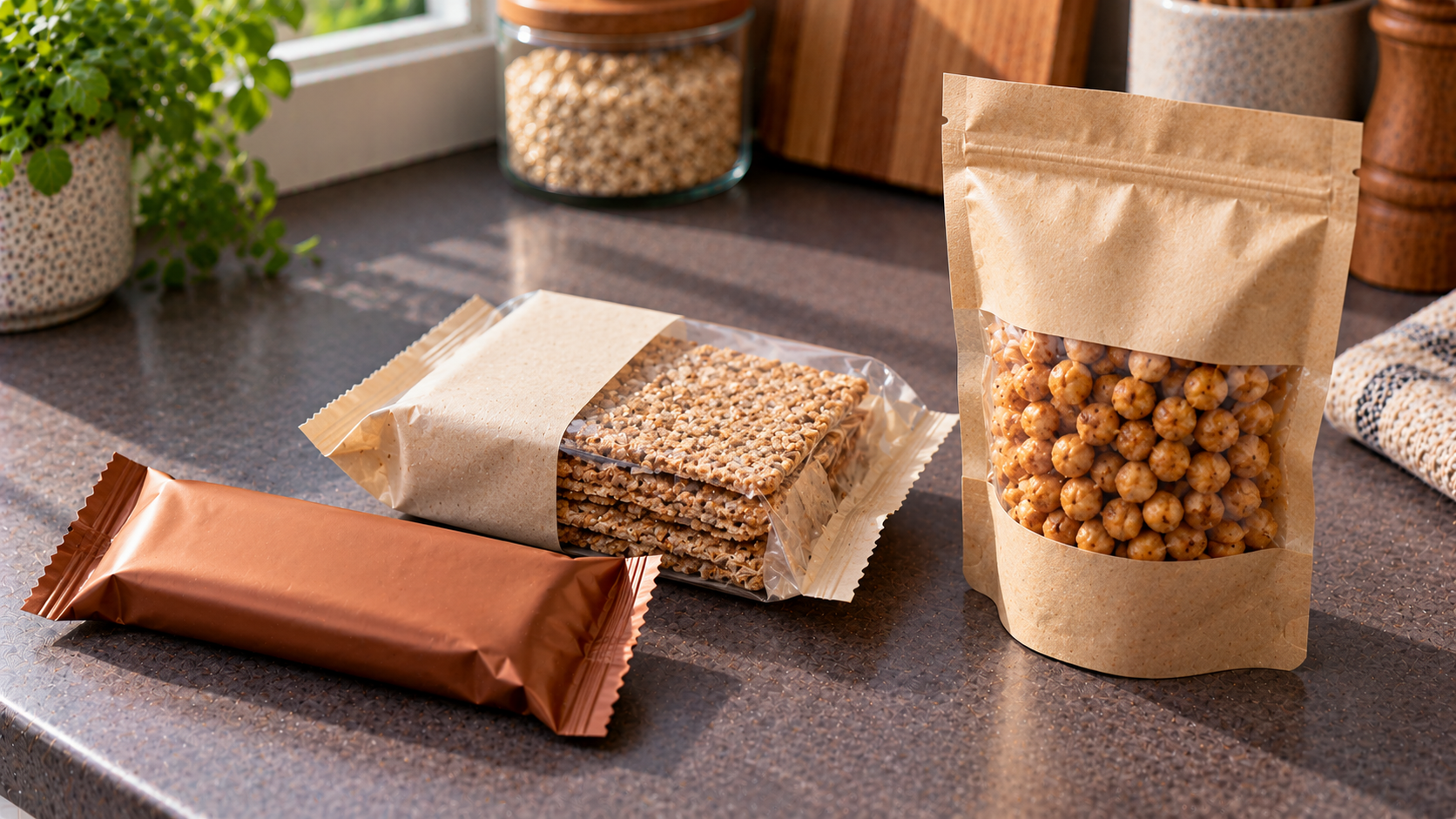
A snack advertised as “high protein” or “source of fibre” may be useful—but the claim on the front of the pack rarely tells you whether it is the best choice. Compare the nutrition panel on a consistent basis, check how much you will actually eat, and keep sugar, saturated fat, salt and price in view. This guide gives you a repeatable way to compare snack bars, crackers, yogurts, roasted pulses and other packaged snacks without assuming that one number tells the whole story.
Start with the same amount of food
In the EU, packaged-food nutrition declarations are generally presented per 100 g (or 100 ml for liquids). Manufacturers can also show figures per portion. The per-100-g column is the fairest starting point for two competing products: it avoids giving an advantage to a brand that defines a smaller serving. After that, convert to the amount you actually plan to eat.
US Nutrition Facts labels usually lead with an identified serving size, so compare the listed grams and convert to a common weight when comparing US products. A serving size describes a reference amount; it is not a personal recommendation. The number of servings in a package matters if you finish the whole thing.
| Label field | What it answers | Common trap |
|---|---|---|
| Protein per 100 g | Which product is denser in protein? | Confusing a dense food with a large real serving |
| Fibre per 100 g | Which contains more fibre for equal weight? | Treating all types of added fibre as identical |
| Protein and fibre per portion | What will you actually get? | Accepting the brand's tiny serving as your portion |
| Energy per 100 g and portion | How much energy comes with those nutrients? | Looking only at protein grams |
| Saturates, sugars and salt | What else is in the snack? | Assuming a protein claim implies low sugar or salt |
| Pack size and price | How much food and value are you buying? | Comparing package prices with different weights |
A worked comparison: three fictional snacks
These numbers are illustrative, not copied from actual brands. Imagine a protein bar, roasted chickpeas and whole-grain crackers. All calculations use stated, hypothetical label values; check real packages before buying.
| Per 100 g | Protein bar A | Roasted chickpeas B | Whole-grain crackers C |
|---|---|---|---|
| Energy | 380 kcal | 400 kcal | 430 kcal |
| Protein | 30 g | 20 g | 12 g |
| Fibre | 8 g | 15 g | 9 g |
| Sugars | 12 g | 4 g | 5 g |
| Saturated fat | 7 g | 2 g | 3 g |
| Salt | 0.40 g | 1.20 g | 1.00 g |
| Example portion | 50 g | 35 g | 30 g |
Multiply each per-100-g figure by portion weight divided by 100. The bar supplies 15 g protein and 4 g fibre in its 50-g portion. Chickpeas provide 7 g protein and 5.25 g fibre in 35 g. Crackers provide 3.6 g protein and 2.7 g fibre in 30 g. A different question produces a different winner: the bar delivers more protein per listed portion, while chickpeas supply more fibre per listed portion despite the smaller weight.
The same portions contain 190, 140 and 129 kcal respectively. These totals matter because a label does not magically change your actual portion. If you eat two bars, all portion values double, including sugar and saturated fat. You can build a useful snack by combining foods, such as crackers with a protein-rich topping, rather than insisting that one packet achieve every nutritional goal.
Protein: grams are useful, but the denominator matters
For a quick comparison, look at protein grams per 100 g, then at protein in the portion you will actually eat. If your purpose is to add protein without much extra energy, calculate grams per 100 kcal:
Protein per 100 kcal = protein per 100 g ÷ kcal per 100 g × 100.
For the example bar, 30 ÷ 380 × 100 = 7.9 g per 100 kcal. The chickpeas provide 20 ÷ 400 × 100 = 5 g; crackers provide 12 ÷ 430 × 100 = 2.8 g. This is a useful comparison metric—not a quality grade, satiety score or statement about amino-acid completeness.
Remember that an EU “source of protein” claim depends on at least 12% of the food's energy coming from protein, and “high protein” requires at least 20%, under the applicable nutrition-claim rules. These are not thresholds of 12 g or 20 g protein per 100 g. A permitted claim does not establish that the product has the highest protein density on the shelf.
A snack can also contain ingredients with different protein profiles. Milk, eggs, soy, wheat and legumes are not nutritionally identical. For most people eating a varied diet, comparing the declared grams plus the wider meal pattern is more practical than declaring a single ingredient categorically superior. If an allergy matters, read the ingredients and allergen statement—not just the protein number.
Fibre: quantity, source and tolerance
Fibre helps distinguish a whole-grain or pulse-based snack from a refined product, but the amount printed on the label is only the start. Look at the ingredients: oats, whole grains, chickpeas, beans, seeds, nuts and fruit may contribute fibre together with other nutrients. Some bars instead obtain much of their fibre from added ingredients such as inulin, chicory-root fibre or polydextrose. These can have legitimate uses, but they do not make every fibre-enriched snack nutritionally equivalent to whole foods.
The EU permits “source of fibre” when a food contains at least 3 g per 100 g or 1.5 g per 100 kcal; “high fibre” generally requires at least 6 g per 100 g or 3 g per 100 kcal. Both alternative routes matter. The rules define when the claim can be used; they do not define your ideal snack size.
For example, a 25-g portion of a product with 6 g fibre per 100 g provides 1.5 g fibre. A 60-g portion provides 3.6 g. Read the actual quantity rather than interpreting “high fibre” as “a large fibre serving.” If you are increasing fibre, do so gradually and drink enough fluids. Rapidly eating large amounts of certain added fibres can cause bloating or discomfort in some people.
Protein and fibre together: a practical two-number screen
A simple first pass is to record protein and fibre in your own serving. For a snack of similar size and energy, a higher amount of both may be useful—but there is no universal magic threshold. A 12-g protein yogurt with little fibre could be paired with berries or oats; a fibre-rich crispbread could be served with quark, hummus or another suitable topping. The whole snack combination matters more than a single product claim.
To avoid accidentally rewarding oversized servings, compare per 100 g first, then write down a realistic amount: 30 g of crackers, one 45-g bar, or a 150-g yogurt pot. For mixed snacks, add the nutrients from the actual components. A food diary can track a combined snack without needing to label one item “good” and another “bad.”
Check calories and the rest of the panel
More protein and fibre are not automatic reasons to ignore other nutrients. Nuts and seeds can be nutrient-dense but also energy-dense; that is not inherently negative, though portion size matters if you are managing total energy intake. Sweetened dairy snacks may deliver protein together with substantial sugar. Savoury pulse chips may contain fibre alongside a sizable amount of salt or oil.
Use a consistent order: energy, protein, fibre, sugars, saturates, salt, then the ingredient list. Under EU labels, “sugars” refers to total sugars; the panel does not generally require a separate added-sugars line. Check the ingredients for syrup, sugar and sweetening ingredients when added sugar is relevant. On US labels, “Added Sugars” is a specific Nutrition Facts declaration, which makes the two systems different.
Salt is another regional distinction: EU packages commonly display salt in grams, while US labels display sodium in milligrams. Do not directly compare the numbers as though the units represent the same substance. As a rough conversion, salt (g) ≈ sodium (g) × 2.5. Check both the amount and the serving basis.
Read the ingredients after the numbers
Ingredients appear in descending order by weight as used in the recipe. This helps identify whether an item marketed as an “oat” snack is mostly oats, or mainly refined flour and syrups with a small oat addition. Likewise, “with nuts” is not the same as primarily made from nuts. The list is not a substitute for the nutrition declaration, but it explains some of the differences.
Look for ingredients that matter personally: milk, peanuts, tree nuts, sesame, soy, wheat/gluten-containing cereals, and other declared allergens. Do not infer gluten-free status from a high-fibre claim or from a product's appearance. Special diets, medical restrictions and allergies require the relevant safety and ingredient information, not a nutritional score.
Compare value without being fooled by pack size
A €1.60 pack containing 40 g may be more expensive per 100 g than a €2.20 pack containing 100 g. Calculate price per 100 g as pack price ÷ pack weight × 100. If the goal is protein, a supplementary metric can be cost per 10 g of protein in that product:
Cost per 10 g protein = pack price ÷ total protein in pack × 10.
Suppose the hypothetical 50-g bar costs €1.80 and contains 15 g protein. That is €1.20 per 10 g protein. A 150-g yogurt costing €1.20 with 15 g protein costs €0.80 per 10 g. This calculation is useful for a budget comparison but does not account for fibre, appetite, convenience, allergens or taste. An item that costs less per gram protein may not be the better snack for your circumstances.
What front-of-pack claims actually mean
Regulated nutrition claims have defined conditions, but they are narrow. “High protein” says something about the share of energy derived from protein; “high fibre” says something about fibre quantity relative to weight or energy. Neither automatically means low in saturated fat, low in salt, or minimally processed. “Natural,” “fitness,” “balanced,” and other promotional expressions should not displace the back-of-pack numbers.
The rules behind a “high protein” badge are explained in the high-protein claim guide, while the source-of-fibre versus high-fibre guide covers the separate fibre thresholds.
Also distinguish a nutrition claim from a health claim. Statements that a food contains a nutrient are different from claims that it causes a health benefit, and health claims have their own restrictions. A colourful badge can be an invitation to check, not a substitute for checking.
A five-step supermarket decision
- Choose two or three snacks you would realistically eat, not products selected only for their marketing language.
- Compare protein and fibre per 100 g, alongside energy, salt, sugars and saturates.
- Convert every figure to the portion you plan to consume; check how many portions are inside the package.
- Read ingredients and allergens, and pay attention to added fibre, sugar or protein sources where relevant.
- Compare price per 100 g and, if useful, per 10 g protein; then decide based on preference and the rest of your day.
This system is especially useful when products have different formats, such as a bar versus crackers or yogurt. It keeps your decision linked to an actual serving rather than abstract marketing claims. If one snack offers more protein and another more fibre, choose based on what your meals already provide, or combine complementary foods.
Three quick label-reading cases
Case 1: Two bars. Bar X lists 20 g protein per 100 g in a 40-g bar; Bar Y lists 16 g per 100 g in a 60-g bar. X delivers 8 g protein per bar, while Y delivers 9.6 g. X wins per equal weight; Y wins per entire bar. Decide which unit is relevant and compare calories as well.
Case 2: A tiny high-fibre cracker serving. A pack lists 8 g fibre per 100 g and a 20-g serving. That portion supplies 1.6 g fibre. If you actually eat 50 g, it supplies 4 g, along with 2.5 times the serving's energy and salt. Neither the front badge nor the manufacturer's portion determines how much you consumed.
Case 3: A protein cookie and plain yogurt. A cookie may win on convenience; plain yogurt may offer protein for less money and fewer added sweeteners, but little fibre. Pairing yogurt with oats or fruit can address that difference. Make comparisons using real labels—not a stereotype that every cookie is unhealthy or every yogurt is superior.
Keep the comparison honest
Nutrition declarations may be based on analytical values or calculations under applicable regulations, and normal batch variation is possible. Treat labels as the best available practical guide, not laboratory precision. Do not add together per-100-g values from products of different weights without adjusting for the portions consumed. Never convert fibre grams into “protein equivalents”; these nutrients serve different functions.
The strongest choice is the snack that fits your purpose, portion and overall eating pattern. For a quick protein boost, real protein per portion may be decisive. For adding fibre, check the actual grams, source and tolerance. For daily use, also ask whether the food is affordable, satisfying, safe for your allergies and something you genuinely enjoy.