
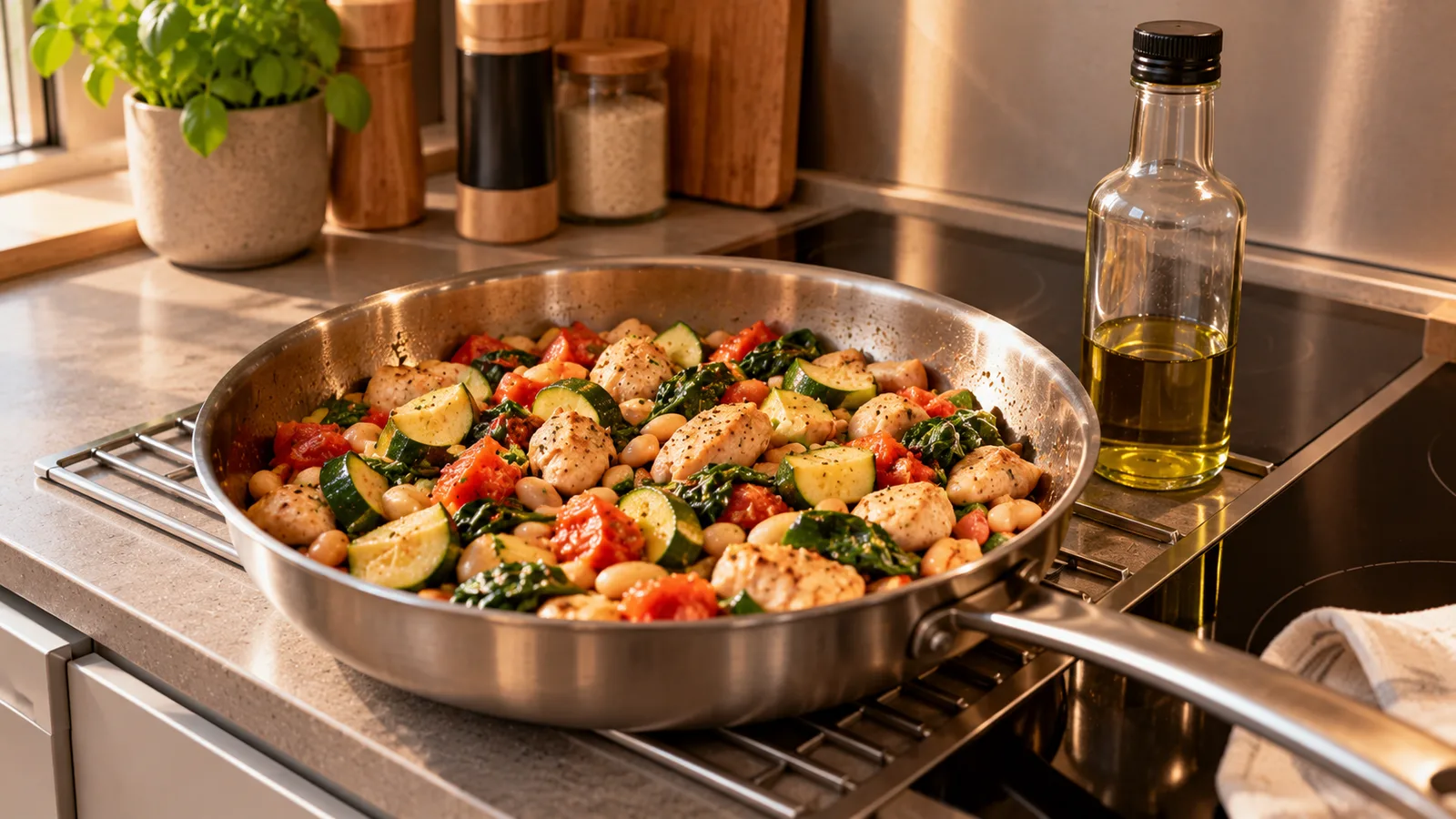
Fat does not need to be eliminated when you are trying to lose weight.
Body weight changes are driven primarily by the overall energy balance over time. Dietary fat matters because it is energy-dense, but it also performs important functions in the body and can be part of satisfying, nutritionally balanced meals.
The practical goal is not to eat as little fat as possible. It is to choose an amount that fits your calorie target while leaving enough room for protein, carbohydrates and the foods you enjoy.
Does eating fat prevent weight loss?
No.
Eating dietary fat does not automatically cause body-fat gain, just as eating a low-fat food does not automatically cause weight loss.
For weight loss, the broader energy balance matters.
A diet containing fat can still produce weight loss when total energy intake remains below energy expenditure over time.
The reason fat deserves attention during calorie planning is its energy density:
- protein provides about 4 kcal per gram;
- carbohydrate provides about 4 kcal per gram;
- fat provides about 9 kcal per gram.
That means relatively small amounts of high-fat foods can contribute substantial calories.
How much fat should you eat for weight loss?
There is no single gram target that is correct for everyone.
A useful starting point is to think of fat as part of your total calorie and macro allocation rather than choosing a gram target in isolation. (WHO — Total fat intake for adults and children (2023))
For adults, commonly used dietary guidance places total fat within roughly 20–35% of total energy intake.
That range is not a special weight-loss formula. It is a general reference range that can help provide context when building a diet.
Your practical target can vary according to:
- total calorie intake;
- protein target;
- carbohydrate preference;
- activity level;
- food preferences;
- dietary pattern;
- medical or nutritional advice specific to you.
Converting calories from fat into grams
Fat contains approximately 9 kcal per gram.
To convert calories allocated to fat into grams:
fat grams = calories from fat ÷ 9
Suppose you eat 1,800 kcal per day and choose 30% of calories from fat.
Calories from fat:
1,800 × 0.30 = 540 kcal
Fat in grams:
540 ÷ 9 = 60 g fat
This gives a practical daily target of about 60 g.
Example fat targets at different calorie levels
The table below shows what 25%, 30% and 35% of calories from fat look like in grams.
| Daily calories | 25% fat | 30% fat | 35% fat |
|---|---|---|---|
| 1,500 kcal | 42 g | 50 g | 58 g |
| 1,800 kcal | 50 g | 60 g | 70 g |
| 2,000 kcal | 56 g | 67 g | 78 g |
| 2,200 kcal | 61 g | 73 g | 86 g |
| 2,500 kcal | 69 g | 83 g | 97 g |
These are calculation examples, not personalized prescriptions.
The appropriate amount depends on the rest of your diet.
Why fat can become important when calories are reduced
When total calories are lower, every macro takes up part of a smaller calorie budget.
Imagine two people both eating 80 g of fat.
80 × 9 = 720 kcal
For someone eating 2,500 kcal, that represents about 29% of total calories.
For someone eating 1,500 kcal, the same 80 g represents 48% of total calories.
So a fat intake that fits comfortably into one calorie target can leave much less room for protein and carbohydrates at another.
This is why fat intake should be considered together with total calories.
Start with calories and protein before fine-tuning fat
A practical macro setup for weight loss can follow this order:
- Establish an appropriate calorie target.
- Set a suitable protein target.
- Allocate a reasonable amount of dietary fat.
- Use the remaining calories for carbohydrates and additional fat according to preference.
This prevents fat from being treated as an isolated target.
If you need to estimate your macro targets, use the Macro Calculator.
Example: fitting fat into a calorie target
Suppose your target is 1,900 kcal.
You decide that 30% of calories will come from fat.
1,900 × 0.30 = 570 kcal from fat
570 ÷ 9 = 63 g fat
Those 63 g account for 570 kcal.
The remaining 1,330 kcal are available for protein and carbohydrate.
The exact split depends on your protein target, activity and preferences.
Why very low-fat is not automatically better
Because fat provides more calories per gram, reducing excessive amounts can make a calorie deficit easier.
But that does not mean the best strategy is to remove nearly all fat.
Dietary fats contribute to:
- cell membranes;
- absorption of fat-soluble vitamins;
- production of signaling molecules;
- provision of essential fatty acids;
- flavor and texture of meals.
A sustainable weight-loss diet should still provide adequate nutrition.
The goal is usually to manage portions and food choices rather than eliminate an entire macronutrient.
Which fats should you prioritize?
The type of fat matters as well as the total amount.
A practical eating pattern generally emphasizes unsaturated fat sources such as:
- olive and other vegetable oils;
- nuts;
- seeds;
- avocado;
- fish;
- nut and seed butters.
Foods higher in saturated fat can still fit into a diet, but dietary guidance generally recommends keeping saturated fat limited and replacing some of it with unsaturated fats.
The overall dietary pattern matters more than labeling individual foods as good or bad.
High-fat foods can be easy to underestimate
Some foods contain many calories in relatively small portions.
Examples include:
- cooking oil;
- nuts;
- nut butter;
- seeds;
- cheese;
- mayonnaise;
- creamy sauces;
- avocado;
- chocolate.
These foods do not need to be avoided.
But portion size can matter considerably when you are working with a calorie target.
Example: cooking oil
One tablespoon of oil can contribute roughly 120 kcal, depending on the amount actually used.
If you pour oil directly into a pan without measuring it, the difference between 5 g and 20 g is substantial.
At 9 kcal per gram of fat:
5 g fat ≈ 45 kcal
20 g fat ≈ 180 kcal
That difference alone is about 135 kcal.
For people who track calories, oils and sauces are therefore useful foods to measure consistently.
See How to Track Sauces, Oils and Condiments More Accurately.
Example: nuts
Nuts combine fat with protein, fiber and micronutrients, but they are also energy-dense.
A small handful and a large handful can look similar while containing substantially different amounts.
If nuts regularly push your calorie intake above target, the solution does not have to be removing them.
You can instead:
- measure the portion;
- use a smaller serving;
- combine them with higher-volume foods;
- plan them into your daily calories.
Can higher-fat diets work for weight loss?
Yes.
Some people prefer a dietary pattern with more fat and fewer carbohydrates.
Others prefer more carbohydrates and less fat.
Weight loss can occur with different macro distributions when the overall diet creates a sustainable energy deficit and provides adequate nutrition.
The best macro split is not necessarily the one with the lowest fat percentage.
It is one you can follow consistently while meeting your nutritional needs.
Can lower-fat diets work?
Yes.
Reducing fat can be an effective way to reduce calories because fat provides 9 kcal per gram.
For example, reducing 15 g of added fat removes approximately:
15 × 9 = 135 kcal
But a lower-fat approach should still contain appropriate sources of dietary fat.
"Lower fat" and "no fat" are not the same strategy.
Fat and fullness
Fat can contribute to meal satisfaction and slows gastric emptying, but fullness is influenced by the complete meal rather than one macro alone.
Protein, fiber, food volume, texture and overall energy intake also matter.
A meal containing some fat together with protein and fiber-rich foods may feel more satisfying than simply adding a large amount of fat to a low-volume meal.
For more on this interaction, see Protein and Satiety.
A practical meal example
Consider a meal containing:
- grilled chicken;
- potatoes;
- vegetables;
- olive oil.
The chicken contributes protein.
Potatoes provide carbohydrate.
Vegetables add volume, fiber and micronutrients.
Olive oil adds fat and flavor.
If the meal needs fewer calories, you do not necessarily need to remove the oil completely.
You could reduce the amount from 20 g to 10 g.
That reduces the theoretical energy contribution by about:
10 × 9 = 90 kcal
while keeping some fat in the meal.
Hidden fat vs visible fat
Some fat is easy to see and measure:
- oil;
- butter;
- mayonnaise;
- dressing.
Other fat is naturally present inside foods:
- cheese;
- meat;
- salmon;
- eggs;
- nuts;
- seeds.
If you track macros, both contribute to your total fat intake.
Adding 50 g of fat from oils and nuts does not mean your daily total is 50 g if the rest of your foods also contain fat.
How to distribute fat across meals
There is usually no need to divide fat into perfectly equal amounts at every meal.
For example, a person targeting about 60 g per day might naturally eat:
| Meal | Fat |
|---|---|
| Breakfast | 12 g |
| Lunch | 18 g |
| Snack | 7 g |
| Dinner | 23 g |
| Total | 60 g |
Another distribution could work equally well.
Daily intake and the overall dietary pattern are generally more useful than trying to make every meal mathematically identical.
A separate guide covers How to Split Macros Across Meals.
What if you keep exceeding your fat target?
First identify where the extra fat is coming from.
Check:
- cooking oils;
- dressings;
- sauces;
- nuts and nut butter;
- cheese;
- fatty cuts of meat;
- pastries and desserts;
- large portions of avocado;
- multiple high-fat foods in the same meal.
Then adjust the easiest source rather than rebuilding your entire diet.
Example:
Your lunch contains avocado, cheese, olive oil and a creamy dressing.
All four can fit individually, but together they may use a large share of your daily fat and calorie budget.
Reducing one or two portions may be enough.
What if your fat intake is very low?
If your tracking repeatedly shows very little dietary fat, review whether your diet contains regular sources of essential fats and whether your overall macro setup is unnecessarily restrictive.
Rather than chasing the lowest possible number, build a diet that can meet nutritional needs while supporting your calorie target.
People with medical conditions or specific therapeutic diets should follow individualized advice from an appropriate healthcare professional.
Do you need to track fat to lose weight?
Not necessarily.
Some people successfully manage weight by tracking total calories, portions or meal structure without setting a precise daily fat target.
Tracking fat can be useful when:
- you want to manage your macros;
- high-fat foods are making your calorie target difficult to maintain;
- you want to understand where your calories come from;
- you are adjusting carbohydrate and fat intake around a protein target.
It is a tool, not a requirement for everyone.
A simple way to set fat intake
A practical process is:
- Determine your daily calorie target.
- Set your protein target.
- Choose a reasonable fat allocation within your overall diet.
- Convert fat calories to grams by dividing by 9.
- Check whether the target works with foods you actually enjoy.
- Adjust the macro split if adherence, meal satisfaction or food choice becomes unnecessarily difficult.
The important point is that fat intake should fit into the whole diet rather than being optimized in isolation.
Example day
Suppose the target is:
2,000 kcal
Fat target:
30% of calories
Calculation:
2,000 × 0.30 = 600 kcal
600 ÷ 9 = about 67 g fat
A day might contain:
- eggs at breakfast;
- yogurt and fruit;
- chicken, rice and vegetables with olive oil;
- a portion of nuts;
- salmon, potatoes and vegetables at dinner.
The exact foods are flexible.
What matters is how the complete day fits the calorie and macro targets.
Fat intake and weight loss: the practical takeaway
You do not need to avoid dietary fat to lose weight.
Instead:
- keep total calorie intake aligned with your goal;
- make room for adequate protein;
- include appropriate amounts of dietary fat;
- emphasize unsaturated fat sources;
- pay attention to portions of energy-dense foods;
- adjust carbohydrates and fats according to your needs and preferences.
Fat is one part of the overall diet, not a standalone switch that determines whether weight loss occurs.
Related guides and tools
- What Are Dietary Fats? Types and Food Sources
- Macro Calculator
- Carbs for Weight Loss: How Much Do You Need?
- Protein and Satiety: How Protein Affects Fullness
- How to Track Sauces, Oils and Condiments More Accurately