
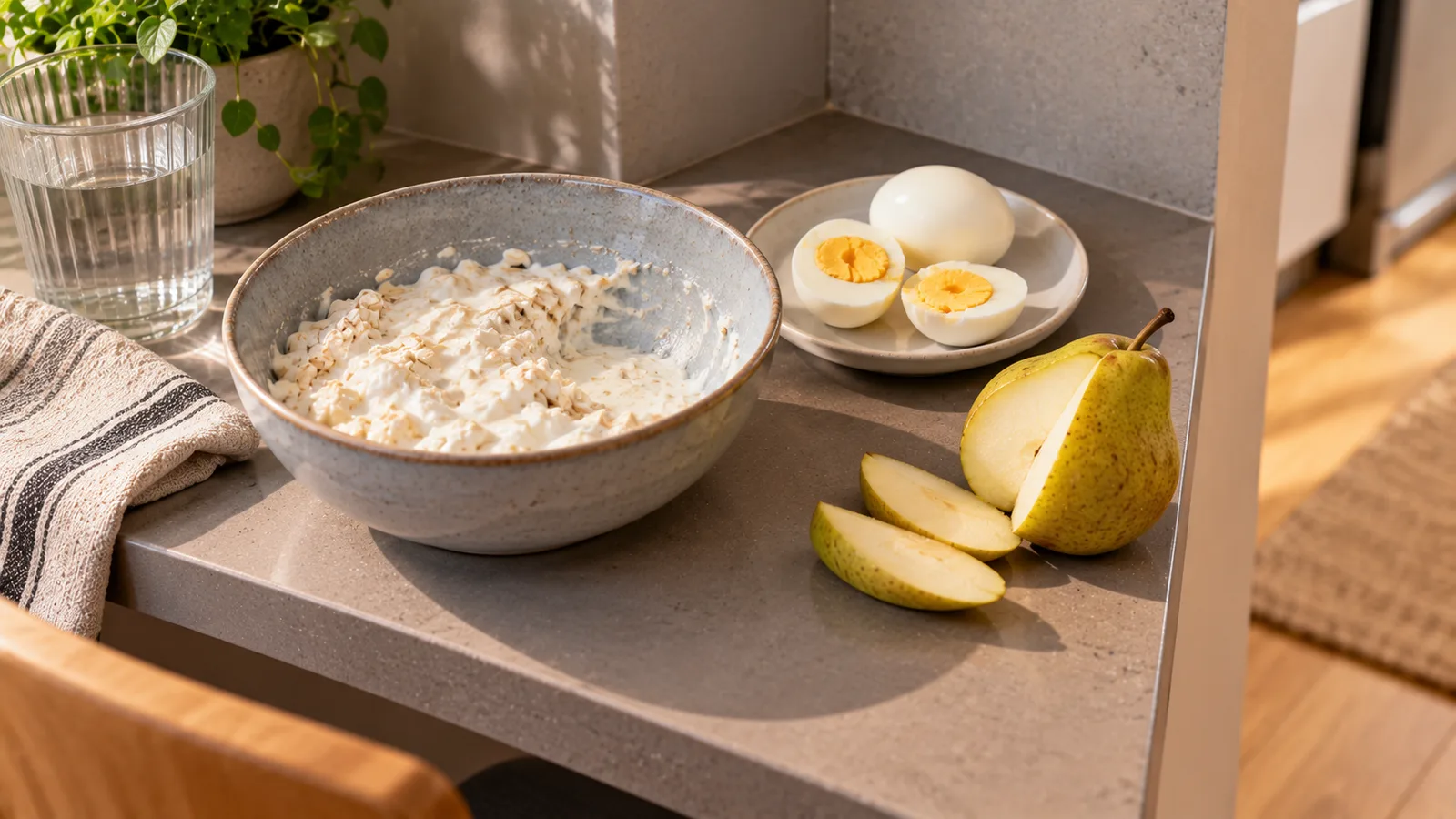
A breakfast for weight loss does not need to be tiny, carb-free or built around special “diet” foods.
A more useful goal is to make breakfast satisfying enough to support your day while keeping the amount of energy appropriate for your overall eating pattern.
For many people, the most filling breakfasts combine protein, fiber-rich foods, some fruit or vegetables, and a portion that matches their appetite.
What makes a breakfast filling?
Satiety is influenced by the entire meal rather than one ingredient.
A practical breakfast can combine four elements:
- a meaningful source of protein;
- a source of fiber;
- enough food volume to feel like a real meal;
- an energy level that fits the rest of your day.
Examples might include:
- Greek yogurt, berries and oats;
- eggs, whole-grain toast and vegetables;
- cottage cheese, fruit and oats;
- oatmeal with milk or yogurt and fruit;
- tofu with vegetables and whole-grain bread.
There is no single breakfast that is best for everyone.
Protein is a useful starting point
Protein can contribute to satiety and helps make breakfast more substantial.
Common breakfast protein sources include:
- eggs;
- Greek yogurt;
- Skyr;
- cottage cheese;
- milk;
- soy foods;
- tofu;
- fish or lean meat when appropriate;
- protein-fortified foods.
The goal is not to turn every breakfast into an extreme high-protein meal.
Instead, compare two breakfasts.
Breakfast A:
- toast;
- jam;
- juice.
Breakfast B:
- toast;
- eggs;
- fruit.
The second meal includes a clearer protein source and may be more satisfying for many people even if both contain carbohydrates.
Fiber can make breakfast more substantial
Fiber-rich foods can add volume and structure to breakfast.
Useful options include:
- oats;
- whole-grain bread;
- berries;
- apples;
- pears;
- other whole fruit;
- vegetables;
- seeds;
- legumes in savory breakfasts.
For example, plain yogurt alone and yogurt with berries plus oats are not nutritionally identical meals.
The second combination provides additional food volume and fiber.
Whole fruit vs juice
Fruit can fit easily into a weight-loss breakfast.
Whole fruit generally provides more physical structure and fiber than juice.
Compare:
- an orange;
- a glass of orange juice.
Both can be part of a diet, but they are consumed differently.
If your priority is a filling breakfast, whole fruit is often easier to build into a substantial meal.
Food volume matters
A breakfast does not have to be physically small simply because you are trying to lose weight.
Foods with a high water content can increase meal volume without necessarily making the meal extremely calorie-dense.
Examples include:
- berries;
- melon;
- tomatoes;
- cucumber;
- mushrooms;
- leafy vegetables.
This can be particularly useful for people who dislike very small portions.
But calorie-dense foods can still fit
Nuts, nut butter, seeds, avocado, cheese and oils can all be part of breakfast.
They simply require more awareness of quantity because relatively small portions can contain substantial energy.
For example, a bowl containing yogurt, oats, fruit, nuts, seeds, nut butter and honey may sound nutritious—and can be—but the combination can become much more calorie-dense than expected.
The solution is not necessarily to remove these foods.
It is to choose which additions matter most to you instead of automatically adding all of them.
A simple breakfast-building framework
Start with a protein source.
Then add one or two fiber-rich foods.
Add a calorie-dense extra if desired.
For example:
Base
200 g plain Greek yogurt
Fiber and volume
berries + oats
Optional extra
small portion of nuts
Another example:
Base
eggs
Fiber and volume
whole-grain toast + tomatoes
Optional extra
a measured portion of avocado
This approach is flexible enough to work with different calorie needs.
How many calories should breakfast contain?
There is no universal breakfast calorie target.
The appropriate amount depends on factors such as:
- your total daily energy needs;
- how many meals you eat;
- whether you snack;
- your appetite in the morning;
- training and activity;
- how much food you prefer later in the day.
For example, someone eating three similar-sized meals may distribute calories differently from someone who prefers a small breakfast and larger dinner.
A breakfast should therefore be evaluated as part of the entire day rather than against one fixed number.
Example calorie distributions
Suppose a person's chosen daily intake is 1,800 kcal.
There are many possible distributions.
Example A:
| Meal | Calories |
|---|---|
| Breakfast | 400 |
| Lunch | 550 |
| Dinner | 650 |
| Snacks | 200 |
Example B:
| Meal | Calories |
|---|---|
| Breakfast | 550 |
| Lunch | 500 |
| Dinner | 600 |
| Snacks | 150 |
Both total 1,800 kcal.
The example is not a prescription. It simply shows why breakfast does not need one universal calorie limit.
Breakfast does not need to be low-carb
Carbohydrate-containing foods can be part of a filling breakfast.
Examples include:
- oats;
- whole-grain bread;
- fruit;
- potatoes;
- beans;
- unsweetened cereals.
The more useful question is what accompanies them.
Oats with yogurt and berries create a different meal from a large serving of sweetened cereal eaten alone.
Toast with eggs and tomatoes is different from toast with a large amount of butter and sweet spread.
Look at the complete meal rather than labeling one macronutrient as the problem.
Breakfast does not need to be fat-free
Dietary fat can also be part of breakfast.
Examples include:
- nuts;
- seeds;
- avocado;
- eggs;
- dairy foods;
- nut butter.
Because fat is energy-dense, portions can make a noticeable difference when several high-fat foods appear in the same meal.
For example:
avocado + cheese + oil + nuts
may provide much more energy than expected even though each ingredient can fit into a balanced diet individually.
What about skipping breakfast?
Breakfast is not mandatory for weight loss.
Some people naturally prefer eating later and feel comfortable without breakfast.
Others become excessively hungry when they skip it and find that eating breakfast helps them manage the rest of the day.
The useful question is not:
“Do I have to eat breakfast?”
It is:
“Which pattern helps me maintain an appropriate overall intake without making eating unnecessarily difficult?”
If skipping breakfast works well for you, there is no need to force it solely because breakfast is traditionally considered important.
What if breakfast makes you hungry again quickly?
Look at the structure of the meal.
A breakfast based mainly on rapidly eaten refined foods or drinks may feel less substantial than a meal containing protein, fiber and solid foods.
Consider whether the meal includes:
- a clear protein source;
- whole fruit or vegetables;
- whole grains or another fiber source;
- enough total food;
- an appropriate amount of fat.
Also consider whether the breakfast is simply too small for your appetite.
Trying to make breakfast as low-calorie as possible can be counterproductive if it leaves you searching for food shortly afterward.
Liquid breakfasts
Smoothies can be convenient, but their composition varies enormously.
A smoothie made from fruit, juice, nut butter, oats and other ingredients can contain substantial energy.
If you prefer a smoothie, consider building it deliberately rather than assuming liquids are automatically light.
For example:
- milk or unsweetened soy drink;
- Greek yogurt or another protein source;
- fruit;
- optional oats;
- measured additions such as nut butter.
Track the ingredients separately when calorie accuracy matters.
Five practical breakfast patterns
1. Yogurt, oats and berries
Combine:
- plain Greek yogurt or Skyr;
- oats;
- berries;
- optional nuts or seeds.
Why it can work:
Protein comes primarily from the dairy product, while oats and berries contribute fiber and volume.
2. Eggs, toast and vegetables
Combine:
- eggs;
- whole-grain toast;
- tomatoes, mushrooms, spinach or other vegetables.
Why it can work:
It provides a clear protein source and allows substantial food volume.
3. Cottage cheese and fruit
Combine:
- cottage cheese;
- fruit;
- optional oats or whole-grain toast.
Why it can work:
Cottage cheese provides protein, while fruit adds volume and fiber.
4. Oatmeal with a protein source
Combine:
- oats;
- milk or soy drink;
- Greek yogurt, Skyr or another protein source;
- fruit.
Why it can work:
Oatmeal alone can be modified into a more complete meal without requiring a complicated recipe.
5. Savory tofu breakfast
Combine:
- tofu;
- vegetables;
- whole-grain bread or potatoes.
Why it can work:
It provides a plant-based protein option and can be adapted to many portion sizes.
Example: improving a breakfast without making it complicated
Imagine your usual breakfast is:
- two slices of toast;
- jam;
- coffee.
You do not need to replace everything.
One option is:
- keep the toast;
- use a moderate amount of jam;
- add Greek yogurt;
- add berries.
Another option:
- keep one or two slices of toast;
- add eggs;
- add tomatoes;
- keep the coffee.
Small structural changes are often more sustainable than replacing familiar foods with a completely different “diet breakfast.”
Hidden calories at breakfast
Some breakfast calories are easy to overlook.
Common examples include:
- butter;
- cooking oil;
- nut butter;
- honey;
- syrup;
- sugar in coffee;
- cream;
- large amounts of milk;
- nuts and seeds;
- granola.
None of these foods need to be forbidden.
But if weight loss has stalled and breakfast seems modest on paper, checking these additions can be useful.
Granola deserves portion awareness
Granola can contain oats, nuts, seeds, oils and sweeteners.
That combination can make it considerably more calorie-dense than plain oats.
If you enjoy granola, measure a realistic portion rather than filling a large bowl without checking the amount.
You can also combine a smaller portion with yogurt and fruit to increase the total meal volume.
Coffee can change the meal total
Black coffee contributes very little energy.
Coffee drinks can be different.
Milk, sugar, syrups and cream all contribute calories.
If you drink several coffees during the morning, these additions can become relevant to your daily intake.
Track what is actually in the drink rather than logging every coffee as plain coffee.
Should breakfast contain vegetables?
It does not have to.
Vegetables can be useful because they add variety, volume and micronutrients, especially in savory breakfasts.
But fruit can also work well in the morning.
A balanced diet is built across the day, not by forcing every food group into every meal.
A filling breakfast is not necessarily a huge breakfast
There is a difference between satisfaction and simply eating a very large amount.
A useful breakfast should help you feel comfortable until your next planned eating occasion without consuming so much that it makes the rest of your day difficult to manage.
Your ideal amount may take some experimentation.
Use hunger as feedback
Instead of judging breakfast only by calories, observe what happens afterward.
Ask:
- Am I hungry again after one hour?
- Do I comfortably reach lunch?
- Am I eating snacks because I am physically hungry or because they are available?
- Does a larger breakfast reduce uncontrolled eating later?
- Does a large breakfast make me less comfortable?
These observations can help you adjust portions.
If you train in the morning
Morning exercise can change what feels practical.
Depending on the timing and intensity of your activity, you may prefer:
- a small meal before training;
- breakfast after training;
- part of breakfast before and the rest afterward.
There is no need for one rigid pattern for everyone.
Your total intake and the overall nutritional quality of your day remain more important than following a universal breakfast schedule.
Weight loss still depends on the bigger picture
A well-designed breakfast can make a calorie deficit easier to maintain, but breakfast itself does not create weight loss.
A person can eat a highly nutritious breakfast and still consume more energy than needed over the full day.
Likewise, a relatively simple breakfast can fit perfectly into a sustainable weight-loss plan.
The purpose of a filling breakfast is therefore practical:
make the overall eating pattern easier to follow.
A quick breakfast checklist
Before deciding that your breakfast is “good for weight loss,” ask:
- Is there a meaningful protein source?
- Is there a source of fiber?
- Does the portion match my appetite?
- Have I accounted for calorie-dense toppings?
- Does the meal keep me reasonably satisfied?
- Does it fit my overall daily intake?
- Is it something I can realistically repeat?
If most answers are yes, you probably do not need to make the meal more complicated.
How Mealisa can help with breakfast tracking
When breakfast contains several ingredients, track the components rather than relying only on a generic meal name.
For example:
- yogurt;
- oats;
- berries;
- nuts;
- honey.
This makes it easier to see which ingredients contribute most of the calories and adjust portions without removing the entire meal.
Mealisa can also help compare breakfast patterns over time so you can identify meals that fit both your nutrition targets and your normal routine.
The practical takeaway
A useful breakfast for weight loss is not defined by one food or a strict calorie number.
Build it around:
- a meaningful protein source;
- fiber-rich foods;
- enough volume for your appetite;
- intentional portions of calorie-dense extras;
- a total amount that fits your day.
Then judge the breakfast by what matters most: whether it helps you maintain a sustainable overall eating pattern.