
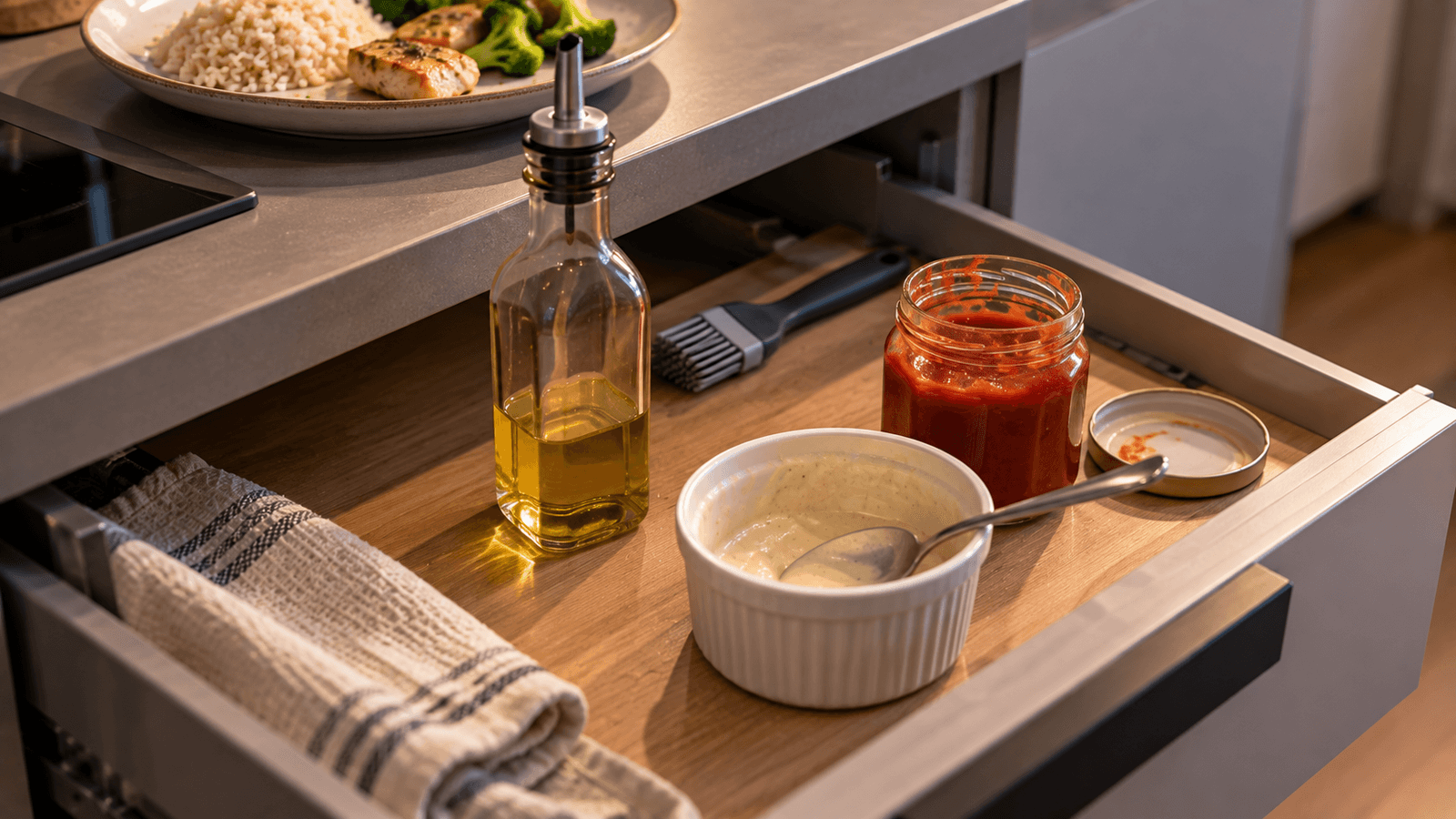
Sauces, oils and condiments are easy to overlook when tracking food because they often appear as small additions rather than separate foods.
But a small-looking addition can contain very different amounts of energy depending on what it is. A spoonful of salsa, mustard or soy sauce is not nutritionally equivalent to the same volume of oil, mayonnaise or a creamy dressing.
The goal is not to measure every drop. It is to identify the additions where a rough guess can meaningfully change your estimate and use a more accurate method for those.
Start with the additions that matter most
Not every condiment deserves the same attention.
A practical priority is:
| Addition | Why tracking may matter | Useful method |
|---|---|---|
| Cooking oil | Energy-dense and easy to underestimate | Measure before cooking or calculate recipe share |
| Salad dressing | Portions can vary substantially | Weigh, measure or use label serving data |
| Mayonnaise | Energy-dense | Weigh or measure |
| Creamy sauce | Recipe and portion can vary | Use recipe or label data |
| Nut-based sauce | Often energy-dense | Weigh or calculate recipe |
| Ketchup | Usually easier to estimate | Label + approximate portion |
| Mustard | Often a smaller contribution | Rough estimate may be sufficient |
| Soy sauce | Usually used in modest amounts | Measure if relevant |
| Salsa | Often relatively low in calories | Approximation may be enough |
| Herbs, spices, vinegar | Usually very small energy contribution | Often not worth detailed tracking |
This prioritization prevents calorie tracking from becoming unnecessarily complicated.
1. Track cooking oil before it disappears into the food
Oil is one of the easiest ingredients to miss because after cooking it is no longer visually separate.
If you cook with oil, the simplest method is to record the amount added to the pan.
For example, if you add 15 g of olive oil to a dish, log the 15 g as an ingredient.
If the dish makes three equal portions, you can initially allocate roughly one third of the oil to each portion.
That is usually more useful than trying to judge the amount of oil from a photograph after cooking.
What if some oil remains in the pan?
Not every gram added necessarily ends up in the food.
Some may remain on the pan or cooking utensils.
For ordinary food tracking, attempting to calculate exactly how much remains can create false precision.
If you consistently use the same cooking method, recording the amount added is a simple repeatable approach.
For recipes where a substantial visible amount is left behind, you can adjust the estimate rather than assuming everything was consumed.
2. Use grams when the portion is difficult to judge by volume
For foods such as mayonnaise, thick dressings and dense sauces, weighing can be convenient.
A simple method:
- put the container on a kitchen scale
- tare the scale
- remove the amount you intend to use
- read the weight difference
Or place the plate or bowl on the scale and add the condiment directly.
If the label gives nutrition per 100 g, the calculation is straightforward.
For example, if a sauce contains 450 kcal per 100 g and you use 20 g:
450 × 20 ÷ 100 = 90 kcal
You do not need to perform this calculation manually when your food tracker accepts grams and already has the correct product data.
3. Check whether the label uses grams or millilitres
Sauces can be labelled per:
- 100 g
- 100 ml
- tablespoon
- serving
Do not automatically treat grams and millilitres as interchangeable.
For water they are close, but oils and many sauces have different densities.
If the package provides nutrition per 100 ml and you measure the sauce in millilitres, use that information directly.
If you weigh it in grams, use nutrition data expressed per gram or a reliable product entry that supports weight.
4. Be careful with “one tablespoon”
A tablespoon sounds precise, but actual spoonfuls vary.
A level tablespoon and a heaped spoonful of mayonnaise can contain quite different amounts.
Household spoons also differ in size.
For an ingredient you use frequently, weigh your normal spoonful once.
You may discover that your usual serving is, for example, 12 g, 18 g or 25 g.
After that, you can use your personal reference portion without weighing it every day.
This is a useful example of measuring once to estimate faster later.
5. Track homemade sauces as recipes
A homemade sauce is usually easier to track as one recipe rather than as several ingredients every time you eat it.
Suppose you make a dressing from:
- olive oil
- yogurt
- lemon juice
- mustard
- herbs
Record the ingredients for the full batch.
Then weigh the finished dressing if your tracker supports recipe weight.
If the entire batch weighs 240 g and you use 30 g, you consumed one eighth of the recipe.
This method also works for:
- pesto
- tahini sauce
- yogurt sauce
- homemade mayonnaise
- curry sauce
- tomato sauce
- creamy pasta sauce
- marinades that are actually consumed
Save the recipe if you make it repeatedly.
6. Separate sauce from the main food when a photo cannot reveal it reliably
Photo-based food tracking is convenient, but hidden ingredients are inherently difficult to infer from appearance alone.
A photograph may show chicken and vegetables clearly while revealing very little about:
- oil used during cooking
- butter under the food
- dressing mixed into a salad
- mayonnaise inside a sandwich
- sauce beneath pasta
- sugar added to a glaze
When you know an important hidden ingredient is present, add or correct it manually instead of expecting the image to determine an invisible amount.
For more on corrections, see How to Correct an AI Food Estimate.
7. Use the actual product when sauces differ substantially
Generic database entries are useful for basic foods, but branded sauces can vary considerably in composition.
If you have the package, use:
- its nutrition label
- barcode data when available
- the exact product entry in your tracker
This is particularly useful for products such as:
- salad dressings
- mayonnaise
- barbecue sauce
- pesto
- curry sauces
- sandwich sauces
If the exact product is unavailable, choose a generic entry that resembles the sauce rather than an unrelated product with a similar name.
8. Don't forget oil used in several cooking stages
Some recipes use oil more than once.
For example:
- oil for frying onions
- additional oil for roasting vegetables
- oil added to a finished sauce
If you record only the first addition, the final recipe can be underestimated.
When cooking a multi-step recipe, treat oil like any other ingredient and include each meaningful addition.
You can record the total amount rather than creating several separate oil entries.
9. Distinguish cooking oil from oil actually discarded
Deep frying and shallow frying create a different problem.
The amount of oil placed in the pan is not necessarily the amount absorbed by the food.
Logging the entire volume used for a frying bath would therefore be inappropriate if most of it remains afterward.
At the same time, assuming that none of the oil was absorbed would also be inaccurate.
Absorption varies with the food, coating, temperature, cooking time and technique.
For foods prepared this way, a reliable database entry for the cooked food may be more practical than trying to calculate oil absorption from the starting volume.
10. Restaurant sauces require a different approach
At a restaurant, you usually cannot know the recipe or exact weight.
Use the best information available in this order:
- restaurant nutrition information, if provided
- a matching restaurant item in your database
- a comparable sauce with an estimated portion
- a reasonable generic estimate
If sauce is served separately, estimating the amount actually used is easier than when it has already been mixed into the dish.
You do not need to reconstruct the restaurant kitchen.
The objective is a useful estimate with the information available.
11. Condiments with small calorie contributions can stay simple
Detailed tracking has diminishing returns.
If you use a small amount of mustard, vinegar, hot sauce or another low-energy condiment, spending several minutes determining whether the serving was 7 g or 9 g may not improve your food log in a meaningful way.
Accuracy should be proportional to impact.
Spend more effort on additions that can materially change the estimate.
Spend less effort on tiny additions that do not.
A practical accuracy hierarchy
When deciding how carefully to track an addition, use this order:
High priority
- cooking oils
- butter
- mayonnaise
- creamy dressings
- pesto
- tahini and nut-based sauces
- large portions of sweet or creamy sauces
Medium priority
- ketchup
- barbecue sauce
- sweet chilli sauce
- larger portions of tomato-based sauces
- marinades that remain on the food
Usually lower priority
- mustard
- soy sauce in small quantities
- vinegar
- salsa
- hot sauce
- herbs and spices
These are practical categories, not fixed nutritional rules. Products and serving sizes differ.
Example: tracking a salad more accurately
Imagine a salad containing:
- vegetables
- chicken
- 25 g dressing
A photo may identify the vegetables and chicken reasonably well but have difficulty determining how much dressing is coating them.
Instead of changing the entire meal entry, keep the recognized foods and correct only the uncertain component.
If the dressing label says 400 kcal per 100 g:
400 × 25 ÷ 100 = 100 kcal
That single correction can be more useful than repeatedly editing ingredients that were already identified correctly.
Example: oil in a four-portion recipe
You cook a recipe using 24 g of oil and divide the finished dish into four roughly equal portions.
A simple allocation is:
24 ÷ 4 = 6 g oil per portion
If portions are unequal, weighing the finished recipe and your serving gives a better proportional estimate.
For example:
- finished recipe: 1,200 g
- your portion: 360 g
- oil in full recipe: 24 g
Your portion represents 30% of the recipe, so approximately 30% of the recipe's oil is allocated to that serving.
This same proportional method can be used for other ingredients distributed through a mixed dish.
Build personal reference portions
You probably use the same condiments repeatedly.
Measure your usual portions once and save a few mental or app-based references.
For example:
- your normal mayonnaise serving
- the amount of oil you usually use for one pan
- your typical salad-dressing portion
- the spoon you use for yogurt sauce
You are not trying to create universal serving sizes.
You are learning what your common portions look like.
After a few measurements, everyday logging can become much faster.
When precision matters less
Food tracking is an estimation process.
Package labels have rounding, recipes vary, cooking changes food weight and visual estimates are imperfect.
Trying to eliminate every gram of uncertainty can make tracking burdensome without meaningfully improving the result.
A more practical system is:
- measure unfamiliar energy-dense additions
- create saved recipes for sauces you make often
- use exact product data when convenient
- learn your repeat portions
- approximate low-impact additions
- correct hidden ingredients that a photo cannot reasonably identify
This gives you more useful accuracy where it matters without turning every meal into a laboratory exercise.