
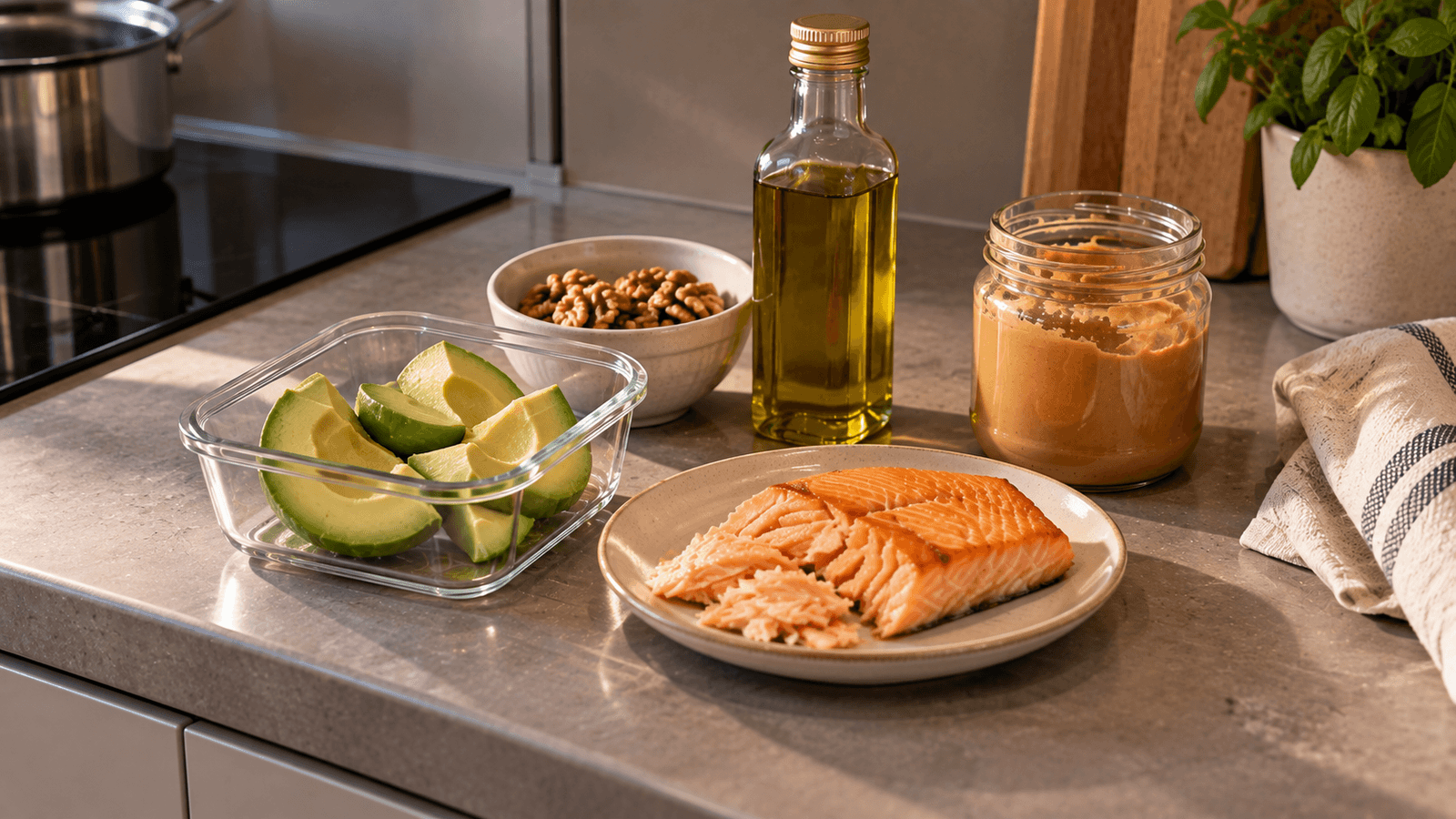
Dietary fat is one of the three main macronutrients, alongside carbohydrate and protein.
Fat is sometimes discussed mainly in terms of calories, but its role is much broader. Dietary fats provide energy, supply essential fatty acids and help the body absorb fat-soluble vitamins.
The type of fat matters as well as the amount.
What is dietary fat?
Dietary fats are compounds found naturally in foods and added during cooking or food production.
Most of the fat we eat is in the form of triglycerides, which are built from fatty acids attached to glycerol.
Different fatty acids have different chemical structures. This is why fats are commonly grouped into:
- saturated fats
- monounsaturated fats
- polyunsaturated fats
- trans fats
These categories are useful because different fatty-acid patterns can have different effects on health.
Fat provides 9 calories per gram
Fat is the most energy-dense of the three main macronutrients.
Approximate energy values are:
| Macronutrient | Energy per gram |
|---|---|
| Fat | 9 kcal |
| Protein | 4 kcal |
| Carbohydrate | 4 kcal |
This means relatively small amounts of oil, nuts, seeds or other fat-rich foods can contribute substantial energy.
That does not make fat inherently undesirable. It simply makes portion size relevant when tracking energy intake.
Why does the body need fat?
Fat has several important functions.
It:
- provides energy
- contributes to cell membranes
- supplies essential fatty acids
- helps absorb vitamins A, D, E and K
- contributes to the production of biologically active compounds
- helps provide texture and flavour in food
Some fatty acids can be produced by the body, but others must come from food.
Essential fatty acids
Two fatty acids are considered essential because humans cannot synthesize enough of them:
- linoleic acid, an omega-6 fatty acid
- alpha-linolenic acid, an omega-3 fatty acid
They therefore need to be supplied by the diet.
Foods containing these fatty acids include various plant oils, nuts, seeds and other foods.
The broader omega-3 family also includes EPA and DHA, found especially in fatty fish and seafood.
Unsaturated fats
Unsaturated fats contain one or more double bonds in their fatty-acid structure.
They are divided into:
- monounsaturated fats
- polyunsaturated fats
Health organizations generally recommend emphasizing unsaturated fats over saturated and trans fats.
Monounsaturated fats
Monounsaturated fatty acids contain one double bond.
Common food sources include:
- olive oil
- rapeseed or canola oil
- avocado
- many nuts
- peanuts
- some seeds
A food does not contain only one type of fat. Olive oil, for example, is rich in monounsaturated fat but also contains smaller amounts of saturated and polyunsaturated fatty acids.
Polyunsaturated fats
Polyunsaturated fatty acids contain more than one double bond.
This group includes omega-6 and omega-3 fatty acids.
Sources include:
- walnuts
- flaxseed
- chia seeds
- sunflower seeds
- soybean oil
- sunflower oil
- rapeseed oil
- fatty fish
Again, the exact fatty-acid profile differs between foods.
Omega-3 fats
Omega-3 is a family of polyunsaturated fatty acids.
Important members include:
- alpha-linolenic acid (ALA)
- eicosapentaenoic acid (EPA)
- docosahexaenoic acid (DHA)
ALA is found mainly in plant foods such as flaxseed, chia seeds, walnuts and certain oils.
EPA and DHA are found particularly in fish and seafood.
The body can convert some ALA into longer-chain omega-3 fatty acids, but this conversion is limited.
Omega-6 fats
Omega-6 fatty acids are another family of polyunsaturated fats.
Linoleic acid is an essential omega-6 fatty acid.
Sources include:
- sunflower oil
- soybean oil
- corn oil
- nuts
- seeds
Omega-6 fats are not inherently "bad fats." They include essential fatty acids required in the diet.
The practical focus is generally on overall fat quality and replacing substantial amounts of saturated fat with unsaturated sources rather than trying to eliminate omega-6 fats.
Saturated fats
Saturated fatty acids contain no carbon-carbon double bonds.
Common sources include:
- butter
- cream
- cheese
- fatty meats
- sausages and some processed meats
- lard
- coconut oil
- palm oil
Some foods contain mixtures of saturated and unsaturated fats.
For example, dairy products contain saturated fat but also other fatty acids and nutrients.
Current public-health guidance generally recommends limiting saturated fat and replacing part of it with unsaturated fats rather than simply removing fat without considering what replaces it.
Why replacement matters
Nutrition is not only about removing one nutrient.
If saturated fat is reduced, something else usually takes its place.
Replacing saturated fat with unsaturated fat is different from replacing it with a large amount of refined carbohydrate.
This is why advice about fat quality often focuses on substitutions.
Examples include:
- olive or rapeseed oil instead of butter for some uses
- nuts or seeds instead of some highly saturated-fat snacks
- fish in place of some higher-saturated-fat meat choices
The whole dietary pattern remains important.
Trans fats
Trans fatty acids are unsaturated fatty acids with at least one double bond in the trans configuration.
They can occur naturally in small amounts in meat and dairy from ruminant animals and can also be produced industrially.
Industrially produced trans fats have historically been associated especially with partially hydrogenated oils.
WHO recommends that trans fats provide less than 1% of total energy intake and calls for industrially produced trans fats to be avoided.
Food regulations have substantially reduced industrial trans fats in many countries, but their presence varies globally.
Fat is not the same as cholesterol
Dietary fat and dietary cholesterol are different substances.
Cholesterol is a sterol found in animal-derived foods and is also produced by the human body.
A food's total fat value does not tell you its cholesterol content, and cholesterol is not one of the three macronutrients.
When discussing cardiovascular health, the types of dietary fat and the overall dietary pattern are important considerations.
Food sources rarely contain only one kind of fat
The labels "saturated-fat food" or "unsaturated-fat food" are simplifications.
Most fat-containing foods provide a mixture.
For example:
Olive oil: mostly monounsaturated, with some polyunsaturated and saturated fat.
Walnuts: largely polyunsaturated, but also monounsaturated and saturated fat.
Butter: predominantly saturated relative to many plant oils, but still contains other fatty acids.
The useful question is usually which type predominates rather than whether only one type is present.
How much fat do you need?
Fat requirements depend on age, energy needs and individual circumstances.
Public-health recommendations are commonly expressed as a percentage of total energy rather than one fixed number of grams for everyone.
WHO states that fat is an essential nutrient and advises adults to obtain at least 15% of energy from fat, while its healthy-diet guidance generally recommends limiting total fat to around 30% of total energy or less at the population level.
WHO also recommends:
- saturated fat: no more than 10% of total energy
- trans fat: no more than 1% of total energy
Recommendations can differ somewhat between authorities and individual circumstances.
For a dedicated calculation guide, see How Much Fat Do You Need Per Day?.
Turning a percentage into grams
If you have a fat target expressed as a percentage of calories, you can convert it to grams because fat provides about 9 kcal per gram.
For example, if a hypothetical 2,000 kcal intake contains 30% of energy from fat:
30% of 2,000 kcal = 600 kcal
600 ÷ 9 = about 67 g of fat
This is only a calculation example, not a personal recommendation.
Individual calorie and macro targets depend on the person and context.
Reading fat on a nutrition label
Nutrition labels commonly show:
- total fat
- saturated fat
Depending on the country, they may also show other information such as trans fat, monounsaturated fat or polyunsaturated fat.
For everyday tracking, total fat is usually the number used for macro totals.
The saturated-fat value is part of total fat, not an additional amount to add on top.
For example, if a product contains:
- total fat: 12 g
- saturated fat: 4 g
the product contains 12 g of fat in total, not 16 g.
Cooking oils can change a meal quickly
Because oil is nearly pure fat, relatively small amounts contain substantial energy.
If calorie or macro tracking matters to you, cooking oil is one of the ingredients worth estimating realistically.
Oil that remains in a pan is not necessarily all consumed, so exact absorption can be difficult to determine.
For home tracking, consistency is usually more useful than pretending an uncertain number is perfectly precise.
See How to Track Sauces, Oils and Condiments More Accurately.
Choosing fat sources in everyday meals
A practical approach is to include a variety of foods rich in unsaturated fats while keeping saturated fat within recommended limits and minimizing trans fat.
Examples can include:
- using olive or rapeseed oil
- adding nuts or seeds
- eating fish where appropriate
- including avocado
- varying protein and dairy choices
This does not require eliminating every food containing saturated fat.
The overall pattern and the foods replacing one another matter.
Dietary fat and body fat are not the same thing
Eating dietary fat does not mean that the same fat automatically becomes body fat.
Body-fat storage and loss depend on overall energy balance and metabolism over time.
Because dietary fat is energy-dense, it can contribute a substantial number of calories in small portions, but carbohydrate and protein also contribute energy.
For weight management, total dietary context matters more than treating dietary fat as uniquely responsible for body-fat gain.
A practical way to think about fats
Instead of dividing foods into "fat" and "fat-free," ask three questions:
- What type of fat predominates?
- How much am I eating?
- What food is this replacing or being added to?
That provides more useful information than judging a food by total fat alone.