
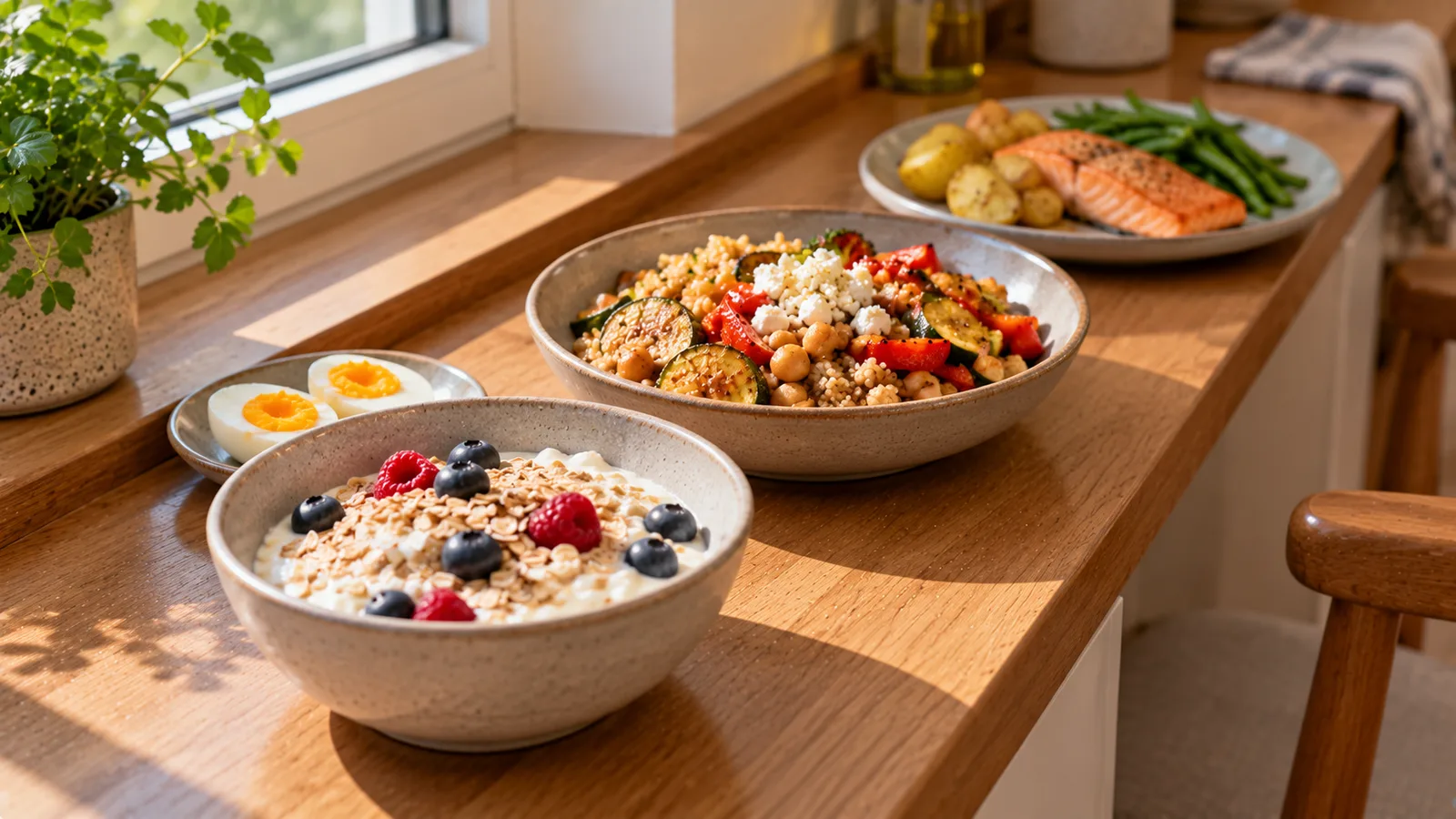
Your daily macro targets do not have to be divided perfectly evenly between every meal.
If your target is 140 g of protein, 220 g of carbohydrates and 70 g of fat, you could divide each number by three and eat exactly the same amount at breakfast, lunch and dinner.
But that is only one option.
A more practical approach is to distribute macros around your appetite, schedule, meal preferences and activity while keeping the daily total in view.
Start with your daily targets
Before splitting macros between meals, you need daily targets.
For example:
- protein: 140 g
- carbohydrates: 220 g
- fat: 70 g
The question is then not whether every meal must look identical.
It is:
How can those daily amounts fit naturally into the way you actually eat?
The simplest method: divide evenly
If you eat three meals and want a simple starting point, divide your daily targets by three.
For 140 g protein, 220 g carbs and 70 g fat:
| Meal | Protein | Carbs | Fat |
|---|---|---|---|
| Breakfast | ~47 g | ~73 g | ~23 g |
| Lunch | ~47 g | ~73 g | ~23 g |
| Dinner | ~46 g | ~74 g | ~24 g |
| Daily total | 140 g | 220 g | 70 g |
This is mathematically simple but may not match your normal eating pattern.
Many people prefer a smaller breakfast, larger dinner or one or more snacks.
You do not need identical meals
Suppose the same daily target is:
- 140 g protein;
- 220 g carbs;
- 70 g fat.
A more varied three-meal distribution could look like this:
| Meal | Protein | Carbs | Fat |
|---|---|---|---|
| Breakfast | 35 g | 50 g | 20 g |
| Lunch | 45 g | 70 g | 20 g |
| Dinner | 60 g | 100 g | 30 g |
| Total | 140 g | 220 g | 70 g |
The meals are different, but the daily totals remain the same.
That flexibility is often more useful than trying to make every meal mathematically identical.
Splitting macros across three meals
A simple three-meal structure works well when you rarely snack.
Example daily target:
- 120 g protein;
- 180 g carbs;
- 60 g fat.
An even split would be:
- 40 g protein per meal;
- 60 g carbs per meal;
- 20 g fat per meal.
But you could also use:
| Meal | Protein | Carbs | Fat |
|---|---|---|---|
| Breakfast | 30 g | 45 g | 15 g |
| Lunch | 40 g | 60 g | 20 g |
| Dinner | 50 g | 75 g | 25 g |
| Total | 120 g | 180 g | 60 g |
Both approaches reach the same daily target.
Splitting macros across three meals and one snack
If you regularly eat a snack, reserve part of your daily macros for it before distributing the rest.
Example target:
- 140 g protein;
- 220 g carbs;
- 70 g fat.
Possible distribution:
| Eating occasion | Protein | Carbs | Fat |
|---|---|---|---|
| Breakfast | 30 g | 45 g | 15 g |
| Lunch | 40 g | 65 g | 20 g |
| Snack | 20 g | 30 g | 10 g |
| Dinner | 50 g | 80 g | 25 g |
| Total | 140 g | 220 g | 70 g |
This prevents the common situation where all daily macros are assigned to meals and the snack becomes an unplanned addition.
Splitting macros across five eating occasions
Some people prefer three meals plus two snacks.
For a daily target of:
- 130 g protein;
- 200 g carbs;
- 65 g fat,
one example is:
| Eating occasion | Protein | Carbs | Fat |
|---|---|---|---|
| Breakfast | 25 g | 40 g | 15 g |
| Snack 1 | 15 g | 20 g | 5 g |
| Lunch | 35 g | 55 g | 15 g |
| Snack 2 | 15 g | 20 g | 5 g |
| Dinner | 40 g | 65 g | 25 g |
| Total | 130 g | 200 g | 65 g |
The purpose is not to copy these exact numbers.
The table shows how a daily target can be translated into a realistic eating schedule.
A percentage-based method
Instead of assigning exact grams first, you can allocate a percentage of your daily intake to each meal.
For three meals and one snack, you might use:
- breakfast: 20–25%;
- lunch: 25–30%;
- snack: 10–15%;
- dinner: 30–35%.
These percentages are not universal recommendations. They are simply a planning framework.
Suppose you decide on:
- breakfast: 25%;
- lunch: 30%;
- snack: 10%;
- dinner: 35%.
For 200 g of daily carbohydrates:
- breakfast: 50 g;
- lunch: 60 g;
- snack: 20 g;
- dinner: 70 g.
The same method can be applied to protein and fat, although you do not have to use identical percentages for every macro.
Protein does not have to follow the same pattern as carbs and fat
You may prefer to distribute protein relatively evenly while allowing carbohydrates and fat to vary more between meals.
For example:
| Meal | Protein | Carbs | Fat |
|---|---|---|---|
| Breakfast | 35 g | 35 g | 20 g |
| Lunch | 40 g | 60 g | 20 g |
| Snack | 25 g | 25 g | 5 g |
| Dinner | 40 g | 80 g | 25 g |
This can be easier than forcing every macronutrient to follow one identical percentage split.
Start with protein if planning all three macros feels complicated
A practical way to build the day is:
- set the daily protein target;
- distribute protein across your main meals and planned snacks;
- add carbohydrate sources based on preference and activity;
- distribute fat through meals;
- check the daily totals;
- adjust portions rather than rebuilding the entire plan.
This turns macro planning into a sequence instead of trying to solve three targets simultaneously.
Example: distributing 150 g of protein
Suppose your daily protein target is 150 g and you eat four times.
A simple split is:
- breakfast: 35 g;
- lunch: 40 g;
- snack: 30 g;
- dinner: 45 g.
Total:
150 g
It does not have to be exactly 37.5 g at every eating occasion.
A practical distribution that fits your meals is easier to maintain.
Carbohydrates can follow your schedule
Carbohydrate distribution can be adjusted around when you prefer to eat them and when they are useful in your routine.
Someone who likes a substantial breakfast may place more carbohydrates there.
Someone who trains later in the day may naturally prefer more carbohydrate around the meals near that activity.
Someone who prefers a larger dinner may reserve more for the evening.
The daily total can remain unchanged.
Fat can vary considerably between meals
Fat is easy to concentrate in particular meals because many fat-rich foods are energy-dense.
Examples include:
- oils;
- nuts;
- seeds;
- cheese;
- avocado;
- nut butter;
- fatty fish.
You might eat relatively little fat at one meal and considerably more at another.
That is not automatically a problem if the overall diet and daily target remain appropriate.
Build meals from foods, not just numbers
A macro target is useful, but a meal still needs to be practical food.
Instead of thinking:
> I need 40 g protein, 60 g carbs and 20 g fat.
Translate the target into a meal structure:
- a protein source;
- a carbohydrate source;
- vegetables or fruit;
- a source of fat when needed.
Then adjust portions.
For example:
- chicken + rice + vegetables + olive oil;
- yogurt + oats + berries + nuts;
- eggs + bread + vegetables + avocado;
- tofu + noodles + vegetables + sesame-based sauce.
The foods can change while the general macro structure stays similar.
Use ranges instead of exact numbers
Exact macro targets can create unnecessary friction.
If your planned lunch is:
- 40 g protein;
- 60 g carbs;
- 20 g fat,
you do not necessarily need every lunch to hit those numbers exactly.
A planning range might be more practical, for example:
- protein: 35–45 g;
- carbs: 50–70 g;
- fat: 15–25 g.
The remaining meals can absorb small differences.
Daily consistency matters more than forcing every individual meal to land on an exact number.
Use the remaining-macros method
You do not have to plan every meal in advance.
Another approach is to track what you eat and calculate what remains.
Suppose your daily targets are:
- 140 g protein;
- 220 g carbs;
- 70 g fat.
After breakfast and lunch you have consumed:
- 75 g protein;
- 125 g carbs;
- 35 g fat.
Remaining:
- protein: 140 − 75 = 65 g
- carbs: 220 − 125 = 95 g
- fat: 70 − 35 = 35 g
Those remaining macros can then be distributed between a snack and dinner.
This is especially useful when your meals vary from day to day.
Example of adjusting the rest of the day
Imagine dinner was originally planned for:
- 45 g protein;
- 70 g carbs;
- 25 g fat.
But lunch ended up containing 15 g more carbohydrates than expected.
You do not need to redesign the whole day.
You could simply reduce the carbohydrate portion at dinner by roughly 15 g if you still want to stay close to the original daily target.
Small corrections are usually easier than rigid meal-by-meal control.
When breakfast is small
Some people are not very hungry in the morning.
Trying to force one-third of every daily macro into breakfast may make the plan harder to follow.
For example, a smaller breakfast might contain:
- 25 g protein;
- 30 g carbs;
- 10 g fat.
More of the daily target can then be allocated to lunch, dinner or snacks.
The best split is the one that fits the actual eating pattern while supporting the overall nutrition goal.
When dinner is your largest meal
A larger dinner can fit into a macro plan.
Suppose your daily target is:
- 140 g protein;
- 210 g carbs;
- 70 g fat.
You might allocate:
| Meal | Protein | Carbs | Fat |
|---|---|---|---|
| Breakfast | 30 g | 35 g | 15 g |
| Lunch | 40 g | 60 g | 20 g |
| Snack | 20 g | 25 g | 5 g |
| Dinner | 50 g | 90 g | 30 g |
| Total | 140 g | 210 g | 70 g |
The dinner is clearly larger, but the daily numbers still work.
When you skip a snack
If you planned macros for a snack but are not hungry, you do not have to eat simply because the spreadsheet says so.
Depending on your goals and the rest of the day, you can:
- move some of those macros into another meal;
- eat a smaller snack;
- leave the day slightly below the planned target.
Macro planning should organize eating, not force unnecessary eating.
When an unplanned snack happens
The reverse can also happen.
If you eat an unplanned snack, record it and look at what remains.
For example, the snack contains:
- 10 g protein;
- 30 g carbs;
- 12 g fat.
Instead of treating the day as “ruined,” subtract those values from what was left and make reasonable adjustments to later meals.
This keeps the system flexible.
How to handle restaurant meals
Restaurant meals are harder to predict precisely.
One practical approach is to keep earlier meals relatively straightforward and leave more flexibility for the restaurant meal.
Do not try to compensate aggressively.
Estimate the meal as reasonably as possible, record it and continue with your normal pattern.
The goal is useful information, not false precision.
How to split macros when meal prepping
Meal prep makes macro distribution easier because several portions can be built from the same recipe.
Suppose a batch contains:
- 160 g protein;
- 240 g carbs;
- 80 g fat.
If divided into four equal portions, each contains approximately:
- 40 g protein;
- 60 g carbs;
- 20 g fat.
If you want different portion sizes, divide the recipe by finished weight instead of assuming every container is identical.
Do macro splits need to be the same every day?
No.
Your daily schedule, activity, appetite and food choices may change.
For example:
Day A
- larger breakfast;
- moderate lunch;
- smaller dinner.
Day B
- small breakfast;
- larger lunch;
- larger dinner.
Both days can still end close to the same daily macro targets.
A repeatable framework is often more useful than identical meal numbers every day.
Should macros be split differently on training days?
Some people choose to change meal timing or carbohydrate distribution around training.
For example, they may prefer more carbohydrate in meals before or after exercise.
Others keep essentially the same meal structure every day.
The appropriate approach depends on training demands, personal preferences and overall goals.
For general meal planning, there is no need to create a complicated timing system unless it provides a practical benefit.
What if your macro targets do not match your calorie target?
Protein, carbohydrate and fat also determine much of the energy in your diet.
The basic approximation is:
- protein: 4 kcal/g;
- carbohydrates: 4 kcal/g;
- fat: 9 kcal/g.
So if your macros produce a calorie total very different from your intended calorie target, check the numbers.
For example:
- 140 g protein = 560 kcal;
- 220 g carbs = 880 kcal;
- 70 g fat = 630 kcal.
Total:
2,070 kcal
You can use the calories-from-macros formula to check your targets.
A practical weekly approach
You do not need to invent a new macro split every morning.
Create two or three templates that match common types of days.
For example:
Standard day
Breakfast + lunch + snack + dinner.
Busy day
Quick breakfast + substantial lunch + simple dinner.
Training day
Meals arranged around the time you normally train.
Each template can use similar daily totals while distributing them differently.
This gives structure without making the plan rigid.
Common mistakes when splitting macros
Trying to make every meal identical
There is usually no practical need for breakfast, lunch and dinner to contain exactly the same macros.
Forgetting snacks
If snacks are a normal part of your day, reserve room for them from the beginning.
Using macro numbers without considering actual foods
A mathematically perfect split is not useful if the meals are inconvenient or unappealing.
Correcting every tiny difference
Being 3 g over one macro at lunch does not require rebuilding the rest of the day.
Ignoring calorie consistency
If macro targets and calorie targets were set separately, check whether they approximately agree.
Making the plan too complicated
More meal-specific targets do not automatically produce a better plan.
Use only as much detail as helps you make decisions.
A simple system you can reuse
- Write down your daily protein, carbohydrate and fat targets.
- Decide how many meals and snacks you normally eat.
- Reserve macros for regular snacks.
- Give each main meal a reasonable protein amount.
- Distribute carbohydrates according to appetite and schedule.
- Add fats through the foods you normally eat.
- Check the daily totals.
- Adjust portions rather than rebuilding meals.
- Use ranges when exact numbers create unnecessary friction.
- Reuse the structure on similar days.
How Mealisa can help
A meal-planning system can make macro distribution easier by showing both what has already been eaten and what remains for the day.
Instead of treating every meal as an isolated target, Mealisa can use the daily context to help compare planned or logged meals with the remaining calories and macros.
This is especially useful when the actual day differs from the original plan.
Key takeaway
There is no requirement to divide protein, carbohydrates and fat equally between every meal.
Start with your daily targets, then distribute them across the meals and snacks you actually eat.
A useful macro split should:
- fit your schedule;
- work with your appetite;
- leave room for normal snacks;
- translate into real foods;
- keep the daily totals reasonably close to target;
- remain flexible when plans change.
The goal is not a mathematically perfect breakfast, lunch and dinner.
It is a daily structure that you can realistically use.
- How Many Carbs Should You Eat per Day?
- How Much Fat Should You Eat per Day?