
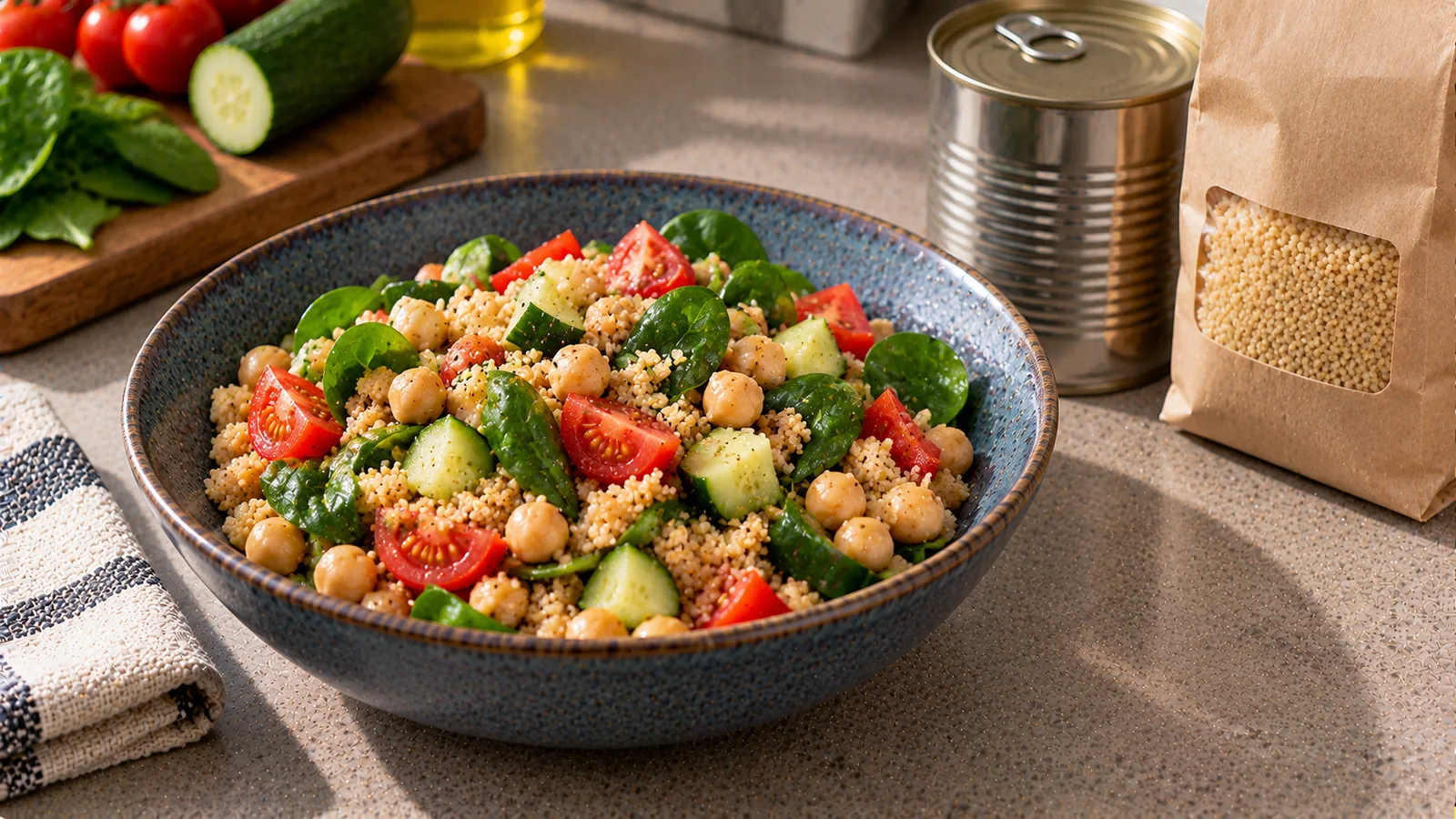
A freezer is convenient for batch cooking, but it is not a prerequisite for bringing lunch to work five days a week. What matters is when the food is prepared, how it is cooled, how long it stays refrigerated, and what you actually pay for the portions you eat. This five-day plan uses a refrigerator, shelf-stable unopened goods, fresh vegetables and two short cooking sessions. It does not assume that a lunch cooked on Sunday remains suitable for Friday.
The plan is for one adult, Monday through Friday, with five distinct lunches: chickpea couscous salad; white-bean pita with carrot; a fresh lentil-couscous bowl; a second lentil-and-pepper bowl; and tuna-white-bean pita. Ingredient-use cost is €11.56 for five lunches, approximately €2.31 per lunch, under a deliberately fictional grocery-price model. Buying the complete packages in that same model costs €18.57 upfront; the difference is usable remaining pantry food, not a refund. Your real cost depends on local prices, pack sizes, appetite and leftovers.
What “without a freezer” means—and what it does not
This is a refrigerator-based plan. You need reliable chilling at home, preferably a refrigerator thermometer, and a way to keep perishable lunches cold during transport and at their destination. You do not need a freezer compartment, frozen bulk batches or homemade frozen gel packs. If your workplace has a refrigerator, carry the meal directly there and refrigerate it promptly. An insulated bag alone does not guarantee a safe temperature for a long commute. Without a refrigerator or adequately cold transport, use a separately designed shelf-stable unopened lunch, not this prepared salad plan.
The German Federal Institute for Risk Assessment (BfR) meal-prep guidance recommends eating reheated/pre-cooked components within 2–3 days under suitable refrigeration and meals with raw components no later than one day after preparation. The USDA's refrigeration guidance recommends keeping the fridge at 4.4°C (40°F) or below. These figures are conditional safety guidance, not a guarantee that every prepared food lasts that long. Follow shorter instructions on products and take greater care for vulnerable eaters.
For this schedule, assemble fresh tomato, cucumber and carrot on the day of eating. Cook Wednesday's lentils and couscous for Wednesday and Thursday only, chill them promptly in shallow containers, and keep cut vegetables separate. Friday's tuna can stays unopened until Friday. This is a meal-timing workflow, not a promise that canned foods become shelf-stable after opening.
Five lunches: the portions and the actual preparation day
The measured amounts below are dry weight for couscous and lentils, drained edible weight for canned beans and tuna, raw edible weight for vegetables, millilitres for olive oil and fractions of whole lemons. Water used to hydrate couscous is not an extra purchased ingredient. Pita weights are packaged bread weights. These are realistic example portions rather than nutrition prescriptions; adjust your energy needs with additional food and recalculate cost.
| Day and lunch | Main ingredients per lunch | When to prepare | Example ingredient cost |
|---|---|---|---|
| Monday: chickpea couscous salad | 75 g dry couscous, 160 g drained chickpeas, 120 g tomato, 100 g cucumber, 10 ml oil, ¼ lemon | Monday | €1.69 |
| Tuesday: white-bean carrot pita | 240 g drained white beans, 80 g pita, 100 g carrot, 100 g tomato, 10 ml oil, ¼ lemon | Tuesday | €2.17 |
| Wednesday: lentil, pepper and chickpea couscous | 75 g dry couscous, 65 g dry red lentils, 80 g chickpeas, 150 g pepper, 100 g tomato, 10 ml oil, ¼ lemon | Wednesday | €2.16 |
| Thursday: warm lentil-and-pepper couscous | 75 g dry couscous, 65 g dry red lentils, 150 g pepper, 80 g tomato, 100 g carrot, 10 ml oil, ¼ lemon | Cook base Wednesday; finish Thursday | €1.99 |
| Friday: tuna and white-bean pita | 120 g drained canned tuna, 160 g drained white beans, 80 g pita, 100 g cucumber, 100 g tomato, 10 ml oil, ¼ lemon | Friday | €3.55 |
A quarter lemon per lunch is a bookkeeping amount, not an instruction to measure each wedge to laboratory precision. Salt, pepper and optional dried herbs are not included in the stated cost; use them to taste, and include them if you want an all-in budget. Do not add mayonnaise, cheese, sauces or additional oil while continuing to use the figures shown here.
Sunday shopping and the precise grocery basket
Buy everything once if you have refrigerator space for the produce, but do not prepare five lunches on Sunday. The whole tomato and pepper supply can remain refrigerated according to product condition; wash and cut individual portions later. Store unopened cans and the dry couscous and lentils according to their packages. Check dates and choose produce that can reasonably last until its scheduled day; replace any spoiled produce instead of trusting the plan's calendar.
| Shopping item | Example package and checkout price | Used in five lunches | Note on remainder |
|---|---|---|---|
| Dry couscous | 500 g / €1.29 | 225 g | 275 g dry remains |
| Canned chickpeas | 240 g drained / €0.89 | 240 g | Open Monday; finish Wednesday |
| Canned white beans | Two 240 g drained cans / €2.18 | 400 g | 80 g remains from Friday's can |
| Dry red lentils | 500 g / €1.49 | 130 g | 370 g dry remains |
| Canned tuna | 120 g drained / €1.69 | 120 g | Open on Friday |
| Pita bread | Five 80 g pitas / €1.49 | 160 g | Three pitas remain; follow pack storage |
| Tomatoes | 500 g / €1.69 | 500 g | Fully used |
| Cucumber | 350 g / €0.89 | 200 g | Approx. 150 g remains |
| Bell peppers | 300 g / €1.79 | 300 g | Fully used |
| Carrots | 500 g / €0.99 | 200 g | 300 g remains |
| Lemons | Two / €0.89 | 1¼ lemons | Approx. ¾ lemon remains |
| Olive oil | 250 ml / €3.29 | 50 ml | 200 ml remains |
Checkout total: €18.57, calculated by summing the twelve fictional package prices. These prices are teaching assumptions—not current German offers, price checks, or manufacturer quotes. One can's listed 240 g is drained edible weight, not its total liquid-filled tin weight. A different brand's drained weight will change the numbers. Check can integrity, the date and the manufacturer's instructions. For a convenient way to track pack-level quantities, use Mealisa's budget grocery list method.
Monday: chickpea couscous without a Sunday batch
On Monday, boil clean water and hydrate 75 g dry couscous according to its package. Open one can providing 240 g drained chickpeas; weigh 160 g for today's meal. Transfer the remaining 80 g immediately to a clean covered food container and refrigerate it for Wednesday. Do not leave open beans sitting on the counter while you cook and commute. Put cooked couscous in a shallow container to cool quickly before combining it with chilled components. Cooked grains can become unsafe when warm too long even if they do not smell unusual.
Wash and cut 120 g tomato and 100 g cucumber that morning, add the chickpeas and the cooled couscous, then stir in 10 ml olive oil and ¼ lemon. For crisp texture, pack lemon separately and mix just before eating. Eat the assembled raw-and-cooked salad the same day. If you prepare it the night before, that is still within BfR's one-day guidance only with correct refrigeration; do not plan to keep it until Wednesday.
The model allocates €0.19 couscous, €0.59 chickpeas, €0.41 tomato, €0.25 cucumber, €0.13 oil and €0.11 lemon before normal two-decimal display rounding. The precise sum is approximately €1.69. You have purchased the whole chickpea can even though only two-thirds is today's ingredient. That remaining third belongs to Wednesday's meal, not to the cost of Monday alone.
Tuesday: fill a pita rather than store a wet sandwich
Open the first can of white beans and use its entire 240 g drained weight. Mash some of the beans with ¼ lemon and 10 ml olive oil, leaving the rest whole for texture. Grate 100 g carrot, dice 100 g tomato, and stuff the mixture into one 80 g pita just before leaving or at lunchtime. Keeping the filling separate from the bread during transport prevents sogginess. Beans and vegetables still require safe cold handling after opening and preparation; pita bread does not make the filling shelf-stable.
Tuesday's portion is deliberately generous in beans, so its quantity and texture differ from a deli sandwich. If you want half the beans, halve that ingredient's price and plan what to do safely with the other half—do not discard it silently from the cost model. The example charge is €2.17, including roughly €1.09 beans, €0.30 pita, €0.20 carrot, €0.34 tomato and about €0.24 for oil and lemon together.
A side of whole fruit can make lunch more substantial, but it is not priced in the five-day basket. For the difference between the package's advertised serving size and the portion you really pack, see portion size versus serving size. With any canned legume, the actual sodium amount depends on the product, whether it is rinsed, and the label; do not claim a fixed reduction simply because you drain the can.
Wednesday: one short cooking session for two days
Wednesday is the second preparation anchor. Measure 130 g dry red lentils and 150 g dry couscous for two lunches combined. Cook the lentils fully according to the package, and hydrate the couscous separately. Divide each cooked batch into two equal portions: each lunch represents 65 g dry lentils plus 75 g dry couscous before cooking. Added water increases cooked weight but does not multiply dry-ingredient protein or cost. Roast or sauté 300 g bell peppers using no additional priced oil; split them into two equal 150 g portions. You may cook the peppers in a nonstick pan with a splash of water.
For Wednesday, mix one freshly cooled grain-and-lentil portion with 150 g peppers, 100 g freshly cut tomato and the refrigerated 80 g chickpeas remaining from Monday. Add 10 ml oil and ¼ lemon. Check that the Monday beans were promptly chilled and have stayed cold; if their handling is uncertain, discard them and open a fresh product, updating the basket and cost. USDA guidance for opened low-acid cans, including beans gives 3–4 refrigerated days under suitable handling, but this is not a reason to ignore BfR's more cautious prepped-meal approach.
Immediately divide Thursday's cooked portion into a separate shallow container. Let it cool rapidly in the refrigerator rather than holding a deep pot of hot lentils on the stove. Refrigerate the cooked peppers for Thursday in their own clean box; keep Thursday's raw carrot and tomato whole and uncut until that day. Wednesday's illustrated ingredient total is €2.16. The two-day preparation is about cooked components, not one already-dressed two-day salad.
Thursday: finish the held cooked base with fresh vegetables
Take the Wednesday-cooked lentils, couscous and 150 g peppers from the refrigerator. Confirm they were chilled promptly, stored at a reliably cold temperature and have not passed any shorter ingredient-specific limit. If you want them warm, reheat the cooked portion thoroughly to 74°C (165°F), the USDA temperature for reheating leftovers. Do not warm the tomatoes or carrots merely to make a salad look freshly cooked.
Wash and add 80 g tomato plus 100 g freshly grated carrot on Thursday; finish with 10 ml olive oil and ¼ lemon. You now have a different texture and flavor from Wednesday—no extra chickpeas, but a crunchy raw-carrot addition. If you will carry it cold, chill any reheated components thoroughly again before mixing; repeated temperature cycling is a poor default. Most conveniently, eat the refrigerated cooked base cold with the freshly cut vegetables, assuming it has always been safely stored.
Thursday's illustrated cost is €1.99. The precise unrounded calculation is €1.99345; it includes the cost of the dry quantities originally divided on Wednesday, not the higher cooked weight created by water. The BfR information on Bacillus cereus explains why starch-containing cooked meals need rapid cooling: some harmful toxins are not made safe simply by reheating a badly stored dish.
Friday: use unopened pantry items and fresh produce
Friday's lunch avoids the problem of consuming a Wednesday salad two days later. Open the 120 g drained tuna can on Friday, along with the second can of white beans; use 160 g drained beans for your serving. Mix with 100 g freshly cut cucumber, 100 g tomato, 10 ml olive oil and ¼ lemon. Pack the mixture apart from one 80 g pita until eating. No freezer, leftover cooked fish or reheated Wednesday grains are involved.
Transfer the remaining 80 g beans from Friday's opened can into a clean container and refrigerate for prompt use after the plan, observing safe storage and the package's instructions. The unused pita bread and dry goods may remain suitable for later weeks only as allowed by their labels; do not equate dry pantry stock with dressed lunch leftovers. Tuna is fish: consider allergies and follow any individual advice about fish selection and exposure rather than treating canned tuna as an obligatory everyday food.
The Friday example costs €3.55, making it the most expensive lunch of the five because the tuna alone costs €1.69 in the fictional basket. If you replace it with extra beans, eggs or cheese, calculate the new price and check how preparation, allergens and cold storage change. Friday's convenience is paid for partly in ready-to-eat canned protein and partly in the reduction of midweek storage risk.
Cost audit: per portion, per week and money paid at checkout
The accounting equation is package price × edible quantity used ÷ edible package quantity. For oil use millilitres, for lemon use number of lemons, for drained cans use drained grams, and for couscous and lentils use dry grams. Never compare a 500 g dry grain package to 500 g cooked grains as though water were purchased dry food. The sums are computed from unrounded values and rounded only at the end.
| Cost measure | Amount | Interpretation |
|---|---|---|
| Monday | €1.69 | Chickpea couscous salad |
| Tuesday | €2.17 | White-bean pita |
| Wednesday | €2.16 | Lentil-chickpea couscous |
| Thursday | €1.99 | Lentil-pepper couscous |
| Friday | €3.55 | Tuna-white-bean pita |
| All five edible ingredient portions | €11.56 | Rounded from €11.5594 |
| Mean cost per prepared lunch | €2.31 | €11.5594 ÷ 5 |
| Initial package checkout | €18.57 | Twelve package-line purchases |
For example, 75 g couscous costs 75 ÷ 500 × €1.29 = €0.1935. Friday's 160 g white beans costs 160 ÷ 240 × €1.09 ≈ €0.7267. Wednesday's portion of red lentils costs 65 ÷ 500 × €1.49 = €0.1937. These are price exercises, not verified 2026 offers. The difference between €18.57 checkout and €11.56 used is about €7.01 of ingredients allocated to future use; if bread or vegetables spoil, part of that balance becomes loss. Do not label it automatic savings.
Portion costs exclude electricity, water, utensils, transport, condiments not listed and the time needed for washing or cooking. Nor does a low price per box guarantee a nutritionally complete day. Use Mealisa's balanced meal framework to judge the whole day's food, not only an isolated cheap lunch.
Cooling, transport and warning signs that change the plan
Wash hands, equipment and produce; use separate clean utensils where needed. Refrigerate cooked lentils and couscous promptly in small, shallow containers. Do not leave them cooling for hours on a warm counter. The USDA food-safety basics give a two-hour limit for perishables at room temperature, reduced to one hour above 32°C (90°F). This is a maximum exposure limit, not a recommended waiting time. Refrigerate as soon as practical and account for all unrefrigerated time, including cooking, packing, transport and desk time.
For work, put food straight into an office refrigerator on arrival. The USDA bag-lunch guidance recommends an insulated bag with two cold sources for perishable lunches away from refrigeration; if you have no freezer to chill ice packs, that option may be unavailable unless you acquire suitable prechilled or commercially frozen sources. An ordinary insulated bag without effective cold sources is not the equivalent. If you cannot keep the food cold, do not pack tuna-bean salad or cooked lentils for a long warm trip. Use unopened shelf-stable components until the point of consumption, or arrange proper refrigeration.
Discard food whose safe time/temperature history is uncertain, regardless of smell. Do not rely on lemon juice as preservation, on “it's vegetarian” as protection, or on reheating as a fix for improperly cooled starches. Vulnerable people, including pregnant people, older adults and people with weakened immunity, should follow appropriately stricter food-safety advice. For the sodium distinction between rinsed and unrinsed beans, see what rinsing canned legumes changes.
How to adapt the week without inventing longer storage times
If Wednesday is unexpectedly busy, prepare the Wednesday/Thursday cooked lentils and couscous on Tuesday evening only when you can cool them promptly, hold them consistently cold and use both portions within BfR's shorter window. Cut Wednesday and Thursday's raw vegetables on their eating days. If Thursday's meal is cancelled, do not simply roll the prepared Thursday food through the weekend. Re-plan with unopened pantry supplies rather than extending the date label. A label on a box should record preparation time and the intended consumption day—not a blanket five-day expiry.
If you want more variety, substitute one of the pita lunches with a grain bowl or use fresh beans instead of tuna. Preserve the central rule: fresh assembly and staggered cooking are what make a no-freezer five-lunch schedule workable. See Meal Planning Without a Freezer for the broader pantry-and-shopping approach; this guide is specifically the five-day lunch, refrigeration and cost execution plan, not a replacement for that general planning page.
A final budget check is equally important: divide real receipt prices by real edible amounts, count full packages at checkout, and check which leftovers you will use promptly. When safety, portion size and actual spending are all visible, a no-freezer lunch plan becomes both manageable and honest about its limits.
Sources
- German Federal Institute for Risk Assessment (BfR): meal prep for several days — chilled-storage limits and raw versus cooked components.
- USDA FSIS: refrigeration and food safety — cold holding and refrigerator temperature.
- USDA FSIS: food-safety basics — rapid cooling, two-hour rule and reheating.
- USDA FSIS: opened canned food — opened low-acid cans.
- USDA FSIS: keeping bag lunches safe — temperature control during transportation.
- BfR: Bacillus cereus — risks from improperly stored cooked starches.