
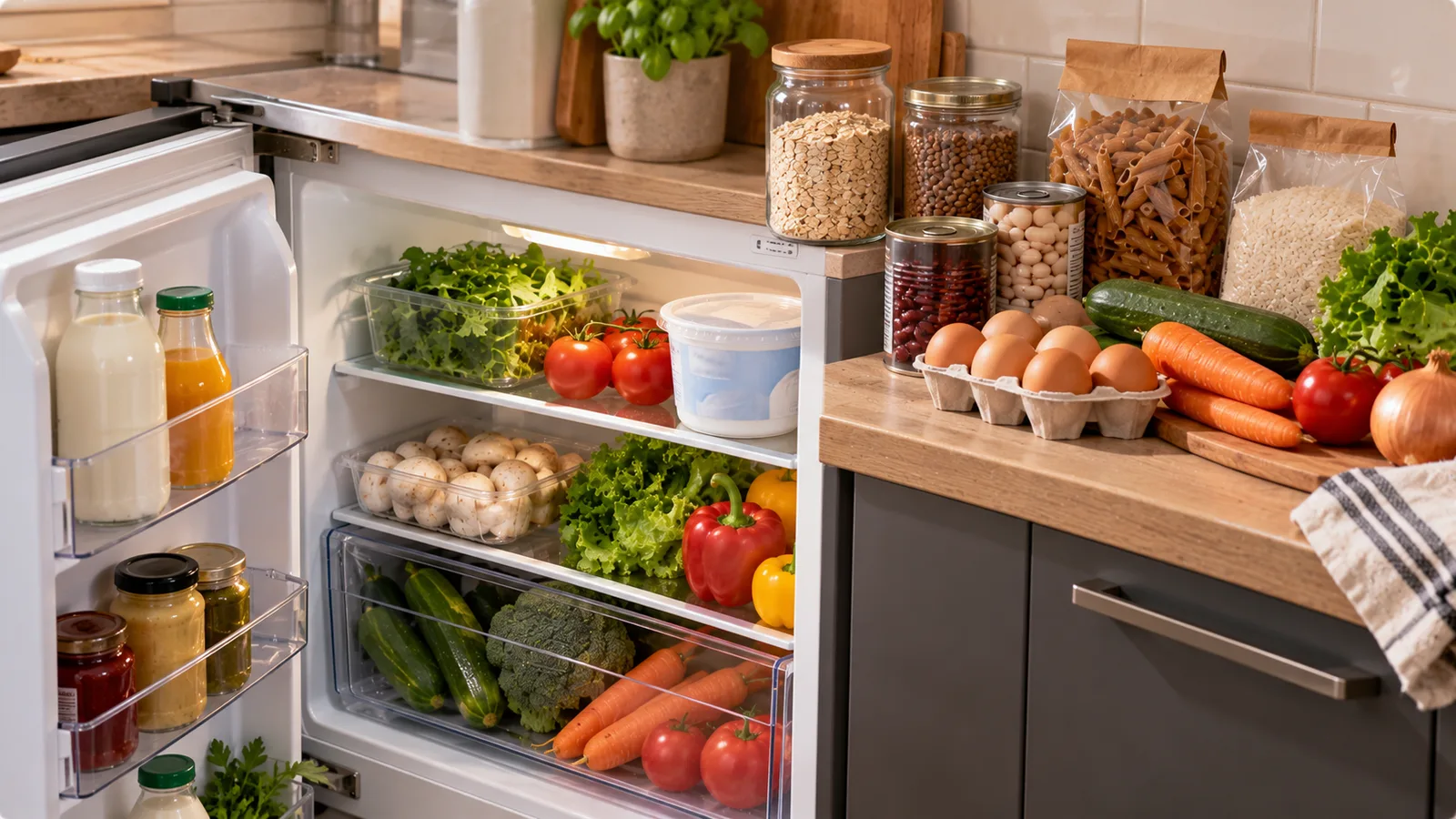
A freezer makes weekly meal planning convenient, but it is not essential.
You can still organize affordable, varied meals if you have only a refrigerator and a small pantry. The main difference is that you need to plan around storage time, shopping frequency and ingredient flexibility, rather than cooking large batches for later freezing.
This guide shows how to build a realistic seven-day system for one adult. It assumes access to a working refrigerator, a stove or other cooking equipment, and a place to store shelf-stable food.
If you have no refrigerator either, the system needs a different food-safety approach.
What changes when you cannot freeze food?
Without a freezer, three familiar meal-planning strategies become less useful:
- Cooking an entire week's perishable meals in advance.
- Buying large amounts of fresh meat or fish for use several days later.
- Saving every leftover for an unspecified future meal.
Instead, build the week around smaller shopping cycles, modest cooking quantities and ingredients that can be used in more than one recipe.
The most important rule is simple:
Do not buy more perishable food than you can safely store and realistically eat.
A freezer-free plan is not necessarily more expensive. However, whether it saves money depends on store prices, shopping access, household size and how much food would otherwise be wasted.
The three-part food system
Divide your groceries into three groups.
| Group | Examples | Planning role |
|---|---|---|
| Shelf-stable base | Dry oats, rice, pasta, lentils, canned beans, canned tomatoes | Flexible meals throughout the week |
| Refrigerator foods | Eggs, yogurt, cheese, opened canned foods, prepared leftovers | Meals scheduled around labels and storage limits |
| Short-life fresh foods | Fresh fish, some meats, leafy greens, berries, cut produce | Meals placed early after purchase |
These are planning categories, not universal shelf-life classifications.
Actual storage requirements depend on the specific product, whether its package has been opened and the manufacturer's instructions.
The FDA's food-storage guidance emphasizes keeping refrigerators at or below 4°C (40°F) and handling perishables promptly.
Shop twice instead of once
For many households, two smaller shopping trips are more practical than one large trip when freezer storage is unavailable.
A possible schedule:
| Day | Shopping focus | Intended use |
|---|---|---|
| Monday | Fresh vegetables, fruit, eggs, dairy, optional fresh protein | Meals for the first part of the week |
| Thursday | Replacement fresh vegetables, fruit and short-life ingredients | Meals for the remaining days |
| Any day | Pantry staples when running low | Flexible backup meals |
This schedule is illustrative. It does not mean every food purchased Monday remains safe until Thursday.
Always follow the actual use-by date, storage instructions and condition of each product.
If the supermarket is far away, adjust the plan toward more shelf-stable ingredients and fewer short-life purchases.
Build meals from ingredients, not seven isolated recipes
Seven unrelated recipes often require seven sets of ingredients.
A freezer-free plan works better when a smaller set of foods can produce different meals.
For example, buy:
- Oats
- Rice or pasta
- Dry lentils
- Canned chickpeas or beans
- Canned tomatoes
- Carrots
- Cabbage
- Onions
- Eggs
- Plain yogurt
- Fresh seasonal fruit
- One or two short-life ingredients for specific early meals
These ingredients can support breakfast bowls, lentil soup, tomato pasta, vegetable skillets, egg dishes and chickpea salads.
The list is a flexible starting point, not a complete nutritionally individualized shopping list.
Example seven-day meal plan
This example uses two shopping trips and avoids relying on frozen food.
| Day | Breakfast | Lunch | Dinner |
|---|---|---|---|
| Monday | Oats, yogurt and fruit | Chickpea and vegetable salad | Fresh fish with rice and vegetables |
| Tuesday | Eggs and toast | Lentil and tomato soup | Cabbage and egg skillet |
| Wednesday | Oats with fruit | Leftover lentil soup, if safely stored | Pasta with tomato and beans |
| Thursday | Yogurt, oats and fruit | Egg and vegetable sandwich | Freshly purchased chicken with rice |
| Friday | Eggs and toast | Chickpea and cabbage bowl | Vegetable and lentil pasta |
| Saturday | Oats and fruit | Tomato-bean soup | Rice with eggs and sautéed vegetables |
| Sunday | Yogurt and fruit | Pantry-based lentil bowl | Pasta with vegetables and cheese |
The meals are examples, not a calorie- or protein-calculated diet.
Choose portion sizes and additional foods according to individual needs.
The fresh fish is scheduled for the day it is purchased. Chicken is scheduled for the second shopping day. Neither choice replaces checking the product's actual use-by date.
Make the refrigerator a planning tool
Before shopping, check:
- Which foods have use-by dates approaching?
- Which packages have already been opened?
- Which cooked foods are left over?
- Which vegetables need to be used first?
- Is there enough space to keep everything properly chilled?
The FDA advises keeping the refrigerator at or below 4°C (40°F).
Do not overfill it so much that cold air cannot circulate.
Keep raw meat and fish separated from ready-to-eat foods to reduce cross-contamination.
How long can cooked leftovers stay refrigerated?
There is no single safe storage period for every homemade food under every condition.
As a general reference, the USDA advises refrigerating cooked leftovers promptly and using most refrigerated leftovers within three to four days when properly handled and stored.
Its guidance also recommends refrigerating perishable food within two hours, or within one hour when ambient temperatures exceed 32°C (90°F).
These are general US food-safety recommendations. Always follow stricter local guidance or product-specific instructions where applicable.
For freezer-free planning, a conservative habit is to prepare only the amount you expect to eat soon.
If a recipe normally makes six portions but you only need two, reduce the ingredients rather than assuming all six portions will remain suitable throughout the week.
Batch-prep ingredients instead of complete meals
Batch cooking is not automatically wrong without a freezer. The problem is making more perishable food than you can use safely.
A better approach is to prepare small components:
- Wash vegetables shortly before use, as appropriate.
- Chop only the quantity needed for the next meals.
- Cook a modest amount of rice or lentils.
- Keep unopened pantry ingredients in their original storage conditions.
- Assemble meals when needed.
Cooked rice deserves particular attention: improper cooling and storage can create food-safety risks. Refrigerate it promptly and follow appropriate local guidance for storage and reheating.
Avoid leaving cooked food at room temperature while you decide what to do with it.
Use a flexible meal order
Rather than treating Monday through Sunday as a rigid schedule, assign meals to priority levels.
Priority 1: use promptly
Meals containing products with approaching use-by dates or already opened short-life ingredients.
Priority 2: use during the current shopping cycle
Meals built around fresh vegetables, dairy and other refrigerated ingredients.
Priority 3: flexible backup meals
Meals based mostly on dry or canned pantry foods.
If your schedule changes, move a pantry meal later and use the more perishable ingredients first.
This is safer and often more economical than following the original meal calendar at any cost.
How to avoid opening too many packages
A common source of waste is opening several large containers during the same week.
For example, opening two sauces, a large yogurt tub and several canned products can create multiple new storage deadlines.
Before opening something, ask:
Will I use the remaining contents within the manufacturer's after-opening instructions?
If not, consider a smaller package, a recipe that uses more of the ingredient or an alternative that stays unopened.
The EFSA explains the distinction between use-by and best-before dates. An unopened package's date does not necessarily describe how long it remains suitable after opening.
What to do with leftover ingredients
An ingredient does not need to become the same meal twice.
| Leftover ingredient | Next possible use |
|---|---|
| Half a cabbage | Stir-fry, soup or egg skillet |
| Cooked lentils | Soup, salad or tomato-based dish |
| Opened canned tomatoes | Pasta sauce or vegetable stew |
| Extra carrots | Soup, roasted vegetables or salad |
| Remaining yogurt | Breakfast bowl or savory dressing |
| Cooked rice | Promptly refrigerated, safely handled next meal |
Only reuse leftovers that have been stored safely and remain within appropriate storage periods.
A creative recipe cannot make unsafe leftovers safe.
A simple shopping quantity formula
For fresh ingredients, estimate:
Amount to buy = expected portion × number of planned uses.
Suppose you expect to use 150 g of carrots in four meals.
150 × 4 = 600 g carrots.
If carrots are sold only in a 1 kg bag, plan another suitable use for the remaining 400 g, provided they can be stored correctly.
This method prevents buying produce simply because a large package has a lower price per kilogram.
For dry pantry goods, you can buy more than one week's usage if you have suitable storage space and expect to use the remainder.
Compare the real cost of shopping twice
Two shopping trips may reduce waste, but they can also add transport costs or encourage impulse purchases.
A useful comparison is:
Weekly food cost = checkout spending + additional shopping costs − value of usable food carried forward.
Treat the final term as inventory value, not immediate cash returned.
For example, suppose:
- One large shopping trip costs €55.
- €8 of food is discarded.
- Two smaller trips cost €57 in total.
- Only €2 of food is discarded.
In this hypothetical example, the value of food actually used is:
- Large trip: €55 − €8 = €47
- Two trips: €57 − €2 = €55
But this does not mean the first approach is automatically better. The quantities of food consumed, remaining usable stock and transport costs must also be comparable.
A better decision comes from tracking several weeks rather than judging one receipt.
When this system may not work
A twice-weekly shopping schedule may be inconvenient if you have limited mobility, long travel distances, irregular working hours or poor access to fresh groceries.
In those cases, emphasize foods with appropriate shelf stability, choose smaller perishable portions and schedule fewer fresh-protein meals.
If you do not have a working refrigerator, do not use this plan unchanged. Perishable foods require a different purchasing and consumption strategy.
If your refrigerator is not maintaining a safe temperature, fix that problem before relying on it for food storage.
Your reusable weekly checklist
Before each week:
- Review use-by dates and opened packages.
- Identify two realistic shopping opportunities.
- Plan the most perishable foods first.
- Choose pantry-based backup meals.
- Buy quantities you can use.
- Prepare modest batches rather than excessive leftovers.
- Check refrigerator temperature and storage conditions.
- Revisit the plan when your schedule changes.
The central principle is straightforward: without a freezer, plan for shorter food cycles rather than larger stored inventories. For a concrete five-day lunch schedule that respects these storage limits, see a five-day lunch plan without a freezer.
A small pantry, a correctly functioning refrigerator and a flexible shopping routine can support a practical weekly meal plan without requiring frozen meals.