
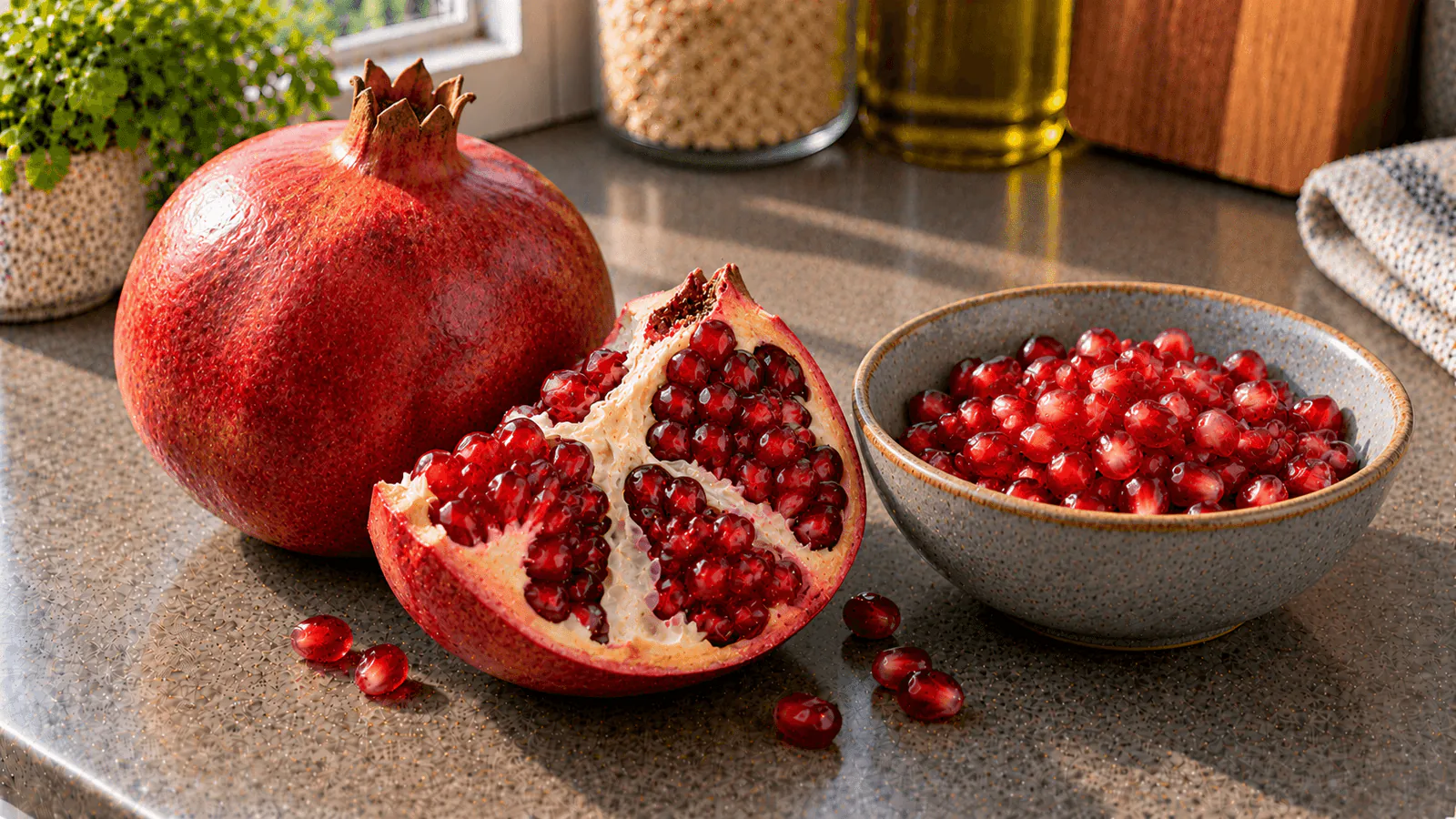
Raw pomegranate contains approximately 83 kcal per 100 g of edible arils, according to USDA FoodData Central. The arils are the juicy red coverings around the small seeds inside the fruit. These are the parts normally eaten. The weight of a whole pomegranate, including its thick rind and white membranes, is not the weight you should enter in a food diary.
This guide explains the nutrition of fresh pomegranate arils, useful portion sizes, how much of a whole fruit may be edible, and why juice, sweetened preparations and packaged products require their own calculations.
Pomegranate nutrition per 100 g
USDA FoodData Central describes Pomegranates, raw (SR Legacy FDC 169134). The figures refer to the edible portion, without peel, added sugar or sauce.
| Nutrient | Per 100 g raw edible arils |
|---|---|
| Calories | 83 kcal |
| Protein | 1.67 g |
| Carbohydrates, total | 18.70 g |
| Sugars, total | 13.67 g |
| Dietary fibre | 4.00 g |
| Fat | 1.17 g |
| Water | 77.93 g |
| Potassium | 236 mg |
| Vitamin C | 10.2 mg |
| Folate | 38 µg |
Source: USDA FoodData Central — Pomegranates, raw, FDC 169134. This is a reference composition, not a laboratory result for the fruit you bought. Variety, maturity, storage and the proportion of liquid and seed material can affect individual samples.
The USDA total-carbohydrate figure includes fibre. European food labels usually list available carbohydrates and fibre separately, so compare like with like.
Calories in common pomegranate portions
The table scales the USDA data by actual edible weight. The sugar column describes naturally occurring sugars, not added sugar.
| Edible arils | Calories | Natural sugars | Fibre |
|---|---|---|---|
| 50 g | 42 kcal | 6.8 g | 2.0 g |
| 87 g | 72 kcal | 11.9 g | 3.5 g |
| 100 g | 83 kcal | 13.7 g | 4.0 g |
| 150 g | 125 kcal | 20.5 g | 6.0 g |
| 200 g | 166 kcal | 27.3 g | 8.0 g |
| 282 g | 234 kcal | 38.5 g | 11.3 g |
Calories = edible aril weight in grams × 83 ÷ 100. For example, 120 g of arils provides about 100 kcal. Use this formula for plain fresh arils, not for bottled juice or sweetened products.
How many calories are in half a cup?
A USDA household measure for this food is half a cup of arils, approximately 87 g. It contributes about 72 kcal, 11.9 g naturally occurring sugars and 3.5 g fibre. The quantity in a cup depends on how full it is and how firmly the arils are packed. Weighing is preferable for a precise record.
What about an entire pomegranate?
Another USDA household measure lists approximately 282 g edible arils for one pomegranate of about 4 inches (10 cm) diameter. At 83 kcal per 100 g, that would be about 234 kcal. This is a reference serving, not a promise that every whole fruit yields 282 g of arils.
For example, suppose a purchased pomegranate weighs 400 g intact but you collect 210 g of edible arils after removing its rind and membranes. The portion eaten contributes approximately 174 kcal, not 332 kcal calculated from the whole fruit's purchase weight. Measure what you actually eat; never apply a fixed edible-yield percentage to every fruit.
Do the crunchy seeds count?
Each aril is a juicy covering surrounding a small seed. Many people chew and eat the entire aril, including the seed, while others spit out the hard seed after drinking the juice around it.
The USDA raw-pomegranate entry is a useful reference for ordinarily consumed arils. If you deliberately discard most of the seed material, the exact nutritional composition of the juice you swallow will differ. You cannot accurately correct this by simply subtracting an arbitrary number of calories.
Pomegranate peel and the bitter white membranes are not part of the standard edible portion in the table. When preparing the fruit, weigh the arils once they have been separated.
Arils versus pomegranate juice
Juice is often easier to drink in a large volume than arils are to eat with a spoon. The two formats can also differ in fibre content, concentration and serving size.
Intact arils provide about 4 g fibre per 100 g in the cited reference. Filtering or pressing away the solid seed material commonly leaves substantially less fibre in the juice. Even a drink labelled 100% pomegranate juice should not inherit the raw-aril fibre figure.
Pomegranate juice may be sold as juice, juice from concentrate, a blended drink or a sweetened fruit beverage. Read the specific nutrition label for calories and sugars per 100 ml. A label in millilitres cannot be assumed to equal the same weight of arils in grams.
When mixing juice into yogurt, a smoothie or dressing, count the volume used and the product's own nutrition values. Do not log a glass of juice as half a cup of fresh arils merely because both come from pomegranates.
Fresh, frozen, dried and sweetened pomegranate
Different forms can serve different purposes, but they should not share one universal calorie entry.
| Form | Relevant measurement | Best calorie reference |
|---|---|---|
| Fresh raw arils | Edible aril weight in g | 83 kcal per 100 g as reference |
| Frozen plain arils | Thawed edible weight; package ingredients | Raw reference or specific product label |
| 100% pomegranate juice | Volume in ml; concentrate status | Juice nutrition label or verified juice entry |
| Sweetened dried arils | Pack weight and added sugar | Product label |
| Pomegranate syrup or molasses | Spoon or gram weight; concentration | Product label or recipe calculation |
| Arils in a prepared salad | Arils plus dressing and toppings | Sum all ingredients |
Freezing without added ingredients does not introduce sugar or oil, but a commercial frozen blend can contain other fruit. Drying and concentration remove water, often raising calories per 100 g relative to fresh arils. Pomegranate molasses is particularly concentrated and should not be logged as fresh fruit.
Practical meal calculations
Consider a breakfast bowl with 100 g fresh arils, 150 g plain yogurt and 20 g oats. The pomegranate contributes 83 kcal. If the yogurt label says 65 kcal per 100 g, it contributes 98 kcal after rounding; if the oats label says 380 kcal per 100 g, they contribute 76 kcal. The illustrative bowl therefore contains 257 kcal before honey or additional toppings.
The yogurt and oat numbers are hypothetical label examples, not universal USDA values. Always replace them with the actual product or a verified food record.
In a salad, 50 g arils adds approximately 42 kcal. If the dressing includes 10 g olive oil, that oil alone contributes about 90 kcal when fully eaten. Cheese, nuts, croutons and other ingredients need to be counted too.
When adding pomegranate to a meal, think in grams of arils. A few scattered arils are not the same quantity as a full bowl.
Pomegranate compared with other fruits
Pomegranate has its own sweetness, texture and fibre profile. If you want to compare fruit choices, use matching edible weights instead of comparing one entire fruit of each kind.
Separate Mealisa guides cover orange nutrition, grape calories and strawberry calories. The values in those pages refer to their own edible fruit portions. None is automatically better or worse based solely on calories; quantity and the rest of the meal matter.
Pomegranate arils can add flavour and texture to yogurt, oatmeal, savoury grain dishes or salads. They are not a substantial standalone protein source, so a balanced meal may need other foods.
Natural sugars, fibre and micronutrients
The USDA reference lists 13.67 g natural sugars and 4.00 g fibre per 100 g raw arils. A 150 g portion provides roughly 20.5 g sugars and 6 g fibre. These figures are for naturally occurring fruit sugars, not sugar added by a manufacturer.
The same portion size also supplies some potassium, folate and vitamin C. Vitamin C supports normal immune function and collagen formation; folate has a role in normal cell division. Those nutrients do not establish that a particular pomegranate prevents or treats any disease.
Pomegranate contains a range of plant compounds, including polyphenols. Research interest in those compounds should not be translated into claims that eating pomegranate cures inflammation or replaces medical care.
The texture and fibre may make intact arils a useful snack option, while juice has different practical properties. Neither form causes weight loss by itself; overall energy intake and eating patterns matter.
How to prepare and store arils
Wash the outside of the fruit before cutting so surface dirt is less likely to be transferred by the knife. Open the rind carefully and separate the arils from the bitter membranes. Collect the edible portions in a clean bowl.
Pomegranate juice stains fabrics easily. Work over a board or bowl rather than directly over clothing. After opening, refrigerate the arils promptly in a covered container and follow ordinary food-safety guidance; discard any fruit that smells fermented or shows visible spoilage.
If the fruit is bought pre-packed as separated arils, check the use-by date and storage directions. An unopened whole fruit and a tub of ready-to-eat arils are not interchangeable in storage time.
How to log pomegranate accurately
Select raw pomegranate arils when eating the fresh edible portions and enter their weight. For a half cup without scales, the USDA 87 g household measure is a reasonable estimate. For a whole fruit, do not use the rind weight. For bottled drinks, syrup or packaged preparations, use the product-specific entry.
If you are uncertain whether a listed weight means purchased whole fruit or edible seeds, consult a portion-size reference. Mealisa explains this distinction in portion size versus serving size.
Source and calculation method
The portion table and meal examples are calculations from the cited food record and clearly described label assumptions. Real values vary with the fruit and ingredients.