
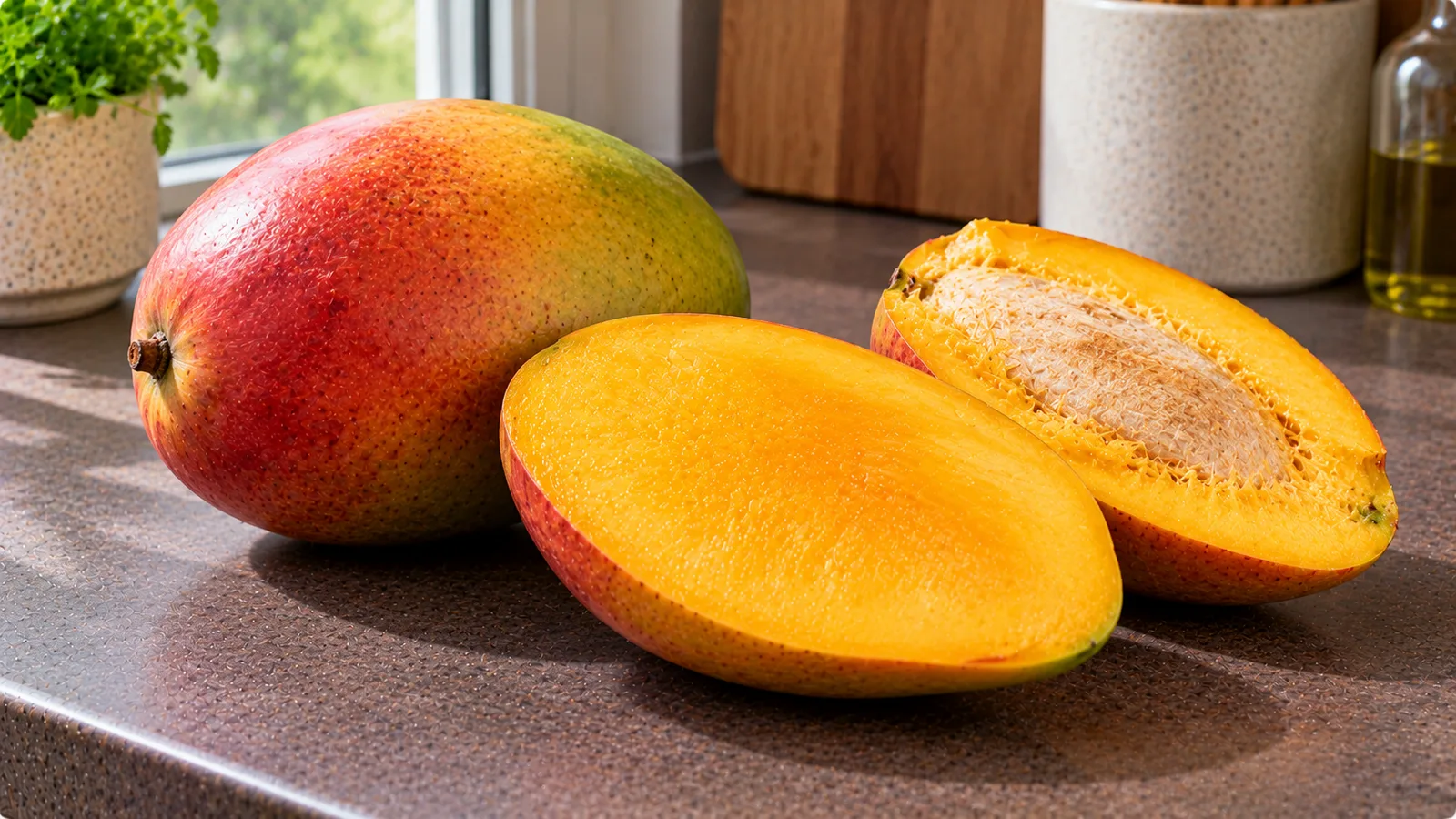
Fresh raw mango contains approximately 60 calories per 100 g of edible flesh.
A 150 g serving provides about 90 calories, while 200 g provides approximately 120 calories.
These values refer to the part of the fruit you actually eat. The peel and large central stone are normally excluded from the weight used for calorie tracking.
Mangoes vary considerably in size, shape, ripeness and edible yield. That means the calories in one whole mango cannot be calculated reliably from the fruit's appearance alone.
Mango calories by serving size
| Fresh mango, edible flesh | Approximate calories |
|---|---|
| 25 g | 15 kcal |
| 50 g | 30 kcal |
| 75 g | 45 kcal |
| 100 g | 60 kcal |
| 125 g | 75 kcal |
| 150 g | 90 kcal |
| 165 g | 99 kcal |
| 200 g | 120 kcal |
| 250 g | 150 kcal |
| 300 g | 180 kcal |
These estimates use 60 kcal per 100 g of raw mango and are rounded.
The values are based on representative raw mango composition reported by USDA FoodData Central.
Actual mango composition varies with cultivar, maturity and growing conditions.
How many calories are in one mango?
There is no single calorie value for one mango.
The important measurement is the weight of the edible flesh after removing the peel and stone.
| Edible mango flesh | Approximate calories |
|---|---|
| 100 g | 60 kcal |
| 150 g | 90 kcal |
| 200 g | 120 kcal |
| 250 g | 150 kcal |
| 300 g | 180 kcal |
| 350 g | 210 kcal |
These are examples of edible quantities, not standardized mango sizes.
A small mango may yield much less edible flesh than a large mango.
Two fruits with similar outside weights can also have different stone sizes and peeling losses.
For the most accurate result, weigh the prepared mango rather than assigning a fixed number of calories to one fruit.
Does the stone count toward mango calories?
No, not if you discard it.
The same principle applies to the peel.
If a mango weighs 400 g before preparation but produces 250 g of edible flesh, calculate the calories from 250 g:
250 × 0.60 = 150 kcal.
Using the entire 400 g would incorrectly count the discarded parts.
The example yield is illustrative. It is not a universal edible-yield percentage.
Mango nutrition facts per 100 g
Typical values for fresh raw mango are:
| Nutrient | Per 100 g | Per 150 g |
|---|---|---|
| Energy | 60 kcal | 90 kcal |
| Protein | 0.82 g | 1.23 g |
| Fat | 0.38 g | 0.57 g |
| Total carbohydrate, US definition | 14.98 g | 22.47 g |
| Dietary fiber | 1.6 g | 2.4 g |
| Total sugars | 13.66 g | 20.49 g |
| Water | 83.5 g | 125.3 g |
| Vitamin C | 36.4 mg | 54.6 mg |
| Potassium | 168 mg | 252 mg |
| Folate | 43 µg | 64.5 µg |
Figures are rounded and represent typical composition rather than a guarantee for every mango.
Source: USDA FoodData Central.
Why carbohydrate values can differ between databases
US food composition data often include dietary fiber in total carbohydrates.
European nutrition labels generally report available carbohydrates and fiber separately.
Using the reference values above:
14.98 g total carbohydrate − 1.6 g fiber = approximately 13.38 g available carbohydrate per 100 g.
This is a difference in reporting conventions, not a difference between American and European mangoes.
When comparing entries from different food databases, check whether fiber is included in the carbohydrate figure.
Reference: Regulation (EU) No 1169/2011.
How to calculate mango calories
For fresh raw mango, use:
Calories = edible weight in grams × 0.60
Examples:
- 80 g: approximately 48 kcal.
- 120 g: approximately 72 kcal.
- 180 g: approximately 108 kcal.
- 225 g: approximately 135 kcal.
- 275 g: approximately 165 kcal.
- 350 g: approximately 210 kcal.
This formula applies to fresh mango flesh.
It should not automatically be used for dried mango, mango nectar, sweetened canned mango, mango chutney or desserts containing mango.
Those products require separate nutrition values.
How many calories are in a cup of mango?
A cup of raw mango pieces is commonly estimated at approximately 165 g.
At 60 kcal per 100 g, that gives:
165 × 0.60 = 99 kcal.
| Mango pieces | Approximate weight | Calories |
|---|---|---|
| Quarter cup | 41 g | 25 kcal |
| Half cup | 82.5 g | 50 kcal |
| One cup | 165 g | 99 kcal |
| One and a half cups | 247.5 g | 149 kcal |
| Two cups | 330 g | 198 kcal |
Cup measurements are approximate.
Finely diced mango can fit differently into a cup than large slices.
A kitchen scale is more reliable when accurate calorie tracking matters.
Calories in mango slices
Mango slices do not have standardized weights.
A thin slice may weigh only 20 g, while a thick piece may weigh 60 g or more.
| Example portion | Edible weight | Calories |
|---|---|---|
| Small slice | 20 g | 12 kcal |
| Medium slice | 40 g | 24 kcal |
| Large slice | 60 g | 36 kcal |
| Three medium slices | 120 g | 72 kcal |
These are illustrative portions.
The calorie calculation should use the actual weight of the pieces consumed.
How to weigh a mango correctly
The easiest method is to weigh the flesh after preparation.
- Wash the mango before cutting.
- Cut the flesh away from the central stone.
- Remove the peel if you do not eat it.
- Collect the edible slices or cubes.
- Weigh them on a kitchen scale.
- Record the weight as fresh raw mango.
If you prepare several mangoes for a fruit salad, weigh the total edible flesh before mixing it with other ingredients.
Weighing by subtraction
You can also weigh the whole mango before preparation and subtract the discarded peel and stone.
For example:
- Whole mango: 520 g.
- Discarded peel and stone: 190 g.
- Edible flesh: 330 g.
330 × 0.60 = 198 kcal.
This approach works if all discarded parts are measured and no edible flesh is accidentally included in the waste weight.
The quantities are an example, not a fixed mango yield.
How much sugar is in mango?
Fresh raw mango contains approximately 13.66 g of naturally occurring sugars per 100 g.
| Fresh mango | Approximate sugars |
|---|---|
| 50 g | 6.8 g |
| 100 g | 13.7 g |
| 150 g | 20.5 g |
| 200 g | 27.3 g |
| 250 g | 34.2 g |
| 300 g | 41.0 g |
The sugar in intact fresh mango is naturally present within the fruit.
Public-health guidance distinguishes naturally occurring sugars in whole fruit from free sugars such as those added to foods and drinks.
Source: World Health Organization — Healthy diet.
This distinction does not mean mango contains no carbohydrates or calories.
The amount eaten still matters when calculating daily intake.
Is mango too sugary to eat?
Mango can be part of a balanced diet.
A 100 g serving provides approximately 60 kcal, alongside water, fiber and micronutrients.
Whether a particular serving fits someone's nutritional needs depends on the overall diet, portion size and individual circumstances.
For people managing blood glucose, the amount of carbohydrate consumed may be especially relevant.
A general nutrition article cannot replace individualized medical advice.
Mango fiber content
Raw mango provides approximately 1.6 g dietary fiber per 100 g.
That means:
- 100 g provides about 1.6 g fiber.
- 150 g provides about 2.4 g.
- 200 g provides about 3.2 g.
- 250 g provides about 4.0 g.
Mango contributes some fiber, but a varied diet should include other sources such as legumes, vegetables, whole grains, nuts and seeds.
The European Food Safety Authority considers 25 g of dietary fiber per day an adequate intake for normal laxation in adults.
Source: EFSA — Dietary Reference Values.
Mango can contribute to this intake without being the only fiber source.
Vitamin C and other nutrients
Mango provides vitamin C, folate and potassium.
According to representative USDA data, 100 g of fresh mango contains approximately:
- 36.4 mg vitamin C.
- 43 µg folate.
- 168 mg potassium.
Vitamin C contributes to normal immune function, collagen formation and protection of cells against oxidative stress.
These nutrient functions do not establish that mango prevents or treats disease.
The actual vitamin content can vary with ripeness, storage and processing.
Source: USDA FoodData Central.
Fresh mango versus dried mango
Dried mango contains much less water than fresh mango.
As water is removed, energy and naturally occurring sugars become more concentrated per 100 g.
Some commercial dried mango products also contain added sugar.
A 30 g portion of dried mango is therefore not nutritionally equivalent to 30 g of fresh mango.
For accurate tracking:
- Check whether sugar has been added.
- Read the nutrition label.
- Weigh the portion.
- Use the product's calories per 100 g.
- Avoid applying the fresh-mango value of 60 kcal per 100 g to dried fruit.
Different dried mango products can have different values, so a single number should not be used for every brand.
Fresh mango versus frozen mango
Unsweetened frozen mango may have nutritional values broadly similar to fresh mango.
However, exact values depend on the product and any added ingredients.
Frozen mango pieces may be packaged with sugar or other additions.
Read the ingredients and nutrition label.
If the product contains only mango and has no added sugar, a suitable fresh-mango database entry can be a practical estimate when no product-specific value is available.
Mango juice, nectar and smoothies
Mango juice, nectar and smoothies are not automatically nutritionally equivalent to whole mango.
Commercial mango nectar may contain added water, sugar or other ingredients.
Juice processing can also reduce the fiber present in whole fruit.
For packaged drinks, use the label's calories per 100 ml.
For homemade smoothies, calculate the ingredients separately.
For example, a smoothie containing:
- Fresh mango: 150 g.
- Plain yogurt: 150 g.
- Milk: 100 ml.
Receives approximately 90 kcal from the mango alone.
The yogurt and milk contribute additional calories.
The smoothie should be logged as a complete recipe rather than as mango only.
Mango in meals and desserts
Mango is used in fruit salads, yogurt bowls, salsa, smoothies, curries and desserts.
The total calories depend on the complete recipe.
Mango with plain yogurt: Count mango and yogurt separately.
Mango salsa: Include the mango, vegetables, oil and any other additions.
Mango sticky rice: Count the sticky rice, coconut milk, sugar and mango.
Mango lassi: Include yogurt, milk and any added sweetener.
Mango sorbet: Use the complete recipe or the packaged nutrition label.
A food containing mango should not automatically be assigned the nutritional values of plain fresh mango.
Is mango suitable for weight management?
At approximately 60 kcal per 100 g, fresh mango can fit into many eating patterns.
Its water content and sweet taste make it a possible snack or dessert ingredient.
However, mango does not independently cause fat loss.
Body-weight changes depend on overall energy balance and other factors.
Replacing a more energy-dense dessert with an appropriately sized serving of fresh fruit may reduce calories at that eating occasion.
Adding mango to an otherwise unchanged diet does not guarantee weight loss.
For practical tracking, focus on realistic serving sizes and the whole meal.
Does mango ripeness change its calories?
Ripening changes mango's texture, sweetness and carbohydrate composition.
Starch can be converted into sugars as the fruit ripens.
However, it is not reliable to assign completely different calorie values to individual mangoes solely from their color or sweetness.
Cultivar, moisture content and growing conditions also influence composition.
For ordinary calorie tracking, approximately 60 kcal per 100 g of edible raw mango is a reasonable reference estimate.
Use product-specific values when available.
Food safety and storage
Wash the mango before cutting, even if you plan to discard the peel.
Use clean knives and cutting boards to avoid transferring contamination from the exterior to the flesh.
Refrigerate cut mango promptly in a clean, covered container.
Maintain the refrigerator at approximately 4°C or below.
Discard cut fruit that has been held under unsafe conditions.
General guidance: FDA — Selecting and Serving Produce Safely.
Practical calorie-tracking examples
Example 1: Mango as a snack
You eat 180 g of fresh mango flesh.
180 × 0.60 = 108 kcal.
Example 2: Half a prepared mango
You weigh the edible flesh from half a mango and obtain 130 g.
130 × 0.60 = 78 kcal.
The calories depend on the measured portion, not on the phrase half a mango.
Example 3: Mango fruit bowl
A bowl contains:
- Mango: 120 g.
- Strawberries: 100 g.
- Plain yogurt: 150 g.
The mango contributes approximately 72 kcal.
The other ingredients must be calculated separately.
Example 4: Whole mango
A mango weighs 480 g before cutting.
After removing the peel and stone, 290 g of edible flesh remains.
290 × 0.60 = 174 kcal.
The yield is illustrative and varies between fruits.
Frequently asked questions
How many calories are in 100 g of mango?
Approximately 60 kcal for fresh raw mango flesh.
How many calories are in 150 g of mango?
Approximately 90 kcal.
How many calories are in 200 g of mango?
Approximately 120 kcal.
How many calories are in one cup of mango?
About 99 kcal if the cup contains approximately 165 g of fresh mango pieces.
How many calories are in one whole mango?
It depends on the weight of the edible flesh. For example, 250 g of flesh provides approximately 150 kcal.
Does mango peel count toward the weight?
Not if you discard it. Count only the portion consumed.
Is dried mango higher in calories?
Dried mango generally has more concentrated calories per 100 g because much of its water has been removed. Check the specific product label.
Sources and calculation methodology
- USDA FoodData Central — representative raw mango nutrient composition.
- Regulation (EU) No 1169/2011 — carbohydrate and fiber labeling definitions.
- World Health Organization — Healthy diet — guidance on dietary sugars.
- EFSA — Dietary Reference Values — dietary fiber reference values.
- FDA — Selecting and Serving Produce Safely — safe produce handling.
The calculations use approximately 60 kcal per 100 g of edible fresh raw mango. Portion estimates are rounded. Processed mango products require their own nutrition data.