
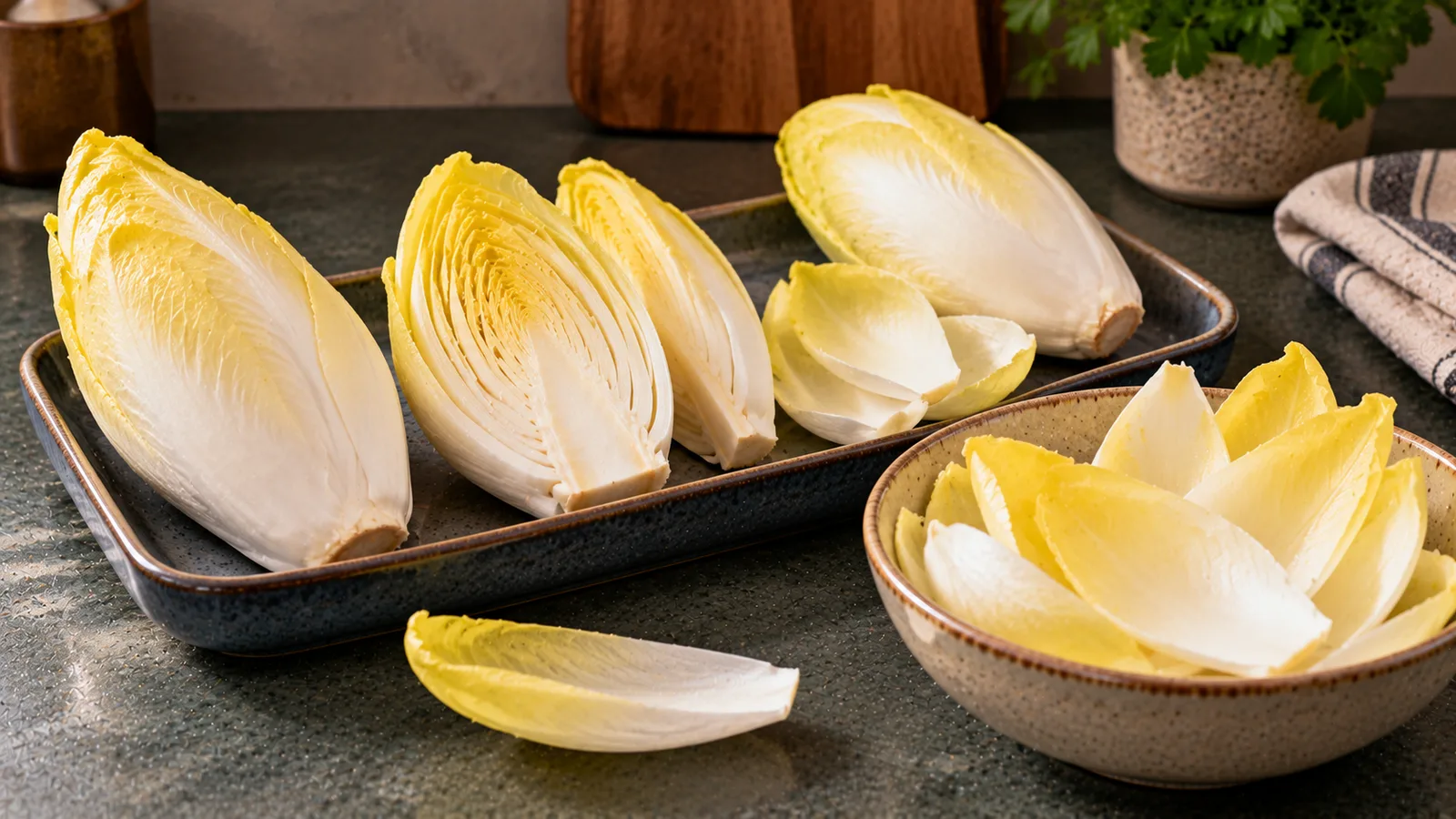
Which endive does this guide describe?
In this guide, endive means the compact, pale Belgian endive, also sold as witloof, witlof or chicory hearts. Its botanical species is Cichorium intybus. It is not the loose, frilly green curly endive or escarole belonging to Cichorium endivia. The everyday name is ambiguous, so the botanical distinction matters more than a supermarket sign. The names and species are described by Kew Science.
For the food calculation, the appropriate historical USDA SR Legacy entry is “Chicory, witloof, raw” (FDC 170404; NDB 11151), not the separate entry “Endive, raw” (FDC 168412). Both happen to list 17 kcal per 100 g, but their macronutrient profiles differ. Mixing those entries would yield a misleading food record.
Calories in raw leaves and weighed servings
Raw witloof contains 17 kcal per 100 g of edible leaves. That works out to 0.17 kcal per gram, so a portion weighing 50 g contributes approximately 8.5 kcal before dressing. The numbers below are weight-based calculations, not assumed head sizes.
| Raw edible amount | Estimated energy |
|---|---|
| 50 g leaves | 8.5 kcal |
| 75 g leaves | 12.75 kcal |
| 100 g leaves | 17 kcal |
| 150 g leaves | 25.5 kcal |
| 200 g leaves | 34 kcal |
A large head and a small head can have very different weights. The USDA historical household measure of 53 g for one head is an example attached to that data entry, not a guarantee about the endive you buy. For a precise food log, weigh the portion actually eaten.
Nutrition per 100 g: the correct USDA record
The USDA FoodData Central search and the SR Legacy record identification show 17 kcal, 0.9 g protein, 0.1 g fat, 4.0 g carbohydrate by difference, and 3.1 g dietary fibre for 100 g of raw witloof. Water accounts for about 94.52 g. The same record gives 211 mg potassium and 37 µg folate per 100 g.
| Component | Per 100 g of raw witloof |
|---|---|
| Energy | 17 kcal |
| Protein | 0.9 g |
| Total fat | 0.1 g |
| US carbohydrate by difference | 4.0 g |
| Dietary fibre | 3.1 g |
| Water | 94.52 g |
| Potassium | 211 mg |
| Folate | 37 µg |
These are reference composition values, not an analysis of every individual head. Variety, storage and preparation can affect actual food composition; rounding also makes tiny portions look deceptively exact.
How to weigh the edible leaves
Remove damaged outer leaves and any hard base you will discard before measuring. If preparing separate leaf boats, put the clean plate on the scale, tare it, then add the leaves intended for eating. For a chopped salad, weigh the prepared raw pieces rather than the bag, container or discarded trim. If you wash the leaves first, drain them well: water droplets otherwise add weight that is not edible vegetable tissue.
When no scale is available, note whether you ate half a head, several leaves or a whole head and treat the result as an estimate. A leaf count is not a standardized gram weight. A useful personal shortcut is to weigh your usual head once or twice and record its edible yield; do not treat that sample as a universal conversion.
Worked example: salad and dressing
Suppose you prepare 150 g of cleaned raw witloof leaves. At 17 kcal per 100 g, the vegetable contributes 25.5 kcal. If you add a dressing containing 10 g of oil, the oil must be logged separately using the composition of the oil you actually used; it does not disappear into the endive entry. A salad with cheese, nuts or sweet sauce is likewise not a 25.5-kcal dish.
If you share 150 g evenly between two plates, each receives 75 g, or 12.75 kcal of endive alone. This example is about allocation of the raw vegetable. It is not a claim about the total calorie value of the finished salad. For further detail, see the guide to actual and reference servings.
Raw versus braised endive
Raw endive makes a crisp salad or edible scoop. Braising or roasting softens it and can alter its weight as water evaporates. Do not apply the raw-food 17 kcal/100 g figure to 100 g of a finished gratin: the cooked serving may include cream, butter, cheese and a different water content. Record the original edible raw weight and all added ingredients, or use an appropriate cooked-food entry when available.
If a pan begins with 200 g of raw leaves, their starting contribution is about 34 kcal. That amount does not increase merely because water boils away. The energy per 100 g of the finished dish may nevertheless rise as its mass falls; any added fat contributes additional energy. The distinction between total recipe calories and energy density prevents double counting.
Why US and EU carbohydrate figures may differ
The 4.0 g carbohydrate per 100 g above is USDA carbohydrate by difference. In the US approach this includes dietary fibre; the USDA entry reports fibre separately at 3.1 g. The carbohydrate number on a European product label generally uses a different, available-carbohydrate convention and does not simply mean the same quantity. For label comparisons, consult the original method and the European Commission's nutrition labelling guidance.
It may be tempting to subtract 3.1 from 4.0 and publish 0.9 g as a certified European label value. That subtraction is only a rough arithmetic illustration, not a laboratory measurement or a verified EU label declaration. Keep the USDA basis visible rather than promising false precision.
Choosing, washing and storing raw leaves
Choose firm heads with intact, crisp leaves and no slimy areas. A little colour at a cut end is not itself a nutrition measurement; discard produce that looks rotten. Keep the vegetable chilled according to the supplier's instructions and avoid prolonged warm storage after chopping. Rinse fresh produce under running water before eating and dry gently. The FDA's guidance for serving produce safely advises against washing vegetables with soap or household detergent.
The reference calories apply to plain raw leaves only. Dressing, oil, cheese and other toppings should be calculated separately. For an uncomplicated log, record the cleaned edible grams and the preparation state, rather than searching for a single calorie number for every dish named “endive.”