
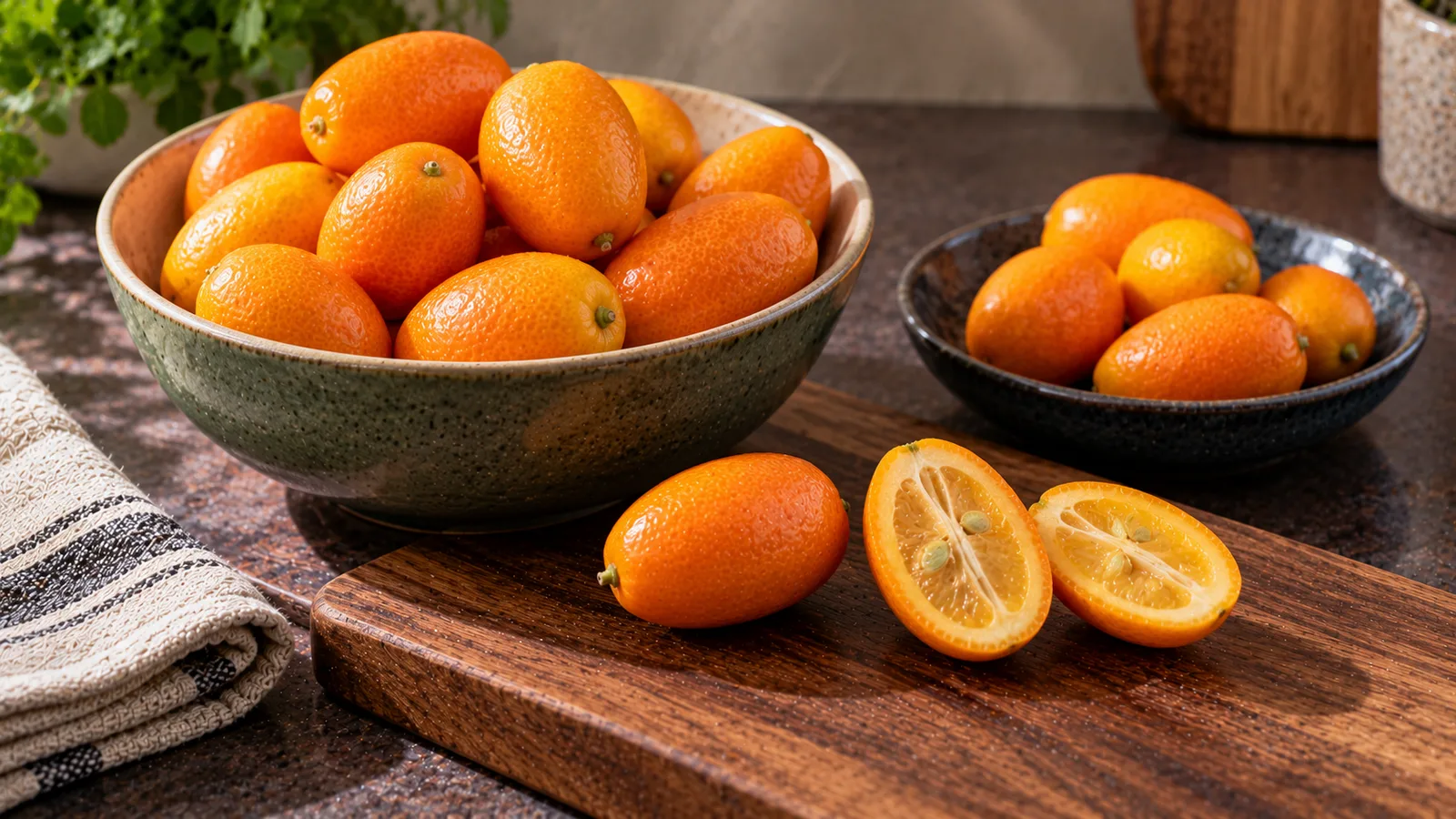
Which kumquats are included?
This guide covers fresh, raw kumquats eaten as fruit, not candied kumquats, syrup-packed preserves or marmalade. Kumquats are small citrus fruits commonly eaten with their fragrant peel. Some people spit out the seeds; others remove them before eating. The useful unit for a calorie calculation is the weight of the part actually eaten, including peel when you eat it.
The figures here come from the USDA FoodData Central “Kumquats, raw” entry, SR Legacy FDC 168154. Its household measure is one fruit without refuse, 19 g. That is a database reference portion, not a promise that every kumquat on a shop shelf weighs 19 g. A bag may contain several sizes, and a fruit with a thick peel can still weigh less than a larger thin-skinned fruit.
Calories per fruit and per 100 g
Raw kumquats contain 71 kcal per 100 g in the selected USDA record. At the reference edible weight of 19 g, one fruit supplies 13.49 kcal, usually rounded to 13 kcal in a food diary. Five similarly sized fruits weigh 95 g and provide 67.45 kcal, or about 67 kcal. For a larger or smaller fruit, multiplying its edible weight by 0.71 kcal per gram gives a better estimate than counting pieces.
These calculations describe the plain fruit. Added sugar, honey, chocolate, syrup or oil belongs in the recipe total separately. A cooked or dried product may also have a different water content and an entirely different value per 100 g.
| Raw edible weight | Estimated calories |
|---|---|
| 1 reference fruit (19 g) | 13 kcal |
| 2 reference fruits (38 g) | 27 kcal |
| 3 reference fruits (57 g) | 40 kcal |
| 5 reference fruits (95 g) | 67 kcal |
| 100 g edible fruit (100 g) | 71 kcal |
Nutrition per 100 g of raw kumquats
The same reference lists 1.88 g protein, 0.86 g fat, 15.90 g total carbohydrate by difference, 6.50 g dietary fibre, 9.36 g sugars and 43.9 mg vitamin C per 100 g. These are composition data for an average reference food; they do not measure an individual batch of fruit. Energy is 71 kcal, and the USDA values are not a medical recommendation or a personal daily intake target.
The carbohydrate figure needs attention if you use European product labels: US total carbohydrate by difference includes dietary fibre, whereas EU nutrition labels list carbohydrate and fibre separately. Do not combine the US total with an EU carbohydrate figure without checking the definition. Nor should 15.90 g be interpreted as 15.90 g of sugar: the separate sugar value is 9.36 g.
| Component | Per 100 g raw |
|---|---|
| Energy | 71 kcal |
| Protein | 1.88 g |
| Total fat | 0.86 g |
| US carbohydrate by difference | 15.90 g |
| Dietary fibre | 6.50 g |
| Total sugars | 9.36 g |
| Vitamin C | 43.9 mg |
Does the edible peel change the calculation?
The peel is part of the usual way to eat a fresh kumquat and belongs in the weight of the edible portion. Removing the peel is a personal choice, but it changes both weight and the portion you are measuring. The database entry is for raw kumquat as an edible food, not a lab analysis of peel alone. It is therefore not valid to assign the per-100-g whole-fruit numbers unchanged to a spoonful of peel, or to peeled pulp only.
Seeds may be left uneaten. If you want a precise food record, weigh the fruit you will eat or weigh the discarded seeds and damaged parts afterward and subtract them. Do not assume every fruit has the same seed weight. Thin slices used as a garnish should likewise be logged by weight rather than by a generic piece count.
How to weigh a handful at home
Place an empty bowl on a kitchen scale and reset the display to zero. Wash the fruit, dry away excess surface water and add the number of kumquats you intend to eat. If you discard seeds or damaged pieces, account for that waste in your estimate. The easiest repeatable entry is a single gram weight for the prepared batch; no special calculator is needed.
Without a scale, the USDA 19 g fruit can be a practical shortcut, with an explicit uncertainty note. Three reference-sized fruits are 57 g and about 40 kcal; a household bowl with ten may be nowhere near ten identical pieces. A photograph does not establish edible grams reliably because the size, peel thickness and hidden seeds vary.
Worked example: a fruit snack for two
Imagine that you weigh 190 g of washed, edible kumquats in a bowl. At 71 kcal per 100 g, the plain fruit contains 134.9 kcal, roughly 135 kcal. If two people split it evenly by weight, each eats 95 g, or approximately 67 kcal. If one person takes 57 g and the other 133 g, their amounts are about 40 kcal and 94 kcal, respectively. The total still corresponds to the same 190 g batch.
For a fruit salad, record the kumquats separately from yogurt, nuts or dressing, then total the ingredients. For a jam, account for added sugar and the final recipe yield; do not apply the raw-fruit 71 kcal/100 g figure to the finished spread.
Interpreting carbohydrates, fibre and sweetness
Kumquats taste distinctive because the peel can be pleasantly sweet while the juice is tart. Perceived sweetness does not give a reliable count of either calories or total sugars. The USDA reports 9.36 g sugars and 6.50 g fibre per 100 g, but fruit size and ripeness can change the eating experience without changing the reference entry you selected.
As a rough arithmetic illustration, subtracting 6.50 g of fibre from the USDA 15.90 g carbohydrate-by-difference gives 9.40 g. That is not a newly analysed EU laboratory result and should not be presented as a guaranteed figure on a specific European food label. For personal logging, be consistent about the database convention and avoid subtracting fibre twice.
Buying, washing and storing safely
Choose fruits that are sound rather than visibly rotten or leaking. Because kumquat peel is normally eaten, clean the surface before eating. The FDA recommends washing fresh produce under running water, not with soap or commercial produce detergent; dry it with a clean towel. Keep fresh produce separate from raw meat and its cutting boards. Washing reduces contamination but does not sterilise fruit.
Store the fruit according to its condition and the retailer's instructions, avoiding damaged or mouldy pieces. Refrigerate prepared or cut fruit promptly and keep it in a clean container. There is no basis here for a universal number of days that every batch remains safe. When fruit is spoiled, discard it rather than relying on an apparently normal smell to prove safety.