
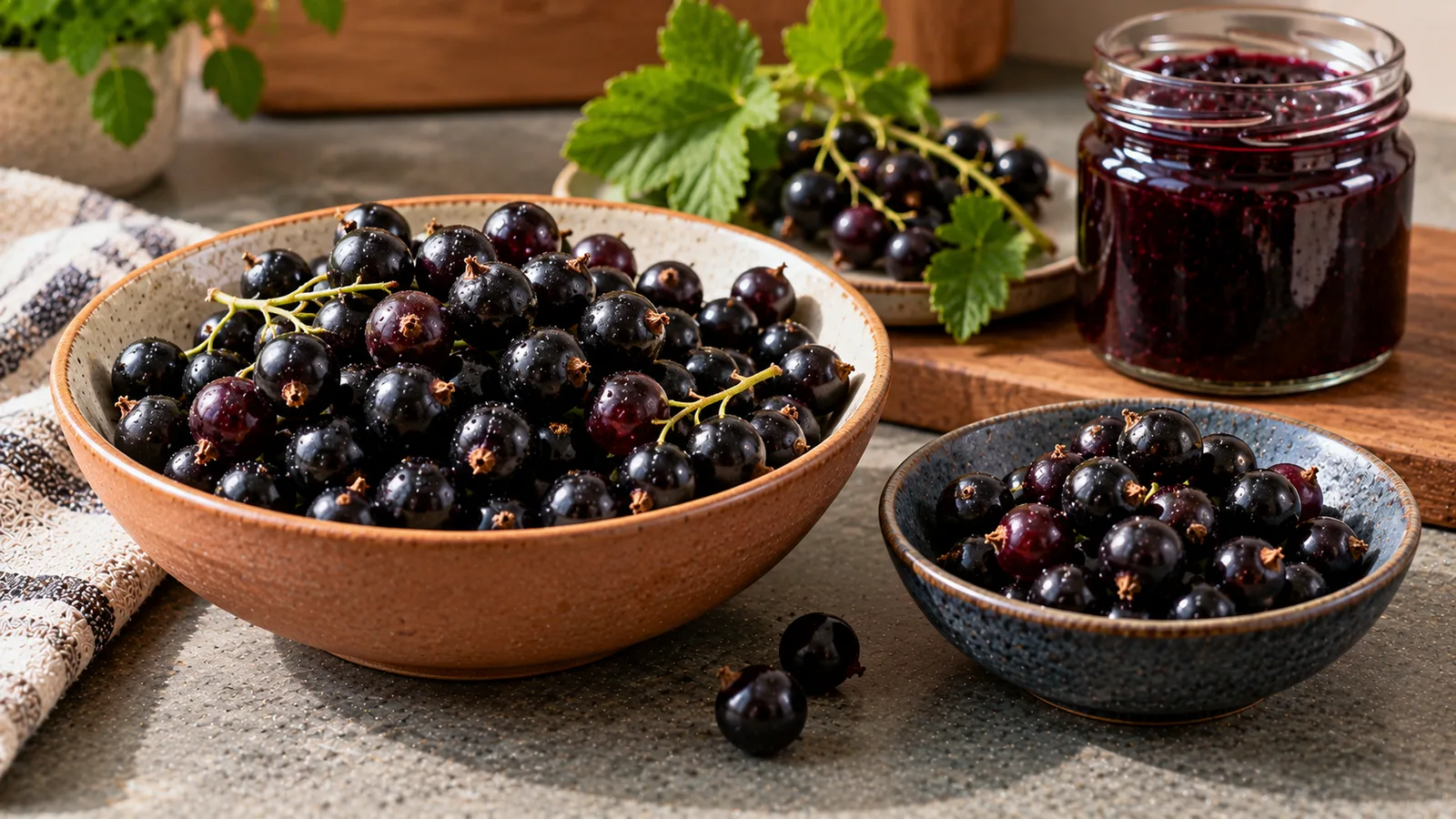
What counts as a raw blackcurrant?
Blackcurrants are the small, intensely flavoured berries of Ribes nigrum. This guide covers the plain, raw edible berries, not redcurrants, dried currants, blackcurrant cordial or jam. Their names can look similar in a food-tracking app, but the products are different. If a database entry simply says “currants”, read its full description before selecting it.
Our reference is USDA FoodData Central SR Legacy FDC 173963, labelled “Currants, european black, raw”. It reports composition per 100 g of edible fruit, not per punnet or per handful. No fixed weight is assumed for one individual berry: variety, ripeness and size vary, and there is no useful universal “one fruit” measure for calorie logging.
Calories in 30 g, 50 g and 100 g
The selected USDA entry reports 63 kcal per 100 g. That is 0.63 kcal per gram. A modest 30 g topping contributes 18.9 kcal, commonly logged as 19 kcal; 50 g contributes 31.5 kcal, about 32 kcal; and 80 g contributes 50.4 kcal, about 50 kcal. A larger 150 g bowl comes to 94.5 kcal, approximately 95 kcal.
These are arithmetic estimates from one raw-food reference. Rounding each ingredient before adding a recipe can create a small mismatch, so keep more precision until the end. A tablespoon is not a dependable mass measurement for small berries; it may contain different numbers of fruit depending on the spoon and how tightly it is filled.
| Raw portion | Estimated energy |
|---|---|
| 30 g | 19 kcal |
| 50 g | 32 kcal |
| 80 g | 50 kcal |
| 100 g | 63 kcal |
| 150 g | 95 kcal |
Nutrition per 100 g: what the database actually provides
Per 100 g, the USDA entry lists 1.40 g protein, 0.41 g fat, and 15.38 g carbohydrate by difference (frequently displayed as 15.40 g after rounding). It also lists 181 mg vitamin C. These are reference composition figures, not laboratory measurements of the berries on your kitchen counter. Their naturally tart taste is not a reliable way to infer how much sugar they contain.
An important limitation: in this particular SR Legacy record, numerical values for dietary fibre and total sugars are not supplied. Missing does not mean zero. Do not fill the gaps with figures from another cultivar, a jam label or a different national database without identifying that second source. US carbohydrate by difference and EU label carbohydrate have different definitions: fibre is shown separately under EU rules, so the figures should not be compared as equivalent.
| Component | Per 100 g raw |
|---|---|
| Energy | 63 kcal |
| Protein | 1.40 g |
| Fat | 0.41 g |
| US carbohydrate by difference | 15.38 g |
| Vitamin C | 181 mg |
| Fibre and total sugars | Not reported in this USDA record |
How to weigh an edible berry portion
Place a clean bowl on a scale, tare it to zero, and add the berries you intend to eat. Remove stems, leaves and obviously damaged fruit first. If a recipe specifies 80 g, weigh that amount rather than counting spoonfuls. For a food diary, multiply the edible grams by 0.63 to estimate kcal. The same reference can be scaled for protein and fat, but that does not make the result exact for every harvest.
If you purchased a 250 g punnet and discarded some berries, the package weight is not the amount eaten. Likewise, when you add berries to porridge or yogurt, count them separately from the oats, milk, sweetener and toppings. 60 g of plain berries adds about 38 kcal; the finished bowl contains those calories plus every other ingredient.
Why blackcurrant jam is different
Raw berries and sweetened preserve are not interchangeable nutrition entries. A jam may contain added sugar and have a different water concentration after cooking, so even 100 g of jam cannot be logged as 63 kcal merely because it began as blackcurrants. Look for calories per 100 g on the specific jar, then multiply by the grams actually spread or stirred into food.
For example, if your jar declares 240 kcal per 100 g, a measured 20 g serving would be 48 kcal. That number is explicitly an illustrative label calculation, not a verified price or nutrient claim about every blackcurrant jam. If the label is different, use its figure. Cordials, syrups and sweetened purées require their own product information too.
Fresh, frozen and cooked berries
Unsweetened frozen blackcurrants are useful for breakfast bowls and baking, but confirm that the bag contains berries without added syrup. Plain freezing does not itself add sugar or calories. A supplier may use a different food composition reference, and thawing can change texture and the amount of juice left in the bowl. Measure what you actually eat, including juice you consume.
Cooking can change the weight substantially through evaporation, even if no sugar is added. Consequently the nutrient value per 100 g of finished compote can differ from that of raw berries. For a homemade batch, log the starting raw weight and every ingredient, then divide the batch calories by the finished edible weight or number of portions. Do not use the raw 100-g figure unadjusted for a reduced sauce.
Using blackcurrants in everyday meals
A little blackcurrant goes a long way in flavour: 30 g over yogurt, 50 g in overnight oats or 80 g alongside other fruit are practical weighed examples. None is a prescribed serving size. Choose an amount that fits the food you are preparing rather than increasing it solely to reach a nutritional target.
If you make six small breakfast jars with 300 g of fresh berries in total, each evenly filled jar receives 50 g and about 32 kcal from the berries. The number describes the berry component only; yogurt, grains, nuts and honey must be included separately.
Selecting, cleaning and keeping them safe
Choose sound berries and avoid containers with visible mould or leaking, crushed fruit. Refrigerate fresh berries promptly and wash gently under running water before eating, not with soap. For longer keeping, freeze sound berries in suitable containers; freezing will not make fruit that was already spoiled safe. If a container has mould, treat nearby fruit cautiously and discard affected berries.
The FDA’s fresh-produce advice is about washing and avoiding contamination, not about promising a particular shelf life for blackcurrants. Quality varies with handling. Do not rely on smell alone to establish food safety, and do not serve visibly spoiled fruit. These handling steps matter independently of whether a portion has 19 kcal or 95 kcal.