
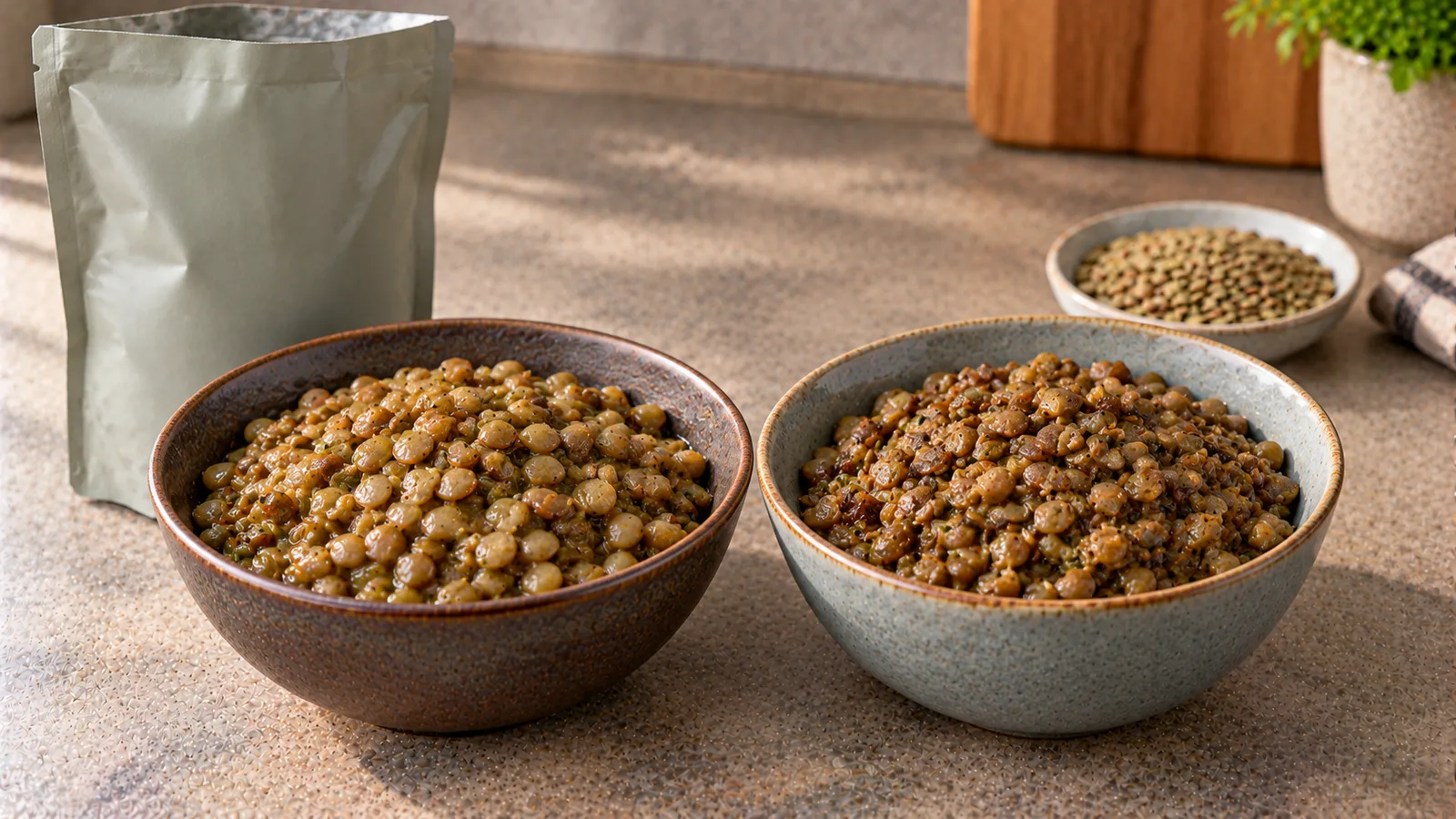
A 250 g pouch of ready-to-eat lentils and a 500 g bag of dried lentils are not directly comparable supermarket purchases. One is hydrated and ready to serve; the other still needs water, heat and some attention. The useful comparison is the cost and nutrition of the same edible, cooked portion, while keeping preparation time, salt and added ingredients visible.
This guide uses a real plain cooked Beluga-lentil pouch as its label example and a real dry Beluga-lentil product as its home-cooking example. A third, mixed ready-to-eat pouch shows why the word lentils on the front does not guarantee that most of the packet is lentils. Prices for the dry product are verified; the pouch price in the worked arithmetic is explicitly hypothetical, not a claimed current shelf price.
Start with the same edible portion
Choose 250 g cooked lentils for a two-person side dish or two modest bowl components. The Voi Guad cooked Beluga lentils come as a 250 g ready-to-eat pouch. The comparator is dmBio dried Beluga lentils, sold in a 500 g bag. The latter label describes a dry ingredient, not food that has already absorbed water.
For a transparent illustration, suppose 100 g dry lentils becomes 250 g cooked lentils. That is a 2.5× weight yield, used as a scenario, not a manufacturer promise. If your drained home-cooked batch weighs 230 g, use 230 g in the calculation; if it weighs 285 g, use 285 g. Cooking styles, evaporation, cooking time and how thoroughly you drain change the yield.
When someone compares a ready 250 g pouch with 250 g of dry lentils, they are matching unlike portions. The dry lentils could produce substantially more than 250 g of food. Conversely, a 250 g pouch of mixed grains and lentils is not 250 g of lentils. Those are two different denominator errors.
What the selected labels actually say
The following numbers come from the stated product listings, not from a generic database entry. The two products use the same lentil variety but different preparation states, so their values per 100 g should not be interpreted as an intrinsic nutritional quality difference.
| Label basis | Ready Beluga pouch, 100 g | Dry Beluga, 100 g | Key interpretation |
|---|---|---|---|
| Energy | 116 kcal | 305 kcal | Water lowers energy density per 100 g |
| Protein | 8.9 g | 23 g | Compare cooked portions, not dry-to-wet grams |
| Fiber | 6.5 g | 17 g | Water changes concentration |
| Salt | 0.40 g | 0.02 g | The pouch contains added salt |
The ready pouch lists lentils, water and salt. The dmBio dry product lists lentils; its near-zero salt figure comes from the product label. Another brand, a flavored pouch or a lentil-and-rice dish may look very different. If you want just cooked lentils, read the ingredient list rather than relying on the product-category label. For a basic refresher on portions of lentils, see Mealisa's lentil nutrition guide.
Convert the dry weight into a cooked serving
Take the dry bag's energy per 100 g, multiply by the amount of dry ingredient used, and then divide by the measured cooked weight. For this illustrative batch, 100 g dry × 305 kcal/100 g = 305 kcal in the batch. If it finishes at 250 g after cooking in plain water, that is 122 kcal per 100 g of the cooked batch.
Use the same logic for protein: 100 g dry provides 23 g protein according to this label. If we assume negligible nutrient loss and a final cooked mass of 250 g, the calculated cooked concentration is 9.2 g protein per 100 g. The analogous fiber estimate is 6.8 g/100 g. These are illustrative calculations, not lab measurements of the finished pot. Draining cooking liquid, rinsing and differing analytic methods can affect the result.
The ready pouch is labeled at 116 kcal, 8.9 g protein and 6.5 g fiber per 100 g. Those figures are close to the illustrative cooked result but should not be expected to be identical. A useful rule is to start with the finished-food label for a ready pouch, and start with dry weight plus your own cooked yield for a home-cooked batch.
Compare the full 250 g portion
The table puts the ready pouch alongside the 100 g dry-lentil scenario after cooking. It deliberately reports separate origins for the numbers. Rounding follows the figures printed on the respective packaging.
| For 250 g served | Ready cooked pouch | Home-cooked 100 g dry | What matters |
|---|---|---|---|
| Calories | 290 kcal | About 305 kcal | Two different label bases |
| Protein | 22.25 g | About 23 g | Similar in this worked example |
| Fiber | 16.25 g | About 17 g | The chosen brands differ slightly |
| Salt | 1.00 g | About 0.02 g before seasoning | Added seasoning changes the result |
The 1.00 g of salt is 0.40 g per 100 g multiplied by 2.5. It is not 1 g sodium: EU nutrition labeling reports salt. For dry lentils cooked in unsalted water, the modeled 0.02 g salt reflects the dry label, not an absolute guarantee about the final meal. Adding stock cubes, soy sauce or a salty dressing can remove the apparent difference immediately.
A different amount is sometimes sensible. A 125 g share of the pouch supplies about 145 kcal, 11.13 g protein, 8.13 g fiber and 0.50 g salt. Halve the home-cooked batch figures for a corresponding 125 g portion. A portion is the amount you actually eat, not necessarily whatever a marketer calls a serving. Mealisa's portion-size explanation covers that distinction.
Price per 250 g: show the assumptions
The dry dmBio Beluga bag is listed at €2.45 for 500 g, or €0.00490 per gram of dry lentils. Under the 2.5× cooked-yield scenario, 100 g dry produces 250 g cooked: the dry ingredient therefore costs €0.49 for 250 g cooked. This excludes fuel, water and your time, and assumes the full batch is eaten.
For the ready pouch, use an illustrative price of €2.49 for 250 g. This is a price assumption solely to demonstrate the method; it is not a verified current offer for Voi Guad. Thus the illustrative pouch premium is €2.00 per 250 g, or about 5.08 times the cost of dry lentils as an ingredient. At another shop price, the answer changes immediately.
| Cost comparison | Ready pouch example | Home-cooked scenario | Calculation |
|---|---|---|---|
| Amount purchased / used | 250 g pouch | 100 g from dry bag | Equal 250 g finished portions |
| Price for that amount | €2.49 assumed | €0.49 verified input | Different certainty levels |
| Price per 100 g cooked | €1.00 | €0.20 | Amount × 100 / 250 |
| Price per 10 g protein | About €1.12 | About €0.21 | Cost ÷ protein × 10 |
A whole 500 g bag costs €2.45 at checkout, even if today's recipe uses only 100 g. The unused 400 g are pantry stock, not consumed in the first bowl. For a single one-off meal, cash paid today and ingredient cost allocated to the meal are both valid quantities, but they answer different questions. The unit-price calculator can help you convert package prices to a common basis; it does not make cooking time disappear.
The cooked-yield sensitivity test
Because yield is uncertain, a cost comparison should not hide it. From 100 g dry lentils at €0.49, a 220 g cooked result works out to €0.223 per 100 g; a 250 g result works out to €0.196; a 280 g result works out to €0.175. Those are calculated ingredient-only costs, not differences in the original nutritional content of the dry batch.
To make exactly 250 g cooked, reverse the calculation: dry weight needed = 250 g divided by your yield factor. At 2.2×, that is about 113.6 g dry and €0.56; at 2.5×, 100 g and €0.49; at 2.8×, about 89.3 g and €0.44. This sensitivity is small compared with the illustrative pouch premium, but precise comparisons should still disclose it.
If water is discarded, do not automatically assume the retained nutrients are identical to those in the uncooked lentils. Values from raw packaging are an approximation for the entire batch, not an independent chemical analysis of the drained finished lentils. This is one reason package nutrient data should be treated as estimates rather than microscopic precision.
Oil, salt and additional grains change the comparison
Not every shelf-stable pouch is a packet of plain lentils. The Alnatura ready mixture is 42% prepared barley, 27% prepared lentils and 27% prepared chickpeas, with oil and sea salt. Its 250 g pouch therefore contains a declared 67.5 g of the cooked-lentil ingredient, not 250 g of lentils. The lentil ingredient itself includes water, so 67.5 g is not a figure for dry lentils either.
Its label gives 167 kcal, 7.1 g protein, 5.8 g fiber and 0.8 g salt per 100 g. Multiplying by 2.5 yields 417.5 kcal, 17.75 g protein, 14.5 g fiber and 2 g salt for the full 250 g mixture. This is a perfectly legitimate convenient side dish; it simply answers a different question from plain lentils. Salt deserves attention, especially if the pouch is accompanied by salted vegetables or sauces.
The Reis-fit rice, lentil and vegetable pouch offers another ingredient-list example: 25% precooked lentils, with rice, vegetables, added oils and seasoning. Do not present the whole package's protein or energy as if it comes entirely from lentils. When a package is mainly rice, compare it with a homemade rice-and-lentil dish if that is the meal you actually intend to make.
The five-label check in the shop
Begin with the exact product name: plain prepared lentils, a lentil-and-grain mix, or a flavored meal. Read ingredients and percentages before comparing front-of-pack phrases. Next identify net weight versus drained weight. A sealed vacuum pouch that is fully edible may have no drained-weight conversion; a can packed in liquid often does. The figure you need for cost per usable gram is the part you actually serve.
Third, read energy, protein, fiber and salt per 100 g, not a selected advertising portion. Fourth, compute the amount for your actual 125 g or 250 g serving. Fifth, divide the full package price by usable edible grams and include any ingredient you would otherwise need to add. EU food-information legislation provides the framework for ingredient and nutrition information; see Regulation (EU) No 1169/2011.
If a product contains a flavored oil or sauce, consider whether the extra components replace things you would have added to dry lentils at home. Adding those costs to only one side of the comparison would make it unfair. The objective is to compare two ways of obtaining the same intended meal, not to prove that every pouch is worse.
Convenience is a real part of value
A ready-to-eat pouch can save washing, simmering and draining, and it may be easier to use at work where there is no hob. It can also be an appropriate option if a recipe needs only a small quantity and cooking a whole pot would leave unused food. Shelf-stable packaging is useful for occasional meals and emergency pantry supplies, subject to the printed storage instructions.
Dried lentils reduce packaging per unit of prepared food in many purchase patterns, and a batch can cover several lunches. But the benefit depends on actually eating or safely storing the batch. If half a pot is discarded, the cost per eaten portion rises. Time and energy also matter: 25 minutes of active or passive preparation is not free for every household. You can value your own time without treating a supermarket premium as automatically unreasonable.
For a regular routine, try cooking a batch once and portioning it rather than comparing one pouch with one freshly cooked pot every day. The budget grocery planning guide helps separate recurring staple purchases from the cost of one prepared serving.
Storage and reheating without shortcuts
A sealed shelf-stable pouch follows the manufacturer's unopened storage and use-by instructions. Once opened, it becomes a perishable prepared food: transfer leftovers appropriately, refrigerate promptly and follow any shorter instruction on the packet. Do not assume the sealed-product shelf life continues after opening.
For home-cooked lentils, cool quickly in shallow containers and refrigerate or freeze. The USDA leftovers guidance generally gives 3–4 refrigerated days for properly handled leftovers, but a pouch's explicit two-day after-opening instruction can be stricter and should take priority. Reheat thoroughly when serving hot; never rely on smell to prove an improperly stored food is safe.
If you are preparing lunches ahead, refrigerate individual portions instead of repeatedly warming and cooling the same large pot. Freeze extra portions early if you will not use them promptly. Packaging, storage and portion control are practical advantages of both routes when handled well.
Choose according to the actual meal
For a plain lentil salad with lemon and herbs, the ready pouch makes a fast lunch while the home-cooked alternative usually offers greater ingredient control and a low ingredient cost. For a strongly seasoned curry, dry lentils can absorb flavor from the start; a pre-cooked pouch may become too soft if simmered for a long time. For a camping or workplace meal, cooking facilities might matter more than the small difference in fiber.
Look at the whole plate, too. Lentils contribute fiber and protein, but a complete meal may still need vegetables, a fat source or another food according to appetite and goals. The lentils-versus-chickpeas comparison puts the ingredient decision in wider context without confusing a ready product with a dry commodity.
A repeatable comparison formula
Write down the usable prepared weight and the price you actually pay. For a ready pouch: portion cost = pouch price × serving grams / usable pouch grams. For a dry bag: portion cost = bag price × dry grams needed / bag grams. To find dry grams needed, divide desired cooked grams by the observed cooked-yield factor. Then calculate nutrition with the relevant label basis.
For example, a €2.49 illustrative ready pouch used in two equal servings costs €1.245 per 125 g serving. Under the 2.5× dry-yield scenario, 50 g dry lentils makes approximately 125 g cooked and costs €0.245. Round prices to cents after doing the calculation; displaying €1.25 and €0.25 per serving is appropriate. Record whether seasoning and electricity are included.
The safest conclusion is not that one format always wins. It is that the cheapest ingredient source in this example is dry Beluga lentils, while the ready pouch buys convenience and contains more labeled salt. Your yield, retailer price and whether the product is plain or mixed can change a real-world purchasing decision.
Sources
- dmBio Beluga lentils: dry-product nutrition, ingredients and displayed price.
- Voi Guad cooked Beluga lentil pouch: ingredient list and nutrition label.
- Alnatura precooked barley, lentils and chickpeas: composition and label.
- Reis-fit lentil, rice and vegetable pouch: composition and label.
- EU food information regulation 1169/2011.
- USDA Food Safety and Inspection Service: leftovers and food safety.
Label figures and the cited dry-product display price were checked for this article in October 2026. The ready-pouch €2.49 price and the 2.5× cooked yield are explicitly illustrative. Local offers, recipes and yields may differ.