
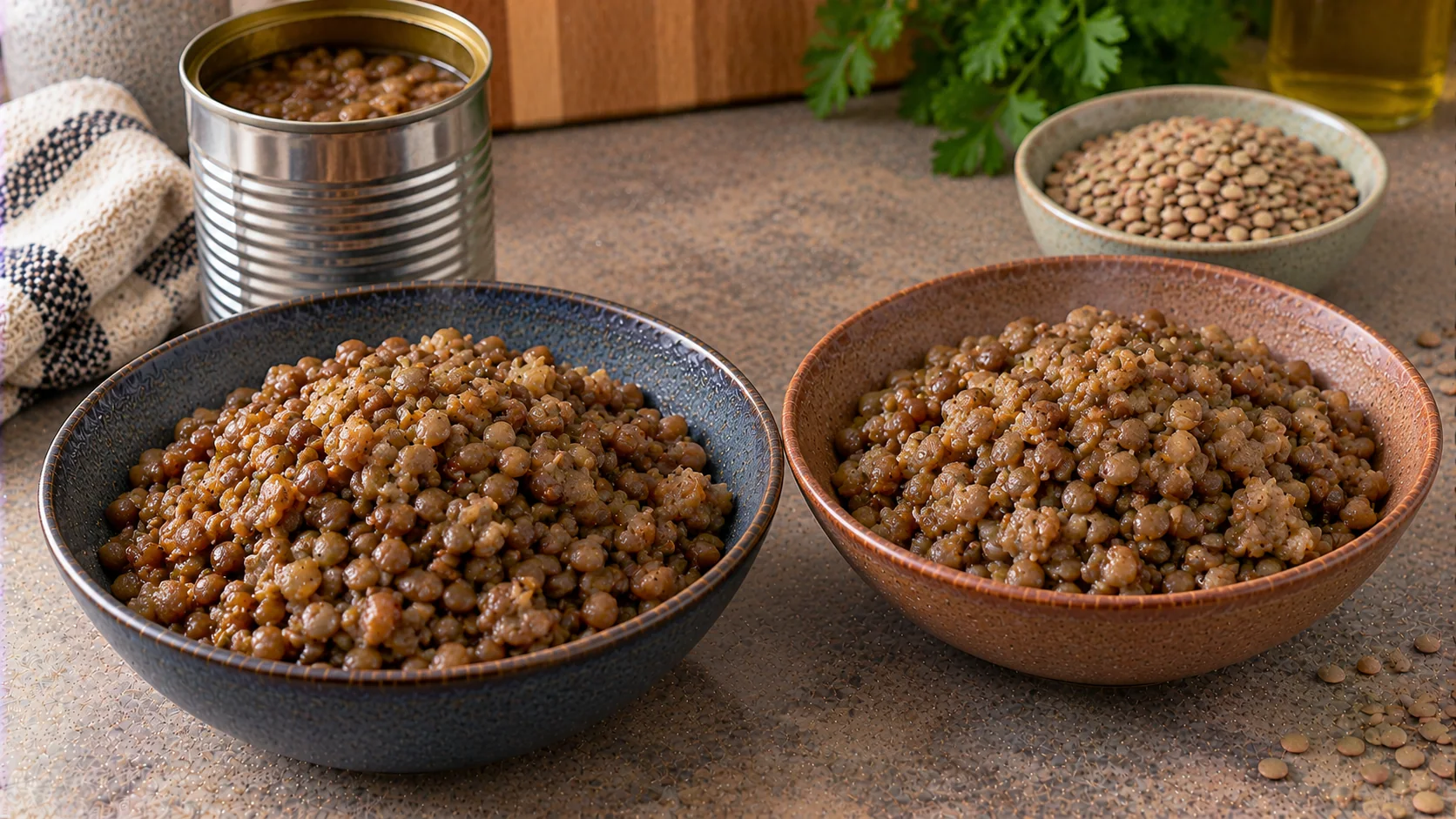
What is the fair comparison?
Canned lentils are already cooked; dried lentils are not. Comparing the shelf price of a 400 g tin with 400 g of dry lentils compares different amounts of water and food. Instead, compare the price of 200 g of edible, cooked, drained lentils. This guide uses a deliberately transparent example for a European shopper. It is not a live German supermarket price survey; substitute your local shelf prices and package labels.
A reproducible example: what you actually buy
| Assumption | Canned | Dried |
|---|---|---|
| Purchased amount | 400 g can, including liquid | 1 kg bag |
| Example checkout price | €0.89 per can | €2.49 per kg |
| Edible reference | 240 g after draining | 2.5 g cooked per 1 g dry |
| Preparation energy allocated to 200 g | €0.00 (cold use) | €0.08 per 200 g cooked |
| Serving compared | 200 g drained | 200 g cooked |
A 400 g tin does not necessarily contain 400 g of lentils: use its actual net drained weight. The 240 g assumption here is an example, not a promise about every brand. For dried lentils, the 2.5× yield is a planning assumption; cooking variety, water, simmering and draining change the result. USA Pulses cooking guidance explains hydration, rinsing and simmering times.
Calculate the price of the same 200 g portion
Canned: €0.89 × 200 ÷ 240 = €0.74 per 200 g, rounded to cents. Dried ingredient: €2.49 ÷ 1,000 × (200 ÷ 2.5) = €0.20; add €0.08 illustrative cooking electricity = €0.28. The difference is approximately €0.46 per 200 g under these particular assumptions, before water, labour or leftover spoilage. Do not read it as a universal saving.
| Cost component / 200 g edible lentils | Canned, cold | Dried, cooked |
|---|---|---|
| Lentils purchased, allocated | €0.74 | €0.20 |
| Illustrative cooking energy | €0.00 | €0.08 |
| Example total | €0.74 | €0.28 |
The displayed values are rounded; precise calculations use the unrounded price (€0.7417 for canned and €0.1992 for dried ingredients). If you heat the canned lentils, add the heating energy on that side too. If you cook a very small pot of dry lentils, the allocated energy per portion can be higher.
Test the yield instead of assuming it
Weigh 100 g dried lentils, cook according to the packet, then drain thoroughly and weigh the cooked result. If your actual yield is 220 g, the dry-ingredient cost of a 200 g portion is €2.49 × 200 / 2,200 = €0.23. If the yield is 280 g from each 100 g dry, the same 200 g portion costs €0.18 in dry ingredients. Both exclude energy. Use kitchen-scale measurements, not a cup-to-cup volume conversion, when reporting weight yield.
| Yield from 100 g dry | Dry weight needed for 200 g cooked | Dry ingredient cost |
|---|---|---|
| 220 g (2.2×) | 90.9 g | €0.23 |
| 250 g (2.5×) | 80.0 g | €0.20 |
| 280 g (2.8×) | 71.4 g | €0.18 |
Cooking energy, water and time
Energy is not a fixed property of lentils. Stove efficiency, cookware, lid, batch size and electricity tariff determine it. For example, 0.20 kWh for a pot yielding 500 g cooked at €0.40/kWh costs €0.08 for the whole pot, or €0.032 per 200 g, not €0.08. Our main table intentionally uses a conservative illustrative allocation of €0.08 per serving; replace it with a measured kettle or hob consumption where available. This distinction prevents incorrectly charging a whole batch to each portion.
Most ordinary dried lentils can be rinsed and simmered without overnight soaking; cooking time varies by type, and split red lentils break down more readily than whole green/brown lentils. USA Pulses suggests checking tenderness rather than relying only on a timer. Canned lentils save that preparation time and may avoid throwing away the unused half of a large dry batch.
Are nutrients equivalent after cooking?
Both are pulses and can contribute protein and fibre. A reference for plain boiled lentils without added salt is about 116 kcal, 9.0 g protein and 7.9 g fibre per 100 g cooked in USDA FoodData Central, SR Legacy record 172421. At 200 g the arithmetic is approximately 232 kcal, 18.0 g protein and 15.8 g fibre. These figures describe the database entry for cooked lentils, not every branded can, and should not be applied to dried weight.
Canning liquid, different lentil varieties, salt and drained weight affect labels. A canned nutrition panel may specify values for the drained product or for the contents as sold; read the wording before multiplying by 200/100. Match the actual label to the product state rather than treating a single USDA record as a lab test of your tin.
Sodium, labels and what rinsing changes
Some canned lentils contain added salt; plain dried lentils let you choose how much salt to add. Compare salt per 100 g of the drained edible product, not just the front-of-pack slogan. Rinsing can remove some surface brine, but it does not guarantee a known reduction for your brand. Check the ingredient list and nutrition table. Unsalted canned versions may be a sensible alternative when convenience matters.
Use the right option for your meal
Choose canned for a fast salad, lunchbox or a single meal without advance preparation. Choose dry when you cook multiple meals, can freeze extras and are able to use the full bag. For low-waste batch cooking, weigh out portions before storing them; our comparing lentil preparation and cost gives more Mealisa context for preparing legumes economically. The cheaper ingredient is not always cheaper once spoiled leftovers, energy and your time are included.
For a practical test, cook 200 g dry lentils once, record the cooked drained mass and electricity if measurable, and compare with the actual drained weight and checkout price of two cans. This gives a personal €/200 g comparison that is more useful than generic national averages.
Safe preparation and leftovers
Cool cooked lentils promptly in shallow containers and refrigerate according to NHS food safety guidance; use refrigerated leftovers within two days under that conservative guidance, or freeze extra portions promptly. Follow can instructions after opening, transfer leftovers to a covered food-safe container and never treat an unopened shelf-life date as a guarantee after opening. Reheat until piping hot; avoid repeated cooling and reheating.
A simple decision checklist
- Read the net drained weight on a can; verify by weighing if needed.
- Record the dry-to-cooked weight yield for your own lentil variety.
- Divide each full pack price by its actual edible cooked yield.
- Compare equal 200 g portions and account for cooking energy on the side where it is used.
- Check added salt, preparation time and whether you can use or freeze the remainder.
Sources
- USDA FoodData Central: cooked lentils, SR Legacy 172421 — only for the clearly identified cooked-reference nutrient values.
- USA Pulses: lentil preparation and storage — for rinsing, cooking and yield context.
- NHS Inform: preparing and storing food safely — for leftover cooling and refrigerator advice.