
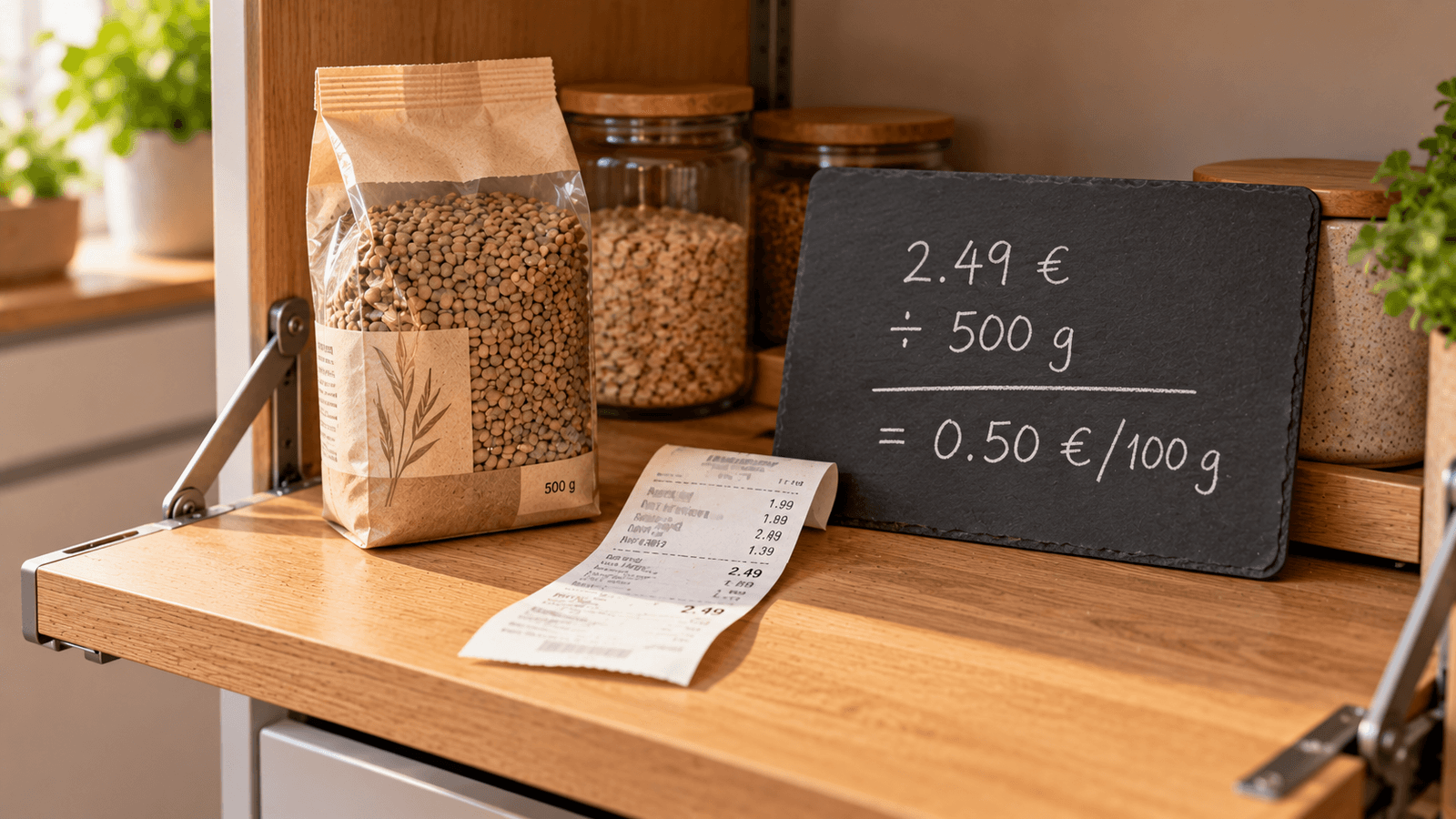
Use the calculator below to compare grocery products that have different package sizes.
Enter the price and quantity of each product, choose the unit, and compare their normalized unit prices.
<div id="unit-price-calculator" data-mealisa-tool="unit-price-calculator"></div>
What the calculator compares
A lower package price does not necessarily mean a lower price for the same amount of food.
For example:
- Product A: 500 g for €2.49
- Product B: 750 g for €3.29
Product A costs less at checkout, but the normalized prices are:
Product A: €4.98/kg
Product B: €4.39/kg
Product B is therefore cheaper for the same weight.
Unit price formulas
For products measured in grams:
Price per kg = price ÷ grams × 1000
Price per 100 g = price ÷ grams × 100
For products measured in millilitres:
Price per litre = price ÷ ml × 1000
Price per 100 ml = price ÷ ml × 100
For products sold by count:
Price per item = package price ÷ number of items
Example: comparing three package sizes
| Product | Package | Price | Price/kg |
|---|---|---|---|
| A | 400 g | €1.99 | €4.98 |
| B | 650 g | €2.99 | €4.60 |
| C | 1 kg | €4.29 | €4.29 |
The 1 kg package has the lowest unit price even though it has the highest checkout price.
Price per kg vs price per 100 g
Both units describe the same underlying price.
For example:
€6.00/kg = €0.60/100 g
To convert:
price per 100 g × 10 = price per kg
or:
price per kg ÷ 10 = price per 100 g
Use whichever unit makes your comparison easiest.
Comparing liquids
Suppose:
- 750 ml costs €2.25
- 1 L costs €2.80
For the 750 ml bottle:
2.25 ÷ 750 × 1000 = €3.00/L
For the 1 L bottle:
€2.80/L
The 1 L bottle has the lower unit price.
Comparing products sold by count
Unit price can also mean price per individual item.
Example:
6 yogurt cups for €2.70:
2.70 ÷ 6 = €0.45 each
10 yogurt cups for €4.10:
4.10 ÷ 10 = €0.41 each
The 10-pack has the lower price per cup.
Make sure both products use the same basis
A useful comparison requires equivalent units.
Do not directly compare:
- €/kg with €/100 g;
- €/L with €/100 ml;
- price per package with price per item.
Convert both products to the same unit first.
Does the lowest unit price always mean the best purchase?
No.
The calculator answers a specific question:
Which option costs less for the same quantity?
It does not know whether you will use the entire package.
A larger package with a lower unit price may still be a poor purchase if:
- some of it will spoil;
- you do not have enough storage;
- you only need a small quantity;
- its total price does not fit your current grocery budget.
Use the calculated unit price together with your actual needs.
Example: when the larger pack is not cheaper in practice
A 500 g pack costs €2.00:
€4.00/kg
A 1 kg pack costs €3.50:
€3.50/kg
The larger pack wins mathematically.
But if you use only 600 g and throw away the rest, you paid €3.50 for 600 g actually consumed:
3.50 ÷ 0.6 = €5.83/kg consumed
Waste can eliminate the apparent saving.
Sale prices
Enter the price you will actually pay after the discount.
For example, if a 600 g package normally costs €4.00 but is discounted to €3.00:
3.00 ÷ 600 × 1000 = €5.00/kg
Compare €5.00/kg with the unit prices of the alternatives rather than comparing promotional labels.
Drained foods
For products such as beans, tuna or olives packed in liquid, decide what quantity you are actually comparing.
If two products will both be drained before eating, drained weight may be the more useful basis.
Example:
A can costs €1.20.
Total weight: 400 g
Drained weight: 240 g
Using total weight:
1.20 ÷ 400 × 1000 = €3.00/kg
Using drained weight:
1.20 ÷ 240 × 1000 = €5.00/kg
Use the same type of weight for both products.
The quick rule
To compare different package sizes:
- Enter the real package price.
- Enter the package quantity.
- Use the same measurement basis for each product.
- Compare the normalized unit prices.
- Then consider whether you will actually use the quantity you buy.
For a detailed explanation of package-size comparisons, see How to Compare Grocery Prices Across Package Sizes.