
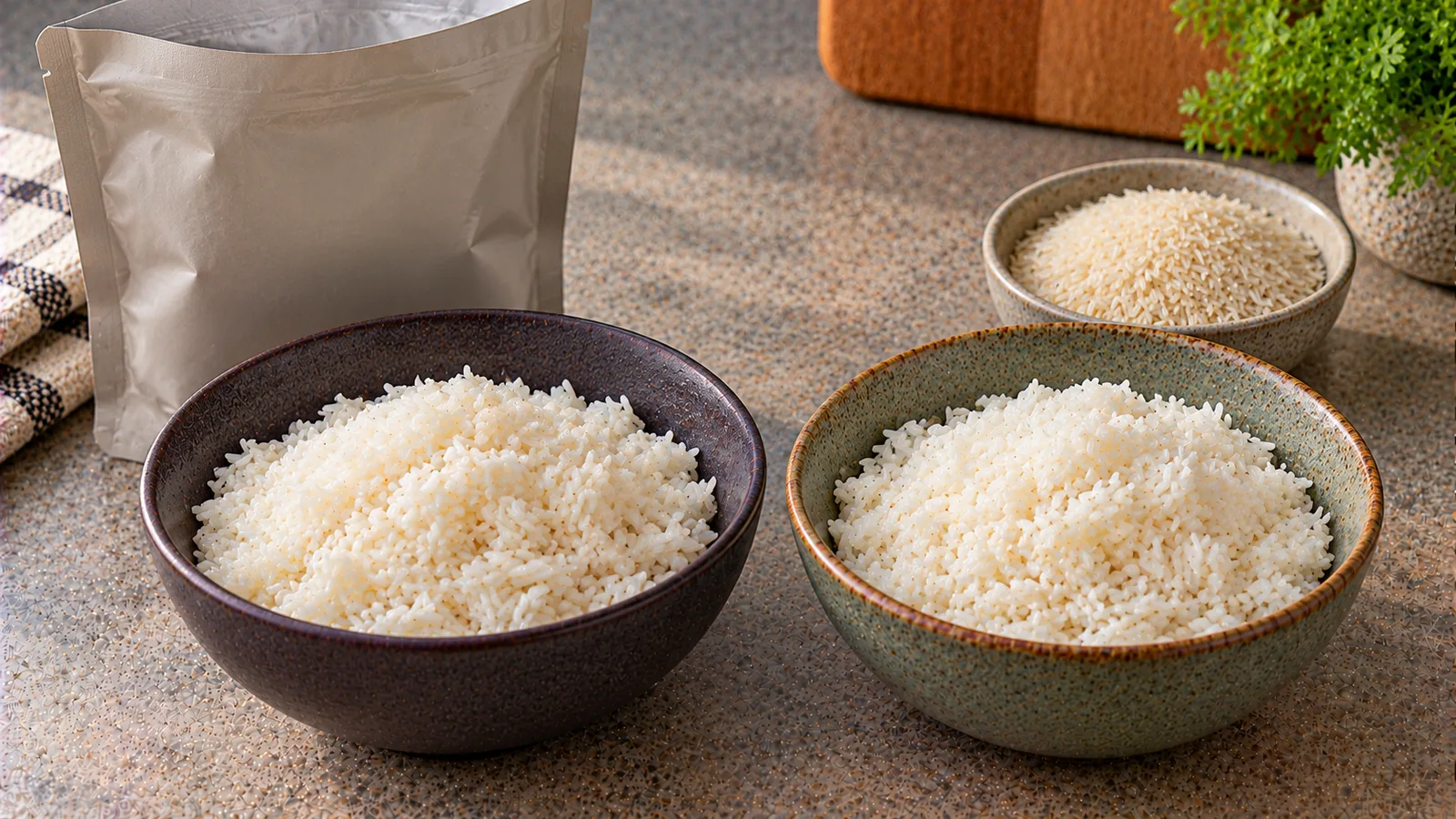
What is being compared
A microwave rice pouch and a bag of dry rice are not directly comparable by package price: one product contains cooked, hydrated grains while the other needs water, a pan or rice cooker, and preparation. This comparison uses 250 g of edible, cooked rice as a single reference portion. It focuses on convenience, edible yield, cash cost and time, not an unsupported claim that one type of rice is intrinsically healthier. Plain products are the fair baseline; flavored pouches can contain additional salt, oils and seasonings.
A fair 250 g edible-portion benchmark
Imagine one 250 g plain ready-to-heat pouch and 250 g of home-cooked plain rice. A pouch marked 250 g usually refers to its net ready-to-eat contents; check whether the instructions require added water or discarding liquid. Dry rice expands as it absorbs water, so buying 250 g dry rice generally produces much more than 250 g cooked. Compare the same rice variety where possible: basmati with basmati, brown with brown, and plain with plain. Our illustrative dry-rice yield is 3.0 g cooked per 1 g dry, but actual yield varies with variety, washing and cooking method.
Weight and cooking yield
At the modeled 3.0× yield, 250 ÷ 3 = 83.3 g dry rice provides approximately 250 g cooked. A 1 kg dry-rice bag therefore yields about 3 kg cooked rice, or 12 portions of 250 g. With a smaller 2.5× yield, the required dry weight is 100 g; with 3.5× it is 71.4 g. Do not mistake the amount of water absorbed for extra nutritional energy: the cooked mass increases, but calories come primarily from the starting dry grain. Weigh your own batch after cooking for a more accurate cost calculation.
Illustrative shelf-price calculation
Here is a transparent illustration, not a live supermarket quote. Suppose a 250 g plain microwave pouch costs €1.79 and a 1 kg bag of dry rice costs €2.49. A 250 g cooked portion then requires about 83.3 g dry rice, costing €0.21 in rice (2.49 × 83.3 ÷ 1,000 ≈ €0.2075). With €0.09 of electricity allocated to that portion, its modeled total is €0.30. Allowing €0.02 of electricity for heating the pouch gives €1.81. The modeled difference is therefore €1.51 per 250 g. Actual tariffs, prices and equipment may change this ranking.
| Option | Edible serving | Rice cost | Energy + total |
|---|---|---|---|
| Microwave pouch | 250 g | €1.79 | €0.02 → €1.81 |
| Dry rice, 3.0× yield | 250 g from 83.3 g dry | €0.21 | €0.09 → €0.30 |
Energy, water and equipment
Cooking energy matters, especially for a single small portion. This model allocates 0.30 kWh per home-cooked portion and 0.067 kWh for pouch heating at €0.30/kWh: €0.09 and about €0.02, respectively. These are scenarios, not measurements of a specific stove or microwave. Cooking a full pot and dividing its electricity over multiple portions can reduce energy cost per portion. A powerful hob, long cooking with excess water, or poor batch utilization may increase it. Water costs are small in this simplified comparison and are excluded; include them if your billing or circumstances make them material.
Active time versus elapsed time
A pouch may require only a minute or two of appliance heating plus handling; follow the product instructions rather than a universal timing claim. Dry rice commonly requires several minutes of rinsing/measuring and additional hands-off simmering or rice-cooker time. Separate active minutes from total elapsed minutes: standing next to a stove is not the same as leaving a covered pan to simmer. Batch cooking adds cooling and storage steps. A pouch is often convenient for one quick lunch, travel with kitchen access, or when leftovers would otherwise be discarded.
Nutrition and salt on labels
On an equal cooked-weight basis, a plain pouch and home-cooked rice of the same variety can be nutritionally similar, but check the ingredient list and nutrition declaration. For packaged rice, compare calories, salt and any added oil per 100 g of prepared product, then scale to 250 g by multiplying by 2.5. Dry-rice labels commonly give values for 100 g dry, which must not be placed beside cooked-product figures as if they had equal moisture. Use the cooking yield and product label to estimate the finished portion. Official composition search is available through USDA FoodData Central.
When the pouch is the better purchase
The pouch can be the rational choice when you have no pan or hob, need only one portion, value predictable cooking time, or cannot safely refrigerate a larger batch. Compare the price of the actual pouch size rather than assuming all brands use 250 g. Look for plain rice with no unnecessary flavoring if you want control of salt. Some products are shelf-stable until opened; always follow their individual storage instructions. Convenience has economic value even when ingredient cost is higher.
When dry rice wins
Dry rice usually wins the ingredient-cost comparison if you eat rice regularly, can prepare multiple portions, and finish them safely. A 1 kg bag provides flexibility in portion size and usually less packaging per gram of edible rice, but environmental conclusions need lifecycle data rather than packaging weight alone. Use a covered pot or rice cooker and measure actual cooked yield. For rice-based meals, use the portion guide to choose quantities and the balanced meal guide to plan beans, vegetables or a protein side alongside the grain.
Storage and reheating safety
Cooked rice needs particularly careful handling: do not leave it cooling at room temperature for hours. Bacillus cereus spores may survive cooking and grow if rice is handled poorly; reheating cannot reliably undo toxins already formed. Cook only what you need, or cool leftovers rapidly in shallow containers and refrigerate promptly. General US food-safety guidance recommends refrigerating perishables within two hours and reheating leftovers thoroughly; for cooked rice, follow any stricter local or product-specific guidance and favor quick consumption. Do not repeatedly warm and cool the same portion. See USDA leftovers guidance and FoodSafety.gov storage information.
Practical shopping checklist
Before buying, record: net edible grams in the pouch; total price; dry-bag cost per kilogram; actual cooked yield; electricity cost per batch; number of portions that will actually be eaten; preparation time; and salt or seasonings. Recalculate if the pouch is discounted, if you have a different rice yield, or if the batch is partially wasted. Price per 250 g edible rice is more informative here than package price or price per 100 g dry.
Sources and related reading
Use USDA FoodData Central for reference compositions; USDA food-safety advice and FoodSafety.gov for safe leftovers and storage. For practical portion planning see portion guide; for building a complete meal around rice see balanced meal guide. Ingredient prices and energy quantities above are explicitly illustrative rather than retailer quotations.