
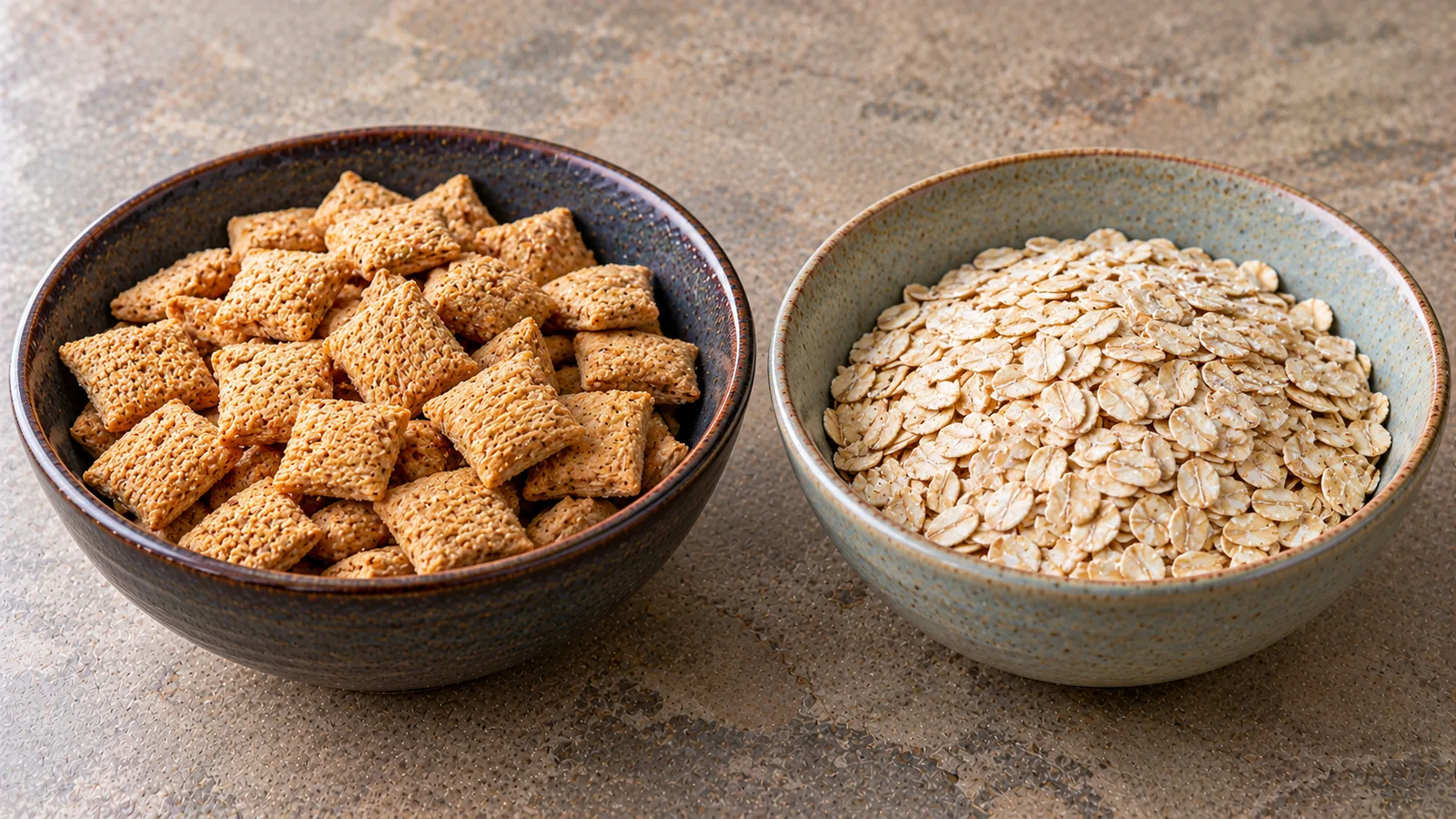
Protein cereals promise an easy way to upgrade breakfast, while ordinary oats have a reputation for being economical and filling. Which offers more protein for the same breakfast calories, and how much extra do you pay? The answer depends on the exact products, the quantity placed in the bowl, and what you pour over them. Comparing an advertised serving of one brand with 100 g of another is not a fair test.
This worked comparison uses ALLOS Das Ungesüßte Protein Müsli, a soy-and-grain muesli containing seeds and raisins, and dmBio Feinblatt wholegrain oats. Both are sold in Germany. The third ingredient is the same 150 ml of 1.5%-fat cow's milk in each bowl. The two products are not presented as all protein cereals or all oats; their labels provide a reproducible example that you can adapt to your own shelf.
Short answer: at about 300 kcal per bowl, the illustrated protein-muesli breakfast provides about 18.46 g protein versus 13.74 g from oats with the same milk. The oats bowl costs about €0.28, compared with €0.75 for the muesli bowl under the documented product prices and an explicitly illustrative milk price. The extra roughly 4.72 g protein costs about €0.47. Neither food is automatically the better breakfast for everyone.
The products and what the labels actually say
The ALLOS product listing reports 378 kcal, 22 g protein, 14 g fibre and 12 g sugars per 100 g. Its 450 g pack was displayed at €4.25 when checked on 17 October 2026. Its ingredient list begins with soy flakes, followed by wholegrain wheat flakes, wholegrain oats, raisins, wheat flakes, seeds and other ingredients. “Without added sugar” does not mean “zero sugar”: dried fruit contributes naturally occurring sugar.
The dmBio oats listing gives 372 kcal, 14 g protein, 10 g fibre and 0.7 g sugar per 100 g, with a 500 g bag priced at €0.85. These flakes contain wholegrain oats, rather than a blend with soy and dried fruit. A cheaper 2 kg oats pack also exists, but using its bulk price on only one side would bias the comparison; this calculation consistently uses the ordinary 500 g bag.
The milk is ja! 1.5% milk, with 47 kcal, 3.4 g protein, 4.9 g sugar and 1.5 g fat per 100 ml according to the REWE label. REWE does not show one reliable nationwide shelf price for this item. To keep the arithmetic transparent, the cost model assumes €1.19 per litre for milk; this is a hypothetical input, not a verified REWE quote.
| Label measure per 100 g dry cereal | ALLOS protein muesli | dmBio fine oats |
|---|---|---|
| Energy | 378 kcal | 372 kcal |
| Protein | 22 g | 14 g |
| Fibre | 14 g | 10 g |
| Carbohydrate | 36 g | 59 g |
| Total sugar | 12 g | 0.7 g |
| Fat | 13 g | 7 g |
| Pack size | 450 g | 500 g |
| Displayed pack price | €4.25 | €0.85 |
Read the state carefully: every value in this table describes the dry product. It is not the nutrition per ready-to-eat bowl. Each label may change with recipe reformulation or a different local SKU. We have deliberately not substituted a generic cereal database value for a branded product label.
Two bowls with the same 300 kcal target
A bowl is a mixture, not merely the dry cereal. Start by reserving 150 ml of the same milk for both breakfasts. That milk supplies 70.5 kcal and 5.10 g protein. To reach 300 kcal total, each dry portion therefore needs 229.5 kcal. Dividing by the dry product's energy density gives 60.71 g protein muesli or 61.69 g oats. Kitchen scales can round to 61 g and 62 g; that changes the totals slightly. For an exact comparison, keep the calculated quantities until the last step.
The formula is simple: `dry grams = (300 kcal − milk kcal) ÷ (dry-product kcal per 100 g) × 100`. Multiply each nutrient's per-100-g label value by dry grams divided by 100, then add the milk's contribution. The fibre contribution from the listed milk is zero.
| Approximately 300-kcal breakfast | Protein muesli + milk | Oats + milk |
|---|---|---|
| Dry cereal | 60.71 g | 61.69 g |
| Milk, 1.5% | 150 ml | 150 ml |
| Total energy | 300.00 kcal | 300.00 kcal |
| Protein | 18.46 g | 13.74 g |
| Fibre | 8.50 g | 6.17 g |
| Total sugars including lactose | 14.64 g | 7.78 g |
| Fat | 10.14 g | 6.57 g |
| Cost of dry cereal | €0.57 | €0.10 |
| Total illustrative bowl cost | €0.75 | €0.28 |
The numerical difference is 4.72 g protein and 2.33 g fibre in favour of this muesli; the oats bowl has about 6.85 g less total sugar. Both bowls include 7.35 g naturally occurring milk sugar, so those figures do not represent added sugar. And the muesli's 12 g per 100 g is a total sugar figure, not proof that sugar was added. If you swap the milk, every total must be recalculated.
A crucial limitation: 300 kcal is a comparison setting, not a recommended breakfast calorie allowance. Someone needing a larger or smaller meal can scale either bowl. Cooking oats with water changes the final weight and texture, not the energy supplied by the weighed dry oats; if some milk is left in the saucepan, however, the consumed nutrients may differ from the calculation.
Price per bowl and price per 10 g protein
Package prices should be converted to the amount actually used. The muesli's dry unit cost is €4.25 / 450 g, or €0.944 per 100 g. The oats cost €0.85 / 500 g, or €0.170 per 100 g. For the calculated dry portions, that produces approximately €0.573 and €0.105 respectively. The identical 150 ml milk adds an assumed €0.179 to both.
| Cost perspective | Protein muesli bowl | Oats bowl |
|---|---|---|
| Product price per 100 g dry | €0.94 | €0.17 |
| Dry amount used | 60.71 g | 61.69 g |
| Dry amount cost | €0.57 | €0.10 |
| Milk cost, illustrative | €0.18 | €0.18 |
| Complete bowl cost | €0.75 | €0.28 |
| Cost per 10 g bowl protein | €0.41 | €0.21 |
Price per 10 g protein means bowl cost divided by bowl protein grams, then multiplied by ten. It is a shopping measure, not a protein-quality or health score. The oats bowl looks especially economical because its milk contributes the same 5.10 g protein at the same hypothetical cost in both examples. The branded mix has more protein in absolute terms, but not at a lower price for each gram of it.
A package checkout total answers a different question. Buying both cereals would require paying €4.25 or €0.85 up front, plus a separate milk container. You do not use the full pack in one bowl. After one breakfast there will be cereal left over; leftovers have value rather than becoming “free” or automatically becoming waste. If you regularly buy larger oats packs, the per-bowl oats cost may be lower than shown here.
What does the high-protein claim mean?
EU Regulation (EC) No 1924/2006 defines a source of protein claim by at least 12% of food energy coming from protein, and high protein by at least 20%. The calculation is based on energy share rather than protein grams alone. For this muesli, 22 g × 4 kcal = 88 kcal from protein per 378 labelled kcal, or approximately 23.3%. For the oats, 14 × 4 / 372 is approximately 15.1%. These are approximate screening calculations using rounded label values, not independent legal certification. See the European regulation.
That explains why a conventional wholegrain ingredient can provide meaningful protein without being sold as a high-protein product. Protein on the front of a pack tells you nothing by itself about the amount in the bowl, price, allergens, fibre or whether the breakfast includes enough variety. The DGE protein reference guidance puts dietary protein into the context of the whole day.
Fibre and sugar change the assessment
Both tested bowls deliver more than 6 g fibre and can help toward an adequate daily intake. German nutrition guidance emphasises wholegrains as useful sources of fibre and other nutrients; see DGE wholegrain recommendations. But fibre grams do not automatically equal fullness for a particular individual. Eating speed, chewing, fluid intake, meal volume and other foods all contribute.
The ALLOS mix contains soy flakes, wholegrains, raisins and seeds. Oats are a simpler single-ingredient option and supply oat beta-glucan. Neither product should be marketed as a guaranteed way to lose weight, control glucose or improve digestion based solely on the table. The types of fibre and their physiological effects differ. The DGE fibre FAQ discusses diversity of sources and gradual increases in fibre intake.
A total sugar number includes sugars occurring naturally in dried fruit and milk. The muesli is described as having no added sugar, yet the per-100-g sugar entry is 12 g because its ingredients include raisins. The oats figure is far lower. It would be misleading to treat all 14.64 g of sugar in the complete muesli bowl as added sugar, or to say that an oats bowl with banana necessarily stays at 7.78 g. Log actual additions.
Milk, yogurt and plant drinks alter both columns
Using the same milk isolates the effect of the dry cereal. If one bowl uses high-protein skyr while the other uses water, the result chiefly compares the topping or liquid, not the cereals. For a fair test, change one variable at a time. You can run a second comparison with 150 g of the same plain yogurt or with a chosen fortified soy drink. Recalculate both bowl sizes to restore the 300-kcal target if calories matter.
Cow's milk contributes protein and lactose. Most ordinary oat drinks contain notably less protein per 100 ml than cow's milk, though labels vary. Soy drinks may be closer to cow's milk in protein; formulations, fortification and added sugar require individual checking. A powdered protein supplement added to oats changes the question yet again: it becomes a recipe comparison involving a third product, not a direct oats-versus-cereal test. For a broader choice of affordable sources, use Mealisa's high-protein foods guide.
Crunchy cereal versus cooked porridge
Crisp muesli can be eaten cold immediately. Porridge requires cooking or soaking, but the amount of water absorbed is variable. If 62 g dry oats are simmered with the 150 ml milk and extra water, the cooked bowl may weigh considerably more than the cold muesli bowl even when both contain around 300 kcal. A higher final cooked weight reflects retained water, not newly created calories.
To record a porridge accurately, log 61.69 g dry oats and 150 ml milk, not the full weight of a water-rich cooked bowl as if it were dry oats. When leftovers are divided among people, total recipe nutrition divided by actual portions is safer than applying a dry label to cooked grams. For background on the ingredient, see calories in oats. For generic cereal labels, consult calories in breakfast cereal.
Allergens and ingredient choices
The selected protein muesli includes soy, wheat, oats and sesame, among other ingredients; check the actual manufacturer's complete label and potential traces. The oats example contains oats, and the retailer lists possible traces from other allergens. A person with coeliac disease should not infer gluten-free suitability from the fact that a product is called oats: choose a suitable certified product and follow medical advice. Milk adds dairy, so the illustrative bowls are not vegan or dairy-free even if one dry cereal is labelled vegan.
“Without added sugar” does not imply low energy; seeds and other fat-containing ingredients contribute calories. “Protein” does not imply a completely balanced meal or automatic superiority. Likewise, the oats' lower shelf price does not make them appropriate for every allergy, texture preference or dietary goal. The best breakfast is one whose real ingredients, quantity and cost fit your situation.
How to compare two packages in your own shop
Use a kitchen scale, a calculator and a consistent target. First photograph both nutrition labels and check they refer to the same dry or ready-to-eat state. Second select a realistic breakfast energy target and decide whether the liquid will be identical. Third subtract the liquid calories from the target and calculate the cereal grams. Fourth compute protein, fibre, sugars and fat from the same quantities. Fifth multiply used grams by the package unit price. Finally compare both the total cost and cost per protein amount, without forgetting taste, convenience and allergens. For the difference between a labelled serving and your own amount, see portion size versus serving size.
If you normally eat 40 g muesli rather than 60 g, calculate 40 g; do not copy the 300-kcal table. If you have only 50 g of oats and prefer a larger portion, adding plain yogurt, seeds or fruit may be more economical than changing cereal brands. The right comparison may be between two complete breakfasts of equivalent calories, not between two packet slogans.
What the comparison can and cannot establish
The observed differences describe one protein-muesli SKU, one oats SKU and one milk SKU at a particular point in time. They cannot establish that every fortified cereal beats all oats for protein, that all protein cereals have more added sugar, or that every supermarket stocks these products at identical prices. Prices may change; the milk price is explicitly a hypothetical example. Nutrient declarations are rounded, and the exact 300-kcal portions are arithmetic constructs rather than manufacturer serving recommendations.
If you value a larger protein contribution from cereal alone and enjoy the mix's flavour, ALLOS can be convenient. If you value low cost, a simple ingredient list, and lower sugars in the tested bowl, plain oats are compelling. A third practical option is oats plus a protein-rich dairy or soy product, priced and counted honestly. The choice is contextual, not a universal winner.
Sources
- ALLOS Das Ungesüßte Protein — product, nutrition and price
- dmBio Feinblatt oats, 500 g — product, nutrition and price
- ja! milk 1.5% — 100 ml nutrition facts
- European Commission/EUR-Lex — Regulation (EC) No 1924/2006
- DGE — wholegrains
- DGE — reference values for protein
- DGE — questions and answers on dietary fibre