
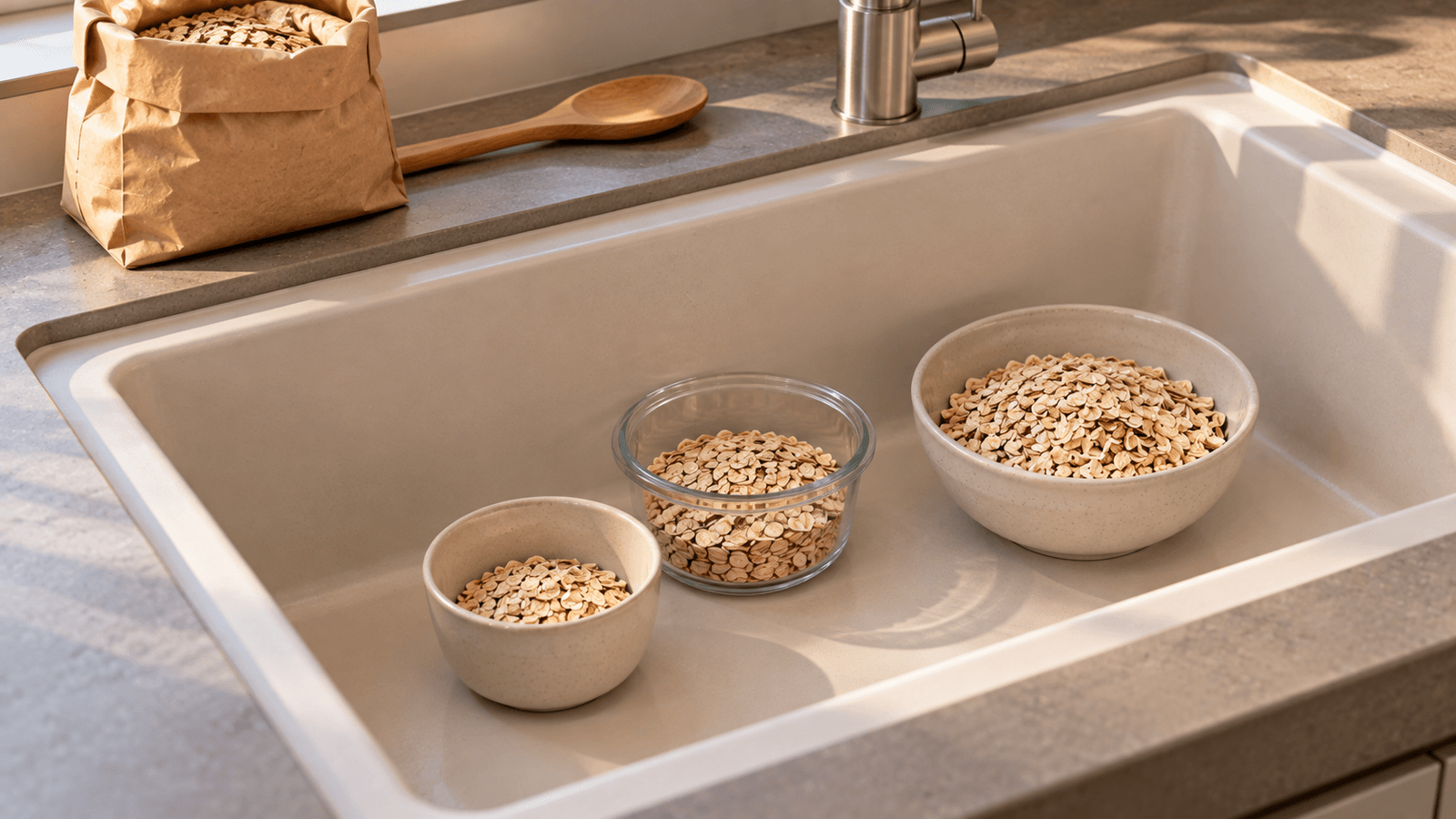
Oats are easy to track once you separate two measurements that are often confused: the amount of dry oats used and the final weight or volume of cooked oatmeal.
Plain oats absorb water during cooking. This makes the finished porridge heavier and larger without adding calories when the cooking liquid is water.
That is why 100 g of dry oats and 100 g of cooked oatmeal are not nutritionally equivalent portions.
Calories in dry oats by portion
Plain rolled oats are typically around 370–390 kcal per 100 g dry, although the exact value varies by product and oat type.
For practical tracking, your package label should be the primary reference for the oats you actually eat.
Using approximately 380 kcal per 100 g as an example:
| Dry oats | Approx. calories |
|---|---|
| 20 g | 76 kcal |
| 30 g | 114 kcal |
| 40 g | 152 kcal |
| 50 g | 190 kcal |
| 60 g | 228 kcal |
| 75 g | 285 kcal |
| 100 g | 380 kcal |
These are calculated examples rather than universal values.
If your oats contain 372 kcal or 389 kcal per 100 g, use that number instead.
A common oat portion
There is no single mandatory serving size for oats.
A practical dry portion might be around 30–60 g, depending on appetite, energy needs and what else is added to the meal.
For example:
40 g dry oats at 380 kcal per 100 g
40 × 380 ÷ 100 = 152 kcal
A 60 g portion of the same oats would contain:
60 × 380 ÷ 100 = 228 kcal
The calculation is simple when you know the dry weight.
Dry oats vs cooked oatmeal
Cooking oats in water changes their weight because they absorb water.
It does not create additional calories.
For example, suppose you cook:
- 50 g dry oats
- water
- no other ingredients
If those oats contain about 190 kcal before cooking, the finished bowl still contains about 190 kcal from the oats.
The cooked oatmeal might weigh 150 g, 200 g or more depending on the amount of water and cooking method.
That does not mean the oats gained calories.
Why calories per 100 g drop after cooking
Imagine 50 g of dry oats contain 190 kcal.
After cooking with water, the porridge weighs 200 g.
The whole portion still contains 190 kcal, but its calorie density is now:
190 ÷ 200 × 100 = 95 kcal per 100 g cooked
If more water is absorbed and the final weight reaches 250 g:
190 ÷ 250 × 100 = 76 kcal per 100 g cooked
The amount of oats did not change.
Only the amount of water in the final food changed.
This is why using a generic "oatmeal, cooked" entry can produce a different result from tracking the dry oats you actually used.
Dry weight is usually the simplest way to track oats
If you prepare oatmeal yourself, the easiest method is usually:
- weigh the oats before cooking
- use the nutrition information for the dry product
- track milk or other calorie-containing liquid separately
- track toppings separately
For example:
- 50 g oats
- 150 ml milk
- 100 ml water
- banana
- peanut butter
The water adds no calories, but the milk, banana and peanut butter do.
This approach avoids uncertainty about how much water the oats absorbed.
What if you only know the cooked weight?
Cooked weight alone is less useful unless you know how the oatmeal was prepared.
Two bowls weighing 200 g can contain very different amounts of oats.
Bowl A
- 40 g oats
- more water
Bowl B
- 70 g oats
- less water
Both could potentially end at a similar cooked weight, but Bowl B contains substantially more oats and therefore more calories.
If you regularly cook the same recipe, you can calculate the entire batch once and then divide it by final cooked weight or number of portions.
How to calculate a batch of oatmeal
Suppose a batch contains:
- 120 g dry oats
- 400 ml water
If the oats provide 380 kcal per 100 g:
120 × 380 ÷ 100 = 456 kcal
Assume the cooked batch weighs 500 g.
Then:
456 ÷ 500 × 100 = 91 kcal per 100 g of your cooked oatmeal
A 200 g serving from that specific batch would contain about:
456 ÷ 500 × 200 = 182 kcal
This calculation applies to that recipe and yield.
Changing the amount of water changes calories per 100 g cooked, but not the total calories in the oats.
Oats cooked with milk
Milk changes the calculation because unlike water, it contributes energy and nutrients.
For example, a bowl might contain:
- 50 g oats
- 200 ml milk
- water as needed
Track the oats and milk separately using their actual labels or reliable food-composition data.
The calorie content of the final bowl depends on:
- amount of oats
- amount of milk
- type of milk
Whole milk, reduced-fat milk and skim milk do not contain identical amounts of energy.
See Calories in Milk: Nutrition, Portions and Common Serving Sizes.
Toppings can change the total substantially
Plain oatmeal and a finished oat breakfast are not the same calculation.
Common additions include:
- milk
- yogurt
- banana
- berries
- dried fruit
- nuts
- nut butter
- seeds
- honey
- sugar
- chocolate
- granola
Some toppings contribute relatively few calories in typical amounts, while others are energy-dense.
Nuts, nut butter, seeds and granola can add significant energy even when the visual portion looks small.
This does not make them "bad" foods. It simply means they should be included if you are trying to estimate the meal accurately.
Example: plain oats vs finished breakfast
Consider two breakfasts.
Bowl 1
- 50 g oats
- water
If the oats provide 380 kcal per 100 g:
about 190 kcal
Bowl 2
- 50 g oats
- milk
- banana
- peanut butter
The oats still contribute the same approximate 190 kcal, but the milk, banana and peanut butter increase the total.
So when someone asks how many calories are in "a bowl of oatmeal," the answer depends heavily on what the bowl contains.
Rolled oats, quick oats and instant oatmeal
Plain rolled oats and plain quick oats can have broadly similar calorie values when compared by dry weight.
However, products vary.
Instant oatmeal packets may contain additional ingredients such as:
- sugar
- dried fruit
- flavorings
- milk powder
- nuts or seeds
Do not assume that a flavored instant oatmeal packet has the same nutrition as plain oats.
Check the product label.
Steel-cut oats
Steel-cut oats are oat groats cut into smaller pieces rather than rolled into flakes.
When compared dry, plain steel-cut oats and plain rolled oats can have similar overall energy content.
The larger apparent differences often come from:
- serving size
- cooking yield
- water content
- specific product formulation
Again, compare dry weights or the nutrition labels of the actual products.
Oats provide more than calories
Oats are a whole-grain food and contribute:
- carbohydrate
- fiber
- protein
- fat
- vitamins and minerals
They are also a source of beta-glucan, a soluble fiber found in oats.
The exact nutrient values vary by oat variety and product.
A typical plain dry oat product may provide roughly 12–14 g protein and around 9–11 g fiber per 100 g, but the package or database entry for the specific oats should be used when precision matters.
How much protein is in a portion?
If a product contains 13 g protein per 100 g:
| Dry oats | Approx. protein |
|---|---|
| 30 g | 3.9 g |
| 40 g | 5.2 g |
| 50 g | 6.5 g |
| 60 g | 7.8 g |
| 100 g | 13 g |
Oats contribute protein, but many oat-based meals contain additional protein from milk, yogurt, skyr or other ingredients.
How much fiber is in a portion?
If oats contain 10 g fiber per 100 g:
| Dry oats | Approx. fiber |
|---|---|
| 30 g | 3 g |
| 40 g | 4 g |
| 50 g | 5 g |
| 60 g | 6 g |
| 100 g | 10 g |
Again, these are examples.
Use the nutrition information for the actual product when available.
Oats vs granola
Oats and granola should not be treated as interchangeable calorie entries.
Plain oats are primarily the grain itself.
Granola commonly combines oats with additional ingredients such as:
- oils
- sugar or syrup
- nuts
- seeds
- dried fruit
These additions can make granola substantially more energy-dense than plain oats.
If you are deciding between them, see Oats vs Granola: Nutrition and Calories Compared.
Overnight oats
Overnight oats follow the same basic calculation as cooked oatmeal.
Track the ingredients that go into the jar.
For example:
- dry oats
- milk
- yogurt
- fruit
- chia seeds
- nut butter
Refrigeration and soaking change texture and water distribution, but they do not remove the calories from the ingredients.
The final jar weight is therefore less useful than knowing what went into it.
Oats in recipes
When oats are used in pancakes, baked oatmeal, muffins or other recipes, calculate the oats as one ingredient within the whole recipe.
For example:
- 150 g oats
- eggs
- milk
- banana
- oil
Calculate the nutrition of every ingredient, add the totals, then divide by the number or weight of finished portions.
Do not use the calories for plain cooked oatmeal as a substitute for the oats inside a mixed recipe.
Measuring oats by cups
Volume measurements are convenient but less precise than weight.
USDA food-yield guidance indicates that the relationship between cups and weight differs among oat forms, and dry cereals can vary in servings per package.
For personal calorie tracking, weighing the actual dry oats in grams is usually more reproducible than assuming every cup or scoop contains exactly the same amount.
If you use the same scoop every day, weigh it once when level and once when more generously filled. That gives you a useful personal reference range.
The most common tracking mismatch
The biggest source of confusion is often this comparison:
100 g dry oats
versus
100 g cooked oatmeal
The dry portion contains much more actual oat material.
The cooked portion contains a substantial amount of absorbed water.
So always check whether a nutrition entry refers to:
- dry oats
- prepared oatmeal
- oats cooked with water
- oats cooked with milk
- instant flavored oatmeal
Matching the database entry to the food you actually measured is more important than finding one universal number.
Practical tracking example
Suppose you prepare:
- 60 g plain oats
- 150 ml milk
- 100 ml water
- 80 g banana
Track:
Oats: 60 g dry
Milk: 150 ml
Banana: 80 g
Water: 0 kcal
If you then add 15 g peanut butter, add that separately.
This gives a much more useful estimate than weighing the finished bowl and searching for a generic "oatmeal" value.
Quick reference
For plain dry oats around 380 kcal per 100 g:
| Portion | Approx. calories |
|---|---|
| 30 g | 114 kcal |
| 40 g | 152 kcal |
| 50 g | 190 kcal |
| 60 g | 228 kcal |
| 75 g | 285 kcal |
The exact value should come from the oats you use.
The simplest rule is:
weigh dry oats, track calorie-containing additions separately, and do not compare dry and cooked weights as if they were equivalent.
Nutrition data sources
Reference values below are per 100 g of the specified food. Product varieties and preparation methods can differ.
- USDA FoodData Central — Cereals, oats, regular and quick, not fortified, dry (FDC 173904; 379 kcal/100 g).