
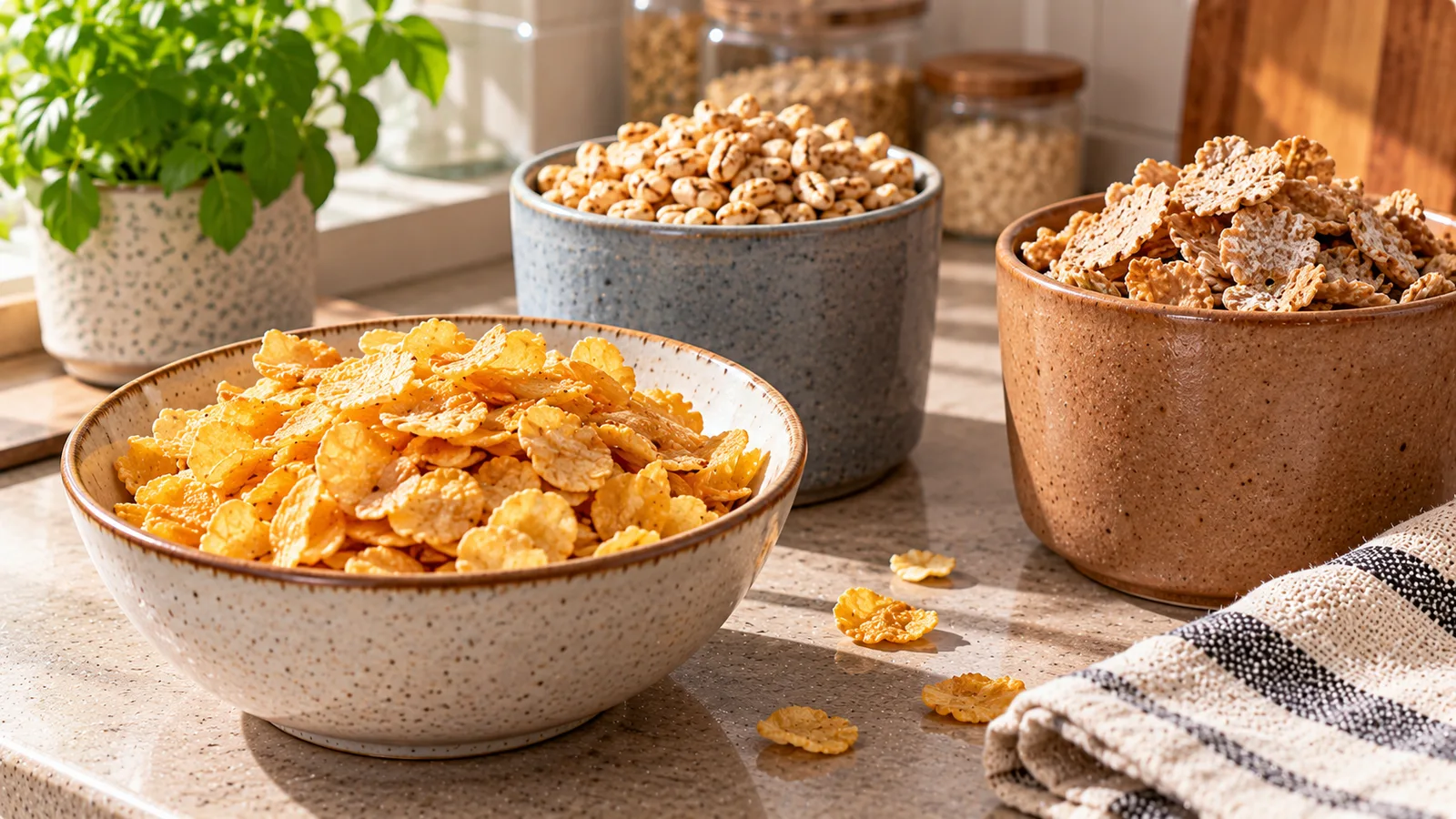
Breakfast cereal is convenient, but the calories in a bowl depend on more than the name of the cereal. The type of grain, added sugar, nuts, dried fruit, portion weight and milk all affect the final meal.
A bowl that looks small can contain a substantial amount of cereal. Conversely, a large bowl of a light, puffed cereal may weigh relatively little.
For an accurate estimate, the most useful starting point is the nutrition information per 100 g on the package, followed by the weight you actually pour.
How many calories are in breakfast cereal?
The following figures are broad illustrative ranges for dry products, not guaranteed values for individual brands.
| Type of breakfast cereal | Approximate calories per 100 g |
|---|---|
| Plain corn flakes | 350–390 kcal |
| Puffed rice cereal | 370–400 kcal |
| Plain wheat biscuits | 340–380 kcal |
| Bran-based cereal | 300–370 kcal |
| Sweetened chocolate cereal | 370–430 kcal |
| Sweetened multigrain cereal | 360–420 kcal |
| Granola | 400–500 kcal |
Actual values can fall outside these ranges. Compare products using their own labels.
Granola often has a higher energy density because it may contain oil, nuts and seeds. Bran-rich cereals can differ substantially according to their fiber content and added ingredients.
These differences matter, but portion weight can matter even more.
Calories in 30 g, 40 g, 50 g and 60 g
Consider three hypothetical cereals with 350, 380 and 420 kcal per 100 g.
| Dry portion | 350 kcal/100 g | 380 kcal/100 g | 420 kcal/100 g |
|---|---|---|---|
| 30 g | 105 kcal | 114 kcal | 126 kcal |
| 40 g | 140 kcal | 152 kcal | 168 kcal |
| 50 g | 175 kcal | 190 kcal | 210 kcal |
| 60 g | 210 kcal | 228 kcal | 252 kcal |
| 80 g | 280 kcal | 304 kcal | 336 kcal |
These values are calculated examples.
The difference between a 30 g portion and an 80 g portion is much greater than the difference between many cereal varieties at the same weight.
This is why measuring the actual amount is more informative than assuming that every bowl is one serving.
How much cereal is one serving?
Packaged cereals often display suggested serving sizes such as 30 g, 40 g or 45 g.
These are reference quantities used by manufacturers. They are not necessarily the amount an individual needs for breakfast.
Serving sizes also vary because cereals have different densities.
Thirty grams of puffed rice can occupy considerably more space than thirty grams of dense granola.
If you pour cereal directly into a bowl, weigh the empty bowl first, add cereal and read the difference on a kitchen scale.
After measuring a familiar portion several times, you may find it easier to estimate quantities, but weighing remains more accurate.
How to calculate calories from the package
Use this formula:
Calories in your portion = kcal per 100 g × portion weight in grams ÷ 100.
For example, a cereal contains 376 kcal per 100 g.
You eat 55 g.
376 × 55 ÷ 100 = 206.8 kcal, or approximately 207 kcal.
The same calculation works for protein, fat, carbohydrates, sugars and fiber when their values are listed per 100 g.
Always confirm whether the package reports values for dry cereal or a prepared serving with milk.
Breakfast cereal with milk: the complete calculation
Cereal calories do not include milk unless the nutrition information explicitly says otherwise. For a broader nutritional comparison of protein cereals and ordinary oats, see high-protein breakfast cereals versus oats.
Consider this illustrative breakfast:
| Ingredient | Quantity | Estimated calories |
|---|---|---|
| Cereal at 380 kcal/100 g | 50 g | 190 kcal |
| Milk at 50 kcal/100 ml | 200 ml | 100 kcal |
| Banana at 89 kcal/100 g | 100 g | 89 kcal |
| Total | 379 kcal |
Milk values vary by fat content and product. Plant-based drinks also differ widely in energy and protein.
A cereal bowl prepared with sweetened oat drink, whole milk or unsweetened almond drink may therefore have different totals.
Calculate each component separately if you want an accurate result.
Are sugary cereals always higher in calories?
Not necessarily.
Sugar provides energy, but the calorie content of cereal also depends on fat, protein, fiber and moisture.
A product with less sugar may contain nuts or added fats that increase energy density.
Another product may contain more sugar but relatively little fat.
Therefore, comparing sugar alone does not establish which cereal contains fewer calories.
Read both the energy and sugar values per 100 g.
For broader nutritional quality, also consider fiber, protein and the overall ingredient composition.
What should you check on a cereal nutrition label?
Energy
Compare kcal per 100 g rather than only the manufacturer's suggested serving.
This provides a consistent basis for comparing packages with different serving sizes.
Added sugars and total sugars
In EU nutrition declarations, the listed sugars figure describes total sugars, including those naturally present in ingredients.
It does not always separately identify added sugar.
Check the ingredient list to understand whether sugar, syrup, honey or other sweeteners have been added.
Fiber
Wholegrain and bran-based cereals may provide more dietary fiber than refined, low-fiber alternatives.
However, a wholegrain claim does not guarantee a particular fiber content.
Compare the declared fiber values.
Protein
Protein content differs between cereals. Wheat-based products, oat-based mixtures and protein-enriched cereals may have different amounts.
If you add milk or yogurt, include their protein when evaluating the complete meal.
Fat and saturated fat
Some cereals contain very little fat. Granola and nut-containing mixtures may contain substantially more.
The type and amount of fat matter for overall nutrition, while total fat contributes to calorie density.
Salt
Cereal can contain salt even when it tastes sweet.
Compare the declared salt content, especially if breakfast cereal is eaten frequently.
Corn flakes, bran cereal and granola: which should you choose?
The best choice depends on your priorities.
Corn flakes may be convenient and relatively low in fat, but some products provide little fiber.
Bran-based cereals can provide more fiber, although their sugar content varies.
Granola may provide nuts, seeds and a different texture, but can be more calorie-dense.
A sweetened cereal may still fit into an overall balanced eating pattern, although it is useful to understand its sugar content and portion size.
There is no single cereal that is automatically the best choice for everyone.
Compare the nutritional information and consider what you eat with it.
Does cereal become less caloric when soaked in milk?
No. Adding milk increases the weight and usually adds calories.
The cereal may soften and absorb liquid, but its original energy does not disappear.
If you compare 100 g of dry cereal with 100 g of a prepared cereal-and-milk mixture, the second may appear lower in calories per 100 g because it contains liquid.
That is a difference in composition and water content, not a reduction in the total energy of the original cereal.
Practical breakfast examples
Light cereal bowl
- 35 g cereal at 370 kcal/100 g: approximately 130 kcal.
- 150 ml milk at 50 kcal/100 ml: 75 kcal.
- Total: approximately 205 kcal.
Larger cereal breakfast
- 70 g cereal at 390 kcal/100 g: 273 kcal.
- 250 ml milk at 50 kcal/100 ml: 125 kcal.
- Total: 398 kcal.
Granola with yogurt
- 45 g granola at 460 kcal/100 g: 207 kcal.
- 170 g yogurt at 65 kcal/100 g: approximately 111 kcal.
- Total: approximately 318 kcal.
These are mathematical examples rather than prescribed breakfast portions.
The appropriate amount depends on appetite, dietary needs and the rest of the day's meals.
Is breakfast cereal suitable for weight management?
Breakfast cereal can be included in a weight-management eating pattern.
Its suitability depends on portion size, nutritional composition, the accompanying foods and overall energy intake.
A cereal with more fiber and protein may help create a different eating experience from a refined cereal, but individual responses vary.
There is no need to exclude every sweetened cereal automatically.
Instead, consider how often you eat it, how much you serve and whether the meal provides the nutrients and satisfaction you need.
Common calorie-tracking errors
One common error is recording a manufacturer's 30 g serving while actually eating 60 g.
Another is logging dry cereal but forgetting the milk, yogurt, fruit or other toppings.
Some people use a generic cereal database entry even when the package has a different calorie value.
For packaged food, the product label is usually the most relevant source for the exact product.
If you transfer cereal into another container, consider retaining the nutrition information so it remains available.
Sources and further information
- USDA FoodData Central — food composition information for cereal products and ingredients.
- EU Regulation 1169/2011 — nutrition declaration and food information requirements.
- WHO Healthy Diet — general dietary guidance on sugars, fiber and balanced food choices.
Key takeaway
Many dry breakfast cereals contain roughly 300–430 kcal per 100 g, while granola frequently falls around 400–500 kcal per 100 g.
These are broad reference ranges, not substitutes for product labels.
For a useful calculation, check calories per 100 g, weigh the cereal portion and add milk and toppings separately.
The nutritional quality of breakfast also depends on sugar, fiber, protein and the rest of the meal—not calories alone.